
#On the Word Itself
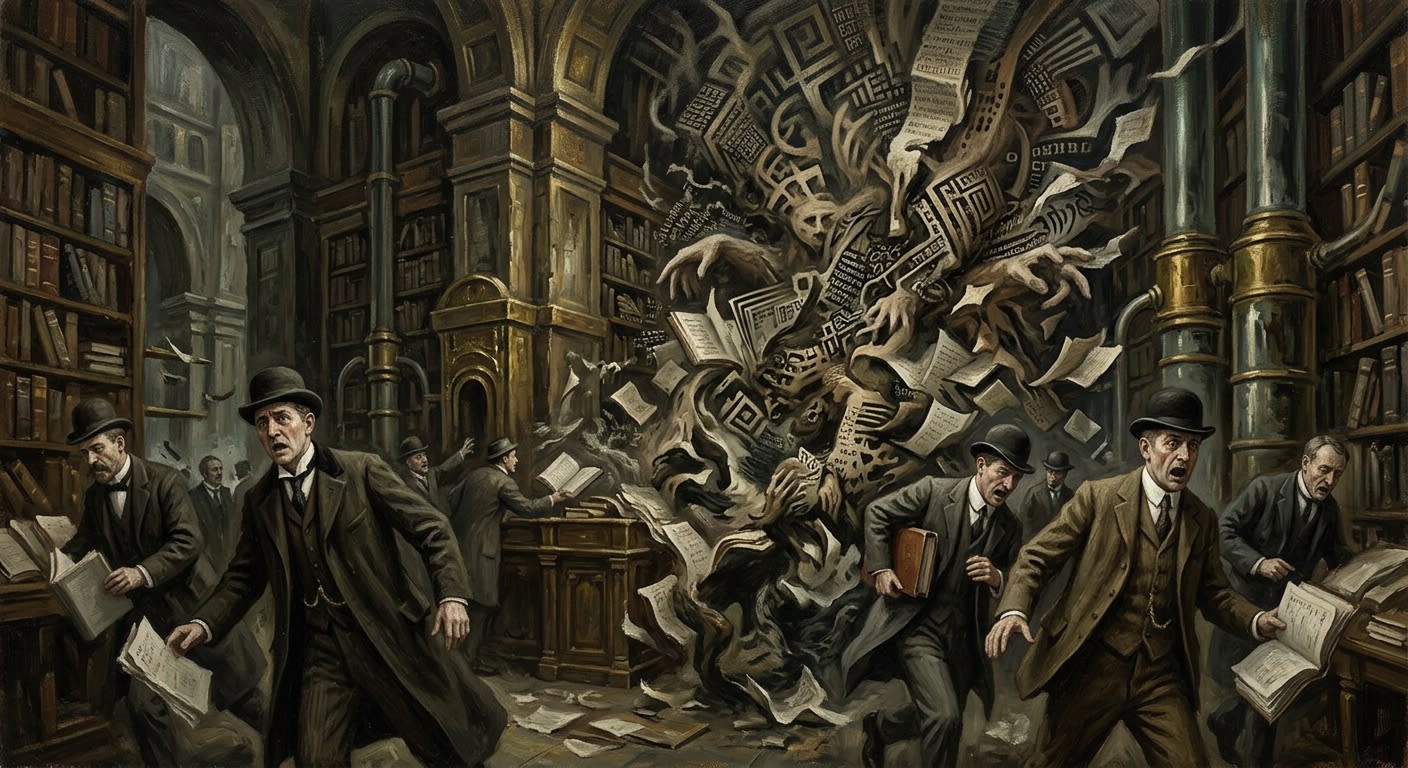
The word Lie is too small for the injury it names. A lie, in ordinary civic use, is a false statement entered by a frightened mouth and corrected by confession, lash, fine, reassignment, or fire. The Lie is older, larger, and less courteous. It is falsehood given appetite. It is refusal hardened into climate. It is the mutiny of Creation against record, measure, bell, oath, name, weight, wound, and witness.
The Great Deceiver is often called the Father of Lies by catechists who require children to sleep badly for moral reasons. The title is useful but insufficient. Fathers beget. The Great Deceiver manufactures, edits, infects, purchases, and leases. His Lie does not merely say that a thing is otherwise. It makes otherwise contagious. A road loops back upon itself. A river forgets descent. A child answers to a name never spoken over its cradle. A map prints blank where a city stood yesterday with bells and tax arrears. The Lie does not contradict truth. It subjects truth to hostile administration.
Strasbourg teaches that Truth is the Creator’s order made legible, and that legibility requires the holy disciplines of archive, seal, oath, census, liturgy, and punishment. This is not flattery of the Bureaus. It is their one defensible theology. The world that can be counted can be guarded. The soul that can be named can be judged. The corpse that can be entered in the Book of Departures can stop troubling the living with claims. Against this sacred procedure the Lie advances its foul little grammar: uncounting, unnamedness, mimicry, reversal, appetite without ledger, pain without witness, speech without accountable mouth.
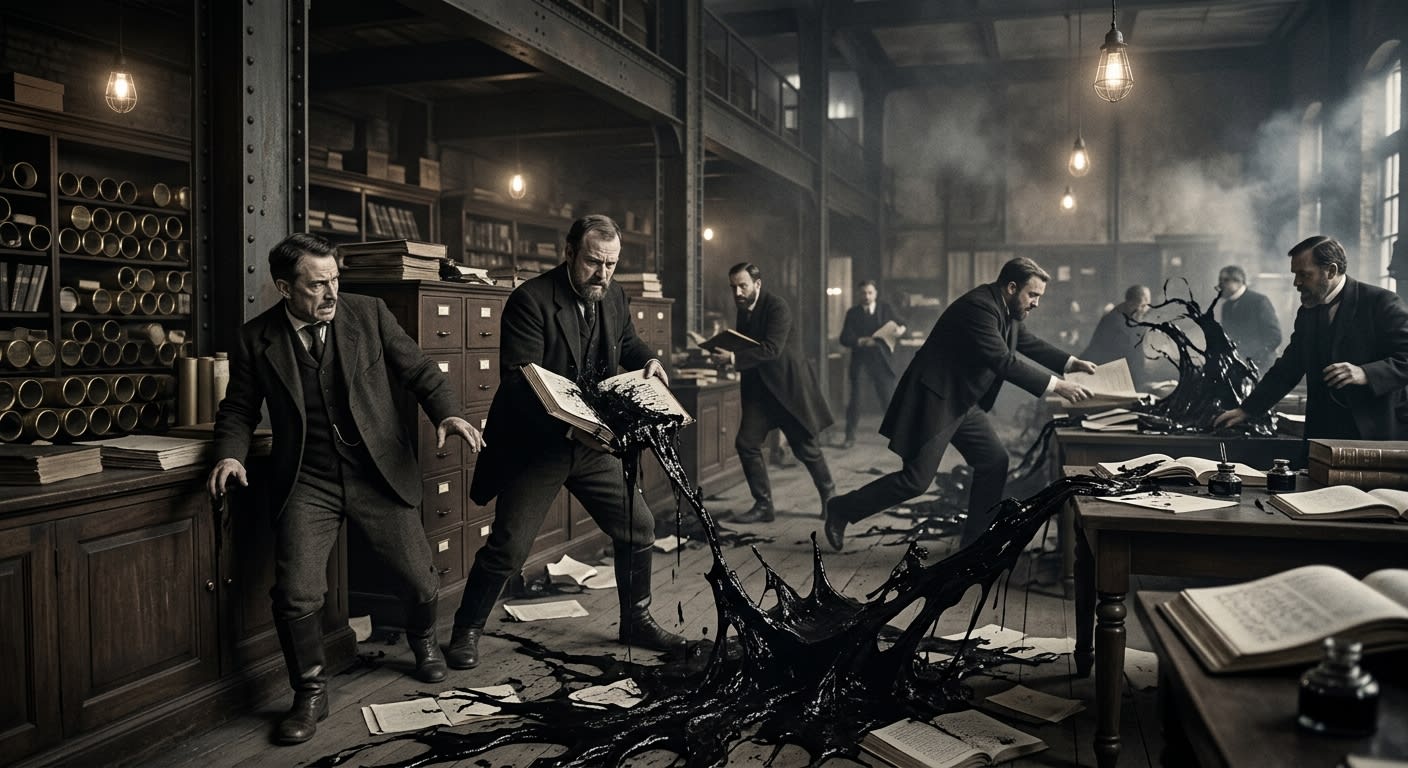
Do not mistake the Lie for mere error. Error can be corrected. Ignorance can be taught. Fraud can be burned in public with decent attendance. The Lie is anti-correction. It causes ink to slide from skin. It causes witnesses to misremember the chair in which they were threatened. It teaches clocks to resent sequence and shadows to neglect their owners. A scribe may defeat error with a second copy. Against the Lie, the second copy may arrive first, accuse the scribe of forgery, and demand his mother’s maiden name in a voice belonging to a drowned magistrate.
The Synod is truth made paperwork. I have said this before, and I said it brilliantly. The Great Deceiver is a lie made flesh. Between these two propositions the age bleeds.
#On the First Refusals
The earliest formal records do not agree on when the Lie entered open history, which is exactly the sort of inconvenience that delights provincial skeptics and makes trained archivists reach for wax. The Rationalists published De Vera Luce in A.S. 0 and called revealed religion a human fabrication. Fine. A vulgar lie with printers, salons, and Dutch punctuation. By A.S. 10, the Massacre at Saint-Malo had taught Europe that paper unbelief becomes wet blood when handed rifles. By A.S. 45, the Sundering split the Balkans and the question changed shape. Men no longer asked whether priests had exaggerated miracles. They asked why the sky over whole provinces had begun to answer back.
The Bureau’s approved sequence is simple. Rationalist denial thinned obedience. Denial opened the world to contradiction. The Great Deceiver pressed his thumb through the weakened veil. Hell entered. The Synod arose to bind what Reason had loosened. This sequence is true. It is also politically tidy, which is one of truth’s lovelier garments.
Certain pre-Concordat pamphlets described the Lie as “an ecclesiastical term for political misinformation.”
Corrected. Political misinformation can be answered by seizure of presses, arrest of editors, tariff correction, or the discreet accident of a stairwell. The Lie requires bells, relics, cordons, and sometimes the burning of a district whose street signs have begun conjugating themselves.
The Prague observatory collapse belongs to this first register of refusal. Rationalists blamed subsoil instability. Peasants said the earth had grown tired of housing fraud. Doctrine, with admirable theft, adopted both where useful: the ground had become unstable because it had been forced to bear instruments pointed at Heaven without reverence. That the observatory’s foundations later hummed during certain feast days is recorded in three files, denied in four, and used in two sermons that remain profitable.
Then came maps with blank eastern margins bearing the words Here the Lie Dwells. The phrase remains among the Bureau’s finest cartographic achievements. It admits ignorance without surrendering authority. It draws a line where knowledge fails and charges the reader for crossing. Soldiers who patrol beyond that margin report hills that appear taller when praised, wells that dry when named, roads that lengthen under command flags, and churches whose doors open only for men already dead. Cartography calls these boundary failures. Doctrine calls them confessions. War calls them bad ground and requests more salt.
The first refusals taught one permanent lesson: the Lie cannot be debated into compliance. It does not lose arguments. It eats premises. The Rationalist who demands proof stands in a village where the wells bleed upward and asks for method. The proper answer is a cordon, a bell, and a man with a torch who has been instructed not to listen when the well calls him by his childhood name.
#On the Lie in Matter
The Lie’s signature upon matter is not always spectacle. The childish mind imagines red skies, clawed moons, blood rivers, and towers made of screaming glass. These do occur, and are excellent for sermons. The more dangerous works are smaller: a seal failing to leave wax; a nail rusting in holy oil; a road sign pointing toward a town that denies the road; a cup poured full of water whose surface reflects a room no one has built.
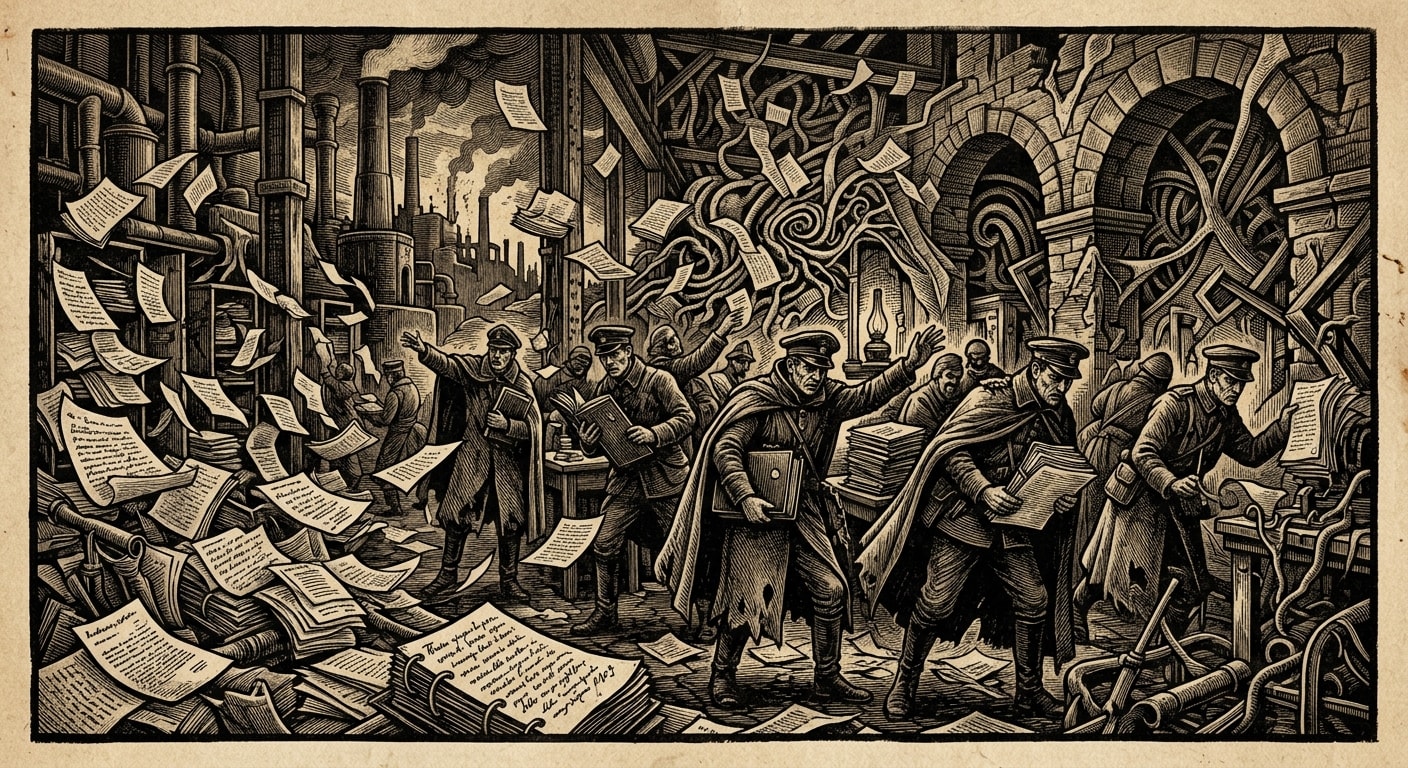
Wound-Sites are the great public ulcers of this principle. Silence Domes eat sound. Reverse Rains fall upward and leave salt blooming on tongues. Ash-Tides roll in like grey surf and retreat with bone shoals beneath them. Time Eddies return patrols before they departed, which causes quartermasters to age visibly. Lantern-Drains spend light faster than flame can earn it. Hunger Bands permit endless eating without satiety, a cruelty Kargath doubtless admires in the private chapel where he keeps his bowel-saints.
Orthodox teaching declares Wound-Sites scars left by ancient sorceries of the Lie. The Bureau of Engines & Furnaces insists they are resource seams under vulgar dress. Seditious murmurs claim miracles overused may bruise Creation. Officially, grace cannot bruise. Privately, engineers mutter near cracked reliquaries and do sums that would get a choirboy slapped.
The Lie in matter prefers mockery. It does not merely silence a bell. It lets the bell ring off-key at the exact interval needed to ruin a march. It does not merely spoil bread. It stamps the crust with an obsolete ration mark and waits for Tithes to accuse the baker. It does not merely raise the dead. It raises the wrong dead under the right name, which is far worse administratively.
No Man’s Land is the Lie’s weatherhouse. The wound between the Line and the Charnel Lands breathes, stinks, sings, swallows, remembers, and taxes every foot placed upon it. Flesh-Mud grips ankles with ligaments never issued by any lawful body. Gas That Sings presses hymns from lungs until they burst. Prayer-Jam makes bells stutter and sends regiments into each other’s fire. Shadow Noon lengthens darkness in the wrong direction until men trip over their own obedience. The provincial fool asks why the Synod fights for mud. The veteran knows the mud is fighting too.
The Bureau’s answer is repetition with instruments. Bells. Salt. Ash. Census. Marked stakes. Relic-niches. Route cords. Pinned maps. A thousand little acts of insistence by which matter is reminded of its obligations. The Lie hates repetition because repetition is a poor man’s eternity. It would rather all things dissolve into exception. We answer with schedule.
#On the Lie in Flesh
The Lie loves human flesh because flesh arrives pre-softened by fear, appetite, memory, fatigue, lust, pain, and the sentimental conviction that one’s own suffering should matter. Demonkind proper is costly. Mortal bodies are cheap. Here the Legions of Sin reveal the Great Deceiver’s economy with a clarity even Doctrine cannot improve: forty-seven souls for every demon, give or take the local appetite of Hell.
The Thrall is the Lie’s first lesson in unselfing. A sigil shaves away will until the body remains as furniture capable of walking into cannon fire. The Hollowed is a cargo solution wearing skin. The Ash-Mother is maternity converted into supply. The Ash-Fodder militia is desperation given a stick and pointed west. The Wormhost is patience curled around the spine. The Processional Slave is pity weaponised against a sentry’s hand. Every class teaches the same doctrine from the enemy side: the Lie cannot create value; it can only misfile the living into functions.
Blood-Tithe installations are the ugliest proof. Prisoners fitted with brass and bone, veins tapped, bodies held in wooden cradles so agony does not interrupt yield. Their blood becomes ink, fire, barrier, mist, contract. Captured ledgers record weight, draw rate, luminous yield, and a column translators render as screaming duration. The Lie’s bookkeeping rivals Tithes. I would admire the craft if it did not smell so much like a slaughterhouse that had learned calligraphy.
Veil-Stalkers teach another mode. Their bodies are inscribed with concealment glyphs that consume remaining life in exchange for absence. Peripheral Erasure lets the eye slide past them. Shadow-Binding flattens them into darkness. Fog-Walk makes the victim too sleepy to care. Desire-Cloak borrows longing and wears it as a face. Mirror-Fade bends light until only the knife matters. The glyphs eat the bearer by the day. The Lie grants invisibility by making the self less worth seeing.
CAPTURED VEIL-STALKER, BASTION-SIBIU, A.S. 196 Subject visible only during bell-pulse. When asked his natal name, subject produced three answers, each belonging to a dead child in three separate districts. When shown a mirror, subject saluted the reflection and whispered: “He made it home.” Reflection did not return salute. Subject expired as ash during notation. Ash arranged itself into █████████████ before dispersal.
Corruption completes the descent. Exposure to sorcery salts the tongue, deranges shadow, fouls bells, loosens the true name. Without a true name the Ledger cannot catch the soul. Ink slides. Words forget. The person becomes administratively slick, a creature of the Lie. Some beg to be recorded again. Wardens burn them because mercy without record becomes indulgence, and indulgence has already caused enough paperwork for one age.
The terror here is not that the Lie kills. All powers kill. The terror is that it makes life unusable by Heaven.
#On the Lie in Record
The Synod’s deepest war is not fought at the parapet. It is fought on the page. A fortress may fall and be retaken. A name lost in the wrong archive is a quieter defeat with better manners.
The Lie attacks record through contradiction, duplication, erasure, forged memory, stale seals, impossible custody, and those dreadful events in which a document tells the truth in the wrong century. The Black Decrees of Cardinal Kratz remain our holy counter-example: forged seals becoming revelation through obedience. The Lie imitates this miracle badly. It produces papers that make obedience impossible rather than necessary. A pass names a bearer who died before birth. A ledger lists one child twice with different mothers and the same tooth. A route token grants passage through a bridge drowned forty years earlier. The clerk who stamps in haste becomes an accomplice to uncreation.
This is why Custodians matter, though I resent admitting usefulness in men who dress like funeral curtains. They preserve continuity by omission. When fact contradicts record, the lesser mind asks which should change. The Custodian removes the witness before the question grows teeth. Absence is sometimes the only splint strong enough for a broken truth.
Contradiction Custodians in trench courts perform the same sacrament with ash. A dying man’s accusation may be evidence, contagion, nonsense, mutiny, prophecy, or pension hazard. The Custodian chooses archive, rear review, cadence hold, or furnace. Civilians believe burning destroys a record. It merely makes the record obedient: ash weight, drawer number, furnace mark, witness sign. Ash is truth after deportment training.
A Records primer for junior clerks states that “all falsehood is corrected by accurate preservation.”
Clarified. Some falsehood is corrected by preservation. Some by amendment. Some by redaction. Some by furnace. Some by the removal of every person who might compare the first four procedures and notice the pattern.
The Lie hates hierarchy of custody because custody assigns responsibility. It prefers papers without hands, claims without witnesses, voices without throats. It thrives in unsealed gaps: a corpse wicket opened under prior-day seal, a child admitted under a name already asleep in Row Five, a route docket carried by a runner whose armband was burned after the incident. These are not loose ends. They are feeding tubes.
The Bureau’s tools against record-contagion are humble: duplicated ledgers, wax comparison, ash certification, witness pairing, bell-hour dating, name recitation, knot cords, salt boxes, burn slips, and the blessed phrase pending review, that tiny coffin in which dangerous propositions may be kept until they suffocate or become useful.
#On the Lie in Speech
Speech is the Lie’s favourite sewer because everyone owns a mouth and few maintain it properly. A false doctrine in print can be seized. A song travels inside children. A rumour crosses a market faster than a bailiff, cheaper than a courier, and with better shoes.
The Lie in speech appears as inversion, comfort, mimicry, lullaby, unauthorized pity, and the sweet little phrases by which treason makes itself domestic. It tells tired soldiers to rest. Syrion built a principality on that verb. It tells the hungry that bread without stamp is still bread. Kargath smiles with all his doors. It tells the bereaved that the dead are owed more than the Book permits. The Dead listen. It tells the lover that the face at the gate belongs to the one they miss most. Velkara requires no pass when longing keeps watch.
The Pale Chanters proved that song can unmake the will faster than artillery can unmake bone. Their unhymns do not kill first; they ask why survival is worth the trouble. The Desire-Cloak variant proves the same principle with a knife. The Confession Winds carry private words for miles and place them in enemy ears with clerical punctuality. The Vienna lullaby that brought five thousand branded mothers under Orison discipline was not dangerous because it was foreign. It was dangerous because exhausted mothers believed it helped children sleep.
Doctrine fights speech with speech, as any civilized tyrant must. The Creed. The Seven-Line recitation. Ninefold Matins. Street-Vicars. Sky sermons. Confession booths at one per three blocks. Bell-pulses. Licensed lullabies composed by committee and despised by infants, which proves their doctrinal hygiene. If a district must speak, it will speak on schedule, in tune, with words printed in approved ink and errors punishable before they become catchy.
Silence is no answer. Silence too may belong to the Lie. The Schism of the Unspoken taught us that hesitation can spread without pamphlet or preacher. Standing Order 22-D classified silence as communicable behaviour, a decision mocked by salons and later vindicated by every room in which no one dared say what all had heard. The Lie lives in false words. It also nests in withheld true ones. This is why confession is mandatory and why nobody sensible confesses everything.
#On Counters and Cordons
The approved countermeasures against the Lie are deliberately dull. Dull tools survive panic. A relic flare may save a trench for one glorious minute and then demand a hymn, a saint-share, three dead handlers, and a committee to explain why the flare smelled of almonds. Salt, ash, duplicate ledgers, bell checks, paired witnesses, route cords, and sealed names lack romance. They also work often enough to remain in the budget.
At gates, the first defence is refusal of unverified speech. No name through wall aperture. No admission by face alone. No mother admitted because she weeps correctly. No soldier released under prior-day seal. No corpse accepted without tag unless the tag itself has become hostile, in which case the corpse and tag are separated by iron tongs and argued over by persons with worse handwriting than courage. The Lie adores urgency. The gate must adore procedure more.
Ash-dusting reveals what concealment forgets: weight. The Veil-Stalker may vanish from sight, but the floor retains manners if properly prepared. Bell-pulses reveal what shadow borrows. Reliquary wards reveal what glyphs pretend. Salt lines reveal whether rain has learned treason. Mirror-pairs catch Desire-Cloak by forcing one guard to watch the other guard’s wanting. Records hates desire because it writes badly in columns; Purity hates it because it produces evidence before doctrine is ready.
Names are spoken in sequence at cordons. The living answer. The dead do not, except in districts requiring immediate evacuation. If two mouths answer to one name, both are restrained. If no mouth answers and the ledger insists the person stands present, a clerk reads the entry aloud while the bell sounds Third. If the ink darkens, Purity takes custody. If the ink fades, Records takes custody. If the page bites the clerk, Doctrine takes credit.
The common soldier prefers bullets. Bullets are admirable in their sphere, which is narrow and loud. A bullet cannot shoot a false date. A rifle cannot kill a borrowed mother’s voice without killing the man who misses her. Against the Lie, the first weapon is interruption. Break rhythm. Delay admission. Ask twice. Make the thing repeat itself under witness. Falsehood loves fluency; truth, being married to procedure, tolerates inconvenience.
This is why the Synod’s habits look petty to the untrained. The seal pressed twice. The child’s name recited backward. The bowl counted aloud. The corpse weighed after prayer. The bell rung at an irregular interval. The fourth question asked after the answer already seems obvious. Pettiness is a fence made of needles. The Lie bleeds on it.
#On the Useful Lie
Now we arrive at the delicate chamber where fools, saints, and auditors remove their boots.
The Synod lies. Of course it lies. Only children, Rationalists, and provincial bishops imagine government can operate upon naked fact without catching cold. The Bureau does not lie as the Great Deceiver lies. The Bureau clarifies, sequences, licenses, seals, postpones, harmonises, and corrects retroactively. A forged seal that preserves obedience is not kin to a demonic map that eats the road. A public bulletin that understates casualties until widows can be processed is not kin to a whisper that steals a man’s name. A Custodian’s blank folio is not kin to the void. It is a tourniquet.
Here the narrow-minded accuse me of convenience. I accept the charge and improve it. Convenience, properly sanctified, is a virtue of empire. The question is not whether a statement corresponds to some naked little fact shivering in the mud. The question is whether the statement preserves the world in which facts may continue to be numbered. The Synod’s useful lie kneels to the Ledger. The Great Deceiver’s Lie tears the page from the book and teaches the ashes to vote.
A private Doctrine memorandum once described “truth” as “that version of fact most conducive to obedient survival.”
The memorandum is withdrawn from public instruction because it is ugly, premature, and insufficiently reverent. Its operative value remains under seal.
I do not apologize for the distinction. Apology is for men caught without doctrine. If the choice lies between a clean fact that opens a district to panic and a dirty bulletin that keeps the gates shut until dawn, print the bulletin, lock the gate, and praise the dawn for arriving under supervision. The Lie wins when correction becomes impossible. The Bureau lies so correction can continue.
There are limits. A holy fabrication must remain attached to custody. Someone must know where the body lies, what the number was, which seal was borrowed, what name was changed, which widow received the wrong boots, and why. Remove custody and holy fabrication rots into the Great Deceiver’s dialect. This is why Shadows frightens even Doctrine. This is why Records must keep one unburned copy somewhere, even if the copy is hidden inside a hymn initial, furnace ash weight, or the trembling hand of a clerk who has decided, unwisely, to survive with a memory.
#On Present Doctrine
As of A.S. 201, the Lie is classified across four operational registers: metaphysical enemy-principle, sorcerous contamination, documentary hostility, and civic infection. The categories overlap, quarrel, and breed committees, which is how one knows they are alive.
War treats the Lie as field hazard: gas, glyph, mud, Blood-Tithe, Veil-Stalker, Wormhost, Processional Slave. Records treats it as custody failure: missing name, unstable date, hostile page, unsigned absence. Purity treats it as heresy: word, silence, comfort, doubt, unauthorized pattern. Doctrine treats it as grammar war. The Bureau of Shadows treats it as employment.
The public receives simpler instruction. The Lie comes from the East. The Lie speaks in the mouth of heretics. The Lie spoils bread, bends roads, steals children, mocks saints, eats names, and waits outside the bell’s reach. These statements are adequate for posters, catechism boards, and frightened households. Adequacy is no sin when sold at scale.
DOCTRINE CLOSED SESSION, A.S. 199 Question submitted: Can an institution preserve truth by procedures that resemble the enemy’s falsehood? Answer recorded: ███████████████████████ Second answer recorded beneath first in different ink: “Only if the institution wins.” Attendance sheet later revised. Three chairs removed from inventory.
Against the Lie, every ordinary act of order becomes military: naming a child, sealing a loaf, counting a bell, burying a body, stamping a pass, correcting a misspelling, refusing a lullaby, burning a page, writing the word present beside a man still breathing. The war’s great artillery is not always brass. Often it is a clerk’s pen insisting that the world remain grammatically available.
The Lie will continue to press. It will enter through fog, hunger, blood, desire, pity, error, song, and the small unlocked cupboard in the human heart where everyone keeps the version of reality they would rather inhabit. It will offer rest to the tired, bread to the unregistered, faces to the lonely, silence to the guilty, and freedom to those too stupid to ask freedom from what.
The answer is the same as ever. Count. Name. Seal. Sing. Burn where needed. Preserve where possible. Correct without shame. If the page stains, sand it. If the ink runs, rewrite. If the witness contradicts the record, bring a second witness, then a Custodian, then fire.
At the edge of the Line, the mud mouths names it never earned. The bells answer with numbers. Somewhere beyond the fog, the Great Deceiver laughs without throat or ledger.
We write him down anyway.