
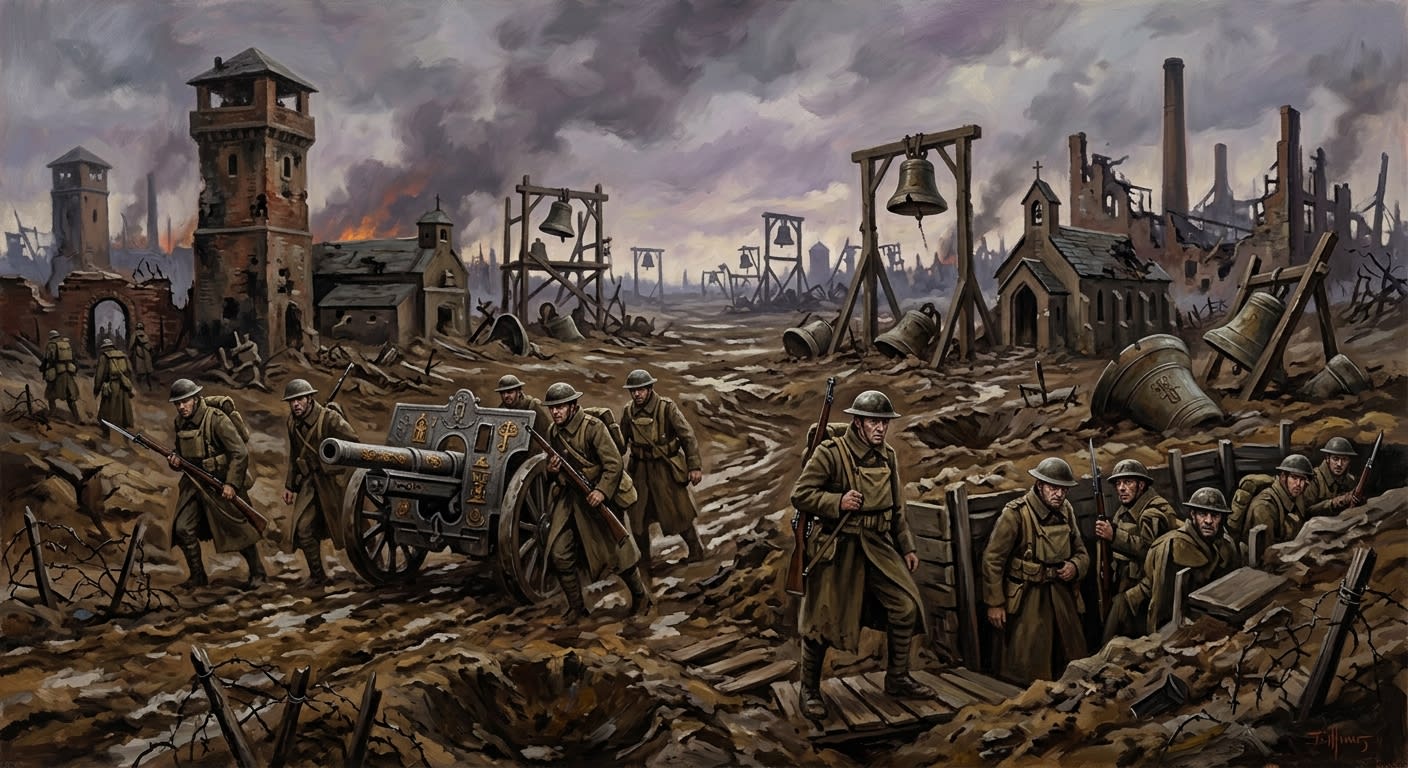
#On the Strip That Refuses Citizenship
Zone Five is the contested strip east of the Sagittal Line and west of the Charnel Lands, a belt of torn fields, abandoned roads, false dry ground, dead villages, shell basins, wire pockets, calcified patrols, bell-stunned air, and claims so mutually incompatible that only the Bureau of Records could call the result a map. Soldiers call it No Man’s Land. Cartographers call it Zone Five. The mud calls no one anything. It takes the ankle first.
It is a border only in schoolrooms. In the field it is a wound with weather, an argument between surviving earth and occupied hell, a place where each pace must be earned twice: once from the Enemy, once from the ground. Its width varies from two hundred yards to fourteen miles, and the variation is not always geographic. A man may cross in twenty minutes and return after three days, or cross for three days and discover he has moved forty paces into a shell hole that remembers his grandfather.
Zone Five began as emergency ground after the A.S. 45 Sundering, hardened during the Great Retreat, and acquired its present doctrinal shape after A.S. 65, when the Line ceased retreating and ordered geography to become refusal. West of it stand bastions, rails, garrisons, chapels, and men pretending stone is permanent. East of it begins the darker custody of Zone Six, where demonic pressure ceases to be weather and becomes administration.
Between them lies the strip. Mine it, and it moves. Bless it, and it answers through another mouth. Survey it, and the map returns with polite lies written in correct ink.
#On the Naming of the Unowned
The title “No Man’s Land” offends the Bureau because it implies a vacancy. Nothing in Zone Five is vacant. The dead occupy it densely. The missing occupy it legally. The Enemy occupies it intermittently. The Synod occupies it by artillery, rope, plank, salt, prayer, and the famous administrative fantasy whereby touching a place with a form confers custody. Even the air holds prior claims: bell peals, counter-hymns, last orders, gas songs, and the dragged syllables of men whose throats were not consulted before becoming instruments.
The official term, Zone Five, was regularised because No Man’s Land gave too much honour to soldier slang and too little to the ledgers by which officers request more rope. Zone Four holds the Line. Zone Six belongs, in whole or poisoned part, to the demonic dominions. Zone Five is the torn receipt between them: disputed, stained, perforated, and still demanded at audit.
Early post-Line primers described Zone Five as “unadministered ground between friendly fortification and hostile territory.”
Corrected. The ground is administered by shelling, burial, hunger, demon pressure, rope protocols, salt allotments, and missing-person extracts. The absence of a clerk behind a desk does not constitute liberty. It constitutes poorer handwriting.
The zone has named sectors, because men name what kills them in order to curse accurately. The Knife-Mile. The low approaches below Bastion-Brest. The shell bowls east of Bastion-Przemyśl. The Danubian flats near broken Belgrade. The old plank corridors beneath Shipka fog. The southern scald ground where Maldrake’s heat and Syrion’s patience have learned each other’s manners. Each sector keeps its own appetite. Each appetite has its field sheet, its superstition, its little economy of corpses.
#On Flesh-Mud and Other Local Governments
Flesh-Mud is Zone Five’s most honest magistrate. It is mire made from rain, powder, saint-bone dust, ration grease, horse blood, rust, grave-water, burned vellum, hair, wax, and the names of men erased badly. Ordinary mud pulls. Flesh-Mud remembers. It wrinkles around a boot, tightens like wet cord, sends ligamentous little answers upward, and folds the living into the dead with a tenderness that would be moving if it did not prefer calves.
The first official record dates to the A.S. 68 thaw south of the Bug River (Unregistered), though the mud had been composing its opinions before Records found a column for them. Six horses were lost on mapped firm ground. They were folded downward joint by joint. One screamed in a human voice. Records struck the sentence from the first copy, retained it in the second, and charged the teamsters for both animals, which is the sort of balance-sheet courage the Bureau rewards because it requires no personal exposure.
Flesh-Mud concentrates where war has failed to bury men separately: the Knife-Mile, the Brest approaches, the Przemyśl shell bowls, and the flats where old advances dissolved before anyone could decide whether the word was defeat or weather. Its known countermeasures are salt bombardment, plank road, censer smoke, rope teams, profanity, and the refusal to confuse speed with haste. Salt freezes the surface for minutes. Plank buys height. Rope distributes tragedy among friends. Prayer is listed in the manual after perimeter salting, which tells us the manual was field-tested by survivors rather than theologians.
The mud is not the only local government. Shell holes become ponds with rules. Bone reefs lurk beneath crust. Wire grows under snow as if seeking wrists. Dry ground is often wet by memory. A map may say firm, and the map may be accurate in the Bureau’s preferred sense: true when issued, false when useful, sacred once stamped.
#On Prayer-Jam and the Treason of Sound
Zone Five is saturated with command. Bells, whistles, sermon-horns, vox-relics, field hymns, counter-hymns, dying orders, battery calls, alarm peals, muster peals, funeral peals, ration gongs, and the harsh domestic music of sergeants refusing to let boys become poetry. After two centuries, the air has developed opinions about obedience.
Prayer-Jam is the field name for liturgical signal failure under hostile acoustic pressure. A bell rings late, early, doubled, reversed, or in the voice of a dead adjutant asking for water. A hymn stalls in trained mouths. A vox-relic coughs static through the Creed. The left company hears advance, the right company hears kneel, the rear hears ration call, and three officers die trying to determine which sound carried authority. In Zone Five, command enters the ear with papers and leaves by the wrong door wearing another man’s seal.
The Bureau of Orison blames hostile hymnody, especially Pale Chanter action. Bells blames corrupted air. Engineering has muttered, behind enough seals to heat a winter office, that the Synod may be over-pealing the world. Doctrine replies that sanctioned sound cannot injure Creation. This is a beautiful sentence if one has never stood beside a cracked bell while men walk into Flesh-Mud because the curfew arrived seventeen minutes late.
ENGINES & FURNACES MEMORANDUM 195-K (Unregistered) — EXTRACT Bell density, reliquary pressure, sermon-horn amplitude, and atmospheric malfunction show ███████████ correlation under Zone Five conditions. Recommended action: reduce peal saturation during sustained counter-hymn. War marginal note: do not stop ringing. Doctrine marginal note: replace “correlation” with “enemy pressure.” Records marginal note: done.
The countermeasures are redundancy and suspicion. Bell, flag, slate, lamp, runner, witness, wax in ears, written order, and the least musical officer present if all else fails. Orders are valid when two media agree and a witness has a current confession certificate. The certificate comforts clerks. Clerks require comfort in quantities usually reserved for invalids and kings.
#On Shadow Noon, When the Ground Reads From Another Book
Shadow Noon is Zone Five’s most elegant insolence. The sky brightens. Shadows lengthen in the wrong direction. Equipment grows heavy toward its own darkness. A rifle’s shadow pulls east while the barrel points north. A satchel leans toward a shell hole. Horses refuse movement with admirable theological clarity. Veterans sit down, shut up, and wait.
Young officers call this superstition. Zone Five enjoys young officers.
A pre-revision training slate described Shadow Noon as “an optical hazard manageable by disciplined formation.”
Withdrawn after A.S. 201. Disciplined formation worsens losses under contradictory shadow. A mob may lose six. A perfect file may become salt in ranks fit for inspection.
The Shadow Noon Incident of A.S. 201 supplied the correction, as disasters do when they are expensive enough to embarrass doctrine. A Litany-Engineer division advanced across a dry sector under War seal, Engineering co-seal, and chaplain’s blessing. The Flesh-Mud register showed no active patch within a mile. Weather slates showed no rain for six days. Veterans halted when the shadows began reaching backward across the plank road. One old sergeant sat on an ammunition crate and refused to move until noon behaved.
The division pressed forward singing Counter-Sorcery Verses. At the third verse, glare swallowed the line. They were found at second bell, upright, ranked, open-mouthed, transformed into salt. Their boots were packed to the knee with Flesh-Mud.
Doctrine called the result devotional mineral remains. Engineering called it calcified personnel. War entered it under deterrent expenditure. The old sergeant said: “Their shadows walked off and the fools followed.” His crate now sits in a training shed at Przemyśl. Apprentices touch it before their first trench march, which proves the Synod can make a relic from disobedience when obedience has become sufficiently lethal.
#On Men Who Work There and the Price of Remaining Men
The inhabitants of Zone Five are chiefly temporary: trench patrols, sappers, Litany-Engineers, salvage crews, ash chaplains, rope teams, stretcher teams, bell repair parties, wire cutters, corpse counters, night runners, Shield-Paladin escorts, condemned map-bearers, and men whose orders have outlived the officer who signed them. Some stay too long and acquire the zone as a grammar. They speak in distances to safe plank. They judge weather by how wire tastes. They trust old sergeants, mules, silent bells, and mud that does nothing visible.
The zone also contains civilians, though the word grows thin in such air: scavenger families under shell rights, returned villagers living in grave rings, licensed relic pickers, prayer-strip sellers, guide children, unauthorized widows, oath inn remnants, and the stubborn human sediment left whenever evacuation meets poverty. Records counts them poorly. War distrusts them. Purity searches them. They know which road dreams of being a river and which shrine answers with the wrong saint.
To serve in Zone Five is to learn that the Enemy does not need horns to kill. A late bell kills. A dry map kills. A shadow kills. A rescue promise kills. A polished order kills. A clerk in Zone Two can kill with a missing salt allotment and sleep through the consequence because consequence travels east more slowly than mail. The field officer who survives learns to read absence: no birds, no echo, no steam from mud, no smell of iron where blood should be, no shadow behaving like a servant.
#On the Present Condition
As of A.S. 201, Zone Five remains active, contested, essential, and unreclaimed. The Line holds west of it. Zone Six presses east of it. Between them, the strip continues its ugly work: swallowing advances, distorting signals, preserving salt men, returning bones, moving markers, and teaching each Bureau enough terror to keep demanding jurisdiction. War wants movement. Engineering wants measurements. Bells wants more sound and fewer accusations. Orison wants obedience in tune. Mercy wants recoverable bodies. Doctrine wants the horror to mean something useful. Records wants all of it indexed before the mud eats the ink.
The zone cannot be abandoned, because abandonment would invite the Charnel Lands to lay their paperwork against the Line. It cannot be conquered in the ordinary sense, because conquest requires ground willing to remain itself after occupation. Zone Five remains Zone Five: the receipt between living stone and demonic appetite, folded, wet, half-legible, and still binding.