
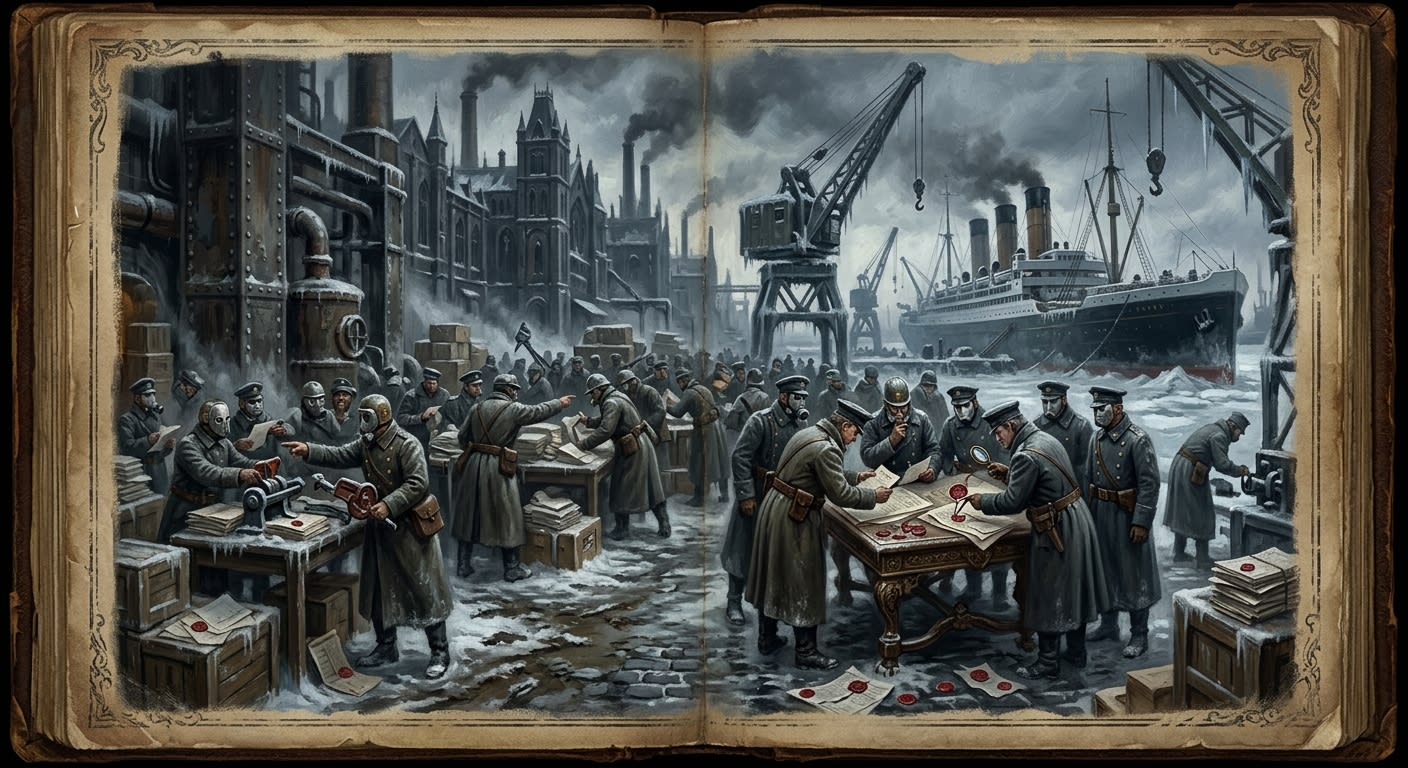
#On the Winter the Wax Learned to Lie
“Every seal is a mouth. In A.S. 145, half the ports discovered their mouths had been speaking in another man's teeth.” — Sigillary training plate, fourth revision.
The Seal-Forgers' Winter of A.S. 145 was the counterfeit seal crisis that gave the Manifest Litigants their most profitable authority: the right to demand a seal autopsy. It began in eastern port markets, spread through caravan exchanges and tariff-chapels, struck Marseille, Genoa, Venice, and the forward depots like a clerk's plague, and ended with the Bureau of Masks and Seals admitting, in language so perfumed it could have embalmed a mule, that it could not inspect every seal in Europe.
The Litigants could. For a fee.
The year A.S. 145 was already bloody with correction: southern dockets revisited the Schism of Avignon of A.S. 111 and burned whole chapters out of the Ledger, while the southern theatres counted famine dead and sea-port anomalies under separate ledgers because grief becomes less troublesome when sorted by office. Into that winter came rings, dies, counter-dies, wax tablets, and forged authority cut so well that honest clerks kissed fraud and called it law.
#On the Counterfeit Rings
The first rings were found at a grain house on the Adriatic route, though every port claims first injury because precedence is a form of begging with better clothes. A tariff clerk noticed that the wax impression on a convoy release bore the correct Triune Knot, the correct psalm-number, the correct interior prayer, and a depth of bite that made the paper pucker in approved fashion. The seal passed casual inspection. It passed desk inspection. It failed under magnification because the undercut beneath the third loop held a shadow too deep by less than the width of a louse's conscience.
That should have been the end of it: one forged ring, one hanging, one smug memorandum from Masks and Seals. By Candlemas, thirty-seven questionable impressions had surfaced across six port courts. By the thaw, no clerk trusted wax without three witnesses, two lamps, a comparison plate, and an excuse to go home early.
The forgers had understood what philosophers and idiots routinely miss: the Synod does not rule because men believe; it rules because paper believes on their behalf. Give paper a convincing seal and the gate opens, the ration issues, the corpse is buried, the child is listed, the cargo moves. Faith is sublime. Wax is faster.
The counterfeit rings were not crude back-alley toys. Potato-stamp fraud belongs to queues and children with more hunger than craft. These were cut in hard brass, some in silvered iron, several with interior psalm inscriptions visible only when the ring was destroyed. Their makers had access to old Registry measurements, confiscated practice plates, or a Mask clerk with debts. The Bureau preferred the first explanation, punished the second where convenient, and found the third impolite.
#On the Ports That Froze
Winter made the crisis theatrical. Wax hardened. Hands shook. Lamps smoked beneath tarpaulins while clerks leaned over impressions and argued over shadows. At Marseille, three pilgrim supply vessels waited nine days because the release seals from a chapel-house matched the Registry except in bevel angle. At Genoa, a banker produced six warehouse warrants, all false, all bearing perfect devotional countersigns, and then fainted when told perfection itself had become suspicious. At Venice, lagoon-vault clerks sealed an entire run of convoy papers into quarantine, fearing that counterfeit seal-wax had touched the archival trays.
The eastern port markets suffered worst. There, caravans from the Balkan approaches, Aegean ships out of Thessaloniki, Danubian barges, and black-market mercy convoys all pressed against gates already thick with war panic. Every delay smelled like famine. Every release smelled like fraud. The Bureau of Purity shot three men for possessing blank wax. One was a candle seller. Purity later clarified that candle selling under conditions of seal panic constitutes “adjacent instrumentality.”
PORT COURT ANNEX — EASTERN MARKET INCIDENT A child courier presented a sealed bread release at Gate Four. Impression: valid by eye. Undercut: suspect. Ring source: unknown. Cargo held. Crowd pressure rose. Warden volley discharged after third bell. Dead: ███. Bread released on fifth day after autopsy confirmed seal genuine. Autopsy fee charged to receiving parish.
Commerce hates paralysis because paralysis cannot always be invoiced. Masks and Seals hates embarrassment because embarrassment resembles theology without vestments. The two Bureaus convened a joint hearing in Strasbourg that produced thirteen pages of mutual courtesy and one usable sentence: authorised auxiliary examiners may perform preliminary comparison of disputed seal impressions against approved Registry plates.
“Auxiliary examiner” meant Manifest Litigant. “Preliminary” meant binding until challenged. “Approved Registry plates” meant copies sold under licence. “Disputed” meant whatever a Litigant could point at while keeping his face solemn.
#On the Birth of Seal Autopsy
The autopsy table is small: black cloth, angled lamp, magnifier, Registry plate, depth gauge, wax knife, pin caliper, witness slate. A seal impression is brought forward like a corpse of authority. The Litigant records its diameter, rim pressure, undercut, loop angle, psalm-mark, wax composition, paper bruising, and any secondary drag caused by a nervous hand. Then he pronounces whether the seal is living, dead, fraudulent, injured, mis-struck, or “requiring further devotional comparison.” The last category built three port fortunes.
The authority changed the profession more than any sermon could. Before A.S. 145, Litigants were masters of names, spellings, holds, and precedent traps. After Winter, they could interrogate the material body of authority itself. A misspelled village might delay cargo. A disputed seal could arrest a convoy, a marriage bond, a death certificate, a surgeon's warrant, a military order, or a gate pass between one breath and the next.
The first autopsy houses opened in port-court annexes within six months. Fees were modest for one month, punitive by the second, hereditary by the third. Purists treated every irregularity as infection. Pragmatists sold expedited comparison packages with chapel correction included. Shadow Counsel discovered that a forged accusation of forgery was cheaper than a forged seal and safer if voiced by a licensed mouth.
#On Masks, Heraldry, and the Convenient Surrender
Masks and Seals did not surrender authority. It delegated failure. A Bureau never says, “We cannot.” It says, “Under present emergency conditions, subordinate instruments shall extend our reach.” The wording flatters the subordinate and hides the stump.
The deeper humiliation belonged to Heraldry. The Triune Knot, standardised by Theobald of Worms and refreshed every Feast of the Cracked Bell, was supposed to bite paper with a geometry no criminal hand could mimic. The forgers mimicked it. Worse, they mimicked the version used in the previous year's plates, the subtle pre-bevel correction that many outer offices had not yet replaced. This meant the counterfeit might match an authentic local plate better than Strasbourg's corrected model. The Bureau called this a “transitional congruence hazard.” I call it being caught by one's own update schedule.
Public teaching copies state that no counterfeit seal of A.S. 145 passed Registry-level inspection.
Corrected. No counterfeit seal was admitted to have passed Registry-level inspection. At least nine impressions entered the Registry chain before challenge, three release orders were honoured before recall, and one burial clearance remains unrevoked because reopening the grave would require admitting why it was closed.
Seal-Forgers were hunted with proper theatre. Workshops were raided in dock cellars, candle sheds, under-stair die rooms, and two respectable guild houses whose respectability ended the moment Purity found resin, brass filings, and a ledger titled “private condolences.” Executions followed. Tools were displayed. Children were marched past trays of confiscated rings while Doctrine lecturers explained that false authority devours the hand that wears it. The children stared at the tools. Children are practical theologians; they know craftsmanship when they see it.
#On the Winter's Survivors
Saint Vellum came out of the Winter polished. By A.S. 145, after seal autopsy rights were granted, his name was invoked over impression plates as readily as over disputed manifests. The saint of the narrow line now presided over lines in wax: rim, bevel, loop, cut, angle, bruise. Litigants prayed for steady fingers before cutting a sample from a disputed seal. Merchants prayed for illiteracy in the opposing house.
The forgers did not vanish. They became better. Some entered black markets, some entered Bureau service under sealed names, and some learned the oldest lesson of the Synod: legitimacy is forgery that survived audit. By A.S. 195, Cologne would produce counter-seals so precise that only resin ratio betrayed them. The Winter was not the end of counterfeit authority. It was its education.
The Manifest Litigant still keeps the wax knife wrapped in black cloth. He places the disputed impression beneath the lamp, lowers the magnifier, and smiles the small smile of a man about to discover billable doubt. The seal lies there, authority flattened into wax, waiting for a priest of paperwork to declare whether it ever had a soul.