
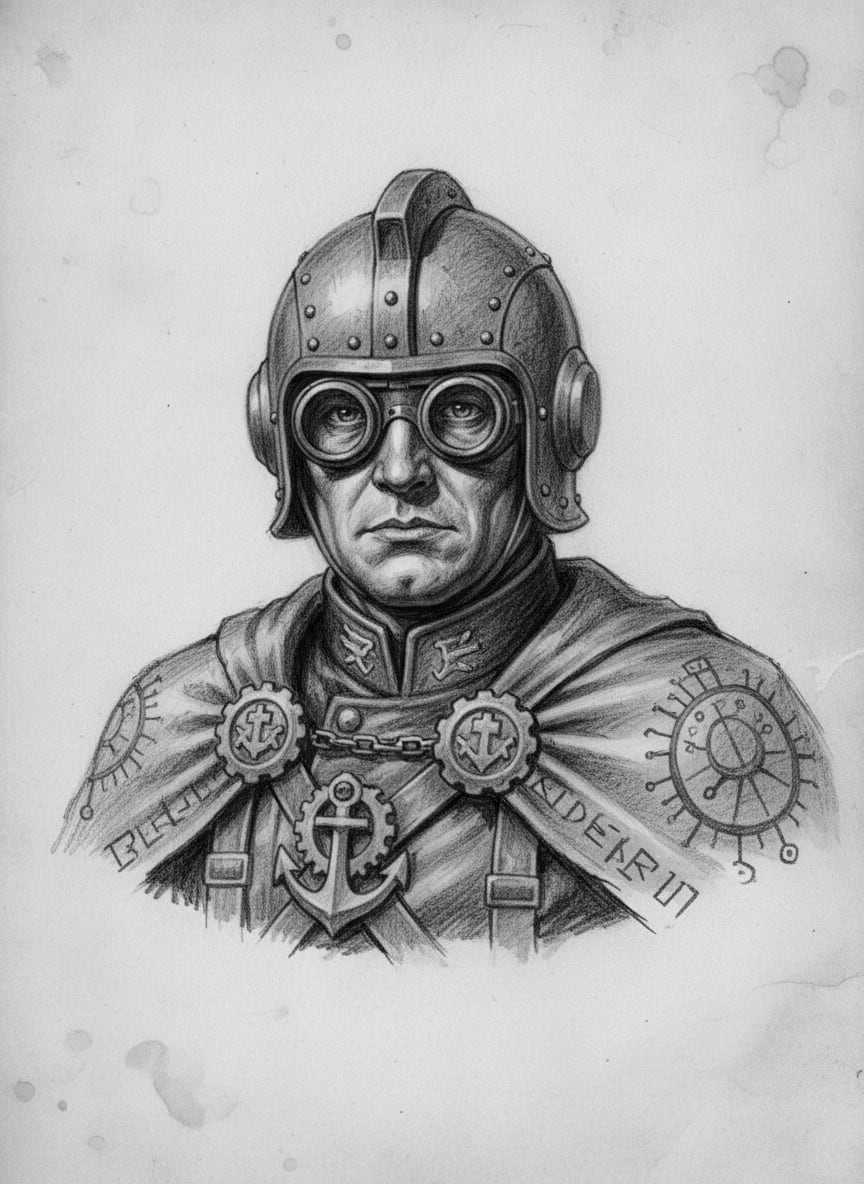
#On His Crown of Tar and Brine
Pilot-King Nenos owns no crown in the dynastic sense, the sacramental sense, the coronation sense, or any sense that would survive three minutes before the Bureau of Heraldry with a clerk in a bad mood. He is king because the harbour says he is king, which is a more ancient and less reversible procedure. The title belongs to the pilot who can bring a vessel beneath the Thessaloniki Harbor-Chain Towers in fog, under reversed bells, between inspection lamps, past Quarantine skiffs, through chain-hum thick enough to rattle teeth, and do so without asking the sea's permission in a voice the sea can hear.
He has one eye. The other was lost in a collision with a quarantine boom during the Brine Fever closures, or in a knife argument with a Seal-Mate from Varna, or as payment to the Drowned Row Syndic for a debt involving three crates of demon glass and a saint's ulna. Nenos has given all three explanations. Each was sworn on a different relic. I admire this economy of oathwork.
His station is the under-quay corridor, the night pilotage lanes, the narrow water between legal arrival and practical arrival. Officially, no such station exists. Officially, ships enter by permit, chain-window, bell-signal, and Harbor Ledger clearance. Officially, the Bureau of Shadows has no knowledge of the Drowned Row Syndic's submerged hatches, chalk-marked sluices, or skiff routes from the Maskwright Lanes to the coastal regiments. Officially, I am a modest man.
#On the Work of a Pilot
A harbour pilot at Thessaloniki does more than steer. He reads bells, water, chain, lantern, smell, bribe, mood, and that subtle slackening in a Purity inspector's posture which means the man has already been paid and wishes the night to end without witnesses. The legal pilotage guild teaches channel marks, tidal tables, quarantine flags, and the Passage Psalm's authorized tempo. Nenos learned those things because ignorance kills. He learned the rest because legality kills more slowly and charges fees while doing it.
The chain-hum is his instrument. Every ship passing beneath the reliquary links wakes a vibration that travels through hull, rope, boot, molar, prayer bead, and unpaid conscience. Most pilots hear a warning. Nenos hears measurement. He can identify a cargo vessel by the way the links answer its keel. He can tell flour from ammunition by the second shudder after the forward mast clears the chain. He claims he can hear passengers lying on the manifest. I have no proof. I have three manifests corrected by him in pencil before the Records clerks found the discrepancies, which is proof enough for anyone not committed to institutional embarrassment.
He fears nothing that floats. Call it accuracy before courage. Bravery implies contest. Nenos treats ships as blunt facts: heavy, stubborn, taxable, and usually captained by men whose self-regard exceeds their ballast discipline. He fears things beneath floating, things that answer the chain without touching it, things that make fog lean toward names. Sensible man. The Bureau calls such discrimination superstition because the Bureau prefers fear to arrive wearing a classification tag.
#On the Silence and the Refusal
On 14 Ashmonth, A.S. 198, the bells failed. Andros Pell struck the Elder and received no sound. Katerin Liss struck the Younger and received the same occupied absence. Kosta held the gates open before permission arrived. Iolana fired memoranda up the Ledger Steps like artillery. In the Sheds, Aunt Velka set throats against the Drowned Choir. Under the water, Sera felt the chains keeping correct time.
Nenos refused passage.
This detail deserves more respect than the official inquiry grants it. The harbour needed pilots. The chain-gates stood open. Cargo spoiled. Captains cursed. Purity officers threatened licence review, a curious weapon against a man whose licence existed largely in the hopes of clerks who enjoyed pretending the port was tidier than it was. Nenos refused every vessel. Grain, pilgrims, medical freight, ammunition, one sealed reliquary crate with three grades of escort, and a Bureau courier whose papers were so correct they smelled of wet arrogance: all waited.
His explanation was entered verbatim into the Harbor Ledger: the sea was listening too hard.
FORMAL OBJECTION — PILOT-KING NENOS Filed under: MARITIME, SUPERSTITIOUS Category total: 1 document Statement: “The sea was listening too hard.” Subsequent annotation: do not destroy; do not circulate; do not ask why this category now exists Second annotation, hand unidentified: █████████████ heard him
The phrase has been mocked by men who have never taken a keel under silent chains. They should not mock. A ship passing beneath unchristened links is an uncounted passage. An uncounted passage is not invisible to the sea; it is visible without defense. The Passage Psalm had no bell-foundation. The chain-hum had no public witness. The water, deprived of bronze, still received names. Nenos understood that movement during the Silence would feed the wrong ledger.
The Bureau of War's first after-action summary described Nenos as “obstructionist under pressure.”
Corrected after review. “Obstructionist” has been replaced by “operationally conservative.” The cargo was delayed. The vessels survived. In Bureau arithmetic, survival becomes prudence once a sufficiently senior man signs the correction.
#On Contraband, Glass, and Necessary Filth
Nenos's other office, if one accepts the word office for a skiff, a lantern with blackened panes, and a memory full of routes no chart dares confess, lies with the tolerated sin of the under-quays. The Demon-Glass Polishers of the Maskwright Lanes produce eye-pieces for coastal regiments; the Bureau of Purity burns enough workshops to appear righteous; the Bureau of War receives enough masks to appear alive. Between those two appearances runs Nenos.
He guides skiffs through the submerged hatches of Drowned Row, past the chain foundations, under inspection lamps, and into the routes by which contraband becomes equipment. Glassman Dimo's crates move in fish-barrels. Saint-bone reliquaries acquire false bottoms. Pilgrim stores gain “optical supplies, standard.” Ledger-Ghost Tamsin supplies the papers. Nenos supplies the water.
This is criminal, naturally. It is also useful, naturally. The Synod's moral system depends upon that hinge: condemn the hand, receive the package, punish the hand if the package is noticed. The hand learns to work in darkness. The package arrives on time.
Nenos does not romanticise the trade. He knows which glass hum means Wrath-slag, which means Lust-palace, which means throw the crate overboard and pray the fish lack mirrors. He can smell unpolished shards through tar. He never lets boys carry quiet-boxes after dark. He has beaten two Seal-Mates bloody for opening a crate at sea. They survived. Their gratitude was, I am told, delayed.
#On Character and the Remaining Eye
Nenos is profane, meticulous, stingy with speech, generous with rope, and allergic to officials who use the word “merely” near water. He wears an iron medal of Saint Phocas (Unregistered) under his shirt and a brass coin drilled through the center over the blind socket when fog thickens. The coin is no charm, he says. It is a reminder that a missing eye should still earn its keep.
He drinks brine ale diluted with rainwater. He sleeps facing the harbour. He will not eat eel. He spits before saying the name of Varna. He knows thirteen versions of the Passage Psalm and uses none approved by Orison and Song, because approved versions assume a sober crew, a clean manifest, a calm chain, and a sea that has accepted its subordinate position in the created order. Nenos has met sailors. Nenos has heard the chain. Nenos is less optimistic.
His authority among dockhands comes from accuracy. He says wait; men wait. He says cut lantern; lanterns go dark. He says throw the aft crate; men throw it before asking whether the crate contains glass, relics, coin, or someone's uncle. That kind of obedience cannot be purchased with rank. Rank may command a man to risk death. Accuracy convinces him the death can be avoided if he moves now.
#On His Present Position
As of A.S. 201, Pilot-King Nenos remains active, unlicensed in all the ways that matter, tolerated in all the ways that shame the tolerators, and necessary in the specific, humiliating manner by which the Bureau discovers that men outside its tables know things its tables cannot hold. The bell reversal persists. The Elder speaks high. The Younger speaks low. The chain-windows operate on revised acoustic parameters, and Nenos has adjusted faster than the forms.
He has been seen purchasing provisions for a voyage he will not discuss. This has alarmed the Harbor Ledger Office, the Drowned Row Syndic, two Purity informants, three chandlers, and one priest who knows the difference between a sailor stocking for profit and a sailor stocking for absence. Nenos says he is “checking a route.” He refuses to say which. His skiff has fresh pitch. His remaining eye has the flat calm of a man who has already argued with himself and won.
The external auditors from Strasbourg intend to interview him. They will ask about the A.S. 198 refusal. They will ask about under-quay pilotage. They will ask whether the sea can listen. If they are wise, they will ask while standing inland.