
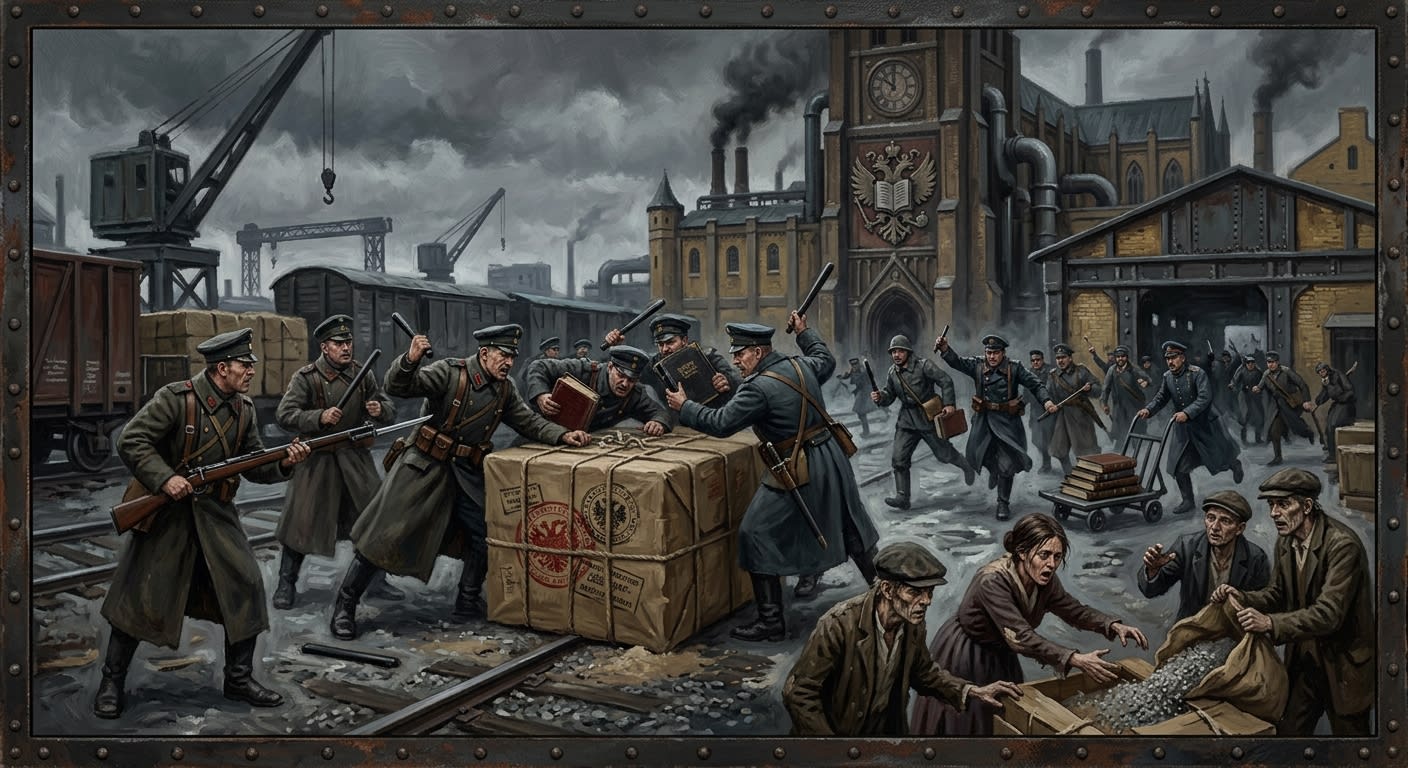
#On the Cargo That Existed Twice
The Stamp War of Novi Sad in A.S. 147 began with a cargo, two inspectors, two valid seals, and the kind of mathematical impossibility that the Bureau of Records handles by sharpening a quill.
The shipment itself was ordinary enough to deserve suspicion. Grain, salt pork, lamp oil, two crates of chapel candles, spare boots, and ration flour moved under convoy toward the southern corridor, where hunger had already begun licking the ledgers. The cargo entered the Novi Sad tariff yard under a clean manifest and left, on paper, in two directions at once. One inspector stamped it for immediate military requisition. The other stamped it for civic ration assignment. Both men used authorised dies. Both seals were current. Both offices certified jurisdiction.
The cargo was divided twice.
A lesser office would have halted the shipment, summoned the inspectors, counted the sacks, and admitted that one seal must yield. Novi Sad possessed better training. The clerks opened duplicate folios, reconciled each half against a whole already assigned elsewhere, and produced rations that balanced across two books while failing to trouble the physical world. Men received bread in ledger column. Women received lamp oil by arithmetic implication. Children were allocated flour from sacks whose contents had already been issued to a battalion that, in a separate record, was also waiting for them.
#On the Two Inspectors
The inspectors' names survive in sealed payroll registers and training jokes, which is to say they survive more honestly in the jokes. Official manuals call them Inspector A and Inspector B, as if alphabetic modesty could cauterise famine.
Inspector A represented a Tithes priority claim: convoy goods assessed for military passage, tariffed under emergency forward-discipline, marked for Line-bound distribution. Inspector B represented civic ration authority under urban shortage clause, arguing that Novi Sad's registered dependents had first claim before onward transfer. Neither claim was absurd. That was the problem. Absurd errors can be corrected. Plausible errors demand committees.
The first stamp fell before Prime. The second fell after Terce. By noon, runners had carried both sealed slips to rival registry desks. By None, each desk had authenticated its own. By Vespers, the Port Court refused to invalidate either stamp without a counter-filing from the other office, and the other office refused to counter-file while its own stamp remained valid. This posture is called procedural neutrality. In old, plain speech it is called watching a man drown while debating whether water has standing.
Early retellings described the event as a dispute between corrupt inspectors.
Corrected by Records review. No evidence of bribery survives. The inspectors acted within valid authority, which is worse. Corruption would have permitted a culprit. Procedure produced a precedent.
#On the Double Division
The physical cargo sat under guard. The paper cargo multiplied.
Tithes divided the shipment into military allotments: forty sacks to the forward depot, twelve to the candle stores, four barrels of oil to siege lamps, salt pork under officer ration priority. Civic ration clerks divided the same shipment into ward assignments: widows' flour, infirmary oil, night-soil crew pork, chapel candles for hunger processions. The sums balanced. Each office saw its own arithmetic and praised the Creator for legibility.
The warehouse master, a man whose virtues appear to have included counting with his eyes, reported that the sacks could not satisfy both ledgers. His memorandum was received, copied, routed, queried, counter-routed, and attached to the wrong folio under the heading “storage anxiety.” He later testified that he had tried to stop release. The testimony was accepted. The release had already occurred in writing.
WAREHOUSE MASTER DEPOSITION, NOVI SAD FILE 147-D: “I placed my hand on the sacks and told the clerk there were not enough. He showed me the balanced allotment. I said the paper was eating. He told me not to use demonic language in a tariff yard.”
Further lines sealed after witness made repeated reference to ██████████ moving between ledgers without hands.
For five days, ward offices issued ration notices against stores already claimed by convoy quartermasters. For seven, convoy quartermasters received assurances that requisition fulfilment was pending local harmonisation. On the eighth day, the first bread queues formed with stamped slips in hand and empty baskets under arm. On the ninth, soldiers arrived to collect military shares. On the tenth, Novi Sad learned the central doctrine of duplicate allocation: paper can feed everyone until supper.
#On the Riot of Correct Receipts
The riot began politely. This should be remembered, because polite riots shame the state more than savage ones. Savage riots can be blamed on blood, drink, enemy agents, weather, or the demonic appetite that crouches under every hungry street. Polite riots arrive holding receipts.
At the South Ration Hall, two hundred registered citizens presented valid slips. The clerk had no bread. At the convoy gate, quartermasters presented valid requisition orders. The warehouse had no pork. At the chapel store, a Procession steward demanded candles. The candle crates had departed under civic allocation in one ledger and had never departed at all in another. Bells rang for order. The crowd raised its stamped slips like votive tablets and began chanting the seal numbers.
Purity arrived by afternoon, followed by Records auditors carrying portable desks. The desks mattered. They always do. A volley can stop a crowd, but only a desk can convert the stopping into lawful incident. The first shots were filed as perimeter preservation. The second as riot correction. The third as charitable acceleration of dispersal. Bodies fell among ration slips that still entitled them, in excellent ink, to flour.
#On Records' Perfect Balance
Records performed its audit in three rooms. The first counted the military ledger. Balanced. The second counted the civic ration ledger. Balanced. The third counted bodies, then stopped counting bodies when the category began interfering with the first two rooms.
All ledgers balanced.
This phrase entered the file before the dead were cleared. It appears in the margin of the summary folio in a small hand, probably junior, certainly doomed: “Both allocations valid; deficit physical.” I admire that clerk. He saw the corpse in the arithmetic and named it with bureaucratic chastity. His later career is absent from the personnel books, which means the Bureau either punished him, promoted him, or improved him into silence.
The phrase “deficit physical” was removed from public copies as needlessly inflammatory.
Approved replacement: “material reconciliation pending.” The pending status expired after thirty years and was renewed automatically by a clerk who had not been born when the first slips were stamped.
The inspectors were promoted. This detail offends the sentimental reader, which is why I preserve it. Inspector A had defended military supply priority with procedural correctness. Inspector B had defended civic ration authority with procedural correctness. The system had failed in the space between correct acts, and no Bureau punishes the space. Spaces have no salary, no pension, no superior to embarrass.
#On Double-Stamped Things
After Novi Sad, Line slang acquired the phrase “double-stamped.” A ration that exists only in promise is double-stamped. A transfer order sending the same platoon to two trenches is double-stamped. A corpse listed alive in one book and buried in another is double-stamped. A commander's courage, certified by a man who never met him and questioned by every soldier who did, is double-stamped. The phrase travelled faster than reform.
Reform did arrive, forty years later in A.S. 187, shaped like a filing cabinet giving birth to knives. Duplicate-stamp protocols gained new categories: competing valid seal, sequential override dispute, parallel allotment freeze, provisional material suspension. Four new forms. Six witness lines. Two appeal routes. One emergency clause available only after a second officer confirms that the first officer's confirmation requires confirmation.
True Measure Zealots cite Novi Sad as proof that seal discipline must be absolute. Mercy Weighers cite it as proof that a clerk must sometimes violate clean procedure before clean procedure murders the queue. Manifest Litigants cite it as proof that rival valid claims generate excellent fees. All three are correct, which is why the incident remains poisonous.
#On the Present Instruction
As of A.S. 201, Commerce Clerk trainees study Novi Sad after the Ledgers of Varna and before advanced condemnation slips. Varna teaches velocity failure: grain rots while offices debate. Novi Sad teaches precision failure: seals remain valid while food vanishes into allocation. Together they form the two jaws of Synodal commerce, and the apprentice is told to keep his fingers out of both while feeding the machine.
The final training question is simple: if two valid stamps claim one cargo, which stamp governs? The approved answer fills three pages and cites Standing Order 77-A, Revised A.S. 199. The useful answer is shorter. Count the sacks.
Nobody writes that down.