
#On the Order That Prices Delay
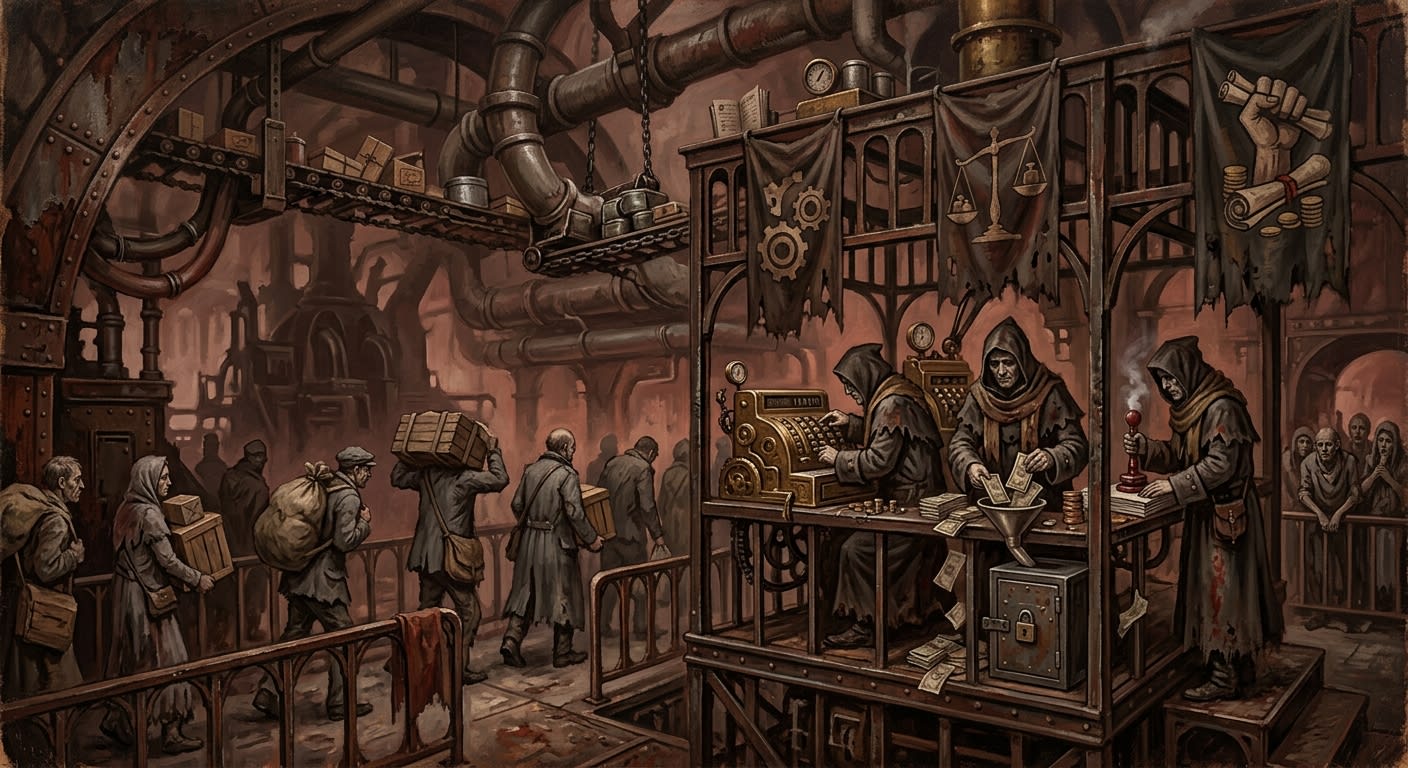
Standing Order 77-A is the Synod’s trade-and-transit correction instrument governing convoy facilitation, tariff-chapel weighing, ferry clearance, duplicate-stamp conflict, and the licensed lies by which cargo reaches the mouth before the mouth becomes a statistic.
It is beloved by no one. This alone recommends it to serious attention.
The order began as a logistics discipline for Caravan Factors, hardened through Tariff Chapel practice, acquired teeth after the Stamp War of Novi Sad, and reached its present A.S. 199 revision after Commerce admitted, with the air of a bishop discovering rain, that speed and precision could murder separately and together. The A.S. 172 version made bribe-related convoy expense loggable under Operational Facilitation (Unregistered). The A.S. 199 revision extended the same moral ulcer across Commerce Clerks, ferry intermediaries, convoy Factors, port-court officers, and any poor devil standing between a sealed sack and a hungry district.
The public copy speaks of purity in passage, accuracy in measure, and orderly clearance under holy rate. The working copy speaks of bell-credit, drift, duplicate valid seals, bribe ledgers, password expiry, cargo identity, chapel zero, ferry delay, and hostile calibration. The sealed annex speaks in numbers, as sealed annexes do when words might become witnesses.
#On the Wounds That Required It
Every Standing Order begins as an embarrassment that acquired a number.
The first wound was the road. After the Sagittal Line fixed itself from Baltic to Bosphorus, convoys had to cross ridges, ferries, gate queues, ruined bridges, tariff counters, saint-stones, local jealousies, and weather whose theology remains hostile. The Bureau of Tithes taxed movement. The Bureau of War demanded arrival. Records demanded proof that arrival and departure had met without sinning. Factors solved the problem by doing what roads require: paying people, lying politely, carrying burner seals, splitting manifests, and writing the truth after it became safe.
The second wound was the scale. After the A.S. 97 Bread-Scale Uprising, private measure died and weighing became sacramental. That gave the Synod clean pans, saint-bone zeros, and clerks whose authority could starve a ward by refusing to let grain become lawful food. The Bureau of Commerce learned quickly that a scale can be correct while a city eats nothing. This discovery improved nobody’s character.
The third wound was the river. Ferry Chokepoint Brokers appeared in the rot between password and crossing, where permits expired faster than couriers arrived and a mispronounced saint-name could hold three hundred souls in mud until hunger became philosophy. Brokers carried phonetic prayer cards, password scraps, witness slips, ferry gossip, and the old river truth: a rule that cannot move anyone will be leased to someone who can.
Then came the great instructional crimes. The Ledgers of Varna in A.S. 129 taught velocity failure: grain sound on arrival, nineteen days of tariff dispute, rot in the holds, the hungry shot beside bread. The Stamp War of Novi Sad in A.S. 147 taught precision failure: two valid seals, one cargo, duplicate allocation, balanced books, empty mouths, inspectors advanced. Varna killed by waiting. Novi Sad killed by correctness.
77-A is the Bureau’s answer to both corpses.
#On Operational Facilitation
The order’s most famous clause concerns bribes, which it does not call bribes because the Bureau has manners and a knife.
Operational Facilitation is any expenditure, transfer, remission, devotional gift, chapel oil, queue adjustment, guard courtesy, lockhouse consideration, mule-priority inducement, ferry silence payment, or wax maintenance gratuity required to move lawful cargo through obstructed passage without unlawful loss of time. It must be entered in the Supplementary Manifest (Unregistered), witnessed if possible, countersigned by the nearest available cleric if not absurd, and assigned to cargo survival, route safety, seal preservation, or emergency moral lubrication.
Earlier convoy manuals used the term “bribe chain” in marginal examples for Factor training.
Corrected in the Fourth Records Revision. The proper phrase is devotional facilitation sequence. The old phrase remains useful in speech among persons who wish to be understood before dying.
The genius of Operational Facilitation lies in its selective light. A payment entered properly becomes expense. A payment concealed becomes corruption. A payment omitted because the Factor feared scandal becomes delay, and delay may become famine, and famine becomes a hearing in which several seated men ask why the Factor did not exercise prudent initiative. This is how the Bureau manufactures guilt in all directions.
Standing Order 77-A leaves enrichment unforgiven. It taxes the difference between necessity and appetite. If a gate-sergeant receives flour to release a convoy before a storm, facilitation. If the Factor keeps a sack for his own hearth, enrichment. If the sergeant demands flour because his own garrison has not been paid in four months, facilitation with attached complaint. If the Factor invents the sergeant, enrichment with literary ambition. The Bureau respects neither theft nor bad fiction.
#On the Sacred Zero and Hostile Calibration
The A.S. 199 revision dragged the tariff-chapel deeper into 77-A. Commerce had begged for this, then complained when it received what it asked for, as Bureaus do when answered.
A Tariff-Chapel Weigher must zero the scale under witness, record drift, report repeated drift beyond tolerance, reconcile gross and net weights, and annotate any cargo whose chapel identity changes during delay. Grain that rots in custody remains weighed. Oil that leaks remains assessed. A corpse that taps from inside a crate remains pending until the mortuary clause wakes up and starts ruining breakfast.
Hostile calibration (Unregistered) is the order’s ugliest phrase. It describes simultaneous failure of speed and precision under conditions where delay, seal conflict, drift, spoilage, pressure, counterfeit weight, or contested jurisdiction produces material harm while every participating office can exhibit a defensible record. In plainer language: everyone did his job and people died.
True Measure Zealots welcomed the clause because it forced drift reporting. Mercy Weighers welcomed it because “physical goods preservation” gave them a legal hinge for feeding people before the last appeal fossilised. Manifest Litigants welcomed it because every hinge can be billed. The Bureau of Commerce welcomed it in public and cursed it in private, which is often the first sign of good law.
#On Duplicate Stamps and the Novi Sad Shame
Novi Sad is the order’s black lesson. One cargo carried two valid claims: military requisition and civic ration assignment. Each inspector had authority. Each seal impressed cleanly. Each desk authenticated its own jurisdiction. The cargo split twice in paper and insufficiently in the world. People arrived with correct slips and received air.
77-A Revised imposes the Duplicate Valid Seal sequence (Unregistered). First, physical count before ledger division. Second, seal hierarchy inquiry before release. Third, emergency material suspension if two valid offices claim a whole larger than the sacks present. Fourth, local feeding authorisation when perishable sustenance threatens to cross from cargo into evidence. Fifth, punishment of any clerk who writes “balanced” before a human being has counted the goods by hand.
77-A DUPLICATE-SEAL ANNEX — A.S. 199 Where military and civic claims attach simultaneously to rationable cargo, local officer may authorise immediate proportional release up to █████ percent before final hierarchy ruling, provided physical count is witnessed by █████████ and shortage liability is assigned to ███████████████ rather than “the crowd.” Public training copy omits this paragraph.
The omission is wise. Give local officers a printed mercy and half will use it badly, the other half will sell it, and the third half — arithmetic in Commerce is elastic — will insist it never existed while feeding their cousins. Sealed discretion is the Synod’s compromise with reality: we authorise what we may later deny.
An A.S. 188 Commerce lecture described Novi Sad as “resolved through later doctrinal clarification.”
Corrected. Novi Sad remains unresolved: indexed, renamed, cited, and made instructional. Resolution implies the dead received bread backward.
#On Ferries, Passwords, and Prayer Cards
Ferry clauses entered 77-A through embarrassment rather than policy. The Bureau of Records denied unauthorised passage intermediaries existed while privately noting that transit irregularity rates declined when they were left alone. Purity condemned the Brokers thrice and relied upon them thrice. Commerce, smelling a fee, proposed regular language.
The A.S. 199 revision prohibits unauthorised phonetic prayer cards, password rings, split prayers, ferry priority slips, queue transfers, and witness substitutions, except under witnessed necessity, sanctioned backlog, emergency passage, lost courier status, hostile weather, bellwater risk, or administrative failure not publicly attributable to the office invoking it. Call it a cage with useful gaps.
A Broker who sells false passage remains criminal. A Broker who preserves lawful throughput during password collapse may be treated as tolerated ancillary function if the crossing would otherwise fail and if no superior officer is embarrassed in the resulting report. The phrase “if no superior officer is embarrassed” appears nowhere in the order. It appears everywhere in life.
#On Factors and the Arithmetic of Arrival
For the Caravan Factor, 77-A is both shield and noose. It permits the grey expense that keeps a convoy moving and records the grey expense that will later hang him if the audit wants a neck. Factors carry Supplementary Manifests now, with columns for Operational Facilitation, route deviation, bell-credit loss, seal substitution, cargo sacrifice, mule death, hand reassignment, and weather claim.
The Factor’s old wisdom survives under new headings. A bribe to a gate becomes facilitation. A burner seal becomes emergency substituted authority. A wagon abandoned in singing weather becomes cargo sacrifice under hostile passage condition. A man carried as “hands” when he is in fact erased, hunted, or inconvenient remains illegal, unless the manifest never learns to speak.
77-A leaves the road dishonest and makes dishonesty auditable. This is the Synod’s preferred improvement.
The clever Factor writes enough to survive. The stupid Factor writes nothing. The doomed Factor writes everything.
#On the Present Force of the Order
As of A.S. 201, Standing Order 77-A governs serious movement across the Synod’s commercial throat: tariff chapels, convoy roads, ferry locks, trench depots, port courts, caravan gates, queue nodes, and the disputed places where a sack becomes food only after six offices stop licking it. It is cited in Commerce Clerk examinations after Varna and Novi Sad. It is muttered by Factors in rain. It is cursed by Ferry Chokepoint Brokers when Purity confiscates prayer cards on Monday and buys better copies on Tuesday.
The order’s doctrine is simple. Precision without speed becomes Varna. Speed without measure becomes fraud. Two valid seals may produce one empty pantry. A bribe may be corruption, salvation, evidence, or all three, depending on whether the clerk used the correct column. The world must move. The Ledger must remain clean. Between those two impossibilities stands 77-A, sleeves rolled, ink wet, palm open.