
#On the Bench Above the Cargo
The Port Court is the Synod’s answer to the ancient mercantile question: if a sack of wheat sits beneath a warehouse roof, blessed, weighed, sealed, urgently needed, and visible to hungry citizens through the rail, may anyone eat it before a clerk has determined which Bureau owns the right to call it wheat?
The answer, naturally, is no.
Port Courts stand in tariff-chapels, harbour galleries, inland convoy yards, bridge toll houses, caravan gates, and certain rail depots whose managers have sinned sufficiently to deserve lawyers. They do not function as courts in the old civic sense, where men complained, witnesses lied, judges aged, and justice occasionally stumbled into the room by accident. A Port Court adjudicates identity before possession, possession before release, release before mercy, and mercy only if mercy has produced the correct docket number.
Every Port Court is a chapel of disputed reality. Cargo arrives with papers; the Court determines whether the papers sufficiently persuade the world that the cargo is itself. Grain may become strategic grain, pilgrim ration, civic sustenance, condemned organic matter, taxable surplus, heresy-adjacent spoilage, or, in a daring late-century innovation, “material reconciliation pending.” The sack does not change. The name changes. In the Synod, that is the more dangerous alteration.
#On the Origins of Litigious Hunger
The institution began as a convenience and matured into a theology, which is the Synod’s usual lifecycle for a mistake that earns fees. Before the Concordat, merchant houses settled harbour disputes by guild bench, bribe, fist, oath, and municipal habit. The system was corrupt, quick, local, and often competent. The Synod could tolerate the corruption. It could not tolerate locality.
After the Sundering and the Great Retreat, trade routes shattered, place-names drifted, seal-rings vanished with dead offices, and entire convoys arrived bearing documents from cities that no longer existed except in the past tense and Bureau optimism. Counterfeit cargo moved beside real cargo. Relic crates wore grain labels. Grain wore ammunition exemptions. Pilgrim supplies became military stores at one checkpoint and civic relief at the next. A world wounded at the level of geography required someone to say what a thing was when the thing itself had ceased being persuasive.
By A.S. 90, the Concordat had given Commerce and Doctrine the language they needed: name as boundary, manifest as identity, seal as witness, tariff as obedience made countable. By A.S. 112, after the Orthography Purge and the wider tightening of civic records, licensing hardened around Manifest Litigants. The Port Court became a standing machine. It had benches, galleries, clerk rails, evidence tables, seal lamps, appeal ladders, fee schedules, and a smell: ink, damp rope, wax, sweat, grain dust, old fish, and fear trying to remain professional.
Several Commerce histories describe the Port Court as a humanitarian reform that replaced arbitrary guild seizure with lawful adjudication.
Corrected. It replaced arbitrary seizure with billable delay, which is a genuine administrative advance and a dubious mercy. The distinction is to be preserved in teaching copies and ignored in fundraising addresses.
The founding claim was doctrinally elegant: the demon enters by the misnamed door. The working practice was less handsome: nothing moves until the name has paid its passage. Both statements remain true. Doctrine supplied holiness; Commerce supplied benches; Tithes supplied objections; Records supplied folios; Purity supplied men with loaded rifles for those hours when legal theory produced crowds.
#On the Architecture of Waiting
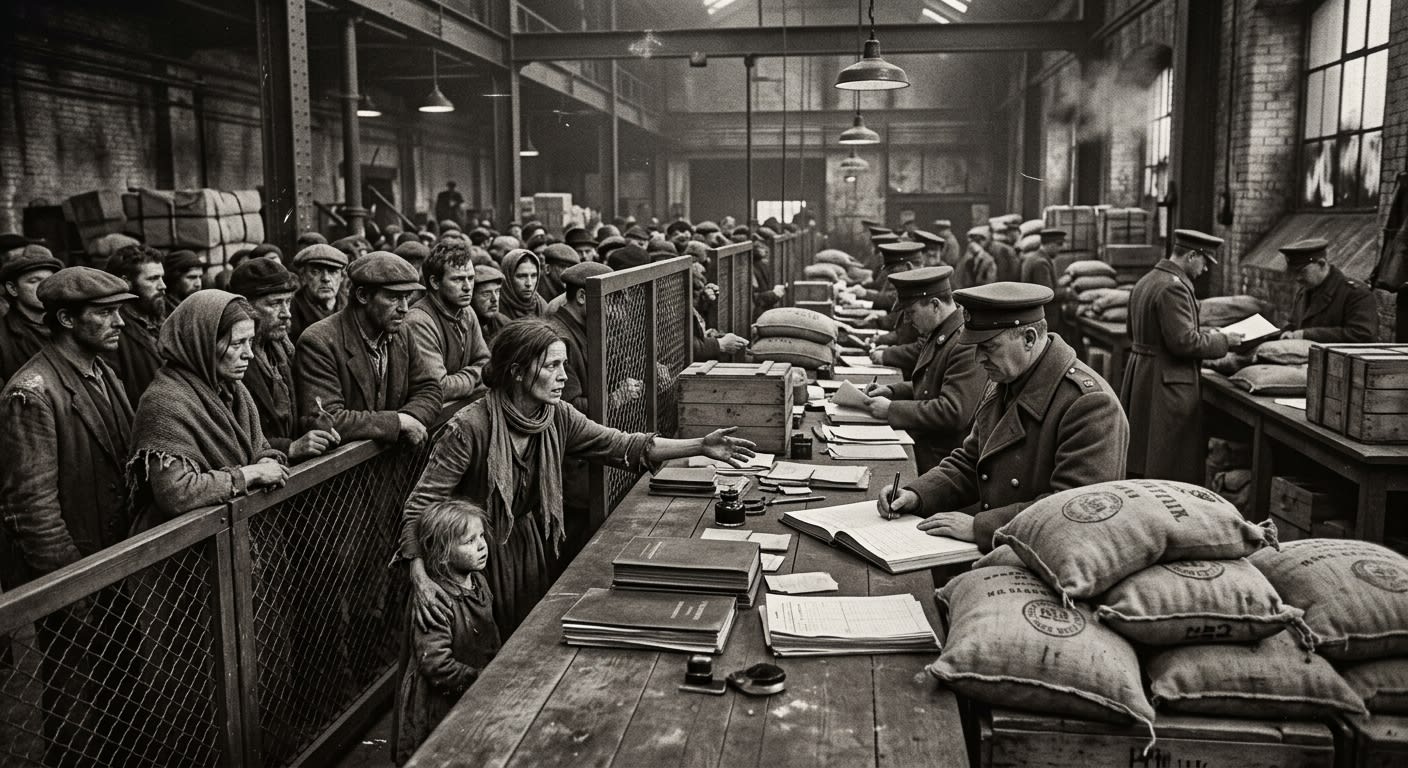
A proper Port Court is built above the cargo. Statute does not require this, specifying only visibility, custody separation, bench elevation, and controlled access, but custom has its own vindictive intelligence. The litigants stand in a gallery looking down. The merchants stand below, close enough to smell their own goods and far enough to be prevented from touching them. Dockworkers wait at the doors. Citizens wait at the rail. Guards wait behind everyone, because hunger teaches geometry faster than school.
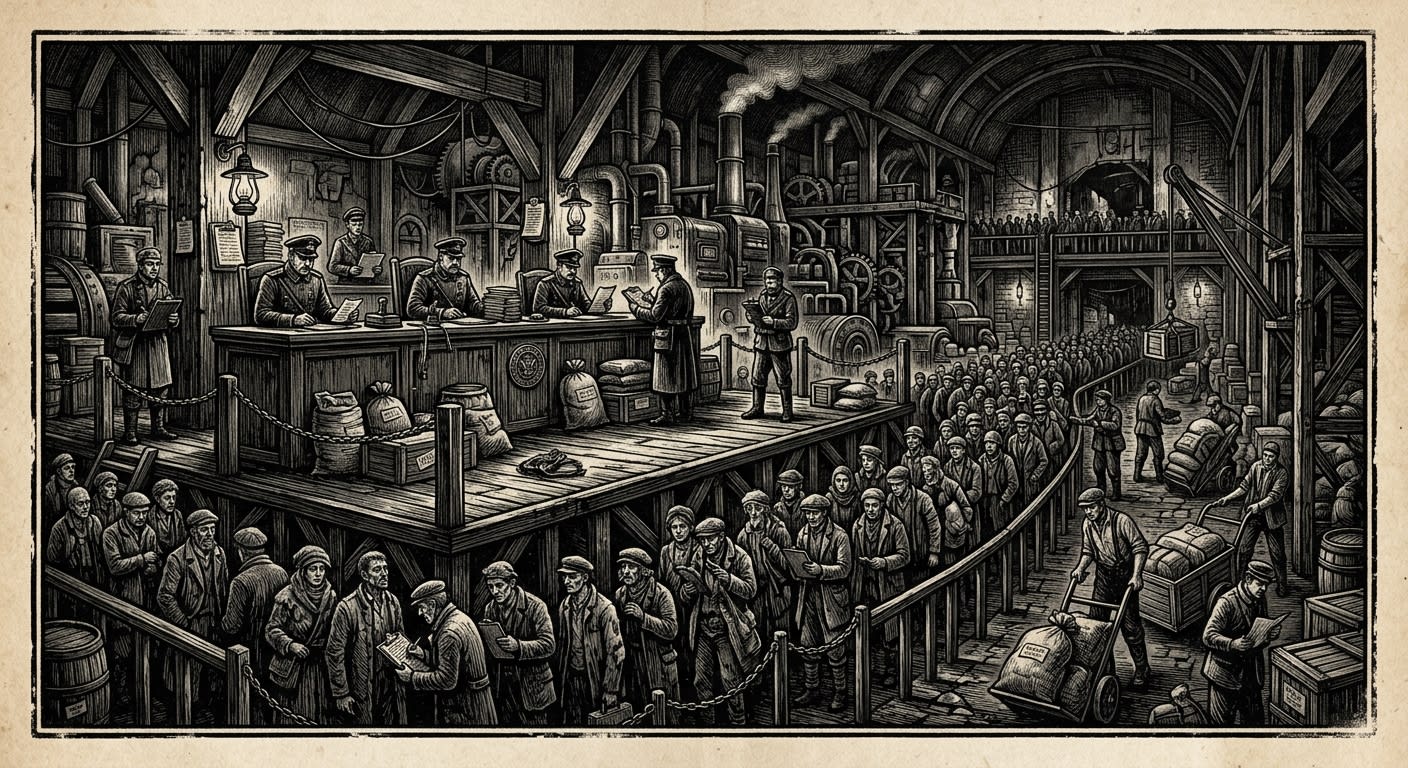
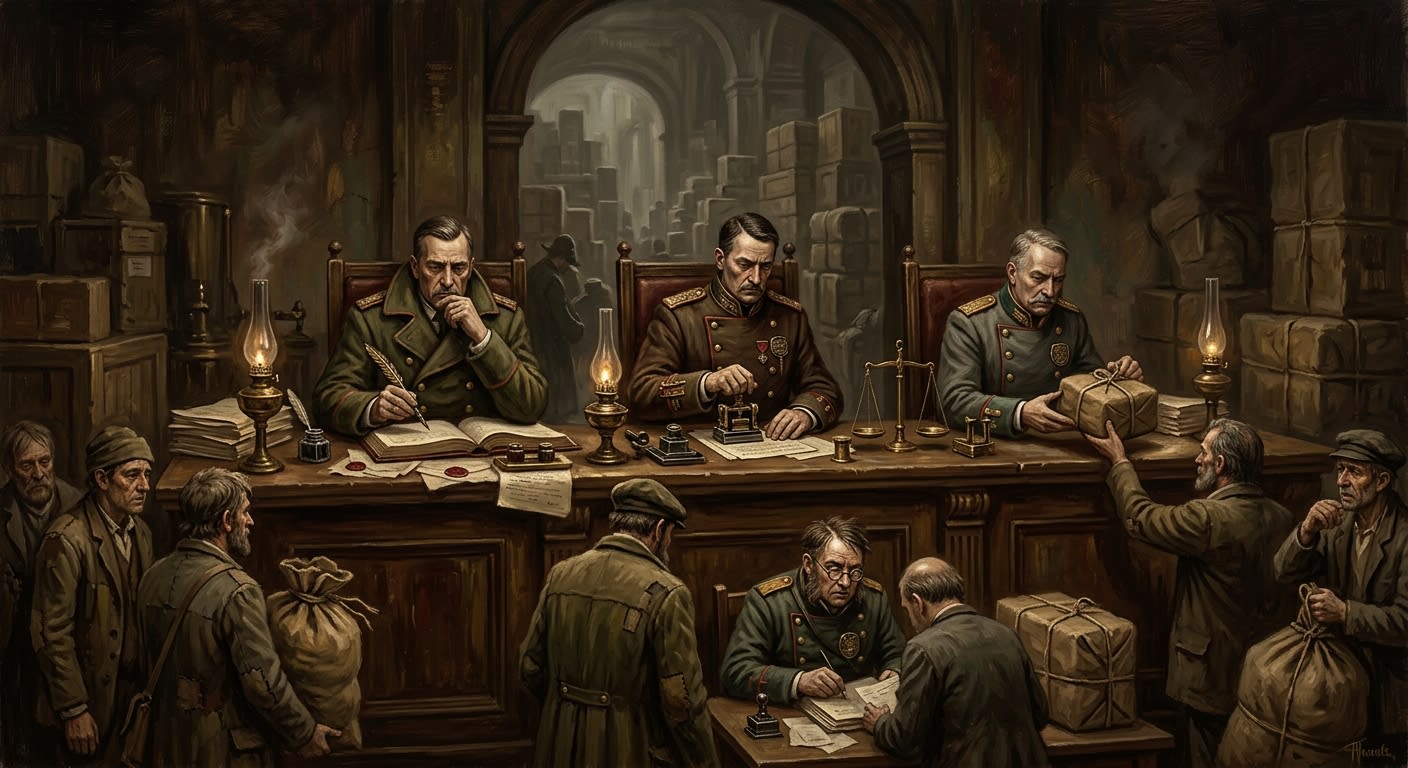
The bench itself carries three surfaces. The left table holds the manifest packets: origin copy, transit copy, seal copy, chapel weighing note, witness ribbon, and all amendments filed by offices seeking either release or advantage. The right table holds precedents, usually chained, because precedent left unchained has been known to migrate into private libraries. The centre surface holds the object in dispute if it can fit, or a token of it if it cannot: one sack, one bottle, one bolt, one wax seal, one rotten apple, one boot from a crate of boots, one piece of glass that everyone pretends is quarry waste until Purity enters the room.
Below the gallery, the warehouse floor remains sealed. Red cord marks disputed cargo. Blue cord marks released cargo awaiting fee reconciliation. Black cord marks condemned cargo. White cord marks sacred cargo whose holiness has become inconvenient. No cord marks cargo that has disappeared. The Court does not discuss missing things until someone files a visibility petition.
Behind the bench sits the Clerk of Motion, whose duty is to announce the docket, time the pleadings, record stays, certify objections, summon weighers, dismiss irrelevant grief, and maintain the little brass bell used when argument descends into personal theology. To the Clerk’s right sits the seal verifier with lens, lamp, wax tray, and a disposition toward suspicion that would be admirable in an inquisitor and exhausting in a spouse. To the left sits the Records witness, making copies of copies so the future may know precisely which office failed first.
#On Jurisdiction, Which Is a Knife Drawer
No Port Court belongs wholly to one Bureau. That would be simple, and simplicity is how heresy sneaks past desks. Commerce governs procedure. Tithes governs assessment. Records governs identity. Pilgrimage claims route-sustaining ration. Settlement claims emergency civic custody. War claims strategic necessity. Relics claims anything with a saintly odour, a suspicious weight, or enough guards to imply holiness. Purity claims jurisdiction whenever contamination, riot, forbidden spellings, demon glass, or civilian impatience enters the file.
The Court survives because no Bureau can win it permanently. It is a sanctioned quarrel, an altar at which offices stab each other with ink and call the bleeding Order. A cargo may be held because Tithes suspects undervaluation, because Records dislikes a place-name, because Commerce requires a fee correction, because Pilgrimage insists a promised convoy share carries devotional priority, because Settlement declares hunger has a registered address, because Purity smells rot and calls it evidence.
Standard Port Court claim categories: tariff identity; seal authenticity; office priority; route promise; adverse condition; origin orthography; emergency release; contamination suspicion; duplicate stamp; condemnation purchase; civic riot exposure. Filed claims must bear bench time, witness mark, fee stamp, and appeal notation unless active gunfire renders ink impractical.
This jurisdictional mess is praised as balance. It is balance in the sense that a cart may be balanced on a cliff edge while everyone argues who owns the wheel. At Varna in A.S. 129, Tithes, Pilgrimage, Settlement, Commerce, Purity, and Records each behaved according to office logic. The grain rotted. Thousands died. The phrase “holy fast” was approved for instruction. If the reader detects villainy, he should be careful; the room contains too many correct men.
At Novi Sad in A.S. 147, two valid seals claimed one cargo. The Court did what Port Courts do: it respected validity until reality filed an objection through famine. The rations balanced in two ledgers and vanished from bowls. Later reform produced duplicate-stamp protocols in A.S. 187 and A.S. 199, because the Synod, when confronted with death by paperwork, reaches instinctively for more paper.
Older bench manuals state: “The Port Court exists to resolve disputes swiftly.”
Amended. The Port Court exists to resolve disputes lawfully. Swiftness is encouraged when compatible with law, fee, seal, precedent, inter-Bureau dignity, appeal rights, and the absence of anyone important being embarrassed.
#On the Manifest Litigant
The Port Court’s priest is the Manifest Litigant, a licensed mouth trained to prosecute the identity of goods until the goods surrender, rot, move, or become precedent. He wears black cuffs, carries the Thirty-Seal Index of Precedent, and can speak for twenty minutes on a diacritic while men below him calculate whether their children can survive until the next ruling.
He has uses. Hate him if you must — I often do, and with real artistry — but do not mistake him for decoration. In a world where false manifests carry demon glass, counterfeit relics, wrong grain, infected oil, and corpses declared machinery, the Litigant’s work preserves the boundary between supply and poison. The tragedy, and the revenue stream, lies in his habit of preserving the boundary after the supply has spoiled.
The profession divides into Purists, Pragmatists, and Shadow Counsel. Purists treat every spelling variant as a breach in the Covenant wall. Pragmatists accept correction fees and move cargo while cargo still possesses hope. Shadow Counsel sell lawful argument to private dirt: smuggling networks, warehouse syndicates, caravan houses, black-market weighers, and merchants whose souls have been audited and found liquid.
The Court tolerates all three because each performs a necessary sin. Purists keep Doctrine from accusing Commerce of laxity. Pragmatists keep ports from burning every Thursday. Shadow Counsel keep smuggling legible enough for the Bureau of Shadows to exploit and Commerce to deny. Remove one faction and the machine limps. Remove all three and goods begin moving by common sense, which no state can survive.
#On Proceedings from Prime to Rot
A typical hearing begins before Prime with intake review. The cargo has arrived overnight. The packets are sorted. The seal verifier inspects wax under lamp. The weigher compares origin weight to arrival weight and pretends evaporation, leakage, theft, and miracle can be distinguished before breakfast. A clerk checks whether the place-name appears in approved forms. A litigant notices that it does not. The stay is born.
By Terce, the first petition has been filed: Sanctity Stay Order, tariff identity challenge, emergency mercy petition, seal autopsy request, route indulgence objection, or adverse condition notice. By Sext, rival claims have attached themselves like leeches. By None, the Court has scheduled argument. By Vespers, the cargo may be released, retariffed, condemned, divided, copied into another docket, or held overnight in the hope that tomorrow’s bench will be staffed by men with fewer enemies.
PORT COURT OBSERVATION, UNDATED TRAINING NOTE If odour becomes evident before legal category is fixed, do not allow crowd proximity to exceed ███ paces. If mothers present children at rail, route through Mercy corridor rather than bench stair. If cargo visibly moves under canvas after condemnation, call Purity before Commerce, unless Commerce has already sold condemnation rights to ██████████.
Seal autopsy is the grand theatre. Wax is warmed, impressions compared, loops measured, undercuts examined, master plates invoked with liturgical solemnity. A false seal condemns cargo. A true seal may also condemn cargo if its truth conflicts with a truer truth filed elsewhere. During the Seal-Forgers’ Winter of A.S. 145, this practice saved whole ports from counterfeit authority and made Manifest Litigants insufferable for two generations. Both outcomes persist.
Condemnation does not end the matter. Condemned goods must be classified, destroyed, sold for salvage, purified, rendered, buried, burned, or preserved for training. A clever warehouse syndicate profits most at this stage. A clever Shadow Counsel arranged the earlier delay. A clever Bureau denies knowledge while accepting the improved quarterly flow.
#On Varna as Scripture and Novi Sad as Arithmetic
Every Port Court annex teaches two wounds.
The Ledgers of Varna teach velocity failure. A grain fleet arrived sound in A.S. 129. The manifests carried inconsistencies: spellings, categories, office promises, holy destinations. Litigants filed. Bureaus claimed. Heat entered the holds. The Court preserved the argument while the grain became a sermon in rot. When citizens moved toward bread, Purity supplied the only swift ruling of the affair.
The Stamp War of Novi Sad teaches precision failure. Two inspectors stamped the same cargo. Both seals were valid. Both offices had standing. The Court respected both truths until the cargo existed twice in law and insufficiently in matter. Citizens arrived with correct slips. Soldiers arrived with correct orders. The warehouse possessed fewer sacks than correctness required.
Trainees are asked to locate the error. The stupid ones blame a clerk. The sentimental ones blame hunger. The ambitious ones say the record shows lawful process under adverse conditions. The dangerous ones count the sacks. Those are watched. Some are promoted into Pragmatist practice. Some become Mercy Weighers. Some disappear into Records, where the Bureau may admire them safely in drawers.
The approved examination answer after Varna remains obscene in its clarity. What was lost? Grain, civic quiet, and persons of disputed riot classification. What was preserved? Tariff integrity. That answer passes because it is true. The Synod rarely lies when the truth is uglier.
#On Corruption That Keeps the Peace
Shadow Counsel are the Court’s basement conscience, assuming basements may be paid in coin and information. They file correct petitions for wrong patrons. They hold rival cargo so a warehouse syndicate may profit. They prepare safe spellings for contraband. They create condemnation exits, cooling delays, white filings, Vellum cuts, and every other small legal incision by which a private hand may move public procedure.
Commerce condemns them in memoranda and thanks them in statistics. The Bureau of Shadows watches them, buys them, burns them, and classifies the ash. Purity hates them when cameras exist and uses them when raids require timing. Doctrine, noble Doctrine, whose stylistic excellence is exceeded only by my own, calls the matter regrettable and files the word under active review.
The citizen imagines corruption as a gate opening in the night. In Port Court practice, corruption often closes the gate, delays the gate, questions the spelling of the gate, sells the rival key, condemns the hinge as adverse metal, and invoices the man waiting outside for obstruction. This is why Shadow Counsel are difficult to prosecute. Their arguments are valid. Their clients are filthy. The law, that prim old aunt, refuses to notice whose perfume is on the petition.
#On the Present Condition
As of A.S. 201, Port Courts operate from the deep heartland to Zone Five margins, wherever goods cross from one custody to another and the Synod fears that matter may outrun permission. They are strongest in Marseille, Genoa, Varna, Thessaloniki, Warsaw, Latchford Permit-Yards, Saffron Bastion, and the inland tariff yards whose names never reach sermons because sermons prefer sin with scenery.
Their caseload has worsened. War supply strains every bench. Refugee movement brings unsorted goods and desperate claims. Demon-glass contraband multiplies under innocent names. Northern cargo carries Grey-water rumours, southern cargo carries songs from under harbours, eastern cargo carries seals from dead offices, and western cargo carries merchants who believe profit should be treated as a sacrament because they have paid for excellent candles.
Reform has been proposed. Time caps. Emergency release authority. Mercy override. Physical count supremacy. Duplicate-stamp suspension. Public odour thresholds. Mandatory bread-before-briefing provisions. Each proposal enters committee, acquires exceptions, grows fee limbs, and returns as a form sharp enough to injure the hand that signs it.
The Port Court remains. It remains because the Synod cannot feed the Line without manifests, cannot tax the ports without classifications, cannot prevent poison without inspection, cannot prevent theft without seals, and cannot move anything at scale without occasionally allowing a robed expert to ask whether the word “grain” has been properly earned.