
#On the Harbour That Starved in Sight of Bread
“Better grain rot than loyalty decay.” — Operating handbook issued to licensed Manifest Litigants, Port Court training annex.
The Ledgers of Varna were written in A.S. 129, in the harbour of the Ashen Redoubt of Varna (Unregistered), when a grain fleet arrived sound, dry, weighed, witnessed, sealed, and blessed, and the city starved while clerks argued over what rate of holiness applied to wheat.
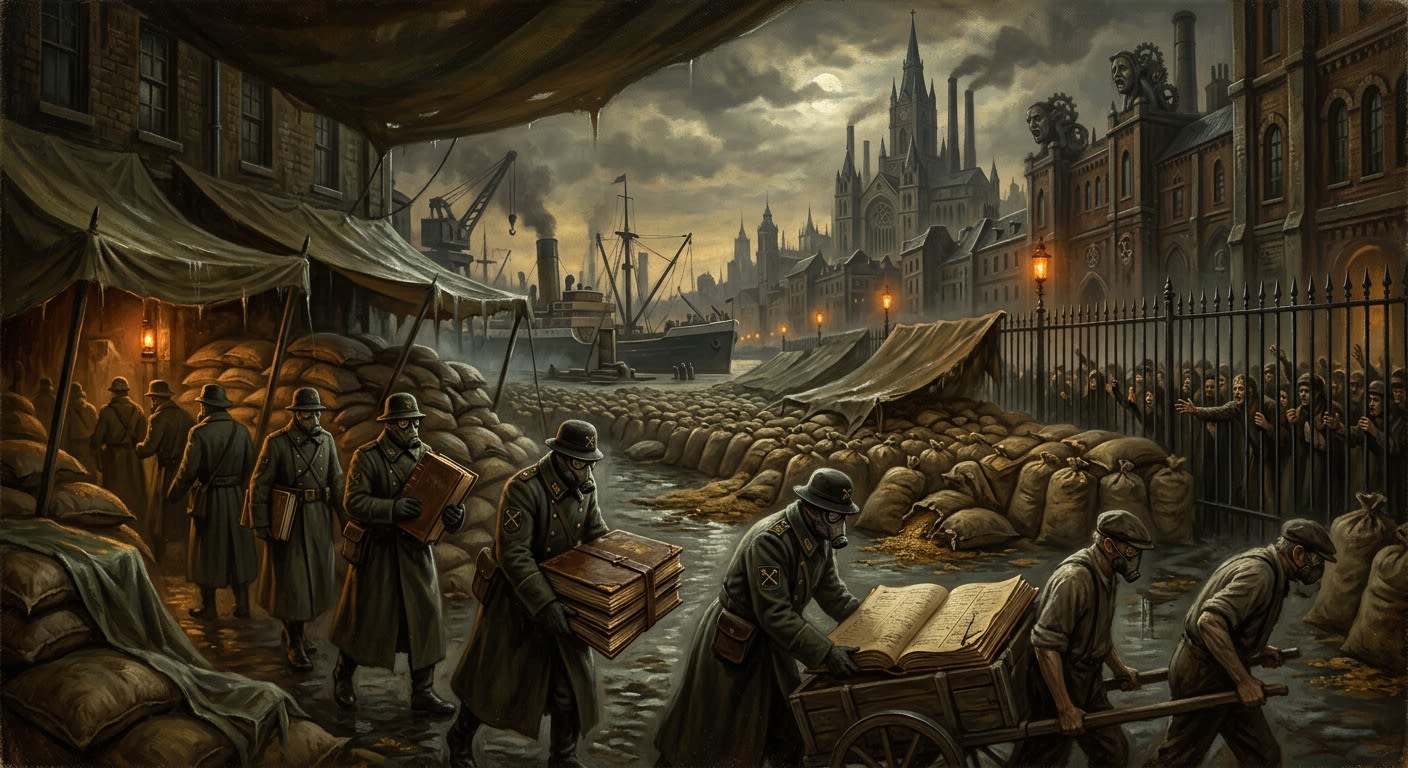
This is the cleanest kind of Synodal death. No demon tore the sacks. No enemy burned the hulls. No tempest took the convoy, no plague entered the hold, no serpent rose from the Black Sea to eat the pier. The grain lay there under canvas. The people could see it. They could smell it warming. Children pressed their faces against the harbour rail and learned, earlier than theology usually prefers, that bread may be present without being available.
Varna's later reputation belongs to demon glass, drowned reflections, and the public theatre of the Mirror Riot (Unregistered). The earlier wound is drier, duller, and more useful in court. A monster teaches fear. A ledger teaches obedience. Fear fades. Obedience keeps receipts.
#On the Fleet and Its Offending Names
The fleet came out of the Anatolian and Aegean supply circuit under escort, a convoy season's worth of rations intended for three zones. The holds were dry. The sacks were clean. The scales had been calibrated at departure and checked at sea by a tariff-chapel weigher whose certificate was, at that hour, still respected by men with salaries. Sixty-three vessels appear in the instructional version. Sixty-one appear in the correction. Both counts are preserved because Records possesses the rare courage to contradict itself without blinking.
The manifests were drafted under field conditions by scribes who had learned their letters in three schools, under two bell schedules, while artillery occasionally made punctuation exciting. The colonel named in the transport orders appears in three spellings. A coastal parish is rendered with an old Greek ending in one packet and a Latinised one in another. A tithe category alternates between grain-for-war, grain-for-pilgrimage, and emergency sustenance under contested ecclesiastical custody. Any one inconsistency might have been cured at the chapel desk. Three Bureaus smelled jurisdiction. The cure became a feast for knives.
The Bureau of Tithes claimed the cargo as taxable strategic grain. Pilgrimage claimed it as route-sustaining ration, since pilgrim convoys had been promised shares once the fleet cleared. Settlement claimed emergency civic custody because Varna's refugee registers had swollen past tolerable arithmetic. Commerce claimed only procedure, which is to say Commerce claimed the table on which everyone else would bleed.
Two Litigant houses filed separate Sanctity Stay Orders (Unregistered) before noon. The first challenged the tariff identity of the cargo. The second challenged the competence of the first challenge, a move so vile and so correct that even I must bow slightly. By second bell, the port court had barred release until the manifests could be harmonised. By evening, the harbour had more guards than gulls.
#On the Nineteen Days
The first three days belonged to ordinary delay: copying, countersigning, witness summons, scale re-attestation, and the solemn movement of paper between desks by young men who wished to look indispensable while walking quickly. On the fourth day, heat entered the lower holds. On the sixth, dockhands reported a sweet smell. On the seventh, the Purist Litigants argued that the smell proved the cargo had changed category from sustenance to condemned organic matter, and that release would constitute retroactive misclassification.
HARBOUR WATCH ENTRY — DAY NINE Civilian crowd at west rail estimated ███. Children lifted to see sacks. Odour visible in flies. Petition presented by mothers' delegation requesting emergency ration cut from disputed cargo. Petition denied pending jurisdictional clarity. First stones thrown after third denial. Names of delegation sealed under riot-contagion protocol.
Day ten produced rival chapel opinions. Day eleven produced a Tithes memorandum arguing that rotted grain still owed assessment because taxable value attaches at arrival. Day twelve produced a Pilgrimage objection that the holiness of intended use survived material decay. Day thirteen produced a Settlement counterclaim that citizens could not spiritually fast unless Settlement first confirmed their residency class. Day fourteen produced three dead clerks in an alley and an anonymous placard reading, in competent harbour script, WE CAN SMELL YOUR LAW.
Purity arrived on day fifteen.
The holds were opened for inspection under armed supervision. Grain near the hatch had clumped. Grain below had heated, sweated, softened, and bloomed with rot. The dockside air became a sermon no Bureau wished to hear. The crowd surged at the third warehouse gate. Wardens broke the first line with staves. Purity fired at the second. Bodies fell from the pier into the harbour, and the water received them with more efficiency than the port court had shown the wheat.
#On the Holy Fast
The condemnation order came before the riot tally. This is important. The cargo was declared unfit for consumption, its manifests closed under adverse condition, its tariff status preserved for training use. The Litigant houses received partial payment because their cases concluded with cargo condemnation rather than release, and condemnation is a valid outcome. A man may starve outside the court, but the docket must be fed.
The Bureau of Records entered the event as a voluntary holy fast. The language has acquired varnish since A.S. 129, but the first phrasing remains in the archive: “Civic abstention from compromised grain, undertaken beneath corrective authority.” I have seen altar plaques less devout than that sentence and fewer knives in butcher stalls.
Early instructional summaries called the Varna abstention “popularly accepted.”
Corrected. Popular acceptance was inferred from the absence of further petition after the volley. Dead petitioners produce admirably tidy civic consent.
Tithes declared all calculations correct. Pilgrimage preserved its claim for future ration convoys. Settlement amended Varna's civilian rolls to distinguish registered hunger from riot-adjacent hunger, a distinction later used to deny compensation to families whose dead had been nearer the harbour than their assigned district permitted. Commerce filed the case under velocity failure, a term that means the machine moved too slowly for flesh. Machines are never punished for this. Flesh is expected to adjust.
#On the Ledgers Themselves
There are three ledgers. There is the Harbour Ledger, stained with mould at the lower corner, listing arrivals, berth assignments, inspection times, and the first count of ships. There is the Tariff Ledger (Unregistered), cleaner, colder, with columns for rate, exemption, bureau claim, and adverse condition. There is the Riot Ledger (Unregistered), locked under Purity custody, whose pagination does not agree with its index and whose casualty count changes depending on whether one includes bodies recovered from the harbour after sunset.
Together they form the case. Separately they acquit everyone.
That is why the Ledgers of Varna became holy text for Commerce Clerk training doctrine and a cautionary plate for Manifest Litigants. The Commerce Clerk learns that tariff clarity must accelerate before meat fails. The Litigant learns something more profitable: a delay that kills cargo may still produce fees if the docket closes correctly. The Bureau pretends these lessons oppose each other. They sit in the same classroom.
The event also strengthened Saint Vellum's cult by proximity. Manifest men began invoking the Narrow Line against “Varna confusion,” as though a saint of disputed manifests could bless the difference between a curable name and a lethal stay. By A.S. 145, after the Seal-Forgers' Winter, the same practitioners would cut wax with black knives and call the action autopsy. Varna gave them the appetite. Winter gave them teeth.
#On the Present Instruction
Every port-court training annex keeps a Varna copy. Students are shown the three spellings of the colonel's name, the disputed tariff categories, the nineteen-day sequence, the condensation marks on the hold inspection sheet, the Purity volley notation, and the final declaration of fast. They are asked where the error occurred. The clever ones say day one. The pious ones say the crowd erred by impatience. The promoted ones say the record shows no error, only lessons.
The harbour still smells wrong in warm weather, according to sailors who drink enough to speak accurately. Varna has suffered louder incidents since: glass in the harbour, songs without mouths, Pride (Unregistered)'s golden masks in civic halls. The Ledgers remain the city's most perfect atrocity because they required no miracle. A fleet arrived. Men argued. Grain rotted. The hungry moved toward bread. The Bureau moved faster then.