

#On the Fortress and Its Province
Stolnaya was a fortress in Thrace, and the archive calls it proud. I keep the adjective because it is the only one the record gives me. The Codex holds nothing I am prepared to seal concerning its builders, its lords, its charter or its garrison roll. A fortress can be dead without a biography.
Thrace is the fallen country north and west of Bastion-Constantinople, east of the southern reach of the Sagittal Line. The Sundering broke it into Maldrake's furnace-shadow. Its plains were grainland once and its forests were timber. The province now contains or borders the Iron Wastes, where the ground runs to glass and the air is unfit for lungs. Somewhere in that province a fortress lies under permafrost. The record gives me no river, road or pass to fix it by, and I have put none on the map.
So there is ice in the domain of Wrath. Any cartographer who set a snow-sign among the Bureau's red hatching would be asked whether he had mislaid his spectacles. In this one case he would be correct, and he would still be reprimanded for it.
Masons build against a known list of insults: the ram, the mine, the bombard, famine, treachery and plague in the cistern. They put a price on each one. Stolnaya was attacked through a quantity its masons had never been asked to price, which was the year.
#On the Two Winters
The besiegers were Maldrake's Wrathforged. The account names no captain among them, no regiment and no engine, and nothing here supplies one. The Lore Book says they came "not with engines but with time itself." Sorcery gnawed a hole in the calendar, and winter came through it twice.
Consider what a garrison depends on. A fortress lives by its almanac. Fuel is cut for one winter. Grain is laid in against one winter. The surgeon judges which of the old and the sick will see one more spring. The almanac is the oldest compact a garrison keeps, older than any oath to a prince, and at Stolnaya it was revoked without notice. Whatever came between the two winters is missing from the record. Perhaps there was a thaw, a false spring, or no interval at all. I will not invent a spring for the people of Stolnaya after the Wrathforged took theirs.
The second winter was harsher than the first. That is the record's wording, and it is enough. Each winter took infants from the womb. The archive gives no count of pregnancies and no names of mothers. It does not say whether the cold, the hunger or the sorcery itself did the taking, and I keep to the limits of the sentence. These children would have been carried to the font and entered in a baptismal roll. They were entered nowhere.
By the second winter, no defenders remained alive. That sentence also comes from the archive, and I preserve its edges. It speaks of defenders. Whoever else lived inside those walls, whether wives, farriers, clerks or children already born, the record does not count, and I will not count them for it. The Bureau of Records prefers a complete casualty return. It has been given an incomplete one and must make do. So must I.
Then the gates opened, and the account is exact about this. They opened to snow. No storming party is recorded and no herald, and no keys were surrendered on a cushion. The Wrathforged are not recorded as entering at all. If Stolnaya was taken, the weather took it.
#On What Remains
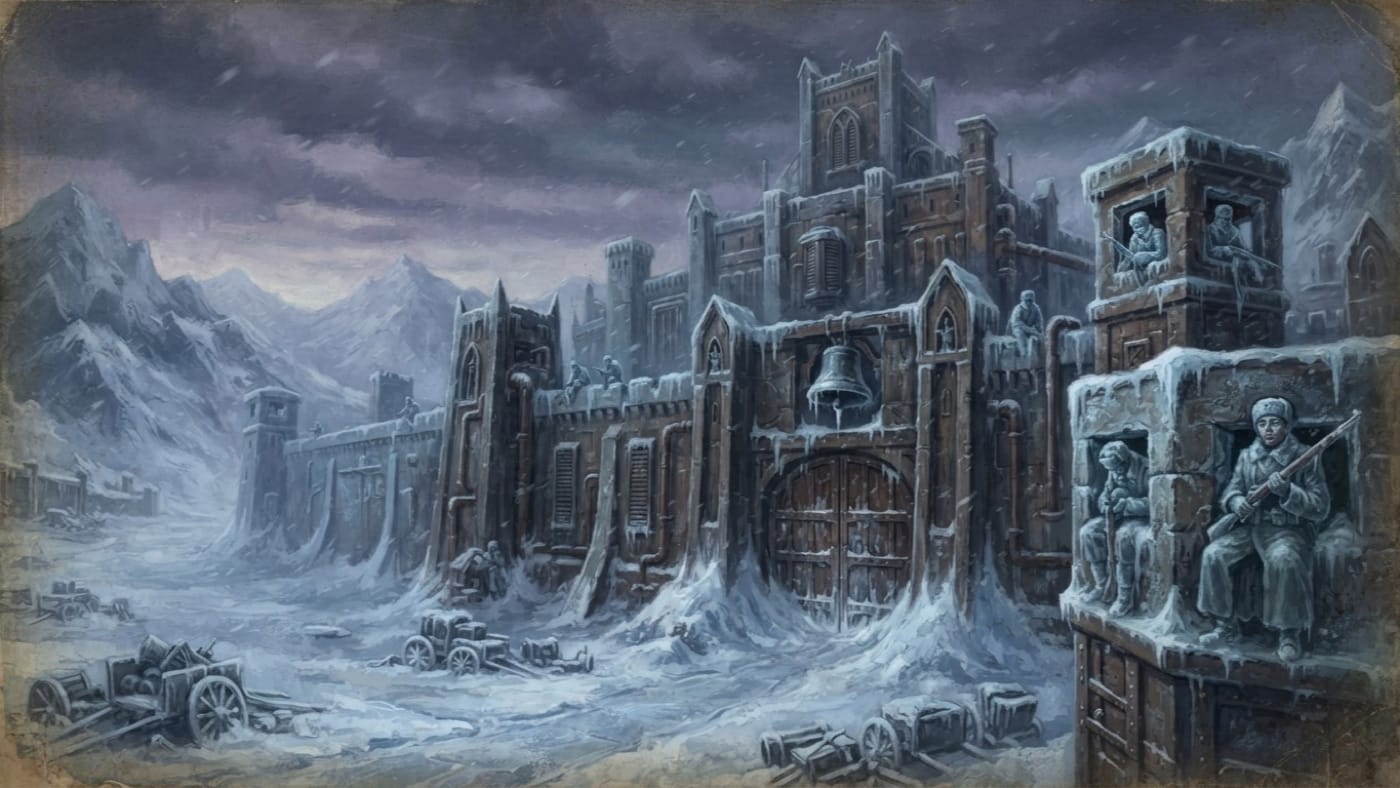
Stolnaya lies buried in permafrost. Its bells are frozen mid-peal. Its wardens are preserved like flies in ice.
I take the phrases one at a time, as a notary reads a will. Mid-peal means the ringing was stopped between one stroke and the next, so that the bells were caught in their office and never finished it. No file I can open reports that anyone has heard them since. I do not expect such a report, and I would distrust it if it came.
The wardens are dead. I write the word plainly because the image invites sentiment: the faithful sentry still at his loophole, eyes open beneath the glaze, waiting to be relieved. He is waiting for nothing. The account preserves bodies. It records no breath, no ghost and no vigil continuing under the ice. A reader who adds one may keep it in his private devotions and out of my folio.
The entry is filed as the Collapse of Stolnaya, and the word needs auditing. What collapsed was the garrison, along with the calendar's arithmetic and the conditions under which people can live behind a wall. The record does not say whether any curtain-wall fell. Permafrost is a jealous mortar, and the stones of Stolnaya may be better held than any others in Thrace.
No recovery appears in the files. Neither does any expedition, salvage claim, thaw or return of the bells to service.
#On the Expenditure of Creation
Here the fortress passes into doctrine. The Bureau of Doctrine has taken possession of it much as the ice did, completely and without consulting the occupants.
Synodal teaching on miracles and sorcery turns on the question of who pays. A miracle of the Creator, sanctioned and entered in the ledger, takes its price from the bodies of the faithful who call on it. They pay in hunger, sleep, memory and years, and the world is left standing. Sorcery, the counterfeit art of the Great Deceiver, takes its price from the world instead. Soil sours, boundaries wander and names come loose from the people who bore them. Doctrine ranks these thefts on a ladder. On one of its upper rungs time becomes debtor's coin, and winter falls twice in a year.
Stolnaya is the name attached to that rung.
Consider the bookkeeping. In a Cathedral Act, choirs who consented give up years of their own lives, and the debit is entered against their names. At Stolnaya the enemy spent a year that belonged to everyone at once: the field, the fortress, the unborn and the snow itself. The cost was charged to Creation and collected from the people inside the walls. None of them had volunteered. The sanctioned ladder is cruel, but it keeps an account. The sorcerous one charged Stolnaya without leaving any record of the charge.
The entry On the Price of the Lie described Stolnaya's wardens as "preserved like insects in amber."
Corrected to agree with the Lore Book, II.C: preserved like flies in ice. Amber is resin and takes centuries. Stolnaya's medium was the winter, and it needed only two.
The military reading is my own deduction, made from the account and not from any standing order. A wall is a wager that the attacker must come to it. The Wrathforged refused the wager. They had no need to breach Stolnaya. They changed the conditions under which a garrison can endure, then waited while the garrison stopped enduring. Stone is proof against men and their engines. It was no defence against a second winter.
Heat is the established instrument of Maldrake. Doctrine records his Forge Evocations as rage hammered into spell-form: slag-storms, heat in the air like a hammer, sanctuaries in which priests were boiled. It assigns the languid hour to Syrion and the Somnolent Aether, under which patrols sleep in mid-step and time slows to a crawl. Stolnaya's year was doubled. The record says Wrathforged, and I leave the attribution where the record put it. Wrath wants its enemy destroyed and has never been particular about the tool.
There is one more entry I am obliged to make. The Church's own discipline against Wrath tells its soldiers to use cold water, ice and snow to slow the heart and cool the fury. At Stolnaya the enemy gave the defenders the remedy in a dose no one could survive.
#On the Present Condition
Stolnaya remains under permafrost. No thaw has been recorded. The bells have not finished their stroke, and the wardens have not left their posts, in the only sense of that phrase still open to them. The Codex lists the place as Thracian, fallen and frozen. It gives no date for the Collapse, because the archive supplies none. I refuse to borrow one from the Sundering or from any campaign that happens to be nearby. Borrowed dates have a way of becoming established ones.
Province: Thrace. Besiegers: the Wrathforged of Maldrake. Means: the calendar. Living defenders: none.