

#On the Name
"Wrathforged — Epithet for Maldrake and his hosts; implies the world is their anvil." — the Lore Book, glossary entry, complete
The glossary entry assigns the word to two owners and then stops. Soldiers on the southern reach of the Line call Maldrake the Wrathforged, and in the same breath they give the name to everything that comes off the Thracian Plain behind him. The entry on the Sin-General has already ruled that the second usage names neither a second demon nor a single species. I concur, with the irritation proper to a man asked to concur with his own filing.
This entry concerns the second owner. The word records provenance, in the way a gunner calls a shell "Liège" without believing it was born there. It covers burned men, made demons and captured guns that have learned to walk. Taken together, it means whatever the forges of the Iron Wastes send forward once the cheap work is done. The cheap work has its own folio. Ash-Fodder are unarmoured captives, driven at our rifles so that the rifles are empty when this entry's subject arrives. Readers of that folio will remember the phrase "the real soldiers." These are they.
#On What the Forges Send
Recruits ask what a Wrathforged looks like. The honest answer is a list, and the list has no common entry except heat.
Ember-Soldiers make up the rank and file, and every one of them was a man once. The road there begins with a real wrong: a ration stolen by a quartermaster, a son taken by a quota that should never have reached him, a village burned by the side sworn to protect it. Strength is offered. The strength works and the wrong is avenged, but the anger stays after its cause has gone. Habit follows the anger, and the body follows the habit. The hands lock. The scars stay warm. In time metal comes up through the skin, and the weapon grows into the fist that once held it. Doctrine teaches that the will survives the transformation and that corruption can in principle be reversed. The Church executes the transformed regardless. That is a policy. It proves nothing about the metaphysics, and the executioners are not examined on the metaphysics.
The Crucible-Born came out of the Crucible Cities changed and still themselves. They keep intelligence, personality and fragments of memory. They are devoted, and some of them asked for it. The record disagrees over how long the Crucible takes and how much of a man it leaves behind, and I decline to set a standard term for a process the Church has never observed from the inside. What matters at the wall is that they can plan, and they can wait.
The Hammered were made in the Eternal Forges. They were never corrupted, because there was never anything to corrupt. There is no human remainder in them for a chaplain to address, and the chaplains who have tried are entered in the Book of Departures.
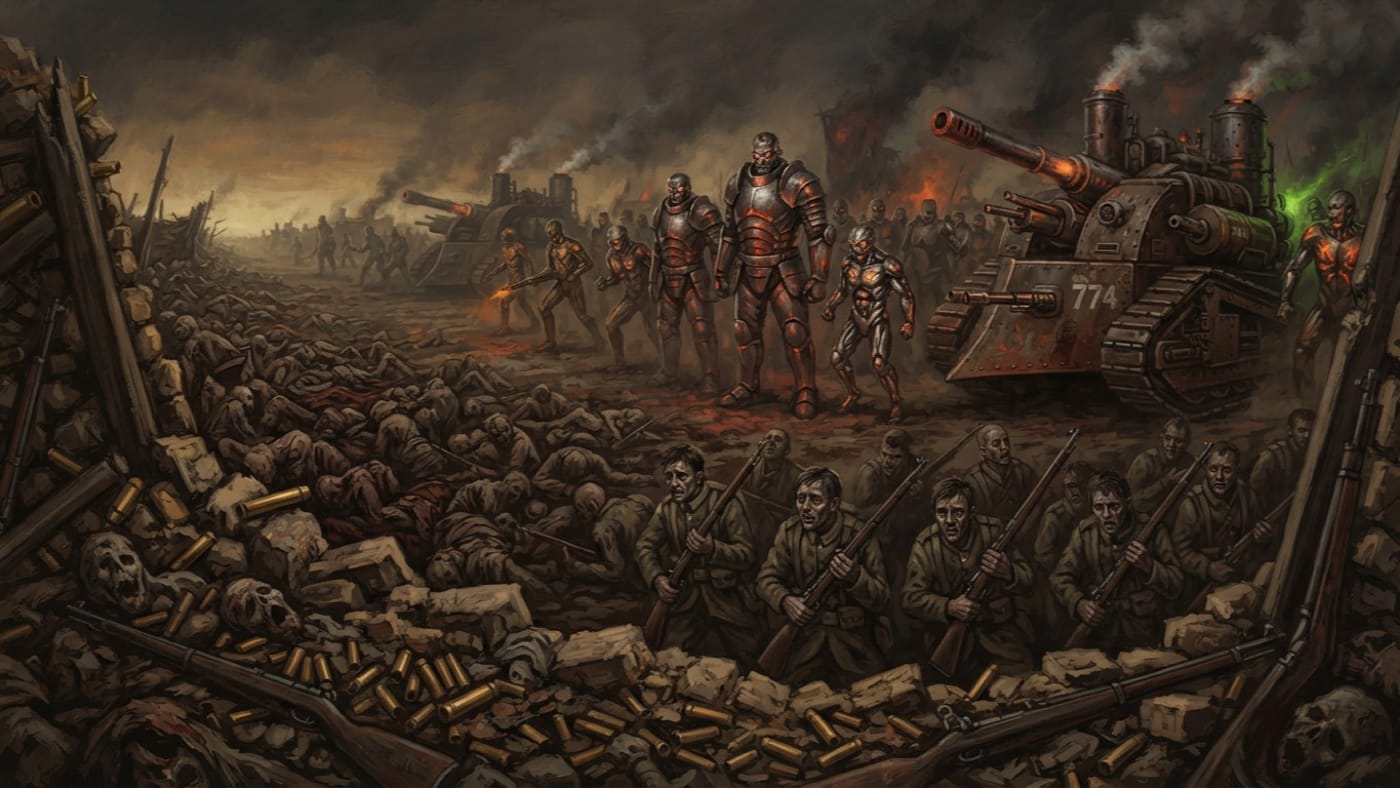
Forge-Beasts were ours. They were Synodal guns, carriages and engines, captured and animated through corruption, often with the crews still fused into the controls. A Forge-Beast may come at a bastion with a regimental number still legible on its flank. Demons do not understand machinery. They understand the violence packed inside it, and they let that out.
The named troop entries add particular violence to particular bodies. Inferno Brutes swing molten iron mauls. The Hellbow Legion looses slag-bolts that burst on impact. Pyre-Smiths brand their allies with burning runes, and a branded ally that is killed detonates. Only the branded detonate. A soldier who expects every Wrathforged to explode watches the wrong thing, and a soldier who expects every one to carry a hammer is surprised by the slag. The Flameheart Colossus is singular, stationary by its last record, and has its own folio.
#On the Spent Advance
The Lore Book calls Maldrake's campaigns sieges of exhaustion. It is the most accurate thing the Lore Book says about him.
Ash-Fodder go first. They draw fire, and every cartridge spent on a starving farmer is one that cannot be spent on plate. The Shield-Paladins lock against the press until their arms shake. The dead pile up in the ditch until the ground is bodies, and footing is lost for both sides. That favours the side whose assault troops have not yet stood in the ditch.
Meanwhile the Wrathforged wait. They are fed. They are rested. Their plate is hot, but they have not yet swung a maul or worn a joint. The withholding is the whole proof of command. A mob of berserkers cannot sit out ten days of other people's dying and then advance in order at the hour the arithmetic arrives. The host is violent, and that violence is directed. Chroniclers who describe it as a rabble have never stood in front of it, or else they stood in front of it once.
An account attributed to Ordinal Valtrix, the Gray Tide at Metz, records the same pattern with a different instrument. There a line of Thralls ten thousand deep walked silently into cannon fire and fell into a bridge, and hammer-hosts crossed it. Thralls are branded and directed, and the Legions of Sin keep them in a separate category from the Ash-Fodder. The account carries no date and I supply none. The bodies differ, but the purpose of the method holds. Somebody else's death clears the way for the armour.
#On Rostov
The received Bureau account of the Siege of Rostov, A.S. 153 / 1863 CE, is the cleanest demonstration of the doctrine in the files. For eleven days Maldrake's host spent Ash-Fodder against a Covenant garrison of six hundred. The Bureau of War estimates the expenditure at approximately ninety thousand. Barrels overheated. Bayonets replaced fire, and then furniture and iron railing replaced bayonets. By the end the defenders stood on a barricade of enemy dead and had almost nothing left to load.
Then the waves stopped.
The silence lasted forty minutes. Whatever the garrison did with it, it could not get back eleven days of sleep or rifle-steel. After the silence came the Wrathforged, rested, in order, with heat in their plate. Rostov fell in two hours.
The ratio is one hundred and fifty to one. It is quoted in every lecture hall west of Strasbourg and it is almost always misread. One hundred and fifty to one compares the Ash-Fodder spent with the garrison that spent them. The Wrathforged are not in it. The abstract gives no strength for the echelon that took the town and no figure for its losses. It does not record whether there were any losses. The forty minutes and the two hours are the only measurements of that host the file has.
I have read lecturers who credit Rostov to hatred. The Ash-Fodder walked into the guns without hatred, because what stood behind them was worse. Hatred arrived at the end, on schedule. It was the one part of the host that had nothing to prove.
#On the Limits of the Register
A collective name invites a collective method, and the archive refuses to supply one.
The Collapse of Stolnaya is recorded against Maldrake's Wrathforged. The fortress lay in Thrace. Its site is unrecorded and so is the year of its fall. The account names no engine and no assault. The besiegers made winter come twice, each time harsher, and by the second winter none of the defenders were alive. The gates opened to snow.
That method looks nothing like the maul at Rostov. A reader with a tidy mind will reach for an explanation, perhaps a borrowed sorcery or a loaned ally from the fog country, and I will not hand him one. The record says Wrathforged, so the attribution stays where the record put it. The word tells you whose host it was. It does not tell you what the host will do next. A garrison commander who reads "Wrathforged" in a dispatch and prepares only for heat has made an assumption the archive does not support.
#On the Defences and the Present Condition
The Church issues two kinds of defence, and they answer two different questions.
The first kind protects a soldier from becoming the thing in the list above. Command discipline forbids violence without orders. Cooling rituals of cold water and slow breathing are prescribed before and after engagements. Rage fasts impose periods of complete non-violence, confession is offered for violent thoughts, and the Doctrine of Cool Hatred asks a man to kill demons out of duty rather than feeling. These help with small tempers. They are weaker against deep grievances, especially true ones. None of them turns aside a slag-bolt.
The second kind is Rostov's doctrinal legacy: larger ammunition reserves, faster rotation of rifle sections, and garrisons trained and stocked for prolonged fighting instead of three days of ordinary action. Each of these measures moves the forty-minute silence further off. None of them cancels it. A bastion that cannot be emptied in eleven days may be emptied in twenty, and the echelon behind the screen does not mind waiting.
The southern-front register states that Maldrake has made fourteen confirmed breaches of the Line "since A.S. 40."
Corrected to A.S. 45, the year Maldrake emerged at the Sundering. A count that begins five years before he existed counts nothing. The figure belongs to Maldrake's campaign record against Bastion-Constantinople and the Line. It is not the battle honours of any Wrathforged formation, and it says nothing about when any class of troop first took the field.
As of A.S. 201 / 1911 CE the forges of the Wastes are working. The Forge-Pyre Bastion has not been entered or measured by any Synodal officer. The host still comes down the Plain in campaigns, and the captives still go ahead of it. The Shadow Court has not run short of either.