

#On the Waterline
"The river forgets; Records remembers." — Rheinscarp proverb
This plate records the Sump Docks as the survey of A.S. 201 (1911 CE) found them. It describes their present condition and nothing more. The Bureau holds no year in which the first barge was made fast here. It has no count of the people who sleep here and no measured line where the district ends. I have looked for all three, and I will not invent any of them.
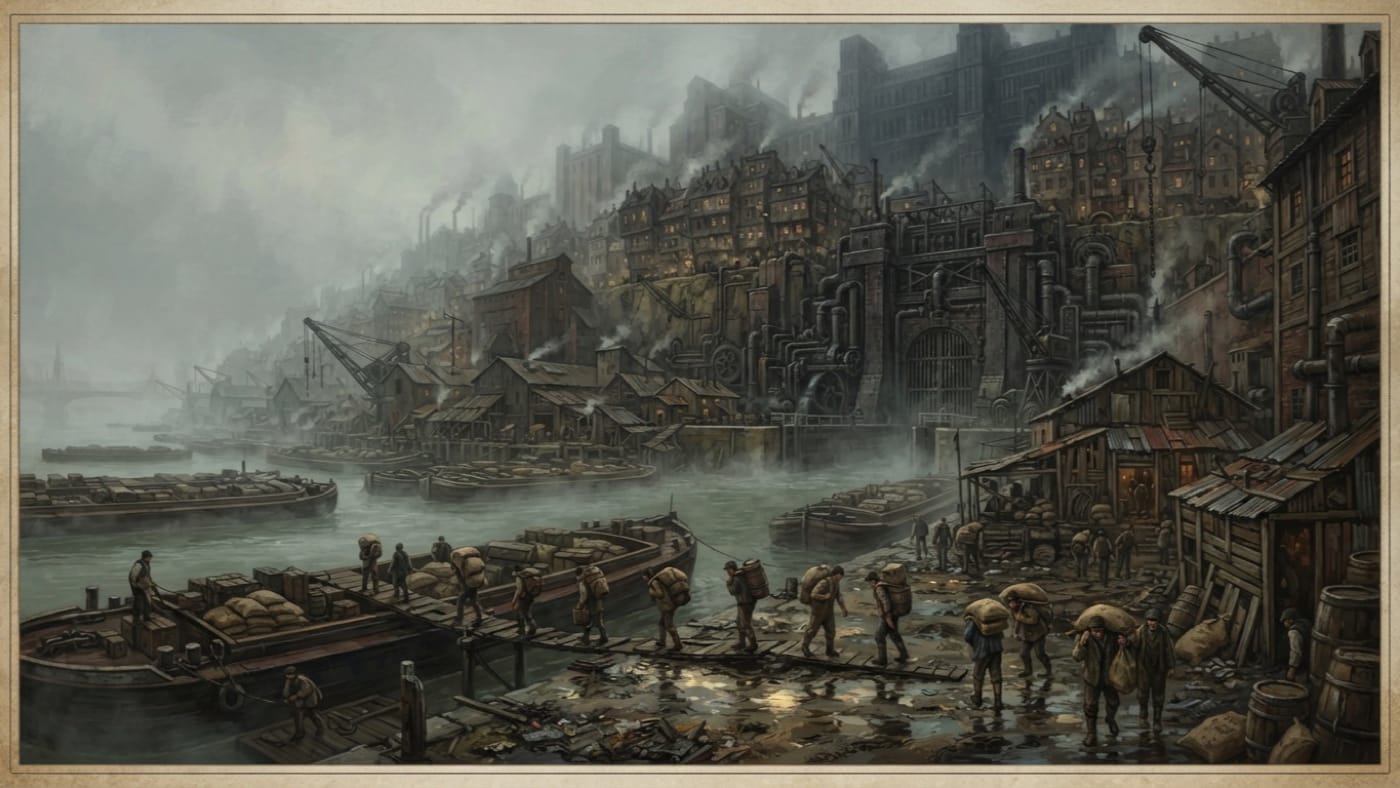
The Sump Docks are the lowest of the nine districts of Rheinscarp, and the only one with its feet in the Rhine. The district consists of river intake, barge yards and silt flats. Hulls come in low and heavy, lie against the yards while the haulers empty them, and go out riding high and empty. Past the yards are the flats, grey and glistening at low water. They take the print of every boot and keep none of them. Tar and rot-brine scent the yards. Rot-brine is the sour liquor that collects wherever river water stands too long in timber, rope and sacking. Silt covers everything below the tide-mark and most things above it.
Above all of this the city climbs. A hauler who straightens up under a sack sees four things stacked in order: the iron of the Lockmouth Works, the lanes of the First Step Market, the flour haze of the mills, and then fog. Haulers do not stand straight for long. The view costs nothing, and at the waterline nothing else is free.
#On What Comes Ashore
Five cargoes define the yards: grain, salt, wax, fuel and paper stock. Other freight comes too. These five are the ones the city cannot do without.
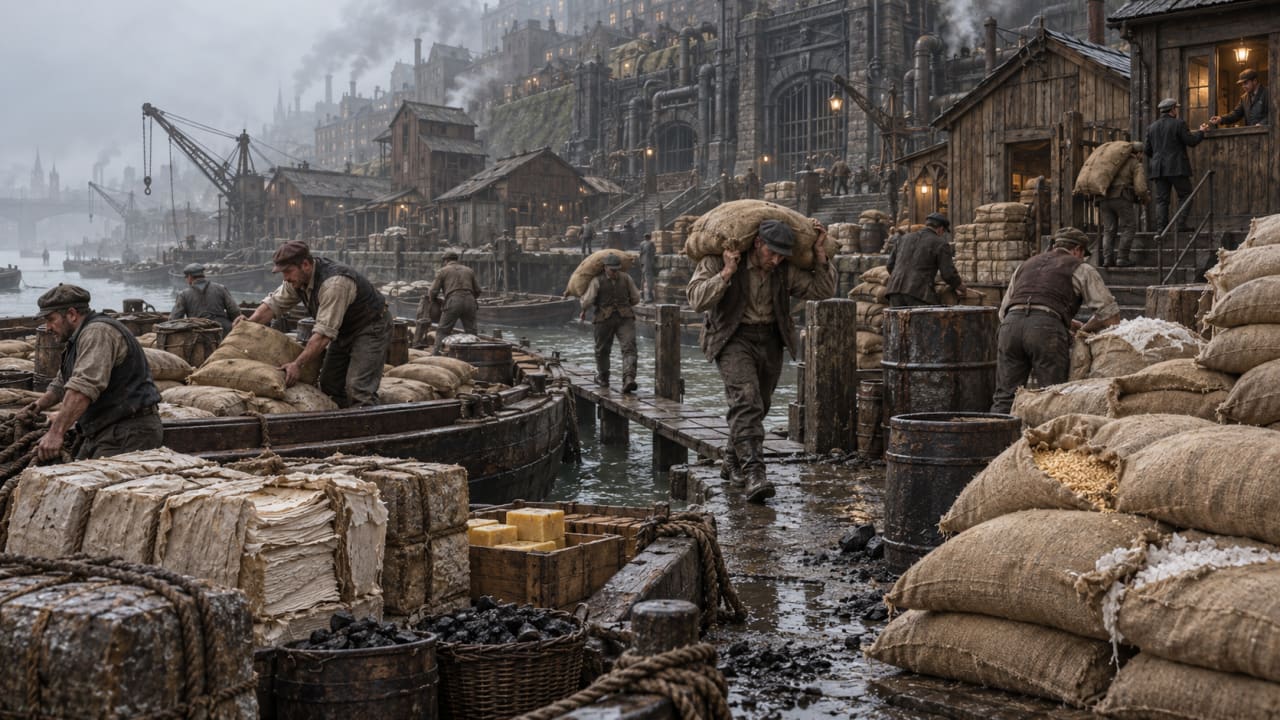
Grain wins every argument. It goes up to the ration mills of the Mill-Crown Terraces and returns as flour and ration chits. Then it leaves Rheinscarp again in convoys scheduled toward the Sagittal Line, which lies far beyond these quiet heartland terraces and consumes whatever the heartlands send it. Salt comes ashore by the sack. By the time it reaches the upper terraces it is counted a luxury, and the men who carried it eat their black bread without it. Fuel feeds the lamps and furnaces above. Wax goes to the seals. Paper stock goes to the Ledger Cloister and to every counting-house and stall that issues a receipt, which in Rheinscarp means every counting-house and every stall.
The yards therefore unload the paper on which their own residents will later be misspelled, and the wax that will seal the misspelling. They handle both with the same wet rope.
Barge haulers do the work. They warp hulls in and out, break the lading out of the holds, and stack it on ground that has shifted again by the next flood season. The survey names no crane, berth or warehouse, and I name none. It records backs, rope and silt, and on those it is generous.
The river admits nothing without Lockmouth's leave. The canalized inlet locks and harbour-control grates of the Works stand on the next shelf up and govern when river traffic passes. A barge held at the grates cannot be unloaded, so a shift goes uncredited and a hauler goes home with nothing to show for the bell. The survey records clearance at the locks and intake at the yards. It does not record how the water is arranged between the two, and I decline to draw that hydraulics for it. The Lockmouth cargo seal clears hull and lading at the river locks and carries nobody up a single stair. The two districts share the river, the damp and the Brotherhood. They keep separate shelves and separate permissions, and correspondence that merges them will be returned.
The parent plate states that "everything enters Rheinscarp through the Sump Docks."
Corrected. Everything the river brings enters through the Sump Docks. The east road enters by the Stamp Gate, and a rarely used rail spur brings munitions. The docks may keep the boast for river cargo, which is most of what the city eats.
#On the Price of Leaving the Docks
"Pay once, bleed twice." — Rheinscarp proverb
From the waterline up, the Nine Steps are the Sump Docks, Lockmouth Works, First Step Market, Mill-Crown Terraces, Ledger Cloister, Widowlight Quarter, Ash Exchange, Cantor Foundries and the High Step Precinct. The figure nine counts districts. It counts no treads and no residents, and it is no price list for the summit. Anyone in the yards who offers to sell you the total is selling verse-cheat slips.
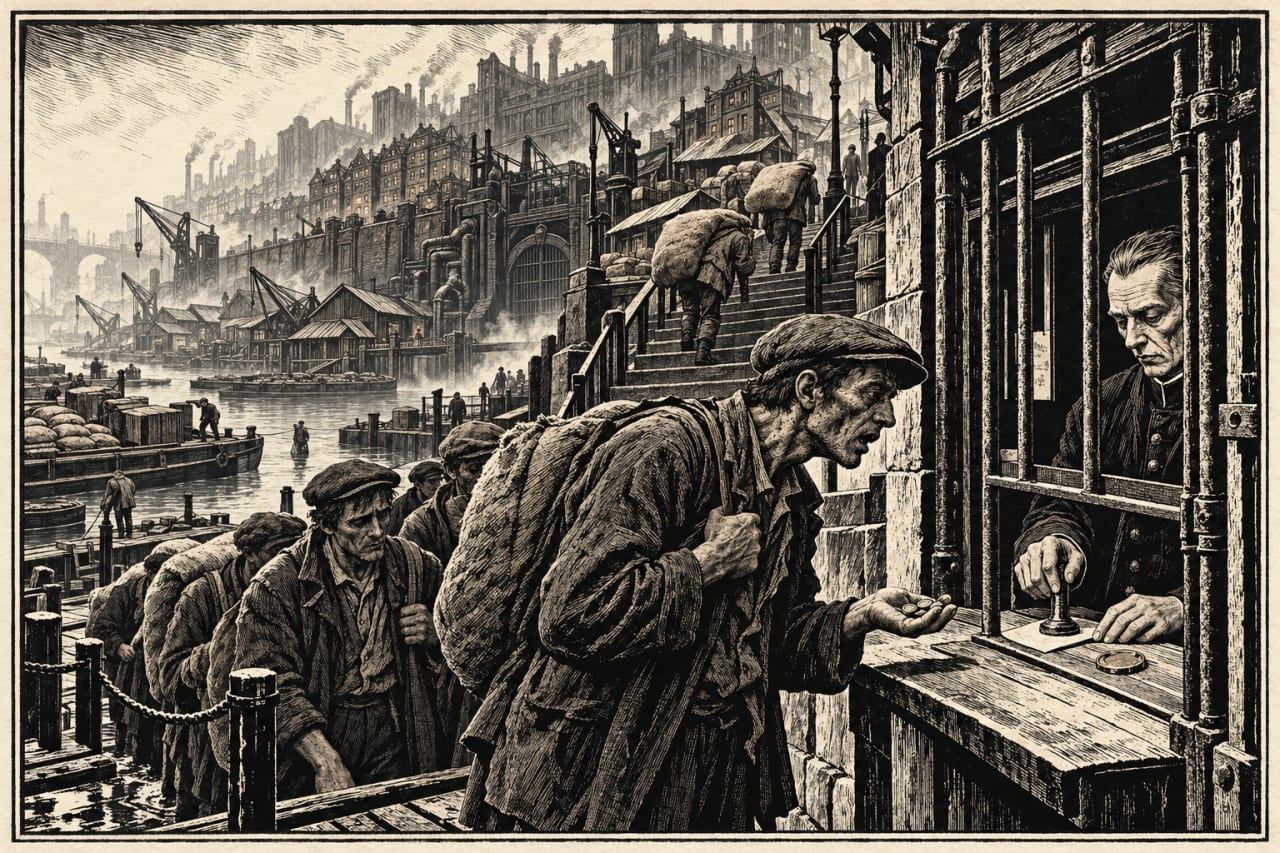
Arrival costs nothing. Departure is charged. Every crossing between terraces demands the same sequence. The traveller speaks their name softly at the window, in the form Records spells it, then recites the authorized Stair Verse whole. The toll is paid in coin, and a clerk presses the stamp in gray wax. A clipped brass stair-token is good for one crossing only. The booths of the First Step Market sell the brass. The same Market sells bread and verse coaching, and all three draw on one purse. Every coin spent on brass is a coin not spent on black bread. Every bell spent in the token queue is a bell lost from the ration queue. Children in the yards can do this arithmetic before they can recite anything.
Cargo goes up by another route. The Hundred Steps are the regulated spine of the city and the only legal corridor for bulk cargo between terraces. Grain bound from the yards to the mills climbs them, paid and recorded at each crossing. Licensed rope-lifts, chain-bridges and toll-stairs carry what the Hundred Steps do not, each at a licensed rate, and none of them is free. The Nine Steps are districts. The Hundred Steps are a corridor. Confuse them at a window and the clerk will collect the fee for the confusion.
So a sack and the person who carried it leave the yards under different law. Once sealed at the locks and entered on the Hundred Steps, the sack rises. The hauler who brought it to the foot of the corridor needs brass, breath, verse, coin and wax to follow it, and generally goes back for the next sack instead. In Rheinscarp the flour holds better papers than the people who carried in the grain.
The city keeps a rite of coming of age: a young person's first licensed crossing to the Second Step. For a child of the yards that rite reaches only Lockmouth's shelf, and it is paid at the ordinary rate. There is also Up-Step Charity, in which a resident buys a stranger one crossing. It moves one person up one terrace. It does not feed them on the landing or correct the spelling of their name.
#On the Hands and the Hours
Rheinscarp ranks its people in five layers, and the docks hold the bottom two. Fourth come mill and dock labour, which is hungry and taxed by movement. Fifth come the silt-dwellers. They are paper-poor, the lowest class the city acknowledges, and so thinly registered that the street calls them absent-adjacent. The upper terraces have one word for both layers. The word is Siltborn, and nobody uses it as a compliment.
The Lockmouth Brotherhood holds the docks and the lockworks together as a union and as a militia. It has divers, keys and river maps. In public it says it keeps the river from eating you. What it wants is control of the lock schedules and the time-credits that pass through them. Its instruments are strikes, threats of sabotage and partnerships with smugglers. This plate lists them as instruments and records no particular deed. A grate closed on the shelf above leaves haulers idle in the yards below, and the Brotherhood's position rests on that fact. The lock-grate divers belong to Lockmouth's own plate. They are paid in ration priority through time-credit assignment, and whenever a grate jams the yards wait on them.
Hours belong to Cantor-Marshal Hrodric Venn, whose office holds bell-hours, time-credits and convoy scheduling. A barge's hour at the grates, a hauler's credited shift and a household's window at the ration counter all pass through his ledger. Miss a bell-credit window and your ration priority collapses. I have seen no document placing the Brotherhood under Venn, or Venn under the Brotherhood. They meet at the same barge.
Names belong to Praetor-Registrar Ysabeau Kelm and the Bureau of Records annex. Her power reaches the waterline as spelling. Formal authority descends from the Synod Chapterhouse, and passage and registration are governed by the Tribunal of Stairs and the Records annex. No document gives the Sump Docks a governor, a harbour-master, a Bureau or a patron of their own. The yards are governed from above, in a hand they do not see.
The docks answer with small practical custom. Gangs exchange witness-oaths in the taverns, so that every member has others prepared to swear to their presence. Tavern-keepers pay juniors of the Registry Choir for early word of spelling audits. Children learn to say their names the way Records spells them, and they learn the proverb before the verse: never argue spelling at a gate. The fog-bells ring at dawn, and the silt markets open in the wet grey with black bread and river-eel stew. Residents hold that a person crossing while the fog climbs upward has their name slide off. The Bureau records the belief and declines to endorse it, and the residents wait for the fog to lift before they cross.
#On the City Above the Flood
Before the Sundering of 1 November A.S. 45 (1755 CE), the cliff already held Rationalist lockworks, river mills, a secular tollhouse at its foot and stairs that charged nothing. Barges paid that tollhouse in coin. This proves an old river economy. It does not date the docks, and no document I have consulted does. After the Sundering, refugees and supplies came down the river together, and traffic grew as the entrenchments to the east hardened into a defensible, incomplete Line around A.S. 65–68.
The Silt Year came in the spring of A.S. 78 (1788 CE). Floodwater came through the Lockmouth grates and drowned the lower terraces, and by the parent survey's reckoning four thousand died. The record does not divide the dead by district, and I will not divide them to give the yards a figure. The survivors climbed. A river-warden recorded only as Warden K. then imposed the first stair-toll regime on them. Who K. was, and how the water got past the grates, are still unestablished.
The Concordat of Strasbourg constituted the formal Synod in A.S. 90 (1800 CE). Rheinscarp's local settlement followed in A.S. 92 (1802 CE). The Chapterhouse was consecrated on the summit, the Bureau of Tithes installed its liaison, and the Tribunal of Stairs received its charter. From that charter on, every crossing out of the yards became a registration.
The parent plate dates the formal constitution of the first Bureaus under the Concordat to A.S. 92.
The Concordat and its constitutional settlement belong to A.S. 90. A.S. 92 is the year of Rheinscarp's local consecration, liaison and charter. The Nine Steps and Lockmouth plates have already corrected this, and the docks, being lowest, receive the correction last.
#On Those Who Remain but Are Not Counted
"Say it the way Records spells it." — Rheinscarp shibboleth
The docks have their own word for the Absence Quota. Tithes calls the procedure variance management. Records calls it provisional identity adjustment. The yards call it vanishing. The docks do not run the Quota and have no office from which they could. They see it from below, as one more cargo that comes down from the terraces.
Two kinds of absence must be kept apart. The first happens at a window. A hauler stumbles over the Stair Verse and is entered absent, and confession repairs that entry for a charge. It is costly, and it is at least a procedure with an exit. The second kind arrives by correction. A name loses a letter in the Ledger Cloister. A crossing receipt is entered against the wrong terrace, or a ration line is moved to a folio marked pending. Nothing happens to the person. They go on hauling, eating when they can and sleeping on the flats. One by one, the ration roll, the residence register and the crossing books stop recognizing them. The body stays at the waterline while the paper goes elsewhere.
The Quota is a ration-balancing practice associated with the mills and Records. Its known beneficiaries are the Tribunal, which gains order, and the Ash Exchange, which gains collateral. When a record begins to drift, the Exchange may open burial-precredit against the person while they are still alive. That is where the business of Broker-Saintsman Damas Rohe touches the yards. The Bureau of Mercy has protested in sealed memoranda. Protest does not make it a partner in the procedure, and its memoranda have been opened and filed elsewhere.
The street puts the rate at one in forty per quarter. Records certifies no figure. I record the street's figure as the street's and decline to multiply it by the yards, since nobody knows how many people the yards hold.
The lawful remedy is an appeal to the Tribunal of Stairs, which sits on the High Step Precinct. Every crossing between the yards and the Tribunal requires a recognized presence and paid passage. Absence removes the presence and poverty removes the passage. A resident of the docks who has vanished must therefore prove, at every window on the way up, the very standing the appeal exists to recover. Even a successful confession repairs only the entry it names, and nobody at the window promises to restore the rest.
The double-entry famine of A.S. 198 is cited in the yards and belongs elsewhere. One grain shipment was recorded as received by both the Mill-Crown and the Widowlight Quarter and was delivered once. Forty-one people died. The grain came up the river as all grain does. The auditors found the fault in the Ledger Cloister, and nothing in their findings lays the missing half at the yards. The docks drew their own lesson from it: a chit is a promise from a ledger, and the ledger can count one sack twice.
Clerics aligned with Mercy have petitioned for a hunger waiver, under which a starving person could eat without a stamp. In A.S. 201 the petition sits on the Tribunal's docket with no ruling. No exemption has been granted, and none has been refused.
#On the Present Condition
The yards work. At dawn the fog-bells sound and the fog begins its climb, and the residents who believe it takes names wait for it to pass. Barges wait at Lockmouth for the grates, and haulers wait for the barges. Grain, salt, wax, fuel and paper stock come ashore, are carried to the foot of the Hundred Steps and go up under seal. Most of the people who carried them stay below. Some buy brass at the Market. Some receive one crossing from a stranger. A few are corrected in a room five terraces up and keep coming to work, because the work does not ask for papers.
The Brotherhood holds its keys and Venn holds his hours. Records holds the spellings, and the Chapterhouse holds formal authority over all three. The district has no office of its own to which any of this could be appealed.
At low water the flats shine, and the tide-mark on the yard posts sits where it sat last season. The survey closes at the waterline.