

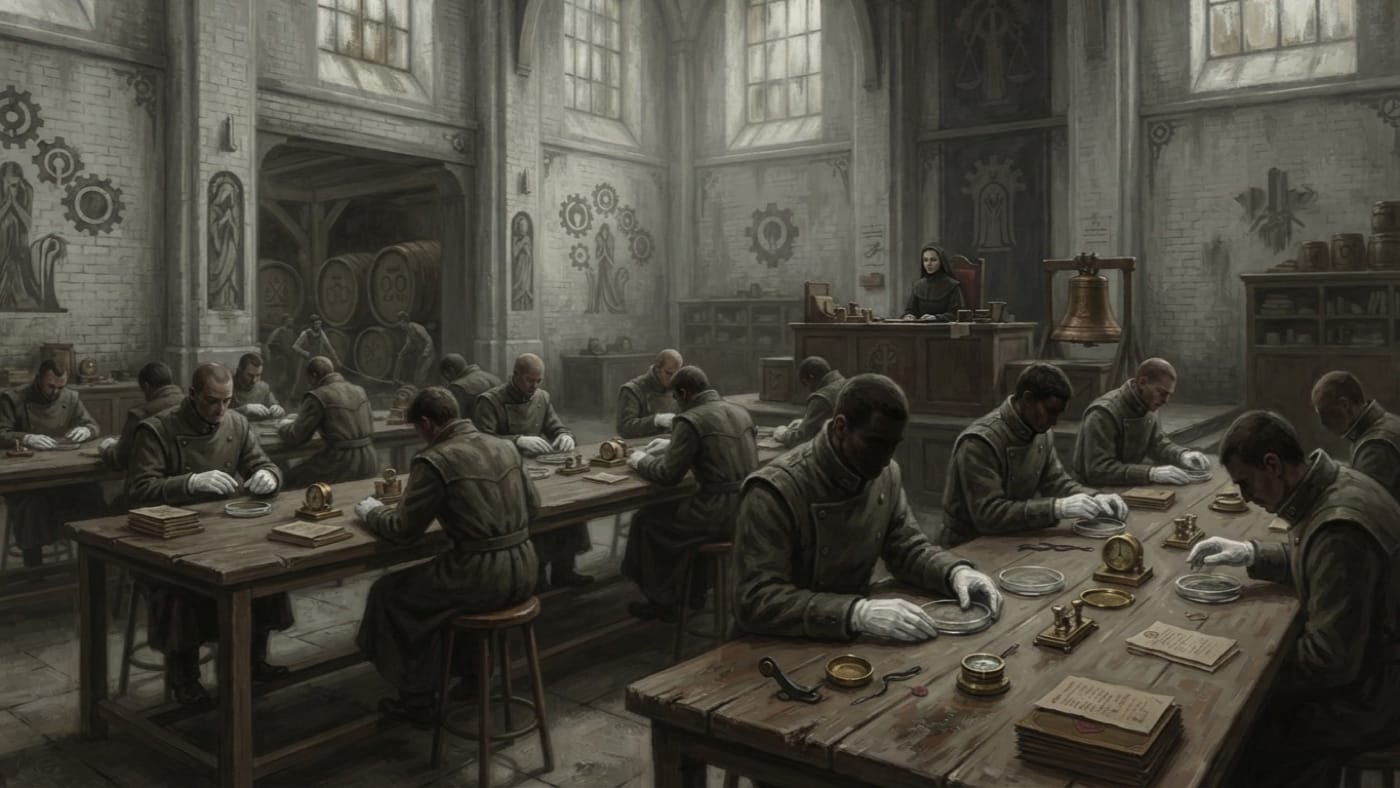
#On the Office's Authority
"Saint-dust heals; doubt is infection." (Mournwater's public line on certified dust)
The Synod Purity Office is the chapter bureau that certifies Saint-Dust at Mournwater. It sits on the White Steps, the certifiers' quarter. The stone there is whitewashed, the air smells of incense laid over bleach, and every hand near a seal wears a white glove. The Office's recorded territory runs from those steps into the Grading Hall of Settled Light. In plainer terms, it runs from the place where purity is first suspected to the place where it is declared.
Its public purpose is to guard miracles from fraud, and that is real work. A river port that ships the remains of the faithful toward the Sagittal Line draws cutters, chalk-mixers and widows offering their husbands' teeth by the ounce. Someone has to refuse them. The Office refuses them, for a fee.
Its actual power is the power to decide what doctrine will call pure. Without the stamp, a cask is cargo. With it, the same cask is a miracle ration, and a signature on the White Steps is the only difference.
Nobody has dated the Office's founding. Local memory says the Synod created a Purity Office in a reform after the town's early troubles, and that certification became doctrine from then on. Residents tie the reform to the White Spill, when an overfilled vat flooded the low streets. No record proves that the spill produced the Office, and no founding instrument has reached the Codex. In this case the absence of a document means only that there is no document.
Its reach has limits. The Office governs alongside the Cooperage Compact and the lock provosts. It does not command the locks or the Compact's yards. It does not command the Crumble Ward Sisters either, who keep their own registers in the quarantine housing. It stands under the ordinary Synodal oversight of the Bureau of Purity. This survey does not record which desk the Prefect answers to.
#On Grading and Certification
A certificate starts as a pinch of grey powder in a shallow glass dish.
Graders in the Grading Hall lay out their samples and wait for the daily settling prayer. During the prayer the Hall falls silent, and the town with it, while the dust comes down. Accepted dust settles into rosary strata, ordered rings like the cut face of an oak log. Irregular dust hangs in the brine, drifts sideways or settles into shapes the graders would rather not describe. The Bureau of Alchemical Standards filed that last behaviour as Irregular Settling Pattern, Category Two, in A.S. 194. Mournwater calls it Crumble-Wrong. The grader stands over the dish with chalk on the cuffs and watches. That observation is the grader's own and nobody else's.
The observation is then carried up the White Steps, where it becomes a certification. Purity Prefect Sister Halvein controls certification. Every lawful cask that leaves Mournwater under the Synodal purity stamp has been certified through her office. Her clerks have not said whether her own hand touches each cask, and they do not answer questions they were not paid to answer.
After certification the dust passes out of the Office's hands. It is suspended in brine, coopered into oak casks in the Compact's yards, and sealed with pitch and confession wax. The Compact writes the shipping manifest. The lock provosts pass the slurry ship through the Seal Locks, the only lawful passage downriver for certified cargo. Each of these three documents has its own author and its own fee. The purity seal states that the dust settled true on the day it was tested. The manifest states what the cask holds and where it is going. The lock pass grants the river permission to carry it. None of the three promises that the dust will still be true when it reaches a trench chaplain four to seven days later.
#On Confession and Clarification
Graders confess two things: doubt and tremor. A shaking hand ruins a test. Doubt, according to the public line, is infection. The confessions are recorded. Confession receipts from graders are counted among Mournwater's dues, together with seal fees, the slurry levy and labour-hours, and the receipts are retained. In this town a grader's conscience is an asset that belongs to the institution.
When a batch is condemned, the Office does not put the dust to any further question, since dust cannot be detained. It questions the grader who handled the dish. That questioning takes place in what the Office calls the clarification suite and everyone below the certifier class calls the cellar. The questions concern the grader's tremor, the grader's doubt and the grader's earlier receipts, which are already on file. The result is lopsided. A passed batch counts to the Office's credit. A condemned batch counts against the grader.
The Office has other instruments. Synodal inquisitors arrive when miracles misbehave. The White Steps hold detentions. Audit schedules are published, and the town treats them as a source of terror. Quarantine pressure can be applied to any family that has coughed in the wrong week.
Testing results, seal allocations and quarantine releases are all for sale. This is the documented pattern in Mournwater, though it rarely appears in the Office's own registers. The street's standard bribe at the White Steps is called certifier ink. This survey names no purchaser and no particular sale. It records the market, and the market is well supplied.
#On the Prefect and the Other Powers
Sister Halvein is said to smile like a seal stamp: flatly, precisely, and in a way that leaves a mark. She holds certification. Master Cooper Vell Arno holds the barrel supply, and a certificate with no cask to sit on is just a sheet of paper. Silt-Rook Dema holds the backchannels, the counterfeit seals and most of the information that moves after the lamps are hooded. Reports say the three have kept one another in check since A.S. 187. That date marks the arrangement. It does not mark the Prefect's appointment, which is unrecorded, along with her age, her training and her order.
Dema's position depends on the Office in a way the Office does not mention. A forged seal is worth something only because the genuine seal is honoured at the locks. Every honest certificate issued on the White Steps keeps the price of a counterfeit up in the Backchannel Shacks.
The Graders' Quiet Union has no standing and a great deal of patience. In public it speaks for safety standards. In practice it uses silence tests, whistle codes and slowdowns, and a Hall that grades slowly is a Hall the Office cannot certify around. According to the published account of the town, the Union's files hold evidence concerning Sister Halvein's passage of tainted dust during the A.S. 197 contamination scare. The Codex has not established what form that evidence takes. It has also not established what the Prefect knew when the batch went through or what she intended.
#On Certificates That Outlive Their Assurance
The incidents below are recorded separately because the record does not connect them.
A.S. 197. A contamination scare. The Union's files are reported to hold evidence that a tainted batch was passed through the Prefect's office. No tribunal has examined that evidence. No confession exists.
A.S. 198. Three graders filed sealed reports with the Bureau of Rites concerning the upstream source of the dust. By published account, the three were moved to the Crumble Ward for observation. The reports were suppressed. Their contents are restricted, and this survey does not paraphrase them.
A.S. 199. Two events happened that year. The Settling Bell stayed silent for nine hours, the longest silence on record, and no official explanation was issued. Separately, certified slurry shipped to a garrison on the southern corridor made the garrison's dead crumble within hours, into the fine mobile powder that Category Two describes. The chaplain filed a report. The Synod denied receiving it. The Compact blamed handling. The Synod Purity Office blamed atmospheric conditions. The garrison buried its dead a second time, deeper and under lime. No source establishes that the long silence and the shipment are related.
The Office and the Compact gave the only two explanations on file, and both have one convenient property: each places the failure after the seal. The atmospheric theory protects the certificate. The handling theory protects the manifest. Neither has been proven, and this survey does not endorse either. The two parties have not argued the point with each other at any length, and that is not surprising.
A.S. 200. The Bureau of Alchemical Standards and the Bureau of Rites opened a joint review of the irregular settling. In the same year an annual assurance put Mournwater's contamination rate at three-tenths of one percent. That assurance has since been withdrawn. No revised figure has been published.
Mournwater never ships tainted.
The phrase is withdrawn from Codex usage. The Office's position is now that Mournwater has never certified tainted dust, and that whatever happens to dust after certification falls to the Compact, the river and the weather.
#On the Present Administration
In A.S. 201 the locks are open. The dishes are laid out each day, the town goes silent, the dust comes down, and the White Steps go on stamping. The Cooperage Audit is pending, with no session opened and no completion date recorded. In the meantime the Prefect keeps her office, the Union keeps its files, the Compact keeps coopering and Dema's boots stay dry.
The testing still does useful work, and an honest survey has to say so. Every day the dishes catch cut dust, chalk filler and the cheaper frauds of the River-belt, and those batches never reach a chaplain's hands. The settling test is the best instrument Mournwater has, and possibly the best the Church has for this commodity. The Creator, one assumes, can tell the difference between a saint and the substitutes. The Office is paid to make that judgement on the Creator's behalf, one dish at a time, during a prayer short enough to keep the docks running. What remains unaddressed is the dust that passes the test and turns afterward. The Great Deceiver's guns ground those bones once already, and nobody in the Hall can say what happens to them in the cask.
The Office's standing position is that every cask it certified this year settled true on the day it was certified. This survey records that position without amendment.