

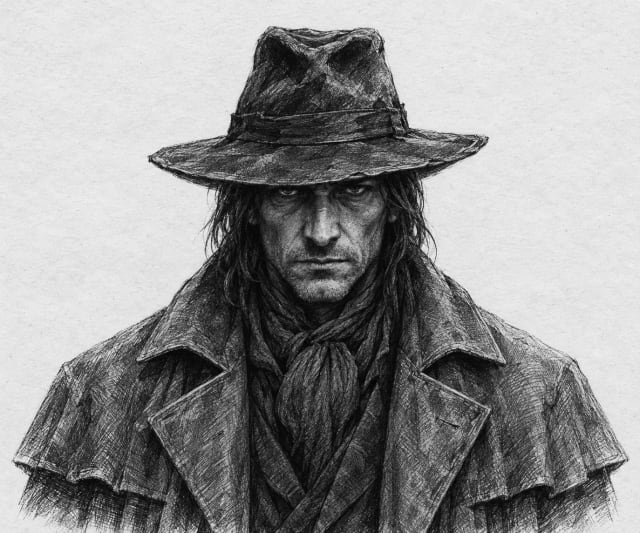
#On His Station
"Mournwater never ships tainted." — legend printed on every clean certificate issued at the White Steps
Mournwater is governed by a Cooperage Guild Compact under Synod oversight, and the Synod Purity Office and the lock provosts divide enforcement between them. That is the government. It votes, decrees and publishes audit schedules. By every practical measure it is also a decoration. In my survey of the Saint-Dust Cooperage of Mournwater I placed practical rule with three persons: Master Cooper Vell Arno, who holds the barrels; Purity Prefect Sister Halvein, who holds the seals; and Silt-Rook Dema, who holds everything else.
"Everything else" is a ledger category. It covers the flooded under-streets beneath the cooperage tiers, the side-sluices that bypass the Seal Locks, and the skiffs that move at night under hooded lamps. It covers what those skiffs carry: cut saint-dust, counterfeit purity seals, and people who need passage without a lock permit, a guild writ or a quarantine release. Lately it also covers the information that travels with such goods, which in Mournwater has come to be worth more than the goods.
The record gives him a sobriquet, a surname and an occupation. The lore files him as Backchannel Broker "Silt-Rook" Dema. It gives no fuller name, no parish of birth and no year of arrival. The Bureau of Records would call this a deficiency. In a broker it is a qualification.
Every account preserves one personal detail. His boots are always dry. He works a district of flooded cellars, silt ferries and black water to the shin, and his boots stay dry. Nobody has explained this. The Shacks discuss it more than they discuss the audit.
#On the Routes and Seals
The backchannels are the Mournwater beneath Mournwater. The town runs along its river bend, with the cooperage on pilings above the flood mark and the slurry docks sunk below it. Between and under them lie the cellars the river took back. These are brackish lanes where a flat-bottomed skiff can go from the Slurry Docks to the Backchannel Shacks without once showing itself to a provost's chain-badge. At night the lock patrols tighten, the lamps go hooded, and the backchannels wake to quiet oars.
The Backchannel Consortium runs these lanes, and the town calls its people the Silt-Rooks. Its public business is ferry service, and the ferries are real. A silt ferry is a lawful conveyance, and a lawful conveyance is the most comfortable hiding place a cask could ask for. Its other business is smuggling cut dust and people, worked through routes, forged seals and blackmail. Dema is the broker at its centre. The record gives the Consortium no charter, no roll of members and no chain of command, and I decline to invent one. The Bureau already keeps enough fiction under seal.
The counterfeit ring is centred on the Backchannel Needleway, a smugglers' run of mud and fish oil. There the White Steps purity seal is copied in wax for casks that never saw the Grading Hall. The seals have to be forged because the genuine certifier signet molds lie hidden under chapel stone and are too closely watched to sell. They are the one honest commodity in Mournwater. A secret side-sluice beneath the Seal Locks serves the same trade.
The people are the cargo that troubles the moral accountants. Some are leaving quarantine. Some are leaving debt. Some are leaving for reasons Mournwater would rather not record. The Consortium moves them on commercial terms. The record does not say whether any passenger thought of the voyage as a rescue or as a purchase. A backchannel boatman, as the local saying goes, will move anything that fits in a cask. A person can be made to fit.
#On His Accounts with Mournwater
Arno controls the staves. Halvein controls the stamp. Neither can be seen to touch what Dema moves, and both depend on its moving.
The arithmetic is plain. A licensed port that ships only what the Grading Hall passes ships less than the war demands. The trench shrines, field hospitals and chapels along the Sagittal Line need sanctity by the cask. So do the broadcast houses that lace Orison signals with dust against the Pale Chanters. None of them waits on a doubtful dish. Stock that cannot lawfully leave is a loss against the Compact's quotas, an embarrassment to the Purity Office, and an inventory someone must make disappear. The backchannels make it disappear. Where it turns up again is not the Compact's question.
His station rests on that contradiction. The relic economy forbids his trade and cannot run without it.
Dema holds routes and information. The others hold barrels and doctrine. Without Arno's casks he has nothing to carry. Without Halvein's seal he has nothing to forge. Without the lawful traffic at the Seal Locks, unlawful cargo has no crowd to hide in. Dema commands none of these institutions. He bargains with each of them. A provost paid to watch the main channel has been bought, not commanded, and anyone who has bought the same provost twice knows the difference.
My published account dates this triangle to A.S. 187. The account stands. I recorded no ceremony to mark the date, because none would have been held. Restraint of this kind is never sworn. Each party holds enough of the others' secrets to make a quarrel expensive. Each has learned that the most expensive quarrel in Mournwater is the one that brings the auditors downriver.
#On the Price of Settling
The Irregular Settling Pattern was classified at Mournwater in A.S. 194. Since then, Dema's second commodity has outsold his first.
The town calls the phenomenon crumble-wrong. It is a failure of the daily settling. In the Grading Hall's glass dishes the saint-dust drifts, hangs, or settles into bone shapes where it should form rosary strata. Worse, dust certified true can turn in transit. When it reaches a chapel or a grave, it reduces the dead a second time into mobile powder. A batch condemned at the dish is a loss. A batch that turns in a garrison vault is a scandal, and scandal moves dust scrip faster than a battle.
Knowing which casks will fail is therefore worth more than the casks.
The graders know first. The Graders' Quiet Union marks suspect batches with private signs in hoop grooves and wax ridges. The marks tell dock crews which casks to avoid, which to sell, which to lose and which to pray over. The Union keeps its own counsel and its own files. By my survey, the evidence on Sister Halvein's certification during the A.S. 197 contamination scare lies with the Union and nowhere else. Dema did not devise the marks. He reads them, and he sells the reading by the phrase.
The buyers form a congregation of their own. A futures clerk who learns that a hoop is notched wrong can sell scrip at the morning price before the evening rate reflects the condemnation. A chaplain's agent can learn which shipment to refuse. A certifier can learn what she is about to sign. Condemned slurry now sells through the backchannels for more than certified dust, because condemned dust can ruin certifiers, blackmail chaplains and move markets. Dema stands where that knowledge changes hands.
The crews who load those casks get no early warning, and neither do the dead who receive them. The quarantine washers know which families are already gone. A dock crew learns that a cask has turned through its lungs.
As for the source, the backchannels trade in what the Purity Office suppresses. That includes the graders' sealed reports of A.S. 198, the rumour that something at the Ossuary Shoals upstream is making new dust from old material, and the warm casks of the Needleway. In A.S. 199 the bell kept a nine-hour silence. By morning the backchannels had an explanation in circulation; the Bureau of Rites had none. Selling a rumour does not mean owning its truth, and nothing in the record gives Dema the upstream mechanism. He sells the question, and the question has paid very well.
Mournwater never ships tainted.
Amended per the southern-corridor garrison report of A.S. 199 and the Eastern Chaplaincy circular of A.S. 200. Both describe certified casks that turned after shipment. The legend remains on the certificates, which are printed in advance.
#On the Locks Remaining Open
Dema's documented fear is that the locks will close permanently. My survey gave the immediate reason: his inventory would be stranded in the channels and his operators left exposed. The deeper reason follows from the arrangement itself. It is the Bureau's reading of that arrangement, not his confession. A smuggler needs a working port. The side-sluices are worth something only because the main channel is busy. Counterfeit seals are worth something only because genuine ones still move cargo. The Needleway is a hub only because there is a lawful river to undercut. Close the Seal Locks for good and Dema loses his routes, and with them the cover that every lawful barge gives him.
The official plan for Mournwater is to expand the Seal Locks, tighten purity protocols and enlarge the Crumble Ward. Each measure is a crackdown, and a lock crackdown is the event the Consortium most dreads. The rumoured plan in the Shacks runs the other way: the Consortium would seize control of passage for a single storm season. It is still only a scheme. The record names no author for it, and I name none.
In A.S. 201, a year after the joint review by the Bureau of Alchemical Standards and the Bureau of Rites, the Cooperage Audit is pending. The locks are open. The slurry ships leave on schedule, and the skiffs leave on none. The daily settling silence still falls over the town, and the backchannel boatmen wait it out like everyone else, poles planted in black water.
Dema's boots, at last report, are dry.