

#On the Certifiers' Quarter
"If it settles, it's true." — Cooperage Compact oath, administered at the Seal Locks
Mournwater keeps seven districts strung along its bend of the River-belt, and each has its own stench. The Cooperage Yards smell of pitch and wet oak. The Slurry Docks smell of brine and sweet rot. The Backchannel Shacks smell of fish oil and wet paper. The White Steps, the Synod certifiers' quarter, smell of incense and bleach. Nobody there will say which of the two is offered to the Creator and which to the floor. In a town where sanctity is shipped by the cask, the question has long since been settled by custom, and custom keeps no minutes.
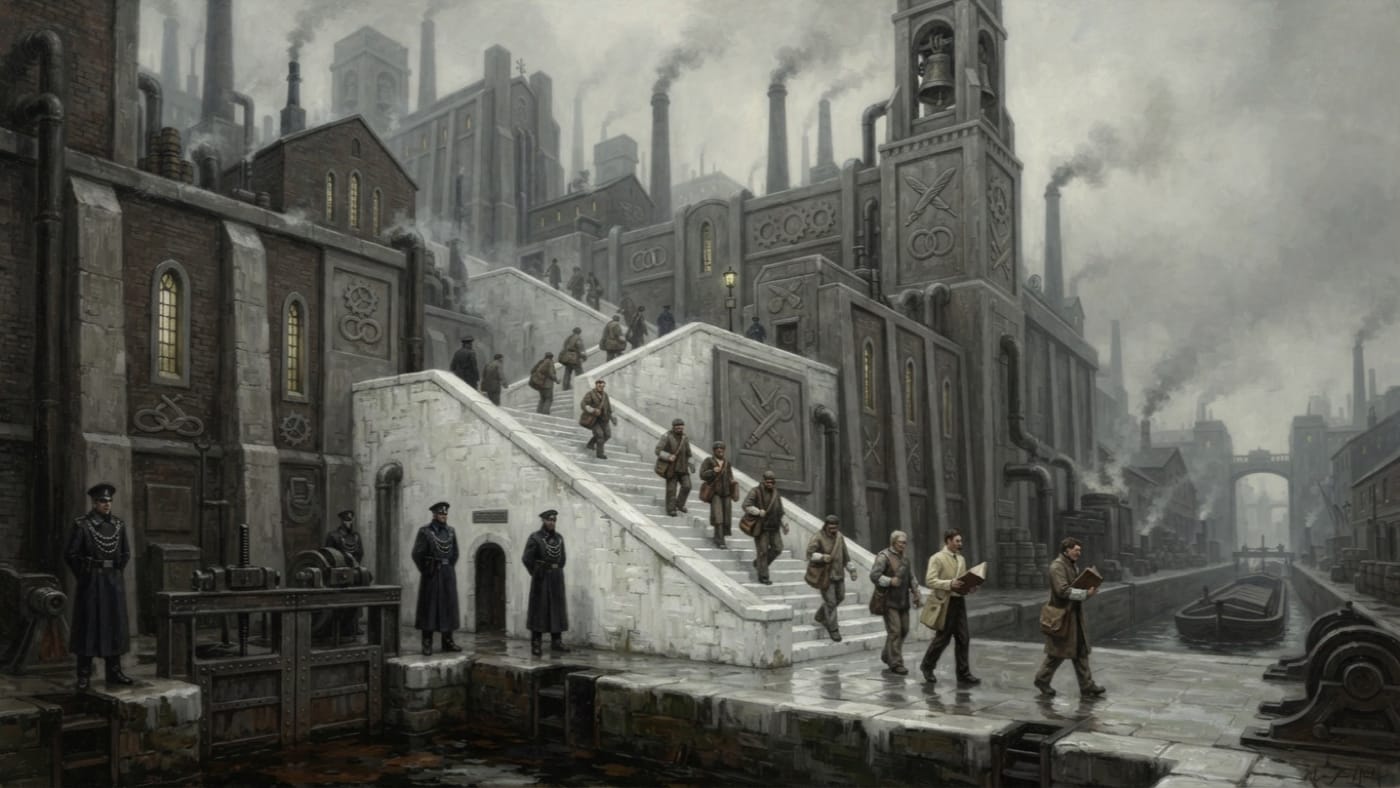
The steps are whitewashed. The town is grey to its pilings: grey mud, grey fog off the lowland water, grey grit in the cuffs of anyone who has worked a full shift near the dust. Against that, the whitewash looks like an accusation. It is renewed often enough that the fog never wins for long. A visitor coming up from the wharves sees the white first and the guards second, and that is the correct order of importance.
Purity stamps are checked at every threshold in Mournwater. At the White Steps they are checked by men and women who make purity their trade. Lock permit, guild writ, dust-labour voucher: each is read, weighed against the bearer's hands and lungs, and either honoured or referred upward. The quarter's insignia is the glove, kept pale, in the way the grader's insignia is the chalk cuff and the lock provost's the chain-badge. A pale glove in Mournwater tells you its wearer handles the papers and lets others handle the dust.
The quarter does three kinds of business. It certifies. It detains. It keeps a chapel. All three are the work of the Synod Purity Office, the local enforcing chapter of the Bureau of Purity, whose public purpose is to guard miracles from fraud and whose working instrument is the seal. The rest of Mournwater makes things: barrels, slurry, manifests, tolls, futures, lies. The White Steps make permission. Nothing lawful leaves the river bend without it.
#On the Seal and the Sample
Each morning the Settling Bell tolls and the town falls silent. In the Grading Hall of Settled Light, samples of saint-dust lie in shallow glass dishes while the graders watch them descend. True dust settles into rosary strata, ring under ring, like the cross-section of sawn oak. Irregular dust hangs, or drifts sideways, or lies down in the shape of something that once had a pulse. The graders measure what they see and write it down. When the dust settles true, the bell rings a second time and the town breathes again.

None of this happens at the White Steps. The Hall observes and the Hall records. What comes up the steps is a finding, and no cask has ever shipped on a finding.
The Steps convert it. A grader's entry becomes, under the authority of the Purity Prefect's office, a purity authorization, and the authorization becomes a seal. Approved dust is suspended in brine as holy slurry and coopered by the Yards into oak casks, pitch-sealed and iron-hooped, closed under confession wax. The Cooperage Compact enters each batch on its manifest. The casks are loaded at the Slurry Docks and must pass the Seal Locks for lawful departure, where the lock provost reads the manifest, a White Steps certifier confirms the purity seal, and the water drops enough to make the barge groan.
Five offices handle one cask. Each keeps its own book and its own grievance. The Hall resents that its truth is useless until someone in a glove countersigns it. The Compact resents that its barrels are worthless without wax it does not own. The provosts resent nothing, being paid by the hour of delay. These are political overlaps, and the White Steps profit from all of them. Its jurisdiction remains distinct all the same. It neither tests the dust nor builds the cask, and it does not open the gate. It authorizes.
Authorization is where the money lives. A sealed cask can be sold, insured against, wagered upon in dust scrip, requisitioned by a bastion chapel, and blamed on someone else when it goes wrong. An unsealed cask can only be smuggled. Approval fixes price, priority and liability in a single impression of wax. That makes the seal the most valuable object in Mournwater, worth more than the dust beneath it, because the dust can be replaced from the Ossuary Shoals and the seal cannot be replaced at all.
What a seal records is narrow. It records that the proper office approved the proper batch and that custody passed in the proper order. It records nothing about what the dust will do in a chapel three weeks downriver, in steam, over a body. A chaplain sees wax and assumes holiness. The wax has never promised him that much.
#On Clean Hands and Retained Confessions
Mournwater keeps its classes in plain order: certifiers at the summit, then guild masters, then graders, then dock crews, then the quarantine poor, then the backchannel untouchables in the category the ledger declines to print. The order inverts the work. Those who touch the dust most are ranked lowest, and those who touch it least sit at the top of the steps in pale gloves. I find nothing irregular in this. Every Church office I have served is arranged on the same principle, and the arrangement has outlasted every reform proposed against it.

Purity Prefect Sister Halvein controls certification. Her office authorizes the Synod purity stamps on every lawful Mournwater shipment. The Codex does not claim that she personally inspects or presses every cask, and no honest record claims it either. An office that size moves by delegation, and delegation is the polite name for many hands sharing one signature. Her age, appointment, training and order are unrecorded. Her title gives her no command over the Sisters of the Crumble Ward, however often visitors confuse the two.
Her office depends on graders the way a press depends on a die. A slowdown in the Hall starves the Steps: no findings come up, nothing is authorized, nothing is billed. The Purity Office answers that dependence with method. Graders confess their doubts and their tremors as a condition of employment, and the White Steps keep the confessions. A tremor confessed under one season's fog stays on file through the next. Between that file and the debt and compulsory labour that bind half the town, refusal becomes something only the rich can afford, and the rich in Mournwater are mostly certifiers.
The White Steps also detain. The town's lore says so without ornament. The Seal Locks record says more: a woman with grading chalk on her hands may be "escorted politely to the White Steps," which is how the lockmen say arrest when they wish to keep their posts, and lock holding category H-5, held by request of office not named on public sheet, is used in Mournwater when the Prefect's office wants a grader before the Compact can count him. The Mournwater survey names a "clarification suite" where condemned batches are discussed with the graders who handled them; it adds that everyone else calls it the cellar. The Seal Locks record mentions a White Steps cellar where certifier notes ought to burn. Whether these are one room the Codex does not say.
A White Steps detention can be a question, a delay, a fine, a frightening, or a transfer to observation elsewhere. The record does not let me equate it with quarantine, or with execution, or with the convenient vanishing the backchannels always allege. Some detentions end with a grader walking back down the whitewash, chalk on the hands and a fresh confession on file. That outcome serves the office better than a corpse.
#On the Chapel's Signets
The White Steps keep a chapel, and the chapel keeps the signets.
The town's lore places the genuine certifier signet molds beneath the chapel stone. It adds a detail I find more instructive than any floor plan: they are too closely watched to be sold on Mournwater's black market. That market sells cut dust, forged seals, "miracle boosters," futures manipulation, upstream maps, condemned slurry, and persons. The one thing it will not offer is the original. Everything else in Mournwater has a price, and the backchannels judge this item too dangerous to quote.
The reason is plain. A seal is the Office reduced to a portable shape. Whoever holds a true mold can make lawful cargo from anything, in any cellar, at any hour, and the provost reading the wax under his lamp will find nothing wrong with it. The town has a fear for this and repeats it as rumour: a swapped signet would buy one night of false purity. The Codex records the fear. No completed theft and no proven substitution appear in any record I accept.
Counterfeits are a separate trade, and a thriving one. Imitation seals circulate through the routes of Silt-Rook Dema, whose network moves cut dust, smuggled persons, information and wax that looks right under a tired lamp. A side-sluice report from the Seal Locks records a cask recovered with no manifest and a White Steps purity seal on its exterior. Nobody has published whether that seal was genuine. The ambiguity profits everyone at once. The Prefect can call it a forgery, Dema can let buyers suppose it was not, and the provosts can charge both parties for the inquiry.
The guarded original and the circulating copy depend on each other. Without the chapel's watch the counterfeit would be worth nothing, because the genuine article would be on sale beside it. Without the counterfeit the watch would look like piety. Permission is valuable only while it is scarce, and the chapel stone keeps it scarce.
#On the Batches That Passed
The Bureau of Alchemical Standards classified the Irregular Settling Pattern as Category Two in A.S. 194. The town calls it Crumble-Wrong. From that year the White Steps certified in the knowledge that dust could lie, and that some of it lied in the shape of a jaw.
During the A.S. 197 contamination scare, according to the published survey of Mournwater, the Prefect's office passed a tainted batch. The evidence lies in the files of the Graders' Quiet Union and, by that account, nowhere else. I cannot describe it. No source I trust says whether it is a ledger line, a retained sample or a grader's memory, how the Union came to hold it, or what Sister Halvein knew when the wax went down. No charge has been laid and no confession entered. The Union holds the file. The White Steps hold the Union's confessions. Each side's evidence keeps the other quiet, and both sides prefer it that way.
In A.S. 198 three graders submitted sealed reports to the Bureau of Rites concerning what grinds the bones upstream. They were later transferred to the Crumble Ward for observation, on a date the record does not fix. Their reports speak of something alive at the Shoals. The Codex holds that claim in the register of restricted report, where it can be suspected without being confirmed.
A.S. 199 brought two separate failures. In the Grading Hall, Dish Twelve refused to settle and the bell stayed silent for nine hours. On the southern corridor, a garrison chapel received three casks stamped pure by Sister Halvein's office. Within hours of application, twelve recently buried soldiers were reduced inside their lime-sealed vaults to a fine powder that moved with the damp, and the sentries found it gathered at the infirmary door before dawn. The chaplain filed a report. The Synod denied receipt. The Compact blamed handling. The Prefect's office blamed atmospheric conditions. No source connects the sample in Dish Twelve to those three casks. The two events share a year, and nothing else in the record ties them.
The Hall has troubles of its own. The town's lore records a falsified baseline ledger in the Grading Hall. It names no author, no year and no shipment affected, and I will not supply any of them in order to tidy the account. A false baseline under a true seal would explain much, and the record proves none of it.
Mournwater never ships tainted.
Withdrawn as a statement of fact. The formula is the town's established trade language and has been printed on clean certificates; whether it is printed still, accounts disagree. The southern-corridor casks of A.S. 199 left under White Steps authorization and arrived as Crumble-Wrong. The Codex retains the phrase only as quotation.
In A.S. 200 Alchemical Standards and Rites completed their joint review. It produced guidance, chiefly second settling: a batch is to be certified only after it has settled true twice. The guidance carries an exception for supply priority. The lock hold orders were written the same way. If dust knocks: hold and summon White Steps. And then, further down: If cask is urgently required by bastion command: release under protest and retain protest copy. The protest copy proves the office knew and objected, and that it released the cask anyway. When the dead crumble at the far end, liability has already been spread across so many desks that nobody can be punished efficiently.
#On the Present Certification
It is A.S. 201, the year of this survey. The White Steps certify. The locks are open. The Cooperage Audit is pending, with no opening session, no named auditor and no completion date, and the joint review of A.S. 200 was never that audit and should not be mistaken for it.
The arithmetic of patience is simple. Trench shrines on the Sagittal Line want slurry for their altars. Field hospitals want miracle-grade residue for salves and for the last rites of men who will not last the night. Orison operations want saint-dust to weight their broadcasts against the unhymns. Mournwater is far from the only source of holiness in the Church, and not every miracle reported from the front is a fraud. But these consumers draw on Mournwater's seals and cannot easily replace them, and an audit that condemned the White Steps would condemn their supply along with it. The Church has weighed that and adjourned.
Vell Arno still controls the barrels. Sister Halvein's office still controls certification. Dema still controls the routes and the counterfeits and much of what is said about both. The mutual restraint the survey dates to A.S. 187 still holds. It holds because each of the three can ruin the other two, and none can survive doing it.
Tomorrow the bell will toll. In the Hall a dish will settle true, and settle true a second time if the guidance is followed and supply priority has not overruled it. A grader whose confessions are kept on the Steps will carry the finding up the whitewash. A certifier in pale gloves will read it, check it against the manifest, and authorize under the Prefect's seal. The wax will go down over the bung. At the locks a provost will read it, the water will drop, and the barge will go downriver to a chaplain who trusts what he is shown.
The entry will be made, and the batch will be lawful.