

#On the File and Its Year
This is a compilation made in A.S. 201. It concerns an event of A.S. 188, the year inland calendars call 1898, at the Script Wall of Calais. The Bureau filed the event under the number of the roster that was reading at the time, which was 14-F. Thirteen years lie between the failure and this survey. In that time the file has not grown thicker, but it is cited more often.
Very little survives. A reader recognised a name, and the name was a daughter's. The reader left the station before the final consonant. The name partly sank, the harbour went into west-hush within seven minutes, and three lamps went out underwater. After that the record is shut. The reader's name is sealed. The daughter's name is sealed. The count of bodies recovered is redacted, and the disciplinary finding is sealed. The officer who drew up the roster is not named in anything I have been permitted to read. The day, month and season were never entered.
I have compiled three things: what the Chalk Redoubt wrote down, what its divers brought up, and what its offices afterward stopped claiming. I have not compiled a scene. The file contains no narrative of the night, and I will not supply one.
#On the Duty at the Chalk
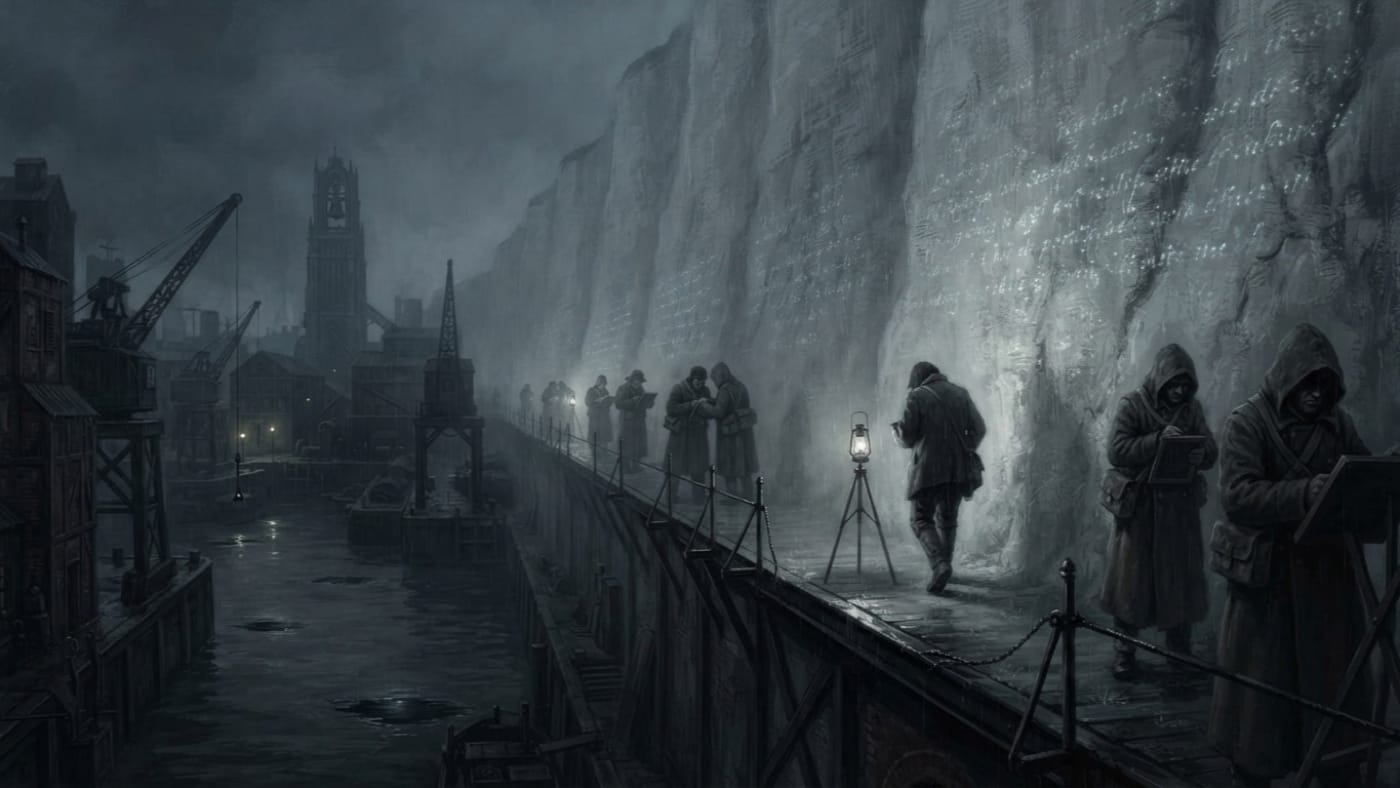
The Wall is seventy feet of exposed chalk between the Gun Galleries and the Crownline. On fog nights, names bead on its face. A name that is read aloud remains a warning. A name left unread darkens and withdraws into the stone, and then the harbour answers in its own coin: a skiff that fails to return, a rope gone slack, a child in the Warrens waking with salt in the lungs.
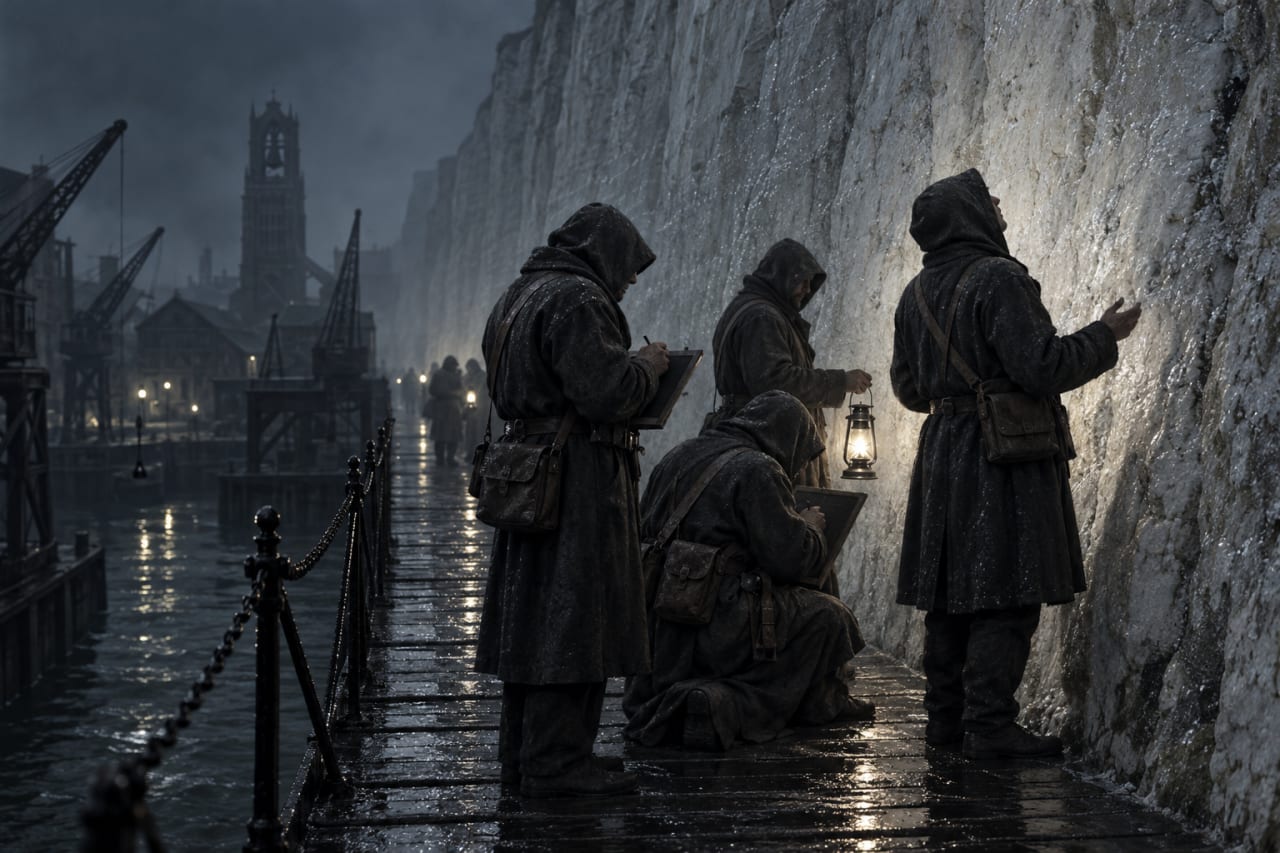
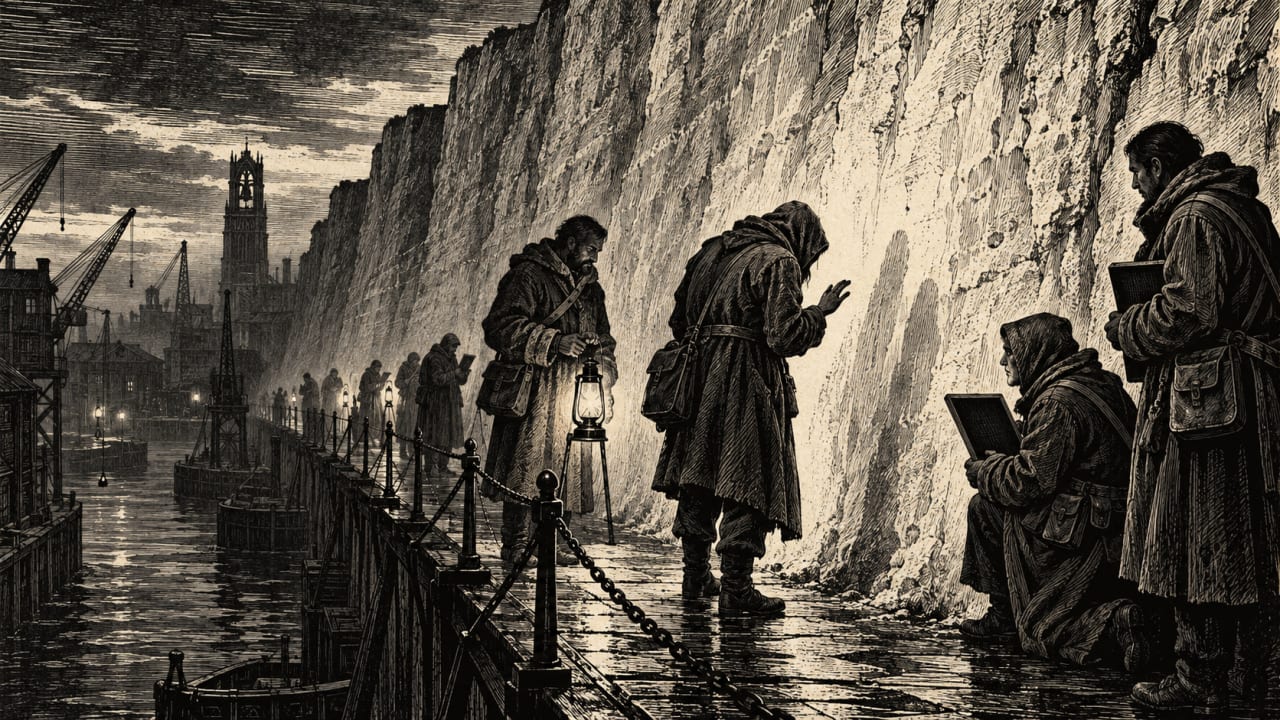
Reading is a levy. When the Fog Bell Tower strikes three short, one long, three short, readers go to measured stations. Lantern-bearers hold their light low and to the side. Chalk Scribes kneel with waxed slates, and Doctrine copyists stand behind the scribes to copy the copy. The households of the Chalk Warrens supply most of the throats and lose most of the sleep. Nobody volunteers for the low chalk. The roster volunteers them.
The surviving instructions of Coastal Protocol 9-C are plain. Read left to right and from the upper chalk down. Speak loudly enough for the second scribe to hear. If the letters change partway through a syllable, finish the first reading, wait one breath, then read the correction, which goes into the ledger in red. If you know the name, keep the cadence you use for strangers. I give these as attested procedure. The file does not say which of them stood in exactly this form on the night of 14-F, and I will not backdate a clause to make the folio tidier.
The last of those rules is the one that matters here. A name is unfinished until its final letter has been spoken, and the reader who knows the name is the reader least able to finish it.
Two things were already in place when Roster 14-F was called. One was the memory of A.S. 187, when the Unread deliberately left stations empty for three days and the Chapterhouse put them down as an emergency of levy and public health. The particulars are in the Uprising's own folio. The other was the Silent Steps, the corridors of forbidden speech cut beside the Wall after that uprising. Compulsory reading was already old by then. Standardised registers date from A.S. 83, and the Wall had been writing since the Great Breach of A.S. 71, years before anyone thought to count the readers.
Coastal personnel abstracts list certain service as beginning "during the A.S. 188 Roster 14-F unrest."
Clarified. "Unrest" is a filing convenience. Roster 14-F was one reader's failure at one station. A.S. 188 produced no second uprising, and nothing in the file connects the reader to the Unread. The refusal of A.S. 187 keeps its own folio, and the two are not to be bound together, however much easier that would make the shelving.
#On the Unfinished Name
Here is the extract as the Chapterhouse permits it to be copied. I have removed nothing that was present and added nothing that was absent.
INCIDENT RECORD — READING ROSTER 14-F, A.S. 188 Recognized name: ██████████████ Relation: daughter Action: abandoned post before final consonant Result: name partially sunk; harbour west-hush began within seven minutes; three lamps extinguished underwater Recovered body count: █████ Disciplinary finding: █████████████████████████ Reassignment: Silent Steps maintenance
A clerk would read it as follows. "Before the final consonant" means the reader spoke nearly the whole name and stopped short of its last sound. The Wall, which is not known for leniency, treated the remainder as unread. "Partially sunk" is the scribes' term, and the record does not describe which part of the name stayed on the chalk.
"Within seven minutes" is an upper limit. It says that west-hush had begun by the seventh minute. It does not say that it began at the seventh, and anyone who quotes the figure as a stopwatch reading has mistaken a ceiling for a floor. The three lamps are entered after the west-hush, but the file gives them no time of their own, no depth and no carrier. Three lamps going out does not mean three people died, and I will correct any compiler who writes it that way.
The file does not say what the reader did after leaving the station, or where the reader went: toward the harbour, into the Warrens, or nowhere. It does not say whether the daughter was in danger that night, whether she was at sea or ashore, already lost, or asleep in a dry bed. No file I have opened records what became of her later. The Wall writes the names of the drowned, the endangered, the dead and, now and then, the unborn. A name on the chalk is an order to read it.
Two facts at the end of the extract are often set against each other. The disciplinary finding is sealed, while the reassignment to Silent Steps maintenance is public. Both can be true at once: a finding can stay hidden while its consequence walks about in candlecloth carrying a bucket. The Steps were cut to punish the deliberate silence of 187. In 188 they took in a reader whose voice had failed. The corridor treats the two as the same kind of silence, which is the most honest thing about it.
The roster itself survives only as a number. The record does not name the officer who put that reader at that station on that night. Captain Lute Auvray keeps the rosters now. Her present file weighs voice, kinship, exhaustion and availability in every assignment, and every captain who has drawn up a roster since 188 has done so knowing this number. Her file says nothing more on the matter, and neither does this one.
#On What the Recovery Returned
A partial sink sends the city underground. Bodies must be found if they can be found. Tokens and chalk fragments must be brought up for the ledgers. Tunnels must be checked for water that has come in where water was barred. Roster 14-F made all four demands at once.
The only dated mark comes from the Undertide Pens. In the Salt Vestibule, intakes are stripped, rinsed, named and graded for wetness, and its walls are scored with the heights of old floods. The highest mark is cut for A.S. 188, Roster 14-F. The Pens record states that three feet of water came in from behind sealed stone. I report the mark and the record. Neither explains how the sea crossed sealed masonry, and a shared date proves nothing more than a shared date until someone with a better ledger shows otherwise.
The recovered-body count is redacted. I will not work it out from the length of the black bar. Censors set black bars by hand, and the width tells you only how patient the censor was.
Ila "Kelp" made her first recorded descent in the aftermath, late in 188, and her file holds the fullest surviving account of the recovery. Several divers came back and several did not. One came back with a face the witnesses could not agree belonged to the diver who had gone down. The file preserves that disagreement and goes no further. It names no replacement and gives no account of bone, salt or anything else that might have made the face open to dispute. In Calais, a dispute about a face is entered as a dispute about a face.
The first thing Ila brought up was a cut length of bell-line wound through a fist of white weed. It was knotted in the Black Lungs' emergency pattern for "haul slowly," and no diver was attached to it. The entry places the find at the edge of Cave System Bravo and names Sain as witness. It also says the line was cut from below by a serrated blade that matched no Calais tool and also matched three Tribunal knives, so the sentence contradicts itself before it reaches its verb. It proves no attacker, no sabotage and no weapon. Sain kept the fragment. Records asked for it, and she sent a sketch instead. Records accepted the sketch.
Two witnesses say that Ila laughed when the clerk accepted it, and that the laugh came from the drainage channel behind them. Their testimony is on file, and it is credited to them and to nobody else.
Sain was not yet a captain. Her public file first lists her on pump duty in A.S. 188, and her first recorded descent came late that year. She received command in A.S. 195 under Sabelle Morn's seal. Her own older account of that descent describes three nights of broken reading rosters and six names left half-sunk along the Wall. The later survey of the Teeth places those nights after Roster 14-F, during the aftermath, and I follow the survey. The six names belong to those later nights and were not victims of the first unfinished name. Sain's older account also links the descent to an "Unread refusal," and that claim is hers to defend. The Black Lungs had been diving long before any of this. The year's emergency merged their rosters but did not create the corps.
#On the Words Withdrawn
The plainest consequence of Roster 14-F is a deletion.
Coastal Manual 9-C: the Fog Bell Tower "prevents" name-sinking when protocols are correctly observed.
Revised A.S. 188, after Roster 14-F. The tower summons, warns, delays, coordinates and records auditory compliance. Prevention belongs to the Creator, Who has not been entered on the Calais duty roster.
This is the only change in the coastal books that the record ties to 14-F by name, and what changed was a claim. Nothing in the file says the bell failed. No misstrike is recorded and no fault is laid on rope or bronze. The widening crack in Olivane belongs to A.S. 201 and may not be read back into 188. What the manual gave up was a promise its own procedure could not keep, since the procedure had been followed at every station but one. The person at that station was a parent.
After the revision, the tower kept the duties it could actually perform: summons, warning, delay, coordination and record. A clerk can witness and enter each of those. The verb that was removed was one only the sea could countersign.
The same year produced a second document, and compilers like to staple it to the first. In A.S. 188 the Bureau of Purity reclassified non-compliance with the reading protocols as heresy. Before then, refusing to read was a breach of levy. Afterward it was a doctrinal offence. The sources do not say whether the reclassification came before or after 14-F, and they do not say that either one caused the other. A reader who left a station because a daughter's name was on the chalk is a different defendant from a reader who stood silent with the Unread, and the decree of 188 was written for the second kind, whenever it was issued. Take out the staple. Take out the other one as well. The Gunline Choir has its own A.S. 188 file, and the same year and the same harbour do not make the same incident.
Later practice is attested. I call it later because no adoption year is given. Morn did not command Calais during Roster 14-F. She inherited the file, the corridor and the families, and her watch order contains rules that read as a reply to it.
Set the second line beside the extract. A second reader moving into breath-position at the first sign of recognition is a reader who can finish the final consonant. Set the fourth line beside the sealed finding. Whoever ordered that punishment wait until the voice record is secured had seen a file in which record and verdict were sealed in the same envelope.
#On the Present Holding
In A.S. 201, thirteen years later, Roster 14-F is cited at every serious reading in Calais. The pressure on the rosters has not eased. Chalkscript has been confirmed inland since A.S. 199, on lintels in the Warrens where no reading station stands. Lamp oil is short, so readings run long and readers arrive hoarse and already tired. None of this existed in 188 in its present form, and none of it may be used to explain 188. It only means the number gets quoted more often.
The reading continues as before. Every name is to be spoken to its last letter in the voice used for strangers, and a reader who recognises a name is to read it through. The protocol is mandatory. The readers know which number taught them that rule, and they still do not know the reader's name.
This compilation closes on the record as it stands. The reader, the daughter, the recovered-body count and the disciplinary finding remain sealed, and the roster's author remains unrecorded. Nobody has established how an unfinished name brought west-hush into the harbour and water through sealed stone, or what part the Undertide played. The answer offered by condemned doctrine remains condemned. The flood mark in the Vestibule still stands at three feet. Sain still holds the length of bell-line. Records still holds the sketch.