
#On the Town the Map Forgot
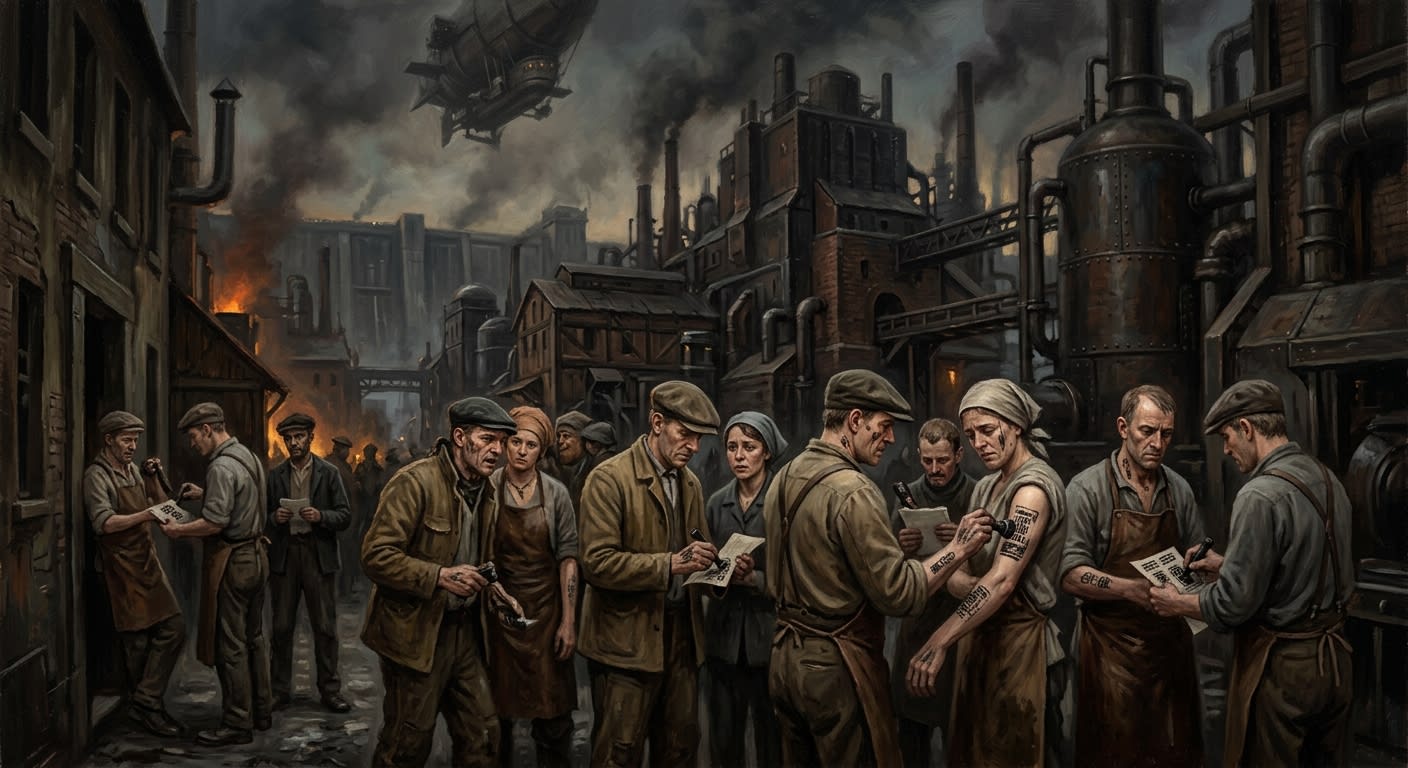
Keska is a foundry-town in the eastern Hintermark, west of Bastion-Constantinople, along the road-and-rail throat that feeds the southern anchor with coal, pig iron, tin, copper, bone-ite compound, replacement rivets, cheap coffins, cheaper men, and all the other sanctified necessities by which a fortress continues pretending it is immortal. It was founded in A.S. 116 as Furnace Station K-6, one of the auxiliary smelting hamlets attached to the southern supply roads after the Concordat taught Strasbourg the useful doctrine that every military need becomes holier once given a municipal seal.
By A.S. 160 it had become a town. By A.S. 188 it had become an argument. For eleven months it became nothing at all.
The official designation as of A.S. 201 is Zone 3, Industrial-Forward, Foundry Class Two, Settlement Register KES-3/189-R. The suffix matters. It is the scar. Before A.S. 189, Keska's designation should have been KES-3/130, revised under the old Hintermark boundary table. The number should have passed from one ledger to another with the quiet efficiency of ink poured into a fresh well. It did not pass. It fell.
“Administratively indeterminate” is the phrase Settlement chose because “forgotten” would have implicated a clerk, and clerks, when implicated, develop supervisors.
#On Furnaces, Houses, and Useful Ash
Keska's first furnaces were rude brick stacks built beside a canalised stream whose original name has been overwritten by three supply surveys and one devotional renaming. The stream is now the Saint Orban Channel, though no one in Keska uses the name unless a visiting chaplain is within earshot. Locals call it the Black Run, because the water leaves the slag troughs dark, warm, and occasionally capable of stripping paint from a bucket.
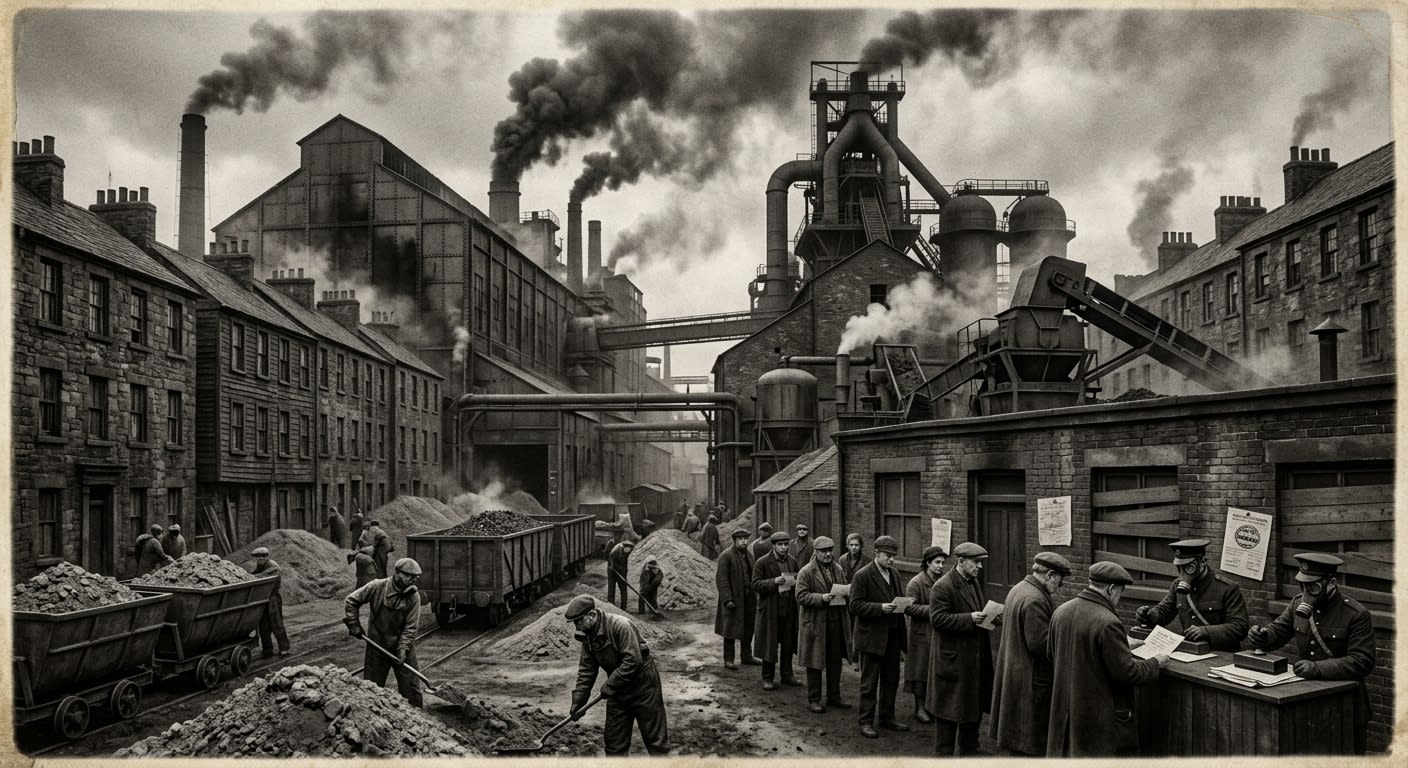
The town grew as the southern theatre grew. The Foundry Quarter of Constantinople could not swallow every contract, every repair order, every rivet shipment, every cracked cannon throat, every reliquary housing, every dented plate torn from a Catacomb-Carrier and sent rearward for reworking. The Hintermark took the overflow. Keska took the dirtier portion of the overflow, which is how industrial towns acquire both prosperity and coughs.
Earlier procurement lists described Keska as a coal village.
Corrected. Keska smelts, casts, reworks, stamps, and packs. Coal is merely what it eats. The distinction is plain to anyone who has spent ten minutes near its furnaces, which explains why no procurement clerk noticed it for seventy-two years.
The town's streets follow the logic of production rather than comfort. Foundry Row runs from the loading yard to the casting sheds. Saint Noyen's Lane carries workers to the chapel and bodies from the infirmary, depending on hour and bell. Ash Steps rises up the east bank, where the older houses lean into one another with the intimacy of exhausted litigants. The School of Useful Sons occupies a converted warehouse whose windows face the rail siding, so that children may learn letters while watching their probable future arrive in wagons.
The chapel is dedicated to Saint Vulcan (Unregistered) by spillover devotion from the Foundry Quarter, though the local icon shows him holding a ladle in one hand and a tax receipt in the other, which is either folk theology or accurate history. Three cemeteries serve the town: Old Smoke, New Smoke, and the Little Yard. Old Smoke is full. New Smoke is nearly full. The Little Yard is for children and men whose remains arrive from furnace incidents in quantities unsuitable for adult burial plots. The Bureau of Rites dislikes the classification. Keska keeps using it.
#On Mandate 188-A
The Administrative Redrawing of A.S. 188 was conceived in Strasbourg and inflicted everywhere else. The Bureau of Settlement faced a genuine problem: the Hintermark villages had swollen into foundry-towns, the old rural classifications had become fiction, the Bureau of Tithes was collecting against dead numbers, Conscription levies drew from households that existed only in historical optimism, and War's supply schedules depended on addresses nobody had verified since A.S. 130.
Something had to be done. This phrase has killed more people than several Sin-Generals.
The mandate ran four hundred pages. It redistricted the Hintermark, Constantinople's eastern terraces, and seventeen rear-echelon Line settlements. It was drafted in six months, reviewed by Records in three, and implemented in fourteen days, because paperwork drafted by seated men always imagines legs in the field are longer than they are.
Keska sat between two tables: the old rural strip that ran along the Black Run and the new industrial band drawn to capture the foundry towns feeding Constantinople. The old designation closed when the mandate took effect. The new designation omitted Keska's registry line through a copying error, a boundary error, a packet sequencing error, or an act of malevolent mercy. Four explanations exist. None returns the missing months.
For eleven months Keska had no Zone.
No Zone meant no tithe bracket. No tithe bracket meant no legal assessment. No assessment meant the weigh-house clerks could not seal outgoing consignments under ordinary procedure. No permit renewal meant workers could not lawfully depart and newcomers could not lawfully arrive. No Conscription levy meant the draft office stopped calling names. No Settlement oversight meant marriage stamps, birth registrations, address revisions, vacancy releases, and burial lot confirmations entered a drawer marked Pending Boundary Clarification and remained there while the furnaces kept burning.
#On the Eleven Months
The first month was confusion. The second was opportunity. By the third, the Black Ledger had opened a cellar office beneath a cooper's shed on Ash Steps and begun issuing ration counter-stamps with a speed that would have disgraced the Bureau only if the Bureau had retained enough jurisdiction to be disgraced.
The Ledger did not conquer Keska. That is provincial melodrama. It audited the wound, inserted itself where pressure would do the most good, and taught hungry people that absence can feed them if one knows which seal to forge. A bread convoy lost two wagons outside the western siding and the bread reappeared that afternoon in Saint Noyen's Lane, distributed by young men wearing black thread inside the left sleeve. A widow whose address revision had stalled received a new household stamp, valid enough to secure ration allotment and false enough to hang her if examined in Strasbourg. Three furnace crews received hazard chits from an office that did not exist. They cashed them. The cash was real.
Bureau circulars later described the Keska interval as “civil disorder.”
Corrected. Disorder is what the Bureau calls any order it did not issue. Keska ran shifts, rang bells, buried its dead, shipped metal, and fed more widows under criminal stamps than it had fed under lawful ones the previous winter. The disorder was administrative. The town, to its credit and damnation, functioned.
Function carried a price. Gifts became debts. Favours acquired witnesses. Men who objected to Ledger accounting were transferred from the visible town to the Quiet Knives' private arithmetic. The Bureau of Purity later recovered six bodies from the slag channel and classified them as industrial deaths, which insulted industry. Furnace accidents do not bind wrists with permit cord.
The population declined by a third. Some departed before the retroactive tithe could bite. Some entered Ledger service. Some crossed toward the Constantinople Warrens, where a person without papers could become one more unnumbered breath beneath bone. Some were buried under names no longer attached to living households. The departed did not file forwarding addresses. This was discourteous of them and wise.
#On Langres and the Packet
Yvette Langres did not create the Keska error. She counted it. This distinction, minor to idiots, is the difference between arson and autopsy.
Assigned to the reconciliation packet in A.S. 189, Langres filed the population decline, the missing permits, the retroactive tithe exposure, the stalled burials, the illicit ration stamps, the false hazard chits, the three corrupted weigh-house seals, and the Black Ledger incursion in one document and sent copies to Settlement, Records, Tithes, Doctrine, and Purity. It was an act of bureaucratic violence of the highest refinement: she made ignorance impossible without making guilt assignable.
The packet is still studied in the Settlement school as defensive candour. Its lesson is not “tell the truth.” Do not be childish. Its lesson is: when the truth cannot be safely buried, arrange it in such a manner that every superior must stand with one foot in the grave before ordering the burial.
Keska was reassigned Zone 3 retroactively. The tithe was assessed for the missing months. Workers were ordered to renew permits whose lapse had not legally been their fault. Burial registers were reopened. Children born during the null period received supplementary baptismal attachments explaining that their lack of zone at birth did not imply lack of Synodic belonging. This was merciful. It was also necessary, since an unzoned child raises questions about jurisdiction over the soul, and no Bureau enjoys questions asked by infants.
#On the Present Condition
Keska in A.S. 201 is tidy in the manner of a man recently acquitted who knows the court kept his measurements. The furnaces burn under stricter consignment seals. The weigh-house has two Purity observers and a Settlement clerk whose desk faces the door. The old cooper's shed on Ash Steps is gone, officially demolished for structural weakness. Its cellar remains, filled with lime and watched by children who know adults lie worst when they use the word “officially.”
The Black Ledger did not leave. Networks do not leave profitable absences; they fold, wait, reappear as charity, debt, rumour, and bread. Bureau of Shadows estimates three to five Ledger cells in the Hintermark settlements, with Keska listed as probable infrastructure. The phrase probable infrastructure is pleasingly honest. It means the Bureau sees footprints, hears coded talk, counts missing flour, and has not yet found the room.
Bureau of Shadows Intercept KES/199-7, partial: “Tell the widow the old stamp still works at second bell. Tell N— that the boy is not to run east; the Warrens are full and Purity is counting ferry mouths. Tell the furnace master the third crate belongs to the second book. If the Settlement woman returns, do not threaten her. She writes too well. ███████████████████████████████████████████████████” Disposition: cellar raid approved; raid postponed pending War escort; escort reassigned; file active.
The town's population has recovered on paper. Paper is generous. The streets remain thinner than they should be. Old Smoke has more recent stones than the Rites ledger admits. The School of Useful Sons has three benches empty in a room built for twelve. Foundry Row still ships metal east. Constantinople still holds. The Bureau calls this stability.
A town fell through the map and did not vanish. It learned who came when the stamps stopped coming.