
#On the Sound the District Denies by Naming
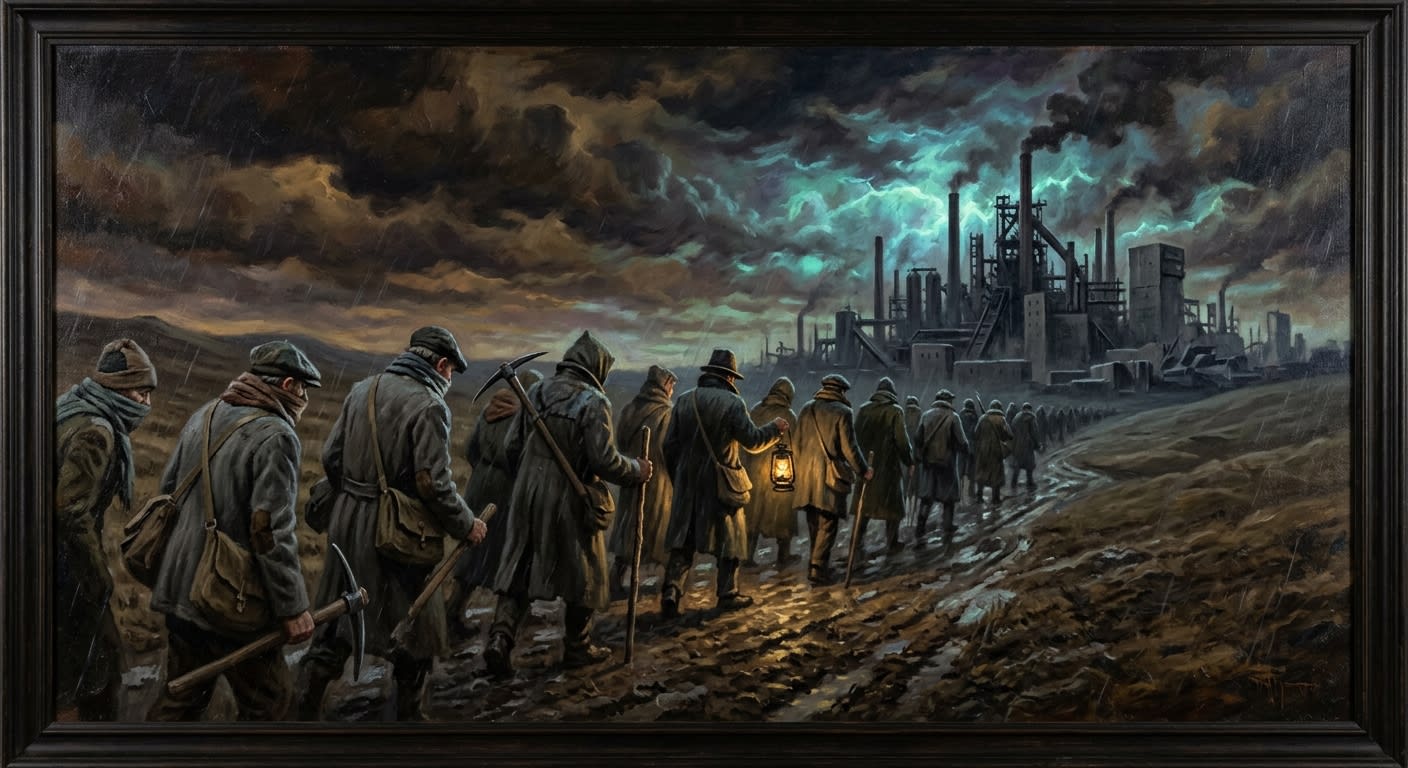
The Breathing is the name given by residents of Praga, the eastern district of Warsaw, to the low arrhythmic percussion that carries across the Polish flat corridor on clear nights and east winds. It is the front heard at a distance of one hundred and sixty kilometres: guns, bells, engines, ruptures, rail impacts, trench drums, and whatever else the east has learned to exhale through mud. The Bureau of Doctrine has forbidden the name. This prohibition has enjoyed the usual success of prohibitions issued against weather, hunger, and mothers.
Doctrine's ruling is simple. Naming a sound grants it civic existence. Civic existence produces files. Files produce budget claims, pastoral obligations, unofficial cult language, children's rhymes, diagnostic categories, and the sour little dignity by which populations begin to possess what frightened them. The Bureau prefers unpossessed fear. It moves more quietly through the streets.
The residents continue to say it. They say it in kitchens, stairwells, coal queues, rail canteens, and the narrow spaces behind bakeries where men smoke after second shift and pretend they are discussing flour. Children learn the sound before they learn the catechism. They sleep through it because familiarity is the first mercy poverty invents. They wake when it stops.
#On Its Passage Across the Flatness
Sound loves flat country. The corridor between Bastion-Brest and Warsaw gives it a table on which to crawl: open fields, winter stubble, low villages, rail embankments, no kindly mountains to break the transmission, no deep forest to swallow the pulse. The official acoustic surveys call the phenomenon an aggregate of distant military activity. The phrase is accurate in the manner of a death certificate that lists “loss of blood” while omitting the axe.
On clear nights the pulse arrives under the city rather than over it. Window glass gives the first notice. Then cup rims. Then the iron rails. In Praga, sleepers claim the sound rises through the bed frame, through the ribs, through the jaw. The old city hears it only when the wind is east. The wind, according to one night porter at the Hotel Sigismundus, is always east.
The Bureau of Bells has measured intervals in the Breathing and refused to publish the sheet music. The Bureau of War calls it operational noise. The Rail-Confessor Corps calls it Category G, a drawer for men who ride the eastern spur and return with sounds inside them. The Bureau of Medicine calls the aftereffects sleep disruption, anticipatory waking, and front-adjacent acoustic fixation. Praga calls it Tuesday.
#On Children Who Wake at Silence
The adult may pretend. The child cannot. Children of Praga sleep through the Breathing because they have never known a night entirely without it. The sound enters infancy as hearth rhythm, rail rhythm, parental whisper, boiler knock, street cough, and distant War stitched into one rough lull. It is ugly, but ugliness repeated becomes furniture.
Silence is the intruder. When the east falls quiet, children sit up. Parents listen. Yard dogs stop before men do. Kettles seem indecent. The whole district holds itself in the dreadful posture of a clerk waiting for a superior to notice the missing folio.
A Bureau of Settlement pamphlet described nocturnal silence in forward-adjacent districts as “a natural opportunity for restorative calm.”
Corrected. In Praga, silence from the east is not calm. Calm has a domestic scent. This silence smells of unopened orders.
The fear is practical. Noise means resistance, exchange, bombardment, movement, and the continuing existence of distances between Warsaw and the Line. Silence may mean fog, suppression, breakthrough, misreporting, or a pause before something large enough to make sound unnecessary. The parents know this without lectures. The children know it by the way parents stop breathing.
#On Doctrine's Prohibition
The prohibition against the name belongs to Doctrine's oldest vanity: the belief that language is a gate and the Bureau holds all keys. Sometimes this is true. Names summon, wound, authorize, condemn, erase, and return with teeth. The Index Damnatus is not a pamphlet of manners. It is a kennel.
The Breathing irritates Doctrine because it has acquired significance without permission. No theologian coined it. No clerk ratified it. No saint bled conveniently onto a brass plate beneath it. The district heard the front breathing and named the fact. That is all. That is intolerable.
DOCTRINE MEMORANDUM — WARSAW ACOUSTIC TERMINOLOGY Unauthorized naming may produce ███████████ communal fixation. Children's repetition of the term correlates with ███████████ night waking. Recommendation: suppress term without creating martyr vocabulary. Marginal note, hand unidentified: “Too late. They say it kindly.”
The White-Mantled Inquisitors have not made a campaign of the word, which proves either mercy, prudence, or manpower shortage. A street-vicar may correct a child. A schoolmistress may mark the term in chalk and erase it. Mothers continue to use it while tying scarves. The Bureau has not yet devised a punishment suitable for pronunciation that occurs mostly in concern.
#On the Railway and the Men Who Carry It
The eastern spur transmits more than freight. Iron remembers vibration with unbecoming loyalty. Drivers returning from the Brest line report hearing the Breathing beneath the wheels even when the night is still. Coupling crews feel it in the palms. Signalmen hear it in telegraph wires after frost. A man can leave the line and bring the line with him. This is why the Rail-Confessors keep Category G: sins confessed by men who cannot distinguish memory from sound and sound from omen.
The Warsaw Standing Brigade treats cessation as a watch condition. No regulation admits this. Regulations prefer visible triggers, because visible triggers can be saluted by idiots. A veteran sergeant knows better. If the eastern pulse stops, he checks signal lamps, yard gates, ration queues, bridge posts, and the faces of children in windows. Especially the children.
#On Present Use
As of A.S. 201, the Breathing remains unnamed in official Doctrine copy and universally named in Praga. Its causes remain safely plural, which is the Bureau's preferred condition when singular causes would require singular responsibility. Guns breathe. Engines breathe. Wound-sites breathe. Men breathe until they do not. The east contributes its own instrument, and Warsaw receives the choir through brick, rail, glass, bone.
An unpublished Doctrine correction proposed replacing the term “Breathing” with “distant operational percussion.”
Rejected before circulation. Even the censor responsible appears to have realized that no child will wake in the night and whisper, “Mother, the distant operational percussion has stopped.”
Praga keeps the word. It keeps it because the word is useful, because fear shared under a name can be carried to the stove and set beside the bread, because a district undercounted by every Bureau has learned to count what reaches it in the dark. The Breathing continues. The children sleep.