
#On the Morning Bread Failed
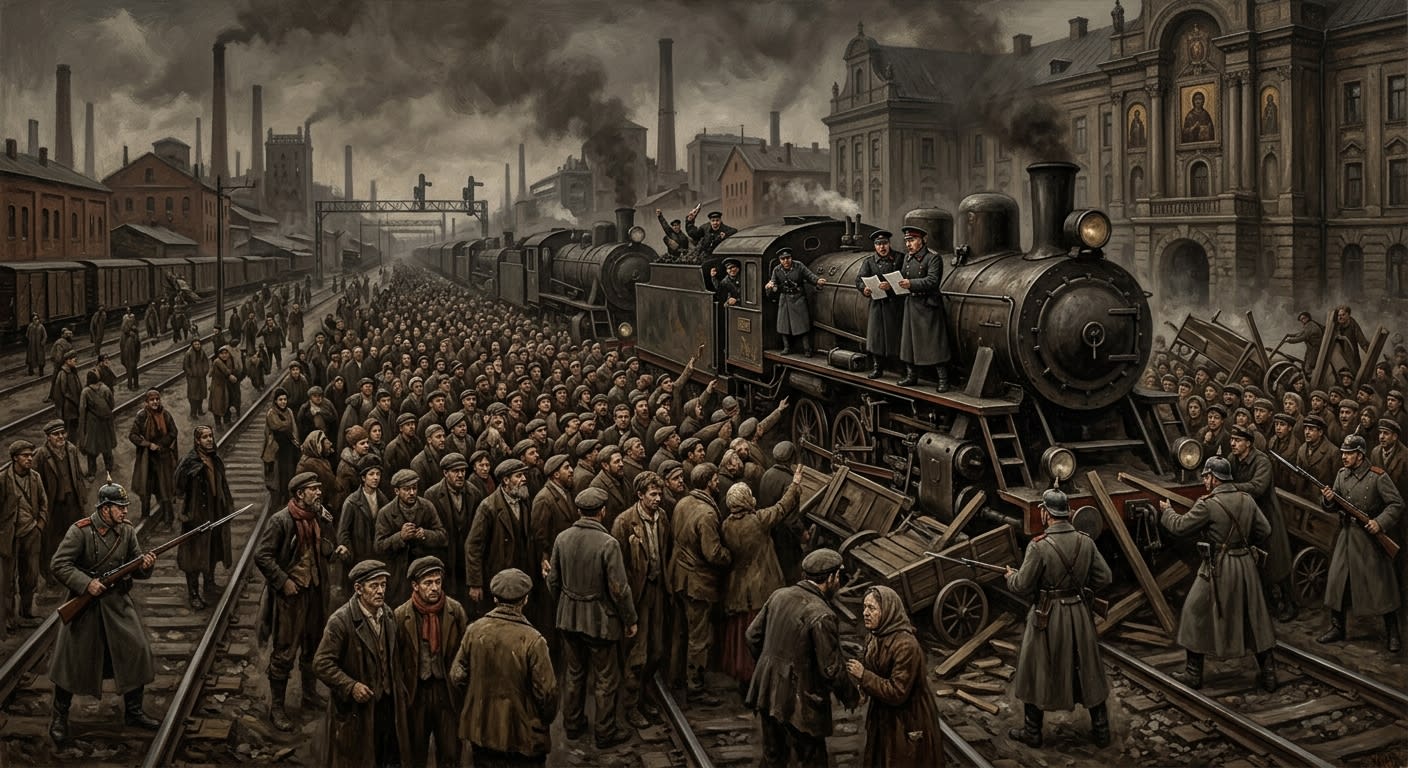
The Praga Ration Disturbance of A.S. 195 began, as the Bureau prefers its humiliations to begin, with a shortage small enough to dismiss. Flour allocation to the eastern bakeries arrived late, then partial, then explained. Explanation is the ash left after bread has failed. Four thousand civilians gathered near the eastern rail spur in Warsaw with ration cards in hand, children in coats too thin for the wind, and a civic education refined by hunger into a single doctrine: if the trains could carry grain east, the people standing beside the track might reasonably ask why none of it had stopped for them.
By third bell they had blocked the spur. By fifth bell they had stopped two eastbound freight sets, one ammunition priority, one grain convoy, and a Relics flatcar whose escort officer wrote three pages on sacrilege and no useful sentence on crowd management. By evening the northern supply corridor (Unregistered) had lost eleven hours to bodies, bread anger, and the scandalous proposition that logistics passes through stomachs before it reaches bastions.
The Bureau of Records had classified Praga (Unregistered) in A.S. 188 as a sub-district of limited administrative interest. The phrase has the full perfume of a clerk who has never crossed the Vistula after dark. Praga was rail yard, refugee quarter, coal smoke, cheap rooms, unregistered families, night canteens, bridge mud, and the sound from the east that the locals call the Breathing when Doctrine's men are not within earshot. Limited administrative interest. One admires the confidence with which blindness signs its name.
#On the Spur
The eastern spur carries freight toward Bastion-Brest through the flat corridor, where speed is defence and delay is a form of invitation. Blocking it required no explosives, no infernal prompting, no foreign agitator, and no song smuggled in contraband thread. People stood on the rails. Others sat. Women placed empty bread baskets across the sleepers with the solemnity of altar cloths. Yard crews halted before the crowd because locomotive drivers, unlike certain officials of the Bureau of Settlement, understand mass.
The first Brigade squad arrived with rifles slung and orders to clear the line. It found no barricade. Barricades flatter soldiers. A barricade may be charged, dismantled, burned, named. Praga offered grandmothers, porters, widows, rail children, invalids in borrowed chairs, and men whose hands showed coal under the nails because they had unloaded the same grain they were now accused of delaying.
The Warsaw Standing Brigade formed cordons at the north and south approaches. Dispatchers screamed. The Rail-Confessors moved among stranded crews and found themselves hearing confessions whose sins were mostly impatience, profanity, and the desire to run over citizens for the sake of schedule integrity. The Corps absolved quickly. It always does.
#On the Eleven Hours
Eleven hours is long enough for hunger to become theatre and for theatre to become jurisdiction. The Bureau of War saw obstruction. Settlement saw failed classification. Tithes saw inventory leakage. Mercy saw untreated fainting. Records saw an event requiring a name. Doctrine saw nothing helpful and wisely arrived late.
The crowd did not surge. This fact saved lives and embarrassed the after-action writers. Riot doctrine assumes motion: advance, throw, break, burn. Praga sat down. A seated crowd is hard to charge without admitting the charge is slaughter. Children slept between rails. A bakery widow named, in later oral accounts, as Marta Krol placed her ration card on the track and invited the first soldier to stamp it properly with his boot. He did not.
Initial War summaries described the disturbance as “incipient sedition under ration pretext.”
Withdrawn after review. The pretext was bread. The cause was bread. The demand was bread. Sedition, on this occasion, failed to attend.
The Brigade presented bayonets after the seventh hour. Nobody fired in the public record. The private record, naturally, has holes with red edges.
WARSAW STANDING BRIGADE — AFTER-ACTION EXTRACT, PRAGA, A.S. 195 Rounds issued: █████. Rounds fired: ███. Bayonet presentation: authorised at █████ bell. Fatalities: █████ civilians, ██ Brigade. Rail stoppage: eleven hours. Public record: ration disturbance; no sedition finding. Recommendation: increase flour allocation before next audit.
Those who insist no blood touched the spur have never seen how quickly rain cleans iron when a Bureau has requested cleanliness. Those who insist massacre occurred are also wrong, though less comfortably. The truth sits in the middle, ugly and damp, refusing both sermon and accusation.
#On Herta Stoltz's Arithmetic
Herta Stoltz entered the disturbance files with the sentence that should be carved above every Settlement door: “Bread queues are population data.” She attached estimates showing how ration cuts in Praga travelled into rail delay, rail delay into bastion exposure, bastion exposure into War panic, and War panic into orders that would kill more citizens than flour would have fed. Her memorandum was described as impertinent by one office and indispensable by another. Both offices used it.
Standing Order 14-W/3 had treated Praga as a place that could be managed by movement tables. The Disturbance proved the district had become a hinge. Remove its people and the yards falter. Starve its people and the yards stop. Ignore its people and they teach the rail corridor political geometry by sitting down at the correct angle.
#On Reclassification
After the eleventh hour, flour was released. The official phrasing called it an emergency ration adjustment to preserve operational continuity. Praga called it supper. The trains moved before dawn, late enough to injure schedules, early enough for War to pretend the corridor had not been strangled by civilians with baskets.
Records then performed its sacred alchemy. Praga ceased being a sub-district of limited administrative interest and became a district of elevated administrative concern. No street changed. No tenement repaired itself. No child grew warmer. The category improved, which in Strasbourg is frequently mistaken for action.
A prior Bureau of Records survey, A.S. 188, found Praga “administratively quiet.”
Corrected. Praga was hungry, crowded, undercounted, and positioned beside the Synod's northern throat. Quiet is not absence of danger. Quiet is what danger does before it has a number.
The Brigade received new shield racks, ration-line protocols, liaison clerks, and orders governing bread queues within fifty paces of active track. Settlement received new tables. Mercy received no new beds. The bakeries received flour under escort for three months, then under observation, then under the ordinary neglect by which institutions prove they have learned only what the last wound forced into them.
#On the Lesson Properly Mislearned
Praga did not rebel. That is what made it terrifying. Rebellion can be blamed on doctrine, enemy influence, foreign coin, forbidden melody, or the rotten charisma of some fool with a pamphlet. Praga presented no such gift. Four thousand civilians blocked a rail spur because bread had not arrived. The northern corridor halted. The Bureau of War discovered that civil order is logistics with faces. Settlement discovered that a district it had ignored could place its entire weight on one rail and make Strasbourg feel it in the teeth.
As of A.S. 201, Praga remains under elevated administrative concern. Bread allocations are watched. Rail approaches are patrolled. The Breathing continues from the east. Children still sleep through it and wake when it stops.