
#On the East Bank Where Pretence Ends
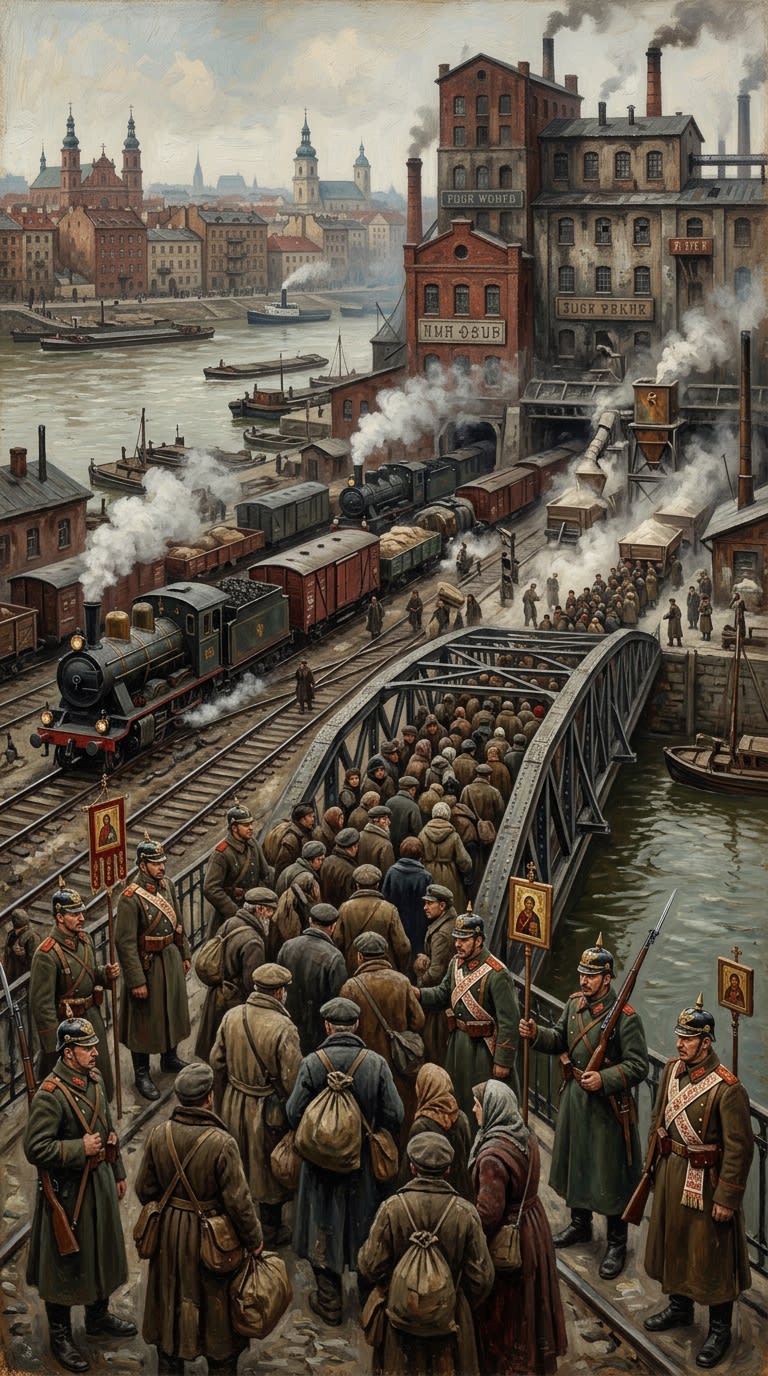
Praga is the eastern bank of Warsaw, three bridges and one quarrelsome ferry service away from the old city, close enough to the Bureau Quarter to be taxed, far enough from its linden trees to be described as provisional by men whose boots have never acquired its mud. It is rail yard, refugee quarter, coal smoke, bridge queue, bakery lane, night canteen, cheap room, unregistered child, and the place where Warsaw stops pretending that one hundred and sixty kilometres from the Sagittal Line is a comforting distance.
The old city has façades. Praga has walls. The old city has offices that call danger theoretical. Praga has windows that tremble when the east speaks. The old city hears policy; Praga hears the Breathing, which is less polite and more accurate.
Records classified Praga in A.S. 188 as a sub-district of limited administrative interest. That sentence deserves preservation in amber, or better, in the mouth of the clerk who wrote it while he is made to stand beside the rails during an east wind. Praga had already become the throat through which Warsaw fed Bastion-Brest and Bastion-Königsberg. Praga had already absorbed families whose villages had been improved into absence by maps. Praga had already learned to sleep through the front and wake when it stopped.
#On the Vistula Crossings
The Vistula divides Warsaw politely on maps and rudely in practice. Three bridges bind Praga to the old city, with the ferry service operating beneath them like an elderly argument the Bureau of Passage has been trying to win since A.S. 110. Passage wants gates, queues, writs, lane ropes, ferry audits, and names that survive damp weather. Praga wants to cross before shift bell, before curfew, before the bread line thins, before a child’s fever decides the office hour has passed.
The bridges are administrative instruments before they are architecture. Westbound, they sort bodies into categories: worker, dependent, soldier, unregistered, ferry-delayed, quarantine-suspect, rail-priority, widow with incomplete papers, child attached to widow unless challenged. Eastbound, they return the same bodies exhausted, carrying ration sacks, coal scraps, repair tools, rumours, stolen minutes, and the news that some office west of the river has discovered a new reason to call them temporary.
The ferry is worse, which is why it is loved. A bridge can be closed by decree and guarded by soldiers who enjoy straight lines. A ferry has fog, ropes, bribes, boatmen, wet planks, misplaced tags, and a long memory for favours. The Bureau posts auditors. The auditors grow cold. The boatmen outlast them. Somewhere beneath the official ferry table lies the true table, kept in heads, hands, and grudges: who crosses first when the baby coughs, which rail crew may jump the rope, which coffin is actually a crate, which crate is actually a coffin, which Passage clerk accepts fish, which one prefers silence.
A Passage memorandum describes the Praga crossings as “substantially regularised under ferry and bridge supervision.”
Corrected. The crossings are supervised. Regularity remains aspirational, seasonal, and dependent upon whether the Vistula is behaving with more civic discipline than the offices beside it.
#On the Rail Yards and Their Hunger
Praga begins where the rail yards begin, and the rail yards begin everywhere. Track runs behind tenements, beside canteens, through coal lots, under bridge approaches, past chapels whose bells have learned to time themselves between departures. Children in Praga know the difference between an eastbound grain set and an ammunition priority by the labouring rhythm of the wheels. Dogs know which whistles mean food dropped from platforms. Women know which crews will trade flour sweepings for coffee, and which quartermaster will report the trade unless his own sister is short.
Warsaw’s annual throughput is counted in millions of metric tons by offices whose tables do not smell of coal. Praga counts it in shifts, back injuries, flour dust, soot collars, missed funerals, broken couplings, and the number of times a man may unload grain bound east while his own bakery queue receives explanation instead of bread. That number is finite. A.S. 195 proved it.
Warsaw Eastern Yard (Unregistered) — Praga Function. Traffic: grain, ammunition, personnel, Relics freight, classified War cargo, coal, repair iron, ration flour. Civilian dependency: bakeries, canteens, washeries, coal sheds, night lodgings, bridge markets. Security: Warsaw Standing Brigade, rail wardens, Passage lane clerks, Rail-Confessors. Operational weakness: hunger beside active track.
The Rail-Confessors move through Praga like grey moths with soot on their hems, blessing departures in eleven seconds and hearing sins in ninety when the timetable permits such luxury. Their booths stand near the platforms, and men who cannot stop their engines lean out for absolution with one hand on the throttle. Praga has little patience for slow holiness. It accepts sacraments that know how to run.
#On the People Settlement Failed to Move
The Bureau of Settlement ordered Warsaw to thin itself under Standing Order 14-W/3 in A.S. 95. Praga answered over the next century with rooms, sheds, bakeries, coal nests, canteens, illegal lofts, registered hostels, unregistered cousins, and grandmothers who refuse to relocate while soup remains possible. By A.S. 201 the district has become a machine for turning refugees into residents before Settlement can finish calling them provisional.
Families arrive by bridge, ferry, cart, rail siding, or rumour. Some come from Bug River settlements whose names survive only as corrections in Records margins. Some are garrison dependents displaced by transfers. Some are discharged soldiers who cannot bear the heartlands because silence there feels accusatory. Some are Poles from the flat villages west of the Line, carrying icons, pans, bad papers, and the particular fury of people who have obeyed evacuation once and will not be fooled by arrows twice.
Herta Stoltz understood Praga because Stoltz understands bakeries. The Order assumes that people told to leave will leave. Praga demonstrates the counter-doctrine: people told to leave may borrow flour, sell rolls, hire nephews, shelter cousins, and become infrastructure before the next review cycle. Settlement maps dislike this. Maps prefer arrows. Bakeries prefer dawn.
SETTLEMENT REVIEW EXCERPT — PRAGA CLEARANCE PROJECTION, A.S. 198 Households requiring removal: █████. Rail labour loss: ████ workers. Bakeries affecting yard ration continuity: ███. Mercy overflow: ███ beds beyond capacity. Civil-order risk: word “unacceptable” struck by War reviewer; replaced with █████████. Recommended language: phased reassessment.
Praga’s population is impossible to count honestly and easy to undercount usefully. Registered residents occupy the ledgers. Unregistered residents occupy the rooms. The Bureau knows this. The Bureau pretends surprise whenever a ration line exceeds the official estimate, then commissions a review, then files the review beneath other reviews until hunger performs field correction.
#On Bread, the Spur, and A.S. 195
The Praga Ration Disturbance of A.S. 195 began when flour failed the eastern bakeries. Late, partial, explained. Four thousand civilians gathered near the eastern spur with ration cards, thin coats, empty baskets, and a civic thesis even a colonel could understand: grain passing through Praga might reasonably stop in Praga before continuing toward glory.
By third bell the spur was blocked. By fifth, two freight sets, one ammunition priority, one grain convoy, and a Relics flatcar stood idle while the Bureau of War discovered that logistics has ankles. People sat on rails. Women placed baskets across sleepers with altar-care. Children slept between iron lines. The first Brigade squad arrived with rifles and found no barricade to flatter its training. It found grandmothers. Infantry manuals are poor against grandmothers.
Eleven hours passed. War saw obstruction. Settlement saw population data arriving rudely. Mercy saw fainting. Records saw an event requiring a name. Doctrine arrived late, which is the nearest it came to wisdom that day. Stoltz wrote the sentence that should be engraved above every Settlement office: bread queues are population data. Flour was released after the eleventh hour under the phrase emergency ration adjustment to preserve operational continuity. Praga called it supper.
Initial War summaries described the disturbance as incipient sedition under ration pretext.
Withdrawn after review. The demand was bread. The cause was bread. Sedition, on this occasion, displayed enough taste to stay away.
Records reclassified Praga after A.S. 195 as a district of elevated administrative concern. No tenement repaired itself. No bed appeared in Mercy. No child grew warmer. The category improved, which Strasbourg often mistakes for action because Strasbourg is rich in categories and poor in shame.
#On the Breathing
At night, Praga hears the east. The sound crosses the Polish flatness under cold rail and clear wind: guns, bells, engines, ruptures, trench drums, iron impacts, and the throat-noise of a war that has not learned discretion. The district calls it the Breathing. The Bureau of Doctrine forbids the term. The term persists, having the unfair advantage of being true.
Window glass knows first. Then cups. Then bed frames. Then ribs. The sound is not always loud; loudness would be theatrical, almost vulgar, and easier to dismiss. The Breathing is intimate. It enters walls as if Praga were an instrument tuned by the front. Children sleep through it because they have never known a night without the pulse. They wake when it stops.
Silence is the true alarm. Noise means resistance continues somewhere beyond sight: batteries firing, engines labouring, bells answering, men ruining the east with sufficient vigour to keep it east. Silence may mean fog, breakthrough, signal failure, suppression, or a pause before something enormous signs the horizon. Parents in Praga do not need Doctrine to explain this. Their children sit up in the dark before the dogs begin.
#On the Present Condition
As of A.S. 201, Praga remains elevated in administrative concern, watched by Records, cursed by Passage, needed by War, measured by Settlement, served badly by Mercy, and corrected by Doctrine whenever Doctrine can find a child small enough to bully and not surrounded by aunties. Bread allocations are watched. Rail approaches are patrolled. Bridge lanes carry more chalk than stone in wet months. The ferry continues to obey the Vistula, which is older than the Bureau and less impressed by seals.
The district has no single centre. Its heart moves according to need: the eastern spur when grain is late, the bridge approaches at shift change, the bakeries before dawn, the canteens during snow, the tenement windows at night when the Breathing travels through the frames. Power in Praga is not held in a palace or registry. It rests in the practical custody of those who know which door hides a fever bed, which coal shed shelters unregistered cousins, which rail foreman lies mercifully, which Passage clerk has a mother east of the river, and which bakery can stretch flour with potato without starting a riot.
Praga is dangerous because it is necessary. This is the worst kind of district for a state that prefers obedience without dependence. Remove its people and the yards falter. Starve its people and the yards stop. Ignore its people and they sit on the rail at the correct angle, proving that the northern corridor passes through stomachs before it reaches bastions.