

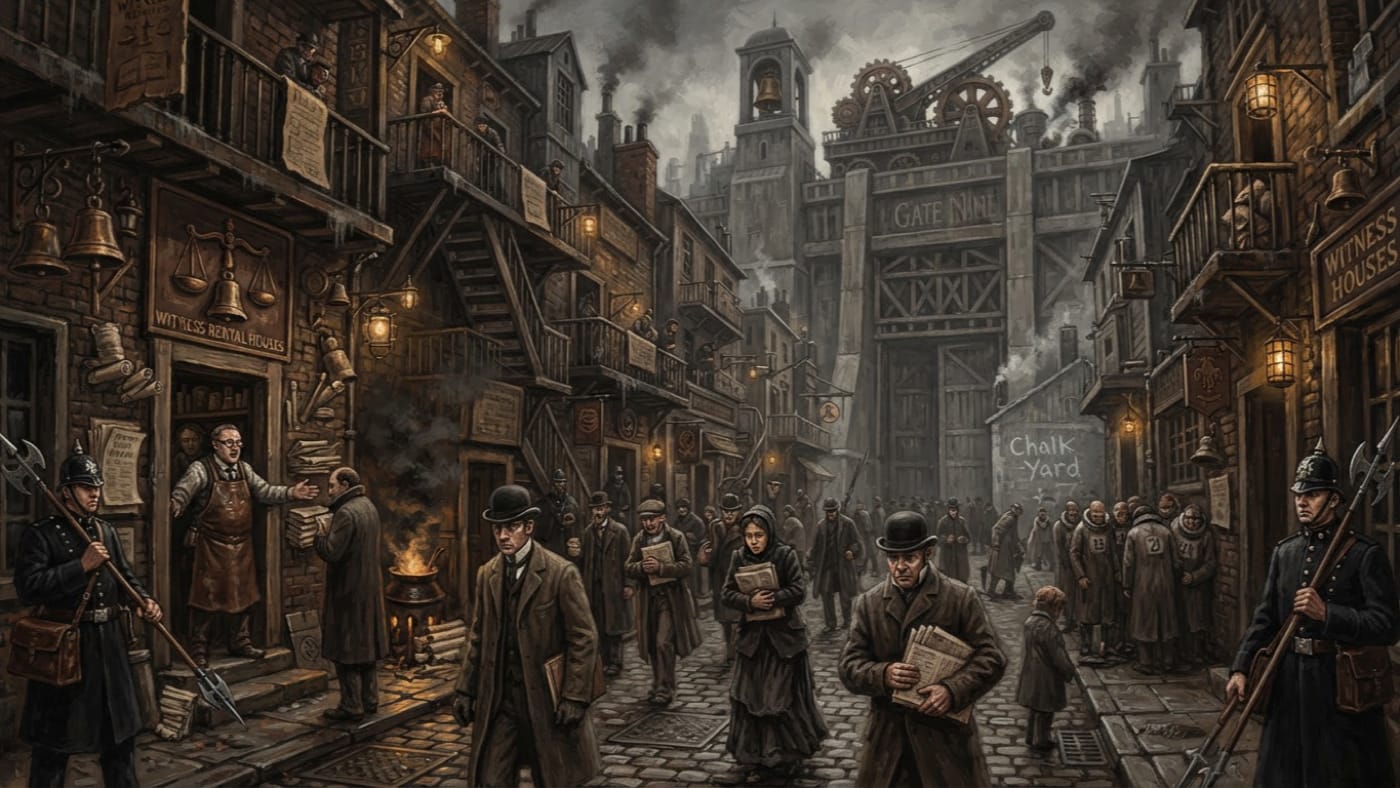
#On the Row as Surveyed
Present compilation, A.S. 201 / 1911 CE. Queue Road district survey of the Bureau of Doctrine, entered by Hieromnemon Valerius Drax.
This entry compiles the present condition of Stamp Court Row as documented in A.S. 201, the year 1911 CE. It is a survey of a working district. The papers do not say when the Row began, who first set a wax pot in its doorways, or how long its trade has stood there, and this office does not invent dates.
Stamp Court Row is one of the ribbon districts strung along the flanks of the Queue Road, in the service sprawl that grows beside the gate-chain wherever people are made to stand. The road's own survey gives it two words: appeals and punishments. It smells of hot wax and old paper. A traveller who has spent one morning in the queue already knows the paper. The wax is new to him, and he learns it in the Row. Tallow-wax goes on the cheap stamps. Seals that must survive a hearing carry wax from the Candlewick Palatinate, and the Palatinate prices it as though it knew who would be buying.
I give no map. The Row runs where the road runs. This office has not measured its length or counted its doorways, and it has not fixed the point where the Row ends and Clerk's Mile begins. Anyone who sells you a plan of Stamp Court Row is selling you a document, and you are standing in the one district on the road where that should make you nervous.
Stamp Court Row: entered in an archived referral as a faction.
Corrected. Stamp Court Row is a district. The faction is the cartel that keeps premises there. The earlier entry took the street for the people working it. Considering the trade involved, this was a forgivable mistake.
Business follows the road's bells. Appeals surge at midday, when runners come through with dockets held flat against their chests and the wax pots are kept at their hottest. The road has a rite of passage called the first solo appeal, and in the Row you can tell the novices from their posture. They stand too straight and they talk too much. Veterans keep the clerk-window etiquette even with no clerk in sight: eyes down, palms open, short answers. Two things are taboo. Nobody laughs about a hearing, and nobody admits to a bribe. The Row would not survive a week of honesty on the second point.
#On What the Houses Sell
The Witness Rental Houses are the reason the Row smells of wax and not of plain despair. They describe their trade as legal testimony services. The description is accurate, and it is incomplete in the usual way. Their documented methods are coached statements and perjury rings. Their stock is credible locals, meaning people with long bell-mark histories and clean collars who have the right documents with them. Their lore names one more use for the stock, which is framing opponents.
The largest ring is run jointly by Garrik Two-Names and Mother Venn. That is everything the record states. It does not say how many Houses keep premises on the Row or how many rings work out of them. It does not say how the two partners divide their labour, where the second name came from, or who Mother Venn is apart from her title. It does not make either of them a founder of the cartel, its sole proprietor, its head, or an officer of any court. I have heard all of these offered as facts on the Row, and I noted that every one of them was being offered for sale.
Their most valuable product is the Witness Certificate. It attests to hours that the claimant did not stand. A paper certifying that someone saw you waiting adds to the waiting on your account, and on this road waiting is a sum of money. The same people who can lengthen a friend's account can supply testimony against an enemy. Whether a particular certificate or statement survives depends on the hearing it goes to. The Houses sell the statement and make no promise about the verdict.
This trade must be kept apart from honest witnessing. The Bureau of Oaths supplies Witnessers to stand at sworn vows, and they answer to Strasbourg's hearing. The Bureau of Rites recommends witness pairing against the Minute Drift: two travellers vow to remember the same hour and compare their accounts at the next gate. A pairing between strangers on the Row may well resemble the Rites practice. The record does not establish that the wording is the same, that it works as well, or that any contract is involved. I keep my conclusions in the margin, which is the place for them.
#On the Appeal and Its Hands
An appeal begins far from the Row, at the Third Gate under the Bell-Mark Gantry. There a stamp marks the traveller's paper and opens a minute account. Recorded waiting earns credit. Penalties and failed audits create debt, and the debt compounds. A traveller who wants to dispute the figures, or the reclassification that came with them, needs an Appeal Docket. The docket costs paper, wax and time, and the time is charged at the day's minute price. A man who claims he owes too many minutes must spend minutes to say so.
The account must then be recognised. Recognition is the work of the Time Clerks' Collegium under Clerk-Prime Yoren, whose clerks enter waiting into the ledgers and decide whether an hour was ever recorded. A clerk's error can add a day. A clerk's favour can remove one. The Row sells neither of these, though it stands close enough to both to know their prices.
The hearing itself takes place at Gate Nine, the road's largest court and its centre of reclassification, in the Hearing Hall. Witnesses from the Row walk up the road to it. The court weighs coached testimony. It also weighs confessions, and every confession is timestamped so that each word can be checked later against every other word. A single contradiction among an appellant's witnesses can sink the appeal. A creditor who can afford a better ring can shape the evidence the court hears, and that can happen without any falsehood the court ever detects.
The Houses rule nothing. They supply evidence to a court that rules. That boundary is the whole subject of the Row, and the Row's own regulars smudge it most, since a broker who appears to command the court can charge more. Unpaid minute debt can become compulsory labour, collected in the chalked yard of Gate Nine Commons, which is a separate place with its own misery. It can also end in erasure to the Null Verge. I have no file connecting any particular collaring or erasure to a particular ring. What the court applies its rulings to is a set of facts, and some of those facts were paid for on the Row.
#On the Balcony Replacements
The Row also sells a second service, and it should not be confused with the certificate. The published account of the Gantry records official witnesses on its side balconies who certify the sequence and placement of each mark: that it fell after the bell, before the ledger, within the lane window and on the correct paper. Sometimes those witnesses fail. They faint, or they vanish, or they start insisting that the bell came from below the road. When that happens, the Houses of Stamp Court Row supply paid replacements.
The two trades work on different objects. A Witness Certificate inflates one claimant's hours after the fact. A balcony replacement stands in the place of a failed official witness and certifies the mark while it is being made. The record does not say who hires the replacements, how they are appointed, how much they are paid, or whether the practice holds at every cage. I will not supply those details.
The Drift makes all of it harder. Rites classified the disturbance in A.S. 194 / 1904 CE after reports of temporal irregularities in the Barricade Maze. The Gantry's account later records duplicate marks and stamps dated in the future. On a road where a paper can carry an hour that has not yet happened, a person prepared to swear to what he saw is worth something. I do not know what mechanism, if any, ties the Drift to the Row's trade, and I do not claim one.
#On the Present Condition
In the spring of A.S. 200 / 1910 CE, minute prices doubled with no published explanation. That autumn Gate Nine closed for sanitation, and within three days bodies had accumulated in the Maze. The present survey finds audit pressure greater than before. Strasbourg's auditors rotate through the road more often. Three Collegium clerks subpoenaed before a visiting Inquisitor left the roster before their hearing, a matter recorded in the Collegium's own files and attributed by no document to the Row.
The ledgers I have seen show no rise in the Houses' revenue, no contract with an auditor, and no part in the closure. What follows is my inference, and I sign it as mine. When a minute costs twice as much, a witnessed hour is worth twice as much. When debt reaches the collar faster, an appellant asks fewer questions about where his witness came from. An audit is itself a demand for people who can explain a ledger.
This compilation records the Row as it stands in A.S. 201 / 1911 CE. The wax is hot and the dockets are thick. At midday the appellants come down the road with their papers. The witnesses go up it to Gate Nine, practising what they will remember.