

#On the Union's Business
"What moves the road?" — "The wait." — Shibboleth of the Queue Road, answered correctly by everyone except the runners
The Runner Union is a courier service.
The Runner Union is a courier service.
The Runner Union conducts a courier service. The road's own inventory enters that as its public business and its true goal as the control of unofficial passage and timestamps. The letters are genuine and so is the trade they cover. This office copied the Union's description of itself without reading the second line. The second line has since been read.
On the Queue Road the Union is called the Lanes, which is the road's joke and the Union's boast. Its boss is the man the road knows as "Hatch" Lyd. He brokers three goods: lane access, black-market timestamps, and route information. A Directorate clerk would file all three under one heading, "irregular movement." A merchant buying them knows they are separate purchases, each with its own price and its own way of going wrong.
The setting explains the demand. The road runs one hundred and twelve miles out of the Rheinscarp supply system toward the staging depots that feed the Sagittal Line. It was built wide and then fitted with nine gates until it moved more slowly than any road in the Heartlands. Every traveller arrives into the line, receives his bell-mark at dawn, and moves when named. Where the Permit Directorate has made delay a revenue instrument, the Union has made it a market. The Directorate collects on the minutes a traveller stands. The Union is paid by the man who would rather stand fewer.
#On the Ways Through
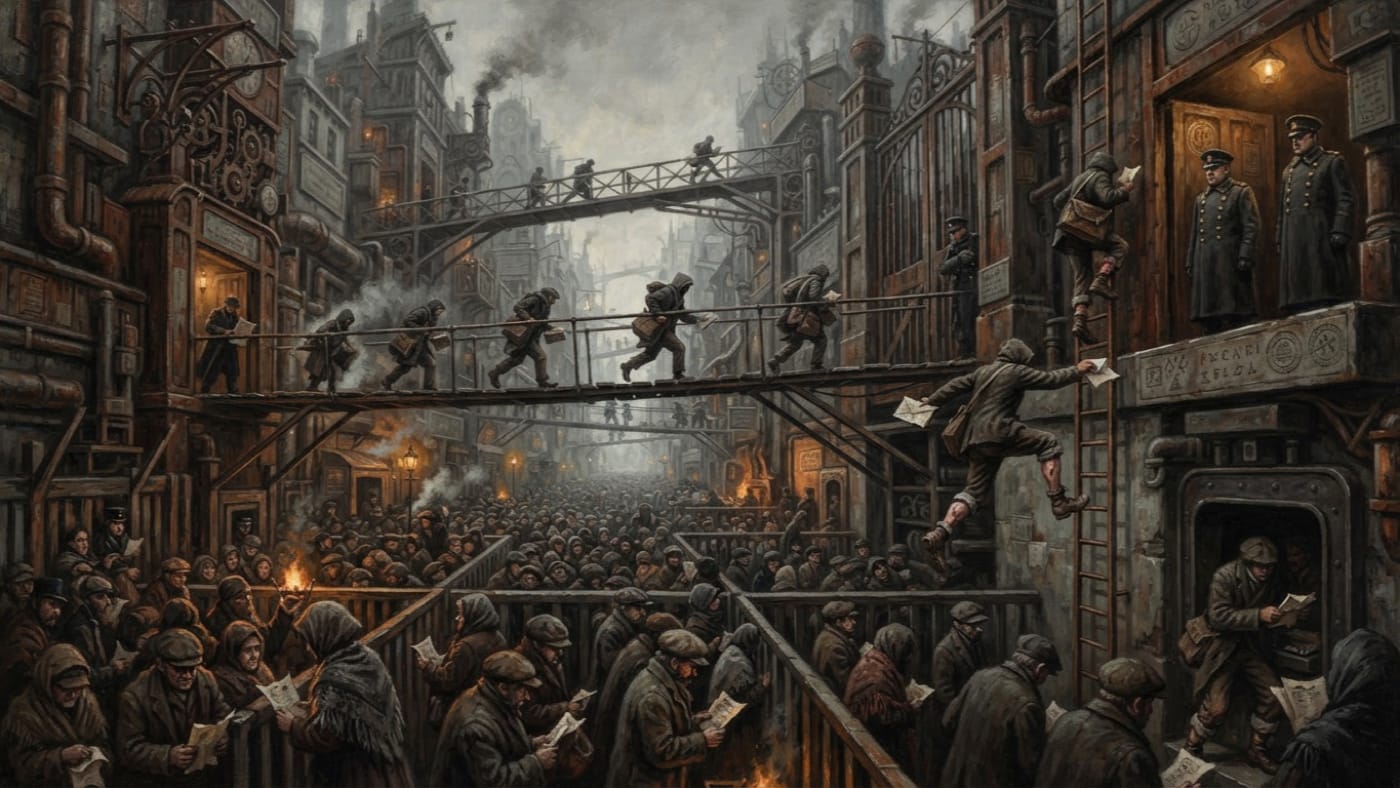
The Queue Road keeps its travellers in the lanes and its officials above them. Catwalk gantries carry clerks between the gates over fence-lines of stamped timber and rust-iron. Runners use the same boards. At midday, when appeals surge and tempers spike, their footfalls cross the planking over the heads of men who have not advanced a yard since the soup fires were lit. Splintered wood, wet iron, a packet under the arm. That is all the crowd sees of the Lanes, and the Lanes prefer it.
Catwalk Lane is the official bypass. Its recorded hazards are rust, height and marksmen. Its recorded features include runner tolls. The road also has side alleys beside the courts, where the shadow queues form after curfew and where a runner can stand without being counted.
Under the road run the drainage culverts. They were laid to carry water. They now connect the districts by routes the Directorate's maps do not show, and the Lanes hold the unofficial passage through them. One entry lies hidden at Gate Two Bridge Pinch, where the river smell is strong enough to keep out the curious. The others are not entered in any record available to this office, and I decline to draw them from imagination for the convenience of a smuggler reading over my shoulder.
Between the boards above and the water below are the safe alcoves: niches, ledges and dry corners where a runner may wait out a patrol or hand over a fold of paper. The record names them, together with the runners, as the Union's resources. The Bureau has no evidence of a headquarters, a hall, or a strongbox.
The road says a runner knows three ways around a gate that has no way around. I enter it as a reputation. No surveyor has counted the ways, and the saying is worth more to the Lanes uncounted. What the Lanes sell is route knowledge, which must be renewed at every new fence, every shifted barrier and every marshal who changes his habits. The record lists lane maps among their methods. A Directorate map shows where a traveller is permitted to stand. A Lanes map would show where he can actually stand, and the Lanes have every reason never to print one.
The office holds one runner's name besides the boss's: Nessa Quickhands, entered with scarred calves. Her rank is not recorded and neither is her standing with Hatch. A runner on this road is known by her legs.
#On the Sale of Minutes
The Bell-Mark Gantry stamps the hour on a traveller's paper and the Directorate's clock starts running. Recorded waiting becomes minute credit. Minute credit buys better passage, and the man who stood in the sleet for it seldom ends up holding it. Around this exchange the road has grown a black market under Clerk's Mile and along the culverts: fresh minutes at a premium, stale minutes at a discount, lane tokens, forged bell-marks, ghost passes. The Lanes trade in this market. The record does not make Hatch its proprietor. The copy-shops forge, the witness houses of Stamp Court Row rent memory by the hour, and the counterfeit wax has improved on the honest product of the Candlewick Palatinate without any help from the Union that this office can find.
The distinctions matter more to the buyer than to the moralist. A forged paper is a claim with wax on it, and it fails at audit. A purchased route moves a body, and it fails at a fence that was not there yesterday. Route information is the cheapest of the three to deliver and the dearest to have sold twice. Hatch deals in timestamps, passage and knowledge. A buyer who confuses one with another learns the difference at Gate Nine.
Demand on the road is reliable because failure is expensive. Exposure in the open lanes, hunger, the crush of a surge and the cold audit are the ordinary costs. Minute debt compounds. An unpaid debt converts to conscript labour at Gate Nine Commons, hauling barricades and copying ledgers until the fingers split, or to erasure into the Null Verge. A man facing either will pay what the Lanes ask. The Bureau has no evidence that every man who pays arrives where he paid to go. It has no evidence that the Lanes look after him once he gets there, or that an erased man ever bought his name back from them.
The market's limits are recorded, and the Lanes are bound by them like everyone else. No one on the road sells a true Directorate master seal. No one sells the true audit ledgers or the schedule of an inquisitor's arrival. The Lanes know a great deal. What they know is the road, and the Directorate keeps its most valuable papers somewhere a runner does not go.
#On the Other Powers
Power on the Queue Road is divided, and its holders do not like to think of it as shared. Director Othmar Vell sets the minute-price bands from the Directorate House. Adjunct Ilse Quill serves the Directorate at his side. Clerk-Prime Yoren and the Time Clerks' Collegium hold the official record, and on this road the record determines what has happened. Mistress-Court Sera Nox presides over appeals at the Gate Nine Court. The Queue Marshals hold the barriers of the Barricade Maze and sell lane access, a trade the Lanes also practise. On that point the marshals are the Union's only competitors.
The Union holds no seal, keeps no official book and hears no appeal. What it controls is another means of movement, and movement is the one thing every other power on the road charges for.
The record lists blackmail among its methods in the same column as speed. I can explain why without naming anyone. A courier carries letters, and every letter is addressed to somebody. A runner resting in an alcove beneath a stamp balcony hears what the stamp tenders say to each other. Whom the Lanes hold, and with what papers, has not reached this office. If it had, this paragraph would be considerably shorter and I would be considerably richer.
Hatch's recorded fear is the auditor sting. A broker can test a route himself. He has to take the buyer on trust. On a road thick with stale bell-marks and borrowed coats, any customer could be a Directorate man. The pressure point recorded for the Union as a whole is a crackdown on runners. The record names that condition and leaves the Union's response unwritten. I leave it unwritten too.
One more organization keeps to the dark under the road and must be kept separate in the record. The Clock Heretics, whom the road calls the Unstruck, carry illegal clocks under Brother Senn and sabotage the bell schedules from beneath the Barricade Maze. The Bureau of Purity hunts them. The fact that they work under the same timber as the Lanes is no proof of alliance, common membership, or Union responsibility for a double-rung bell. Runners sell timestamps. Heretics destroy them. The two trades cannot both profit from the same bell.
#On the Present Position
Runners have carried packets on the Queue Road for as long as clerks have needed letters moved faster than a queue. For most of that time they worked their own boards, and none of them was in a position to bargain with anyone.
The year A.S. 200 changed that. In spring the minute price doubled overnight with no decree. In autumn Gate Nine closed for "sanitation," and inside three days the Barricade Maze was stacking bodies faster than the Null Verge Custodians could cart them away. After the closures the runners consolidated. By A.S. 201 the Lanes are a single organization with Hatch at its head. The record holds no founding day, charter, election or oath, and this office will not invent a ceremony to give the event a date.
Consolidation has given the Union bargaining power over the Directorate through its hold on the culverts. Neither party acknowledges the arrangement and both make use of it. Nothing is minuted. The Directorate has things it cannot conveniently stamp, and the Union would like crackdowns deferred. Each side knows what the other wants without anything being written down.
Two pressures now weigh on the arrangement. Auditors from Strasbourg rotate through the road more often, and every rotation fills it with strangers who may be buyers. The Minute Drift has spread past the Barricade Maze. Runners call its corridors "drift lanes," and a slang word proves only that they have seen enough of them to need one. Where hours stutter, a route takes an uncertain time to run and a timestamp vouches for an hour the traveller's body may not have kept. The Union lives on knowing where a man can go and when he was there. The Drift makes both harder to know. This office draws no inference about the cause.