

#On the District That Boils the City's Sheets
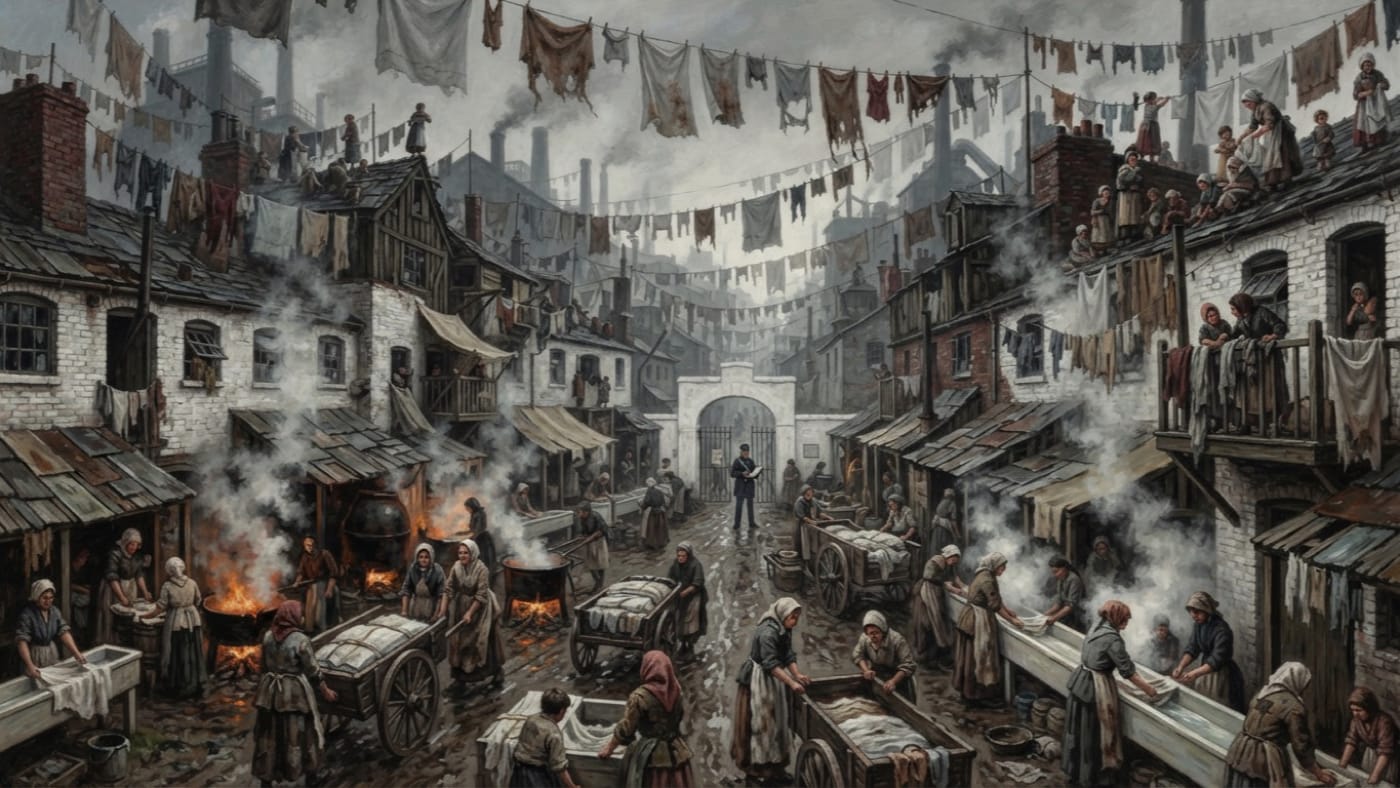
The coppers in the Suture Slums are lit before the intake bell rings, before the first wagon reaches the Wagon Quays, and before the painters drag fresh lime across the clean streets. Someone has hauled the water and someone has fed the fire with whatever it will take. When Marrowgate wakes to count its wounded, this district has already spent an hour boiling the city's sheets.
The Suture Slums house the inland medical port's debt-labourers. It is a district of damp timber and whitewashed brick, and it lodges the people who owe the city for their recovery close enough to their work that nobody wastes a bell walking there. They wash the White Ward's linen and boil its bandages. They push its carts, scrub its floors and carry its messages. When the kiln crews run short they go down at night into the pits of the Lime Yards. Take them away and the wards would drown in their own laundry within a week. Keep them, and the wards may go on believing that clean linen arrives by grace.
You can tell where you are by the air: damp wood, fever sweat, wet cloth, lye, vinegar. When the wind comes from the kilns there is also a dry, mineral taste on the tongue. The slap of washhouse work carries down the lanes like slow, wet applause. Linen hangs from every rooftop line the residents can rig, grey sheets and brown-spotted bandage rolls stirring above the alleys. A man who looks up sees the city's wounds drying against the sky.
Purity's raid captains like to treat the Slums and the Stitchmarket as one creature with two names. The cartel does work through the district, underneath it and often at its expense. A washerwoman is no smuggler because she sleeps above a tunnel. Rations and pain draughts change hands in Mercy Market. The beds are in the White Ward. The Slums house the people who keep both places clean, and the city has never seen any reason to house them anywhere better.
#On a District Nobody Founded
Marrowgate has a founding year. The Slums simply accumulated.
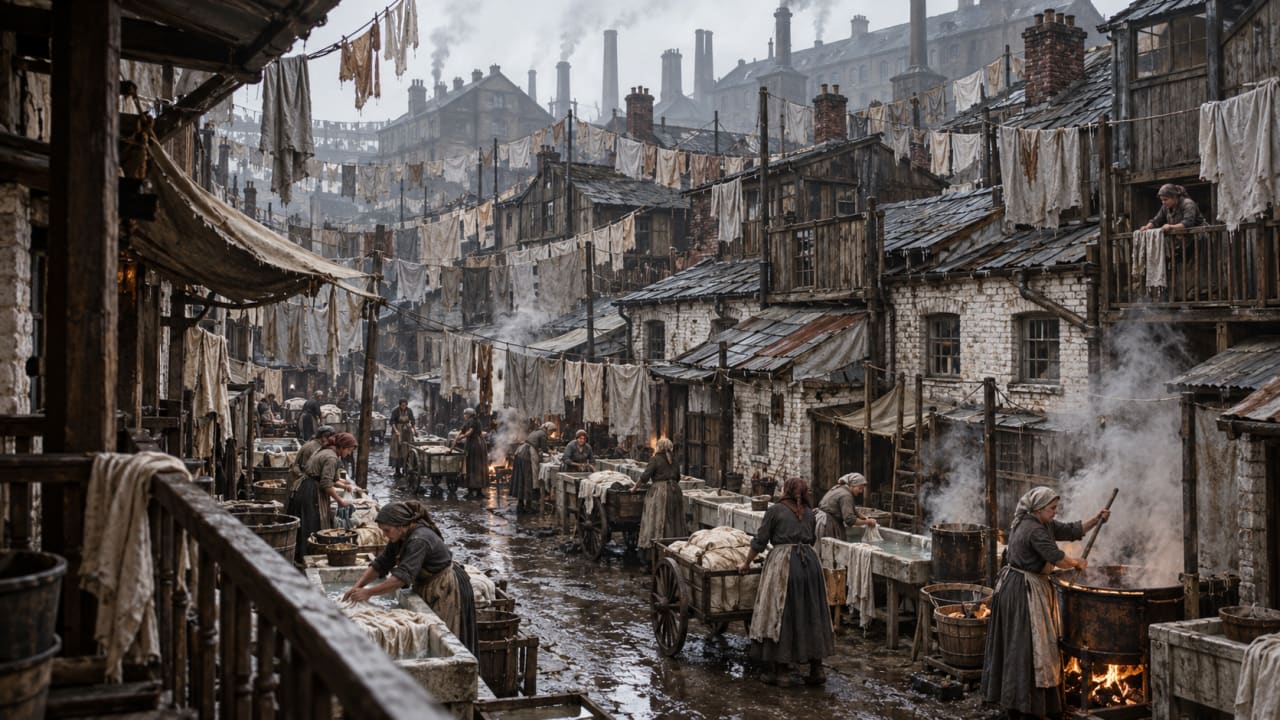
The city was made in A.S. 72. A nameless logistics officer of the Bureau of War took a failing river-market town on its low terraces and refitted it for the casualty trade. Wagon roads served as quays and a rail spur reached toward the casualty railhead. The river was kept for barges of lime, linen and sealed crates. The wounded needed what all wounded need: sheets, bandages, boiled water, broth, and someone to haul the soiled things away. The first washing was done wherever there was a fire and a drain, by whoever could still stand.
No charter records when those washers became a district. I have searched with the patience of a man who enjoys being let down by archives. By the time the Slums appear in the paperwork they are already there, the way damp is already in a wall. Anyone who offers you a founding date for the Suture Slums is selling something, probably out of a cellar.
The machinery that gathered around them can be dated. In A.S. 78, after the plague and the First Ossuary Panic, the Sanitation Chapter laid its first cordon, and the Lime Yards were fenced for good. In A.S. 83 the Civic Triage Tribunal was constituted to decide what a cordon could not: who received a bed, a saw, a broth card, a bill. The formal Synod settled itself in A.S. 90 and inherited a Marrowgate whose emergency offices had already formed habits. The Joint Mandate of A.S. 92 bound Tribunal and Chapter into one quarrelsome arrangement. It was revised in A.S. 187, once bed tokens, work prescriptions and prosthetic maintenance debt had grown beyond what ward staff could falsify politely.
Every one of these instruments made debtors, and every debtor needed a bed near the work. The Saint-Bone Melting Acts of A.S. 96 enlarged the kilns, and the kilns wanted hands. The Gray Clearance of A.S. 157 kept the Yards burning through a frozen winter and showed the whole city how fast a new category can empty a household. The Slums grew the way an ulcer grows: under pressure, without a plan, with the edges always slightly inflamed.
#On Timber, Lime and the Drains Beneath
The houses are built from whatever the medical port could spare after it had built the things it valued. The lower courses are whitewashed brick laid in bone-lime mortar. The Lime Yards supply that mortar, so a family's walls may hold a stranger's femur, and many do. The upper storeys are timber that never dries. The rust-iron gutters drip inside as faithfully as out. There is salvaged glass where there is any glass, and stitched canvas where there isn't. Tallow-wax seals around the window frames last a season before the damp lifts them.
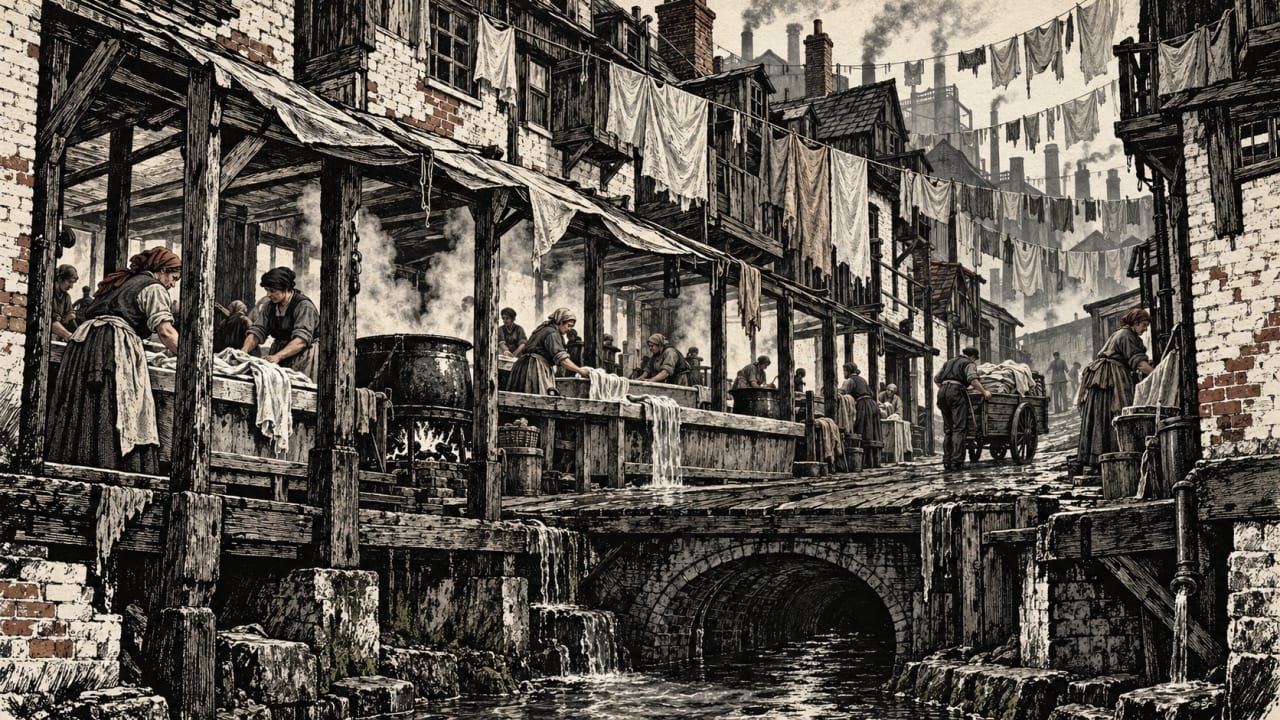
The lanes do not match. Some houses are brick to the eaves, the last of the river-market town. Others are timber lean-tos propped against older walls, roofed in tarred canvas and standing on posts that have started to rot at the foot. What they share is water. In flood season it rises out of the terraces. In every season it comes down from the gutters, and it comes in from the washhouses on the boots, hems and forearms of everyone who works there. Wood swells, plaster sweats and bedding mildews. The district's reputation for fever is earned in the wall before it reaches the lung.
Rooftop drying lines are the real architecture of the Slums. The wards refuse damp sheets, so every roof that can carry a line carries one, and the people light enough not to go through the boards climb up to peg and unpeg. In wet weather the lines come indoors. Families then sleep under the city's laundry and breathe whatever the boiling failed to kill.
The Suture Slums Washhouse is the best-known building in the district. Its floor is permanently wet. Its coppers run from before dawn, and the troughs and wringing boards are worn pale by forearms. Hiring happens there, and so do gossip and warnings: who has been reclassified, whose hearing moved, which inspector is standing at which corner. Grey water leaves through laundry channels under the floor and joins drainage older than any cordon, built by the river-market town and never properly mapped since. The lower rooms hold a night clinic behind whatever screen was cheapest that month. Every resident knows it is there. Officially, none of them has ever needed it.
The washhouse is one of several in the Slums. I will not give you a count. The Chapter's maps disagree with each other, and the residents know better than to correct the maps.
The routes through the district follow the laundry. Soiled linen arrives by cart from the White Ward. Clean linen goes back uphill toward the clean streets, where it must cross a white line under inspection. Part of the Slums presses against the southern wagon intake lanes, so a resident who steps out of a doorway may meet the stink of an arriving wagon before her own breakfast. The night road to the Lime Yards runs the other way, out past the last whitewash, and the kiln shifts walk it in silence.
#On How a Patient Becomes a Tenant
Nobody is born a debt-labourer in the Suture Slums. Some are born into the Slums, which is a different misfortune. Most arrive by a route the Tribunal would call lawful, and it is.
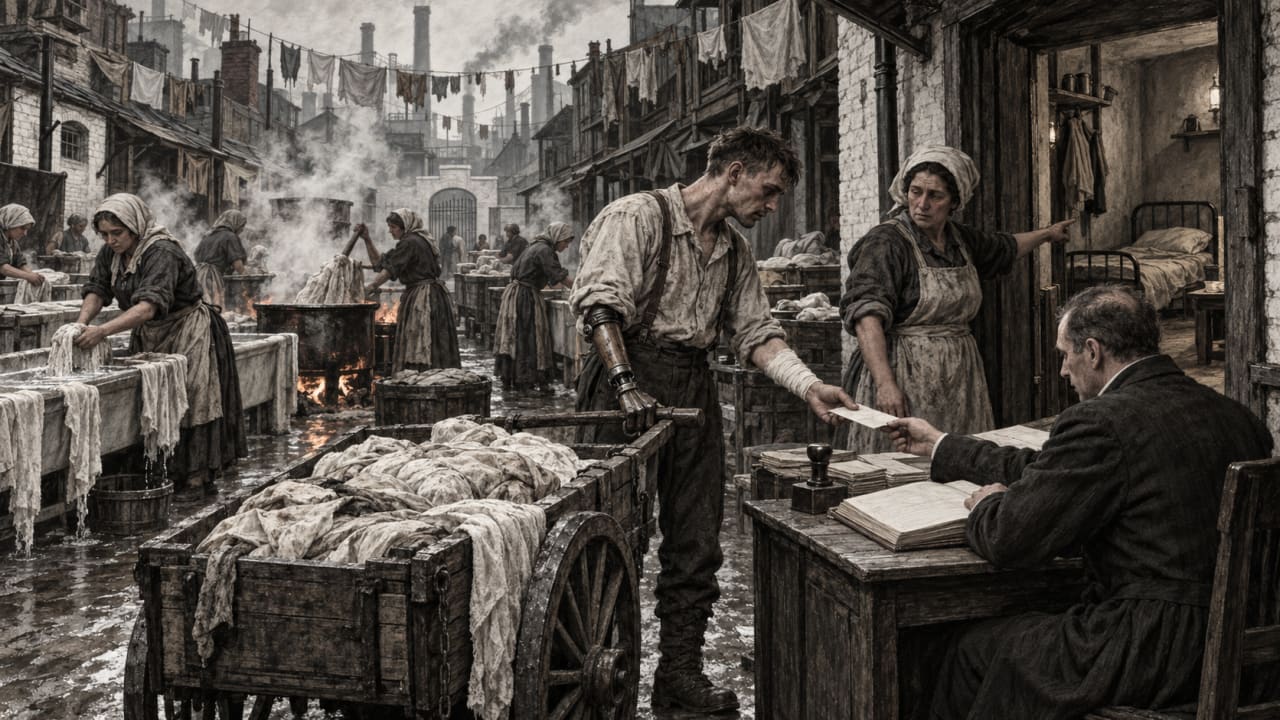
A man comes off the wagon bleeding. He confesses at intake, because the confession receipt opens the ward. He waits for a bed window and is treated if the window holds. Everything that touches him from that point is recorded, and everything recorded can be charged: the broth, the linen, the bed extension when the wound refuses to close, the morphic draught, the witness fee, the appeal stamp. He leaves the White Ward alive and owing. The note that records what he owes is the oath-note, and in Marrowgate it is a kind of currency. It just never belongs to the man named on it.
The Tribunal then converts the debt into a work prescription. In its own words this is rehabilitative service, and on the day it is issued it can look almost generous: the patient owes, the city lets him work it off, and the work keeps his hands busy while his wound finishes healing. Labour may be prescribed to the wards, the laundries, the kilns, the carts, the registry, or simply to "slum external," which means anything the district needs and no other office wants to supervise.
Assignment and supervision belong to different hands, and that division is where the trap lives. The Tribunal assigns. Washhouse overseers, ward staff, kiln foremen and cart masters supervise. When a supervisor writes that a washer scorched a sheet or missed a shift, the Tribunal reads that report at its next review. When the Tribunal lengthens a prescription, the supervisor has no power to shorten it. Neither office answers for the endpoint. The review interval is set at the Tribunal's convenience, and the clerks who set it profit from the discrepancies they find.
Enforcement is blunt. Marrowgate calls it identity throttling: no service until the debt is resolved. A labourer behind on his prescription may find his ration chit refused, his bed window withdrawn, his appeal unheard and his clearance papers left unrenewed. Oath-collar bailiffs collect from those who run. The collar is not universal. The city reserves it for people whose rehabilitation has become indefinite, and the street gives them a name without pity: Debt-Stitch, a labourer owned by the wards.
Prosthetic maintenance is the cleanest example of the method, and not the only one. A soldier who loses an arm needs an approved fitting from the Prosthetics Guild, because a man on an unapproved limb is unemployable in Marrowgate. The Guild fits him and bills him. The straps wear, the socket blisters and the joint loosens, so the Guild maintains the arm and bills him again. He works off the fitting by hauling linen, and the hauling wears out the arm. The Guild need never sell him a second arm, because it sells him the first one forever.
Not every household came in by this road. Some owe for a child's fever, some for a husband's burial docket, some for bed extensions taken out against wounds that killed the patient anyway. The debts have different origins and different holders. In the Slums they all turn into the same thing: hours.
#On the Working Day
The dawn bells sound for the whole city. In the Slums they mean the carts are coming.
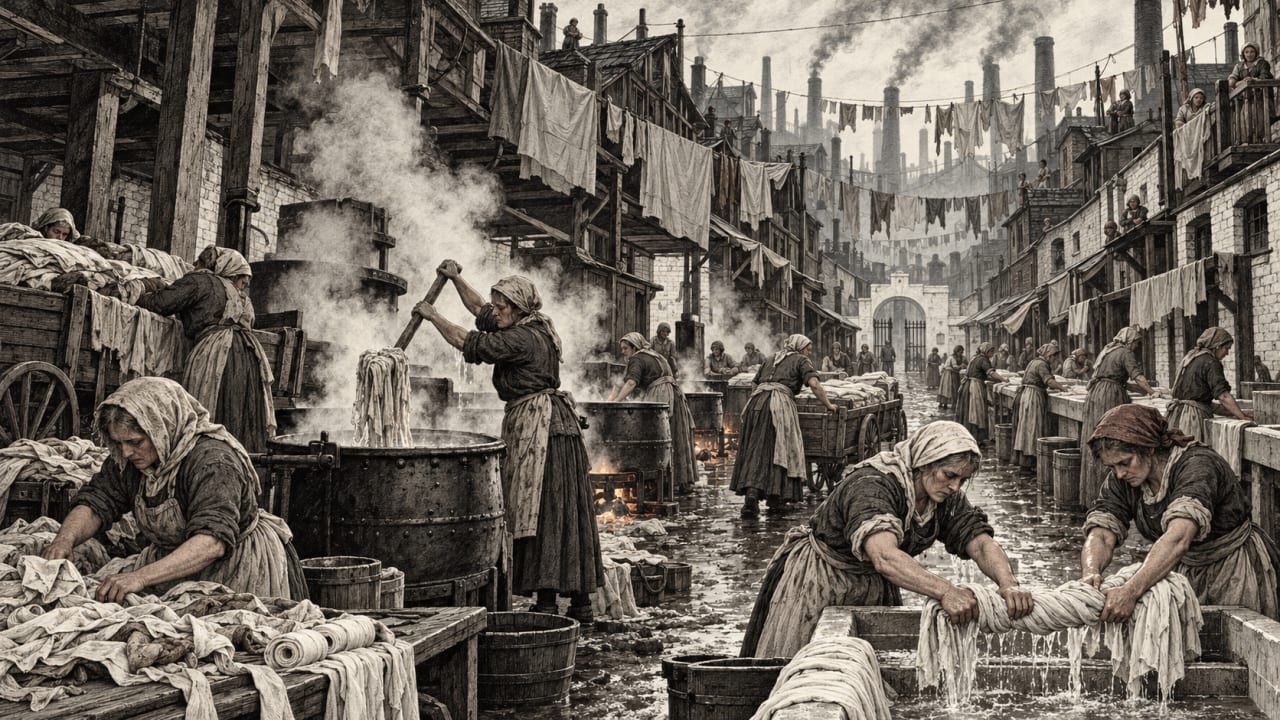
Soiled linen comes down from the White Ward in loads that stink before you can see them. It is sorted by hand at the washhouse threshold into sheets, bandages, gowns and whatever the ward wants burned rather than washed. Lye and boiling water open the skin across the sorters' knuckles, and fever finds those openings faster than any inspector. Bandage-boilers stand over the coppers, lifting stained rolls on wooden paddles, and inside a season their forearms carry scald marks layered on scald marks. Wringing is shoulder work. A wringer works to the end of her prescription or to the end of her shoulders, and the Tribunal does not ask which comes first.
By mid-morning the clean loads are folded and waiting for carts. The carts climb toward the clean streets, and at the first white line an inspector checks the load before he checks the carter, because linen can carry contagion into a ward and a carter can only carry himself. At midday the allocation notices go up, and residents with hearings read them to see whether their slots survived the morning. Others go uphill to scrub ward floors, which pays in broth if it pays at all, and carries the particular indignity of cleaning the beds they were once billed for.
In my survey of the Civic Triage Tribunal I called the Suture Slums "the city's unpaid organ."
Corrected for precision, which I value above modesty. Payment exists wherever the ledger finds it convenient: a chit, a ladle, a night's bed, a credit against an account the labourer may not inspect. The organ is paid. The pay goes back to the people who hold the debt.
At curfew the clean corridors close to everyone without a licensed crossing, and the Slums fold in on themselves. Then the night begins. Debt-labour shifts take labourers out past the kiln sheds to the pits and breaking tables. They come home at dawn with chalk in their hair, lime burns on their lips, and a cough they will be fined for if they bring it near a ward.
That makes a day. The next one follows it without being asked.
#On Households, Broth and Unfiled Children
Food in the Slums follows the city's food, only thinner: thin broth, vinegar tea, hard bread, white salt porridge. Bitter pain-liquor is regulated, so it is drunk where nobody regulates. In Marrowgate a host offers boiled water first. In the Slums this is plain good sense presented as courtesy, since water that has not been boiled has been through the washhouses.
Much of a patient's recovery happens at home, because the White Ward discharges on the bed board's schedule and not the wound's. A man sent home with his stitches still in is nursed by whoever is in the room: a wife on a laundry prescription, a son who runs messages, a neighbour paid in bread. A fevered washer's shift may be worked by her sister. This is arrangement and not law. No statute I have found passes a prescription to kin by right. But unworked hours become reports, and reports become reviews, so a family closes ranks before the arithmetic reaches it.
The Mercy Ward-Sisters and Ward-Brothers come down into the Slums with broth, linen and the ledgers that record both. They dress wounds, hand out ration chits and note recorded exemptions. Some carry an extra ladle that never appears in the broth accounts, and a few have moved contraband medicine in their aprons. The same Sister who brings soup also writes down who coughed while she was ladling it, and both acts go to the same desk. The Bureau of Mercy counts the broth. The Sanitation Chapter reads the cough. The family has no way of knowing which page will matter.
Then there are the children Marrowgate never entered. Some are born in the Slums without registration, to mothers who calculated, correctly, that a child entered is a child with an account. Some are hidden in linen carts by ward staff until a name can be borrowed, forged or bought. The street calls them little ghosts. Prefect Salvius calls them epidemiological uncertainty and prefers holding pens, where risk stays visible. Mercy prefers the orphanarii, which launder names under institutional light. The Bureau of Records prefers intake slips. Each of these offices is a door the mother in the Slums is trying to keep shut.
An unfiled child cannot be denied a service she was never entitled to. She also cannot be treated in a lawful ward, cannot cross a clean line without forged paper, and cannot be counted if she dies. The Slums raise these children on the stairs, out of sight of the windows, and teach them the white line before their letters.
#On Cordons and the Unreachable Hearing
The work prescription is valid, the hearing is scheduled and the labourer has his papers. He leaves the washhouse at the midday bell to walk to Notary Row, where a clerk will review his debt and might, in a merciful mood, shorten it.
Between him and Notary Row is a white line. An inspector stands at it in a salt-stained sash with a fever stick in one hand. He wants a fresh mouth receipt. The labourer's receipt dates from yesterday. The morning's cordon notice changed the interval, and the labourer could not have read that notice, because it was posted inside the clean streets. By the time a fresh receipt has been stamped, the hearing has passed. A missed hearing goes to review. Review is delay with a docket number, and the debt keeps accruing while it waits.
Nobody in this sequence broke a rule. The Tribunal holds the hearing. The Chapter holds the line. In the Slums, the gap between the two is where a debt goes to grow.
Prefect Salvius knows this district better than any other official in Marrowgate, and he earned that knowledge on foot. By A.S. 172 he was cordon captain for the southern wagon lanes, where the Slums press against the intake roads. His reports from those years count coughs by household and forged papers by the smell of the ink. They have to be read honestly. Records credits him with slowing fever spread in two districts of the Slums, and with making mouth receipts harder to forge. A labourer stopped at his line may curse him with working lungs. The Synod is entitled to prefer that outcome, provided it does not mistake the preference for holiness.
His third map, the one showing the cordons he wants, runs white corridors through three Slums alleys and marks two washhouses for temporary closure. Neither has happened. The full emergency lockdown is an ambition at A.S. 201. It is not policy. Salvius tightens by inches: a revised crossing schedule here, a corridor narrowed by a cart's width there. In the Slums, inches decide whether a labourer reaches a hearing.
The residents answer in chalk. On walls the whitewash crews ignore, the Slums keep their own signs. I copied them from doorposts and gutter stones in the course of this survey:
The signs do not prove a conspiracy. No council of washerwomen meets to decide where to put the nicks. Whoever saw the inspector first smears the thumb, and whoever passes second trusts it or doesn't. Rain wipes the chalk away overnight. An informer can draw three nicks as easily as a friend can. The residents read each mark the way they read the allocation board: with interest, and without faith.
#On the Market Beneath the Laundry
The laundry channels under the washhouses carry grey water out to the old drains. The Stitchmarket carries everything else through the same channels.
Washer-runners pass between wards with linen on their shoulders, and inspectors whose authority depends on not noticing filth do not look at them. A message folded into a bandage hem crosses a clean line more safely than a sealed letter in a courier's satchel. Debt-bound carriers move papers, body goods and secrets through tunnels some of them dug as rehabilitation labour. The cartel sells forged clearances, bed tokens, stolen anaesthetic, counterfeit seal impressions, name repairs and night surgery. In the Slums all of these are sold next door to someone who needs them.
The night clinic below the Suture Slums Washhouse is where the trade turns into treatment. A resident whose lawful bed window has lapsed, whose prescription has blocked his ration chit, or whose child has no file can buy care there that the legal city has declined to give. Surgeon Kett is known to cut in such rooms. He is famously clean, and he is willing to close a wound, drain an infection, or alter a body until it agrees with a document. The care is real. So are the fees, and so is the debt to the market, which collects with fewer forms and less patience than the Tribunal.
Needle-King Pavo is said to run the Slums trade, though nobody can confirm his face, his age or whether he is one man. Purity files give him three faces. He speaks through other people. His runners live in the Slums because that is where the debt-bound live, and his customers live there for the same reason. He matches false paper to real desperation precisely enough that the buyer can never report him without condemning herself.
The cost of that trade falls on the district as well. When a counterfeit seal ring turned up in the Slums last winter, licensed surgeons refused to operate until the Tribunal had certified their own rings, and seven patients died during the delay. In A.S. 200 a raid on a washhouse cellar recovered forged fever negatives, Sealhand impressions, stolen draughts and blank birth slips. Raids like that arrest runners and leave the routes in place. The residents above go back to their coppers the next morning, minus a neighbour.
#On Lime Dust, Charcoal Scars and the Marrowwind
Start with what can be explained.
The Lime Yards produce bone-lime for Marrowgate's walls, roads, plaster and clean lines. The dust drifts. When the wind sets from the kilns it settles on the Slums' rooftop linen, in the broth bowls, and in the lungs of everyone who breathes there. The cough it causes is ordinary, chronic and dry, and the night shifts in the pits make it worse. It is not fever. Fever comes from standing water, crowded rooms and soiled linen. Floodwater brings its own contamination in season. Winter brings the chilblains that open into sores. A sensible physician separates these causes. An inspector at a white line seldom bothers, and a cough is a cough on his slate.
Now for what cannot be explained.
The Marrowwind rises out of the Lime Yards. It is a dry chalk gust that enters sealed spaces, carries voices that use old names, reopens sutures and alters records. Its first uncontested correction came in A.S. 194, in the sealed intake cabinet of White Ward Seven, which is a ward and not part of the Slums. Among the documents later corrected was Prefect Salvius's personal wash bill. I note this for its comedy and draw no conclusion about who washed his collars.
The wind escalated during the clean paper plague of A.S. 199. Certificates called patients healthy while fever spread under their linen, and the Marrowwind corrected the dockets at scale. Cleared names went back into the fever columns, ledgers bled ink, and burials were reopened.
By A.S. 201 it reaches the Suture Slums washhouses. The signs are reported consistently enough that I record them without endorsing a cause. The air dries in rooms full of steam. Linen goes stiff on the line, though nothing has warmed it. White dust gathers inside closed chests and folded sheets. Washers report hearing names from basins and drain grates, the names they had before intake, spoken the way a parish roll would read them. Old sutures reopen in straight lines along scars that had been closed for years.
For a debt-labourer this is an accounting crisis before it is a spiritual one. His file records his wounds. His debts follow his wounds. If his flesh after a wind-night no longer matches the file, the debt may be reassessed, in either direction. A correction might lift an assessment that was false. It might add one that was true and had been concealed. Nobody in the Slums trusts the wind to be on his side.
So the debt-labourers mark their scars with charcoal. Before a wind-night they trace each seam, puncture and notarised cut on their own skin. Afterwards they compare the marks against the flesh, and the flesh against whatever copy of the file they have managed to see. If the charcoal line runs past a scar that has shortened, they have evidence of a kind. No court accepts it. Doctrine holds that Marrowwind corrections are inadmissible without living corroboration, and a labourer's charcoal on a labourer's arm is a long way from corroboration as the Tribunal defines it.
True-name slips are worse and more popular. Some labourers keep a family-written name under the tongue through the wind hours, to anchor memory against the voices. The Sanitation Chapter has prohibited them since A.S. 198. Inspectors check mouths with a hook, confiscate what they find and adjust the debt to match. The paper also dissolves, and Marrowgate has no settled teaching on what happens to someone who swallows his own legal origin. Nobody in the Slums calls the practice reliable protection. They do it because charcoal records the body, and they want something that records the person.
Doctrine has sealed its preferred explanation: the wind is an unintended property of properly processed remains, in a city whose administrative theology treats bodies as documents. I find the explanation persuasive, and I sign Doctrine's papers. Neither fact proves it. The Bureau of Alchemical Standards still has the wind under review. Where it comes from, how it works, and why it corrects one ledger and leaves the next alone remain unknown. All the Slums can tell you is that it arrives, and that it has started coming in through the washhouse doors.
#On the Present Condition
At A.S. 201 the Suture Slums are occupied, working and in debt.
The coppers are lit before the bell and the carts still come down from the White Ward. Prescriptions still run as long as the Tribunal decides. The Prosthetics Guild bills another quarter's maintenance. Salvius's inspectors stand at the lines, and his third map still carries closure marks on two washhouses that are open and full of steam. The Tribunal is preparing a scandal and the Chapter is preparing a lockdown, and the residents expect to pay for whichever comes first. Under the washhouse floors the Stitchmarket's channels still run, and the night clinic still takes patients the wards refuse, at prices the wards would recognise. Unfiled children still sleep on the stairs. The wind comes in from the kilns more often than it used to, and the dust it leaves on the linen is drier than steam ought to allow.
At the end of my survey I watched a washer at a trough in the Suture Slums Washhouse dry her arms after the night's last load. She took a stub of charcoal from her apron and redrew the line along an old suture on her wrist, carefully, as a clerk copies a figure he expects to be audited. Then she pulled her sleeve down over it and went to wait for the carts.