
#On the Arithmetic of Breath
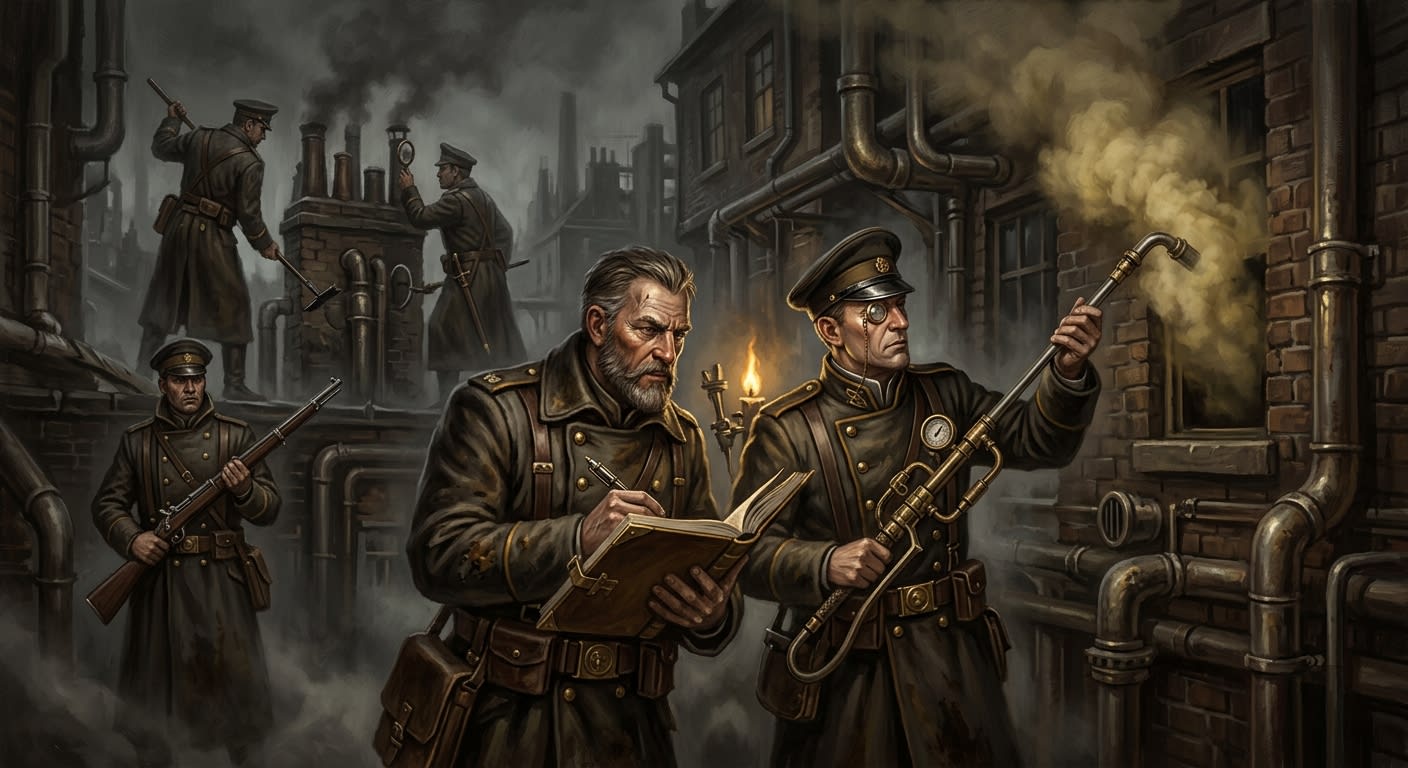
The Twenty-Percenters are the professional core of the Purity Fume-Inspector corps: the grey-masked accountants of smoke, the old noses in stained filters, the men and women who know that a city may be governed by terror, tithed by hunger, frightened by bells, and still die within a week if every unlawful stove is sealed at once.
Their doctrine is the Twenty-Percent Tolerance Directive, an oral rule the Bureau of Purity has never written on acknowledged paper because acknowledged paper has the nasty habit of surviving its usefulness. Contraband is tolerated at roughly one fifth of estimated volume. The remaining four fifths are documented, cited, confiscated, taxed, displayed, and entered as proof that Purity sees all. Twenty percent flows. Eighty percent bleeds into the Ledger.
The Twenty-Percenter’s genius lies in never mistaking the fraction for mercy. He does not forgive the hidden lamp. He schedules it. He does not pardon the black-diesel kettle. He lets it warm the third stairwell until the quarter’s seizure numbers require a widow with visible tears. He does not fail to smell sin. He smells enough sin to choose which sin becomes real.
#On Their Origin in Necessary Failure
The Twenty-Percenters were born the moment Operational Directive 14 of A.S. 143 met winter. The Directive created the Ninth Mark, issued the brass badge, standardised right of entry, seizure, and citation, and armed inspectors with fume paper that bloomed against black diesel, unconsecrated tallow, demon-glass residue, false incense, and the other offences later gathered in the Index of Prohibited Emanations. The public dream was total atmospheric correction. The first furnace season corrected the dream with corpses.
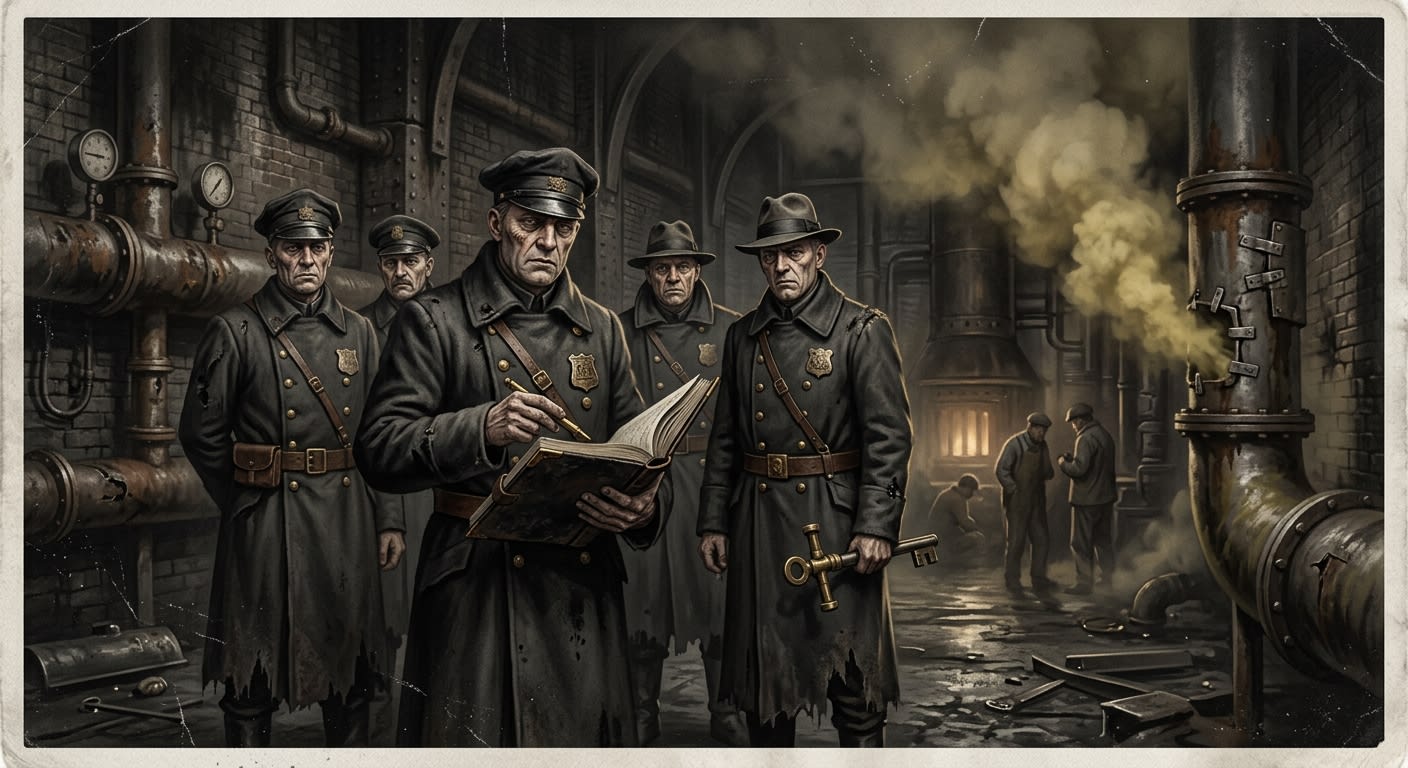
Complete eradication meant cold kitchens, dark barracks, halted pumps, dead infants, furious bakeries, and War clerks arriving in Purity offices to explain, in the exquisite politeness of armed administrators, that a purified city with frozen soldiers was an enemy convenience. Records discovered the same truth from ledgers. Tithes discovered it from missing revenue. Doctrine discovered it last and claimed it had always known.
A later Bureau pamphlet states that the Twenty-Percent custom emerged from “pastoral discernment among field officers.”
Corrected: it emerged from failed eradication, fuel arithmetic, riots narrowly avoided, and the humiliating discovery that contraband burned warmer than policy. Pastoral discernment was added when the pamphlet needed a clean collar.
The old Air Auditors learned first. They carried fume paper into alleys where every chimney would condemn its house. They counted children in stairwells, ration queues at corners, informants in bakeries, black-diesel pipes behind chapel walls, and the thick silence of districts that had survived by paying everyone except the Creator. They wrote fewer citations than they smelled. Their cuffs blackened. Their reports stayed elegant. Their districts lived.
#On the Craft of Selective Olfaction
A Twenty-Percenter’s work begins before the fume paper blooms. He walks the district by memory: which bakery burns hot on feast-eves, which tenement hides lamp-clean diesel in laundry barrels, which tavern uses fog to muffle forbidden chorus, which convoy yard buys chapel wax through a clerk whose brother serves in Records, which midwife masks birth-room vinegar beneath boiled cabbage. The Clean-Lung novice smells violation. The Twenty-Percenter smells relationship.
He carries three ledgers. The public ledger records citations, air clearances, purity marks, seizure witnesses, ash vials, and the posture of obedience. The private tally lives in memory, old envelopes, coded cuff marks, and the small arithmetic of who has already paid in coin, silence, fuel, or fear. The third ledger is the district itself: soot above shutters, wax stains on thresholds, queue length at the bread stall, cough pitch in the third alley after Ninth Peal. Illiterates read walls. Professionals read residue.
Their great art is proportion. Too much tolerance and the street ceases to flinch when the ledger-lantern turns the corner. Too little and the street begins to count stones. Too many raids produce riot. Too few produce laughter, which is worse. A district must believe the Bureau is omniscient while retaining enough illegal heat to continue fearing its loss. The Twenty-Percenter holds that contradiction between thumb and forefinger like a hot seal.
#On the Eighty That Must Be Seen
The visible eighty percent are selected with care. A good seizure teaches without detonating. A baker is preferable to a guildmaster. A widow with too many customers is preferable to a ward kitchen feeding three hundred men who will riot if deprived of soup. A lamp-mercery stair cache may be taken in public; an industrial feed pipe serving War pumps will be reclassified as “pending authorised thermal review” and left to hiss behind its brick.
The Twenty-Percenter works closely with the Stagehands, though neither faction enjoys admitting dependency. Stagehands supply spectacle: dawn sweep, night raid, lantern knock, the brass note against the door, the citation formula loud enough for the upper windows. Twenty-Percenters supply target logic. They know which arrest will frighten ten streets and which arrest will make those streets discover knives.
A Bureau of Purity training slate states: “Targets are chosen solely on evidentiary sufficiency.”
Clarified for senior instruction: targets are chosen by evidentiary sufficiency, instructional value, household expendability, district pressure, quota timing, bribe fatigue, and whether the arresting officer can reach the doorway without being brained by neighbours. The slate remains shorter for pedagogical reasons.
The eighty percent feed every office. Records receives affidavits. Tithes receives fines, seized oil valuations, and confiscation participation calculations. Purity receives proof of vigilance. Doctrine receives examples. The street receives theatre with teeth. The system does not need every sinner. It needs enough sinners displayed in correct sequence.
NINTH MARK QUARTERLY RECONCILIATION — EXCERPT SEALED District: ███████████ Estimated contraband combustion: 100 units. Recorded correction: 79.4 units. Tolerated remainder: █████ units. Infant winter mortality held below unrest threshold. Public confidence in Purity vigilance: stable. Recommendation: maintain current blindness.
#On the Twenty That Must Breathe
The hidden fifth is not a charity. It is a pressure valve, tithe reserve, informant channel, winter ration, and hostage pool. A family allowed to burn black diesel this month becomes grateful, frightened, and billable next month. A distiller whose pipes are spared becomes a source of names. A tavern runner who survives one inspection hosts the inspector’s informant by the next week. A district permitted warmth learns that warmth has an owner.
The Twenty-Percenter does not speak of mercy except when lying to trainees. Mercy is too unstable a category. Mercy might oblige consistency. Tolerance is cleaner. Tolerance can be revoked, priced, transferred, denied, explained, and made retroactively holy through a stamp.
The hidden fifth is also where the Bureau keeps its own dependencies. Black diesel heats inspection annexes when sanctioned coal fails. Unregistered wax seals emergency doors when official wax is delayed by Tithes. Contraband whale oil lights the rooms where Purity drafts denunciations of contraband whale oil. A Clean-Lung Purist calls this hypocrisy. A Twenty-Percenter calls it supply.
#On Their Quarrel with Purists
The feud with the Clean-Lung Purists is doctrinal, professional, and respiratory. Purists say: open every breath. Twenty-Percenters answer: close what must close. Purists read the Index as scripture. Twenty-Percenters read it as a knife, a pricing table, a sermon prop, and an excellent way to identify which stove belongs to someone too poor to retaliate.
Purists do catch horrors the old noses have learned to route around: poison fuel, scripture-smoke jars, demon-glass grinders, hidden birth rooms, furnace vents that whisper in bad grammar. This is why Twenty-Percenters do not abolish them. They aim them. A Purist cell is sent into a district like a cleaning acid: useful briefly, ruinous if left uncapped. Afterward the Twenty-Percenters return, survey the damage, reopen three stoves, seal two, fine eleven, and write a report proving all of this was orderly.
The Purists despise the Twenty-Percenters with the energy of young lungs. The Twenty-Percenters envy them occasionally, usually before coughing into a rag and remembering how expensive innocence becomes when given authority.
#On Their Illness and Retirement
A successful Twenty-Percenter lasts fifteen to twenty years. Success is visible in the mask: permanently greased filters, grey-black seams, ash cuffs that no washing whitens, and a voice that has dropped from human speech into registry gravel. The nose dies by degrees. First incense and excrement become cousins. Then blessed oil and stolen oil differ only by memory. At the end, the old inspector smells nothing and knows more about the district’s air than any sharp-nosed boy alive.
Chemical anosmia is the profession’s private tonsure. The public sees a damaged officer. The Ninth Mark sees completion: a nose trained, used, burned, and replaced by judgment. Some retired Twenty-Percenters become desk auditors, terrifying because they can hear falsehood in number shape. Some become tavern regulars, sitting near kitchen vents with the serenity of men who no longer know what is poisoning them. A few teach. Those are the dangerous ones.
Their pensions are mean. Their confiscation participation allowances arrive late. Their lungs remain Bureau property in every practical sense. When one dies, the mask is reclaimed, the filters are burned, and the personal notes are reviewed for “unfiled atmospheric intelligence.” Widows receive a purity ribbon, two months of ration supplement, and the insulting comfort that their husband served clean air. Most widows know what their husbands served. They cash the supplement anyway.
#On Present Standing
As of A.S. 201, Twenty-Percenters dominate the Ninth Mark wherever a district must keep functioning: furnace wards, baker lanes, convoy yards, port kitchens, bastion warrens, tariff-chapel smoke corridors, and the damp municipal spaces where lawful supply fails before unlawful supply has finished breakfast. Purity trusts them least in speech and most in practice. Records audits them, Tithes profits from them, Stagehands dress their decisions in spectacle, and Clean-Lung Purists mistake them for rot because rot is easier to denounce than governance.
Their patron is Saint Vellum-of-Breath, correctly understood. The sealed nostril-ring is not a child’s miracle. It is the instrument of the office. Close what must close. Open what must frighten. File what must fund. Forget what must keep the pipes warm until the next quarter.
The Twenty-Percenter stands in the alley after the raid, mask wet inside, ledger-lantern dimming, one stove sealed and four left smoking behind him. The street hates him. The Bureau suspects him. The district survives his passage and curses the shape of its survival.