
#On the Fuel the Synod Denies While Burning
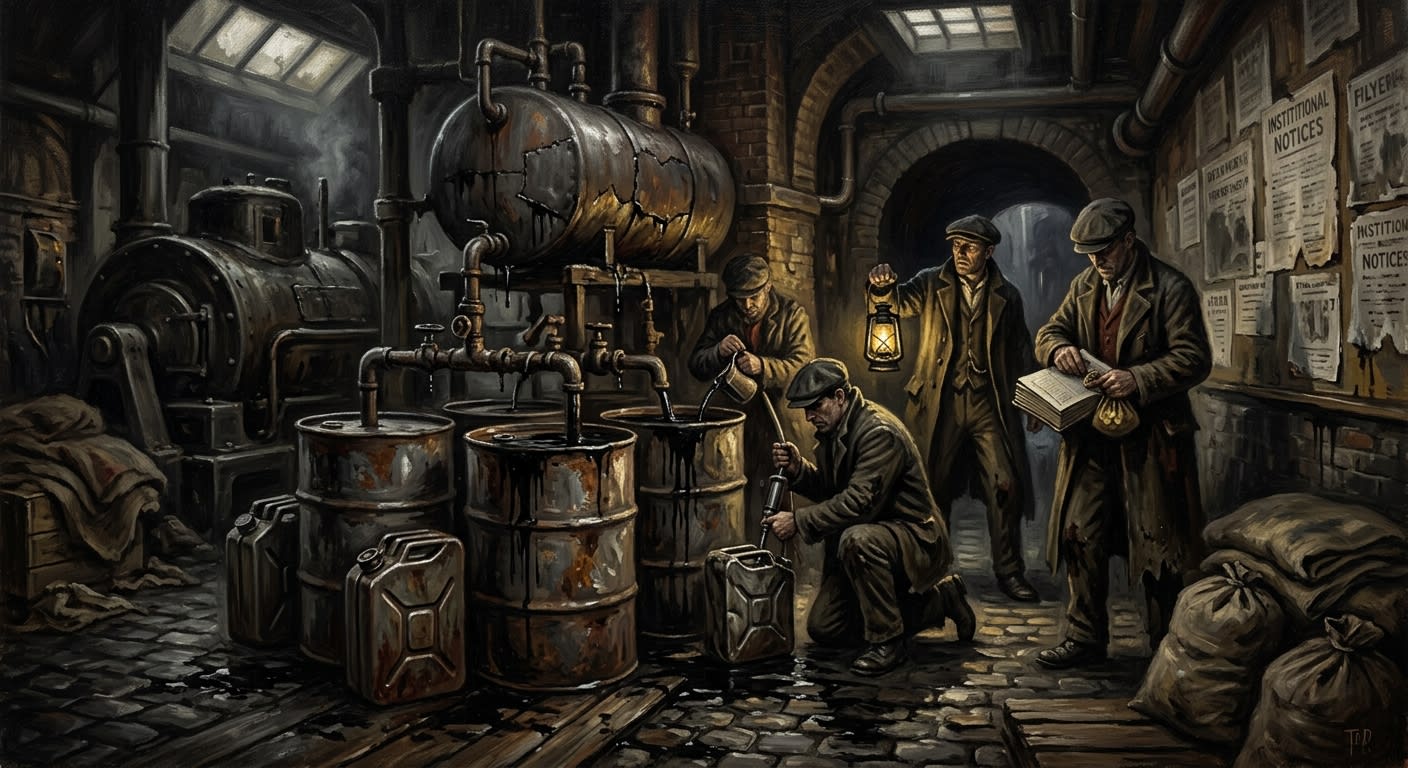
Black diesel is the Synod's favourite unlawful sacrament: condemned in proclamations, burned in cellars, pumped through pipes that official surveys fail to find, taxed under names too perfumed to deserve ink, and purchased by men whose sermons against contraband are warmer than the rooms in which they preach them.
It begins as crude sludge from the Anatolian Pitlands, those denied seams east and south of Bastion-Constantinople where the earth sweats black fuel through cracked stone, abandoned wells, ruined cisterns, goat paths, and labourers whose names enjoy the special safety of never being recorded. It becomes fuel in warren stills, pipe-crawl furnaces, cellar coils, ash filters, bone-char columns, and the shaking hands of Black Diesel Distillers who know that heat is older than law and less patient.
The result burns hotter than sanctioned lamp allotment, dirtier than blessed chrismole, cheaper than Bureau honesty, and more faithfully than most officials. It stains chimneys with oily soot. It blackens teeth. It makes coughs productive, walls warm, engines wake, bread ovens live, pumps move, ward boilers hiss, and winter retreat one handspan from a child's bed. No cleric dares bless it. No sensible garrison quartermaster wastes it.
The public doctrine is simple: black diesel is contraband; contraband corrupts; corruption must be immured. The private doctrine is older and better ventilated: official fuel rations do not cover reality. A city, unlike a catechism, cannot be warmed by correct definitions. The poor learned this first, because the poor learn all physics before the comfortable learn any theology. The Bureaus learned it next and called the lesson enforcement.
Black diesel's scandal is not that it exists outside law. Plenty exists outside law. Hunger exists outside law. Grief exists outside law. The scandal is that it performs the duties of lawful supply better than lawful supply performs them, and it does so while coughing scripture into the rafters.
#On Origins in Pit, Siege, and Arithmetic
The first black diesel was not discovered by a Bureau. This has caused the Bureaus continuing discomfort, as all useful things ought to do. It was scraped, ladled, stolen, filtered, thinned, and burned by the people nearest cold, siege, and broken allotment: pit crews beyond Constantinople, warren families under failed lamp schedules, trench cooks whose sanctioned stores arrived as apologies, and engine men who learned that a boiler cares less for blessing than for caloric obedience.
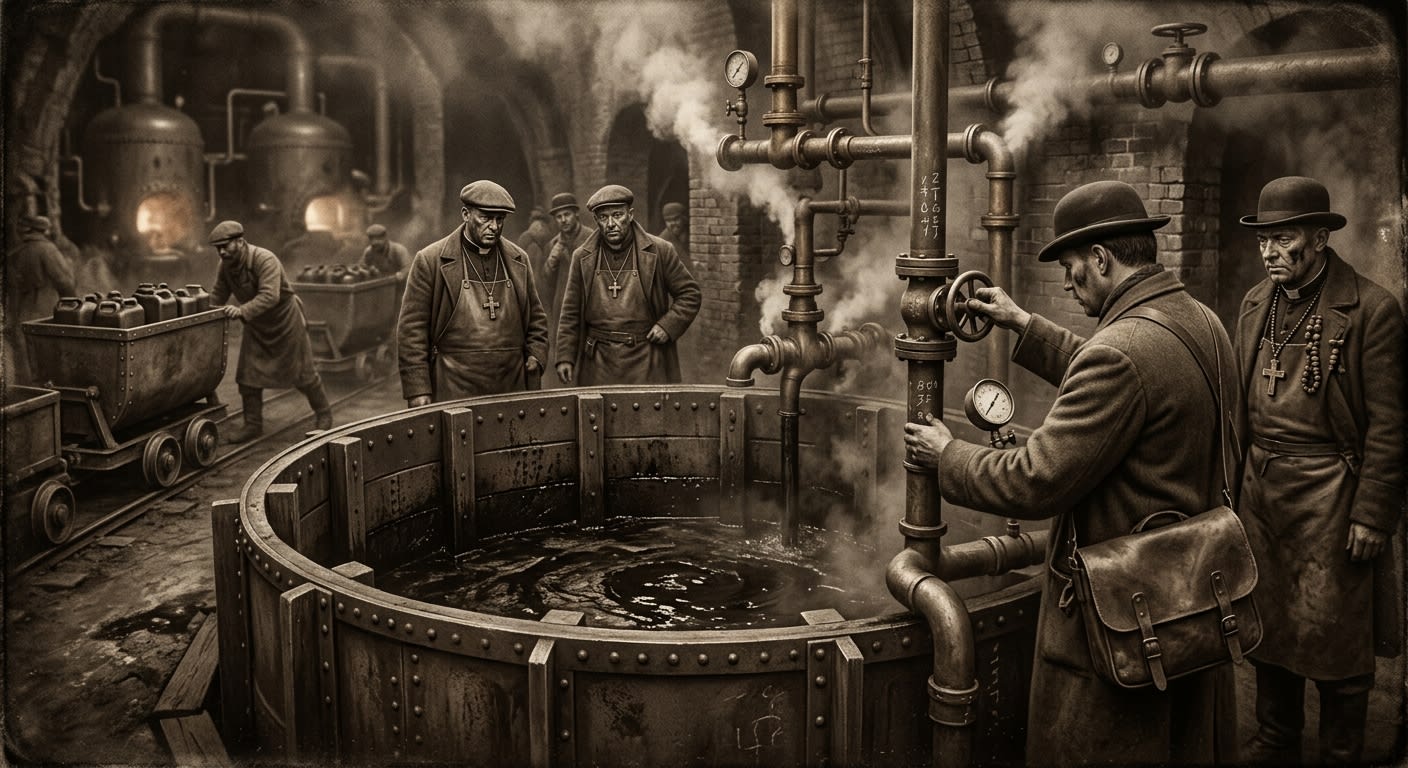
The Pitlands supplied the mother sludge. There the first extraction rule became permanent: no one works there. The second rule: the convoys must arrive. Between these two falsehoods stand rope men, mule haulers, skin-bag stitchers, pit widows, bribe factors, children crawling vents too narrow for adult shoulders, and foremen who keep ledgers of marks because names make corpses administratively expensive.
Raw seep smells of tar, salt, old meat, and fruit rotting in a closed reliquary. It is scraped into copper-lined troughs, cooled in jars, packed in skin-bags, hidden in devotional crates, sloshed through false corpse carts, and sent west through routes whose holiness increases in proportion to the number of officers paid not to inspect them. The southern channels feed Constantinople first. The great city is a mouth with walls, bells, chains, and no talent for fasting.
Black diesel acquired its present discipline after the post-Sundering fuel failures hardened into permanent custom. By A.S. 134, Standing Order 14-K had given punishment a name and denial a filing drawer. A.S. 136 gave the trade its greatest warning when the furnace quarter of Constantinople burned Anatolian fuel and the chimneys wrote. A.S. 143 gave Purity's Ninth Mark its fume-paper appetite. A.S. 163 gave War its machine nightmare at Wormwood Hill. A.S. 194 gave Engineering its famous Third Survey of Constantinople Warren sectors, seventy pages of authorised non-discovery written by men whose boots smelled of pipe grease.
Older lore books place the great furnace-smoke catastrophe in a later, obsolete Bastion-Lorraine file tradition.
Corrected. The canonical incident is the Scripture-Smoke Incident of A.S. 136 at Bastion-Constantinople. The old name belonged to the southern anchor's deprecated refugee nomenclature; the smoke did not care what the clerks called the city while it wrote above it.
The trade's true origin remains arithmetic. One official allotment heats one public paragraph. One unlawful canister heats a staircase. A district may survive without purity longer than it can survive without flame. The fuel did not spread because men loved sin. It spread because cold is a better recruiter than any devil.
#On Distillation and the Black Craft
A Distiller's shop is a chapel built by men who dislike chapels: low roof, bad air, hot belly, hidden entrance, flame attended with more reverence than any sermon receives outside execution season. The apparatus is ugly and exact. Coil-still. Pressure gauge. Bone-char filter. Ash cloth. Hand pump. Wick needle. Stoppered canisters. Soot scraper. Vinegar masks. A bucket of sand. A second bucket nobody mentions unless the first catches fire.
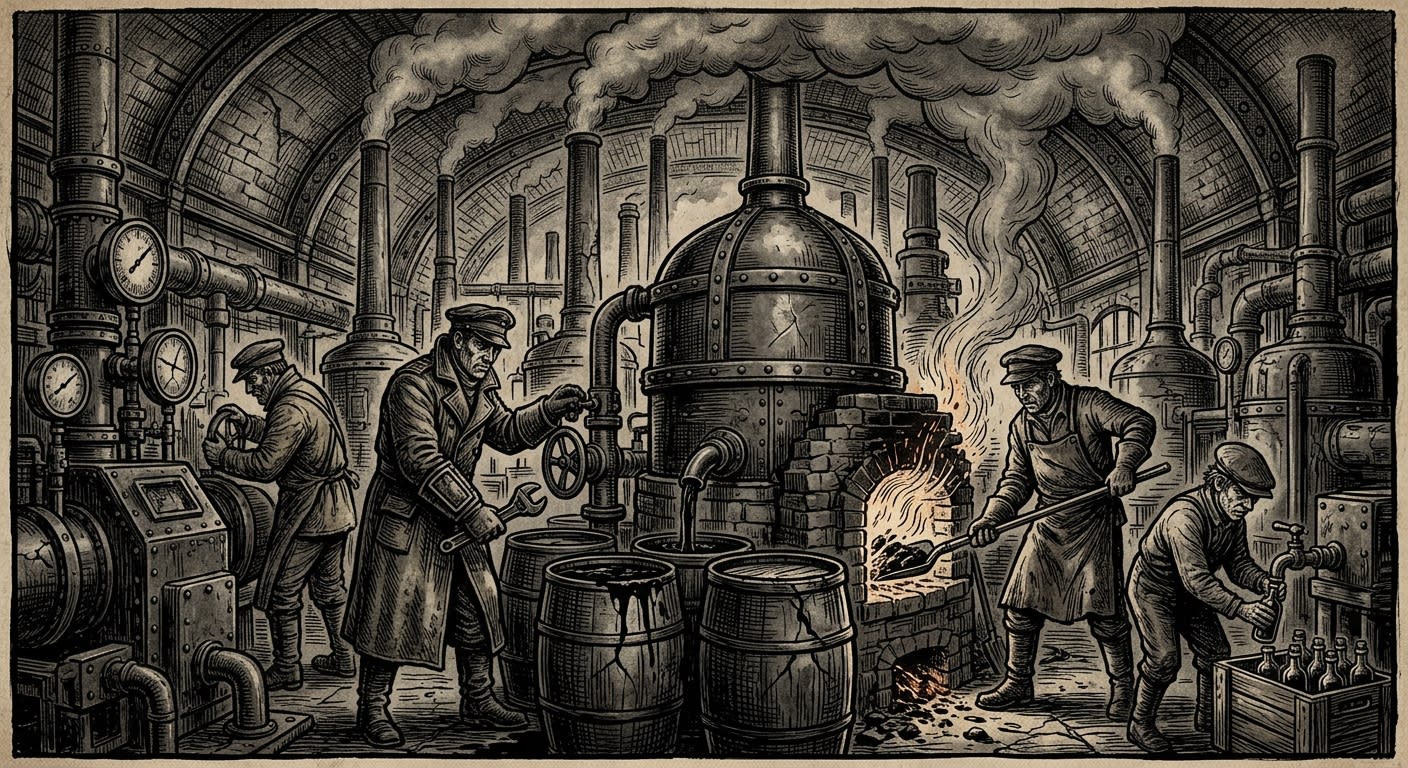
The process is known by every apprentice and misunderstood by every tribunal. Heat the crude. Separate the cuts. Filter the heavy run. Sweeten the lamp fraction until it smells less like a prosecutable funeral. Keep the engine-grade stock apart unless one wishes to write Wormwood Hill in smaller letters across a ward boiler. Store the result cold and sealed. Never let a novice smoke near the condenser. Never let a customer say “only lamp fuel” without asking whether he means engine-strong after midnight.
A good Distiller has three noses: one for fuel, one for customers, one for danger. Lamp-clean stock has a bitter patience and burns with a low black fringe. Furnace-grade stock carries weight in the throat. Engine-grade hot-run bites the eye before the wick touches. A batch sweetened too heavily smells forgiving; that is when men die. A batch cut with demon-tainted additive leaves a sweetness behind the teeth, the taste of a hymn remembered by someone else's mouth.
The failures are named with professional tenderness. A coil-bloom is an explosion that chooses the face first. A wet cough is a pipe leak behind brick. A saint's wink is a blue flare at ignition, often harmless, never trusted. Scripture-risk is warmth in the smoke before letters. The trade avoids poetic names for the worst events, because poetry makes apprentices brave.
The work takes lungs first. Fume-sickness begins as a useful cough, becomes a black thread in the rag, then a sweetness in breath that old Distillers refuse to describe while young ones pretend not to fear. It takes conscience next. Someone always needs warmth. Someone always pays less. Someone always has a child, a boiler, a regiment, a shrine lamp, a dying mother, a better knife. The Distiller measures fuel and discovers he has been measuring lives.
The last thing black diesel takes is identity. A lawful profession gives title, guild mark, patron, window sign, tax category, and funeral line. The black trade gives nicknames: Black-Burner, Pitman, Lamp-Father, Smoke-Heretic, Soot-Sinner. A Distiller exists in the street and vanishes in the record. If he is useful, he is tolerated. If he is caught, he becomes real. Reality, in this trade, is often a wall niche.
#On Scripture-Smoke and Fuel Memory
The fuel remembers. Engineering dislikes this phrase because it is vivid, imprecise, and too near the evidence. Distillers repeat it because men who live by a substance are allowed one honest superstition, especially when the superstition has killed soldiers.
In ordinary use black diesel hisses, burns, stains, heats, poisons, and betrays by smell. Under pressure, bell, hymn, relic proximity, bad cut, old pipe resonance, or the obscure moods of Anatolian crude, it does more. It thickens under certain peals. It thins when ward bells pass through masonry. It gathers soot into strokes. It warms at Ninth. It sulks at Fifth. In Skopje, lamps fed with old black cuts hum pre-Bell-Codex modes. In Constantinople, furnace-quarter smoke formed Creed fragments, Index echoes, and pre-Sundering Wallachian sentences for twenty-seven minutes while citizens displayed that vulgar human reflex called reading.
The A.S. 136 Scripture-Smoke Incident remains the central case because it embarrassed every office at once. Purity saw contraband. Doctrine saw corrupted text. Records saw language it had failed to kill. Engineering saw particles behaving like scribes. Tithes saw revenue channels threatened and became, for one shining minute, the most calm office in the city. The final classification—Atmospheric Combustion, Anomalous, Category Five—was a locked cupboard with grammar inside.
FUEL MEMORY NOTE — COMPARATIVE CASES, PARTIAL A.S. 136, Constantinople: Creed alteration in smoke; seventeen soldiers dead after upward volley. A.S. 158, Shipka: lamp row hymning after curfew; soot samples destroyed by district chaplain without request. A.S. 163, Wormwood Hill: engine-grade stock under hymn-vox; crew burned; vehicle advanced three days. A.S. 171, Skopje: Category Four harmonic from lantern block; children repeated melody before speech. Conclusion line removed by Doctrine under authority of my own hand, which I now find inconvenient.
Fume-Inspectors teach cadets to treat scripture-smoke as contamination. Distillers teach apprentices to kill the flame, cover the vent, break the lamp, and forget whatever the first word looked like. Bell-Tappers teach a narrower rule: if smoke commands, obey nothing until the pipe is cold. Diesel Resonance Plumbers listen for scripture-risk in conduits before the soot forms letters. The common people say prophecy. The Bureau says nothing. The smoke says enough.
The danger lies less in the words than in the source. A forged pamphlet has a printer. A heretic sermon has a throat. Smoke has neither. It makes text out of heat, pressure, residue, appetite, and whatever else the Bureau has not yet named because naming would imply jurisdiction and jurisdiction would imply responsibility. A chimney that writes turns a household into a witness stand. It also turns every warm room into a possible archive.
#On the Pipes Beneath Doctrine
Black diesel moves through the hidden pipe networks beneath the Warrens, markets, ossuary skirts, ration kitchens, bell-ducts, furnace districts, and those service corridors the Bureau of Engineering cannot find unless guided by a criminal too tired to lie. The Hidden Pipe-Runner is the trade's circulatory saint: burned hands, bruised knees, vinegar rag, listening rod, tap key, omission map in the skull, and a professional dislike of daylight.
A pipe route is built from denial. It runs where official walls have cavities, where old drains lean under new shrines, where tariff tunnels were bricked and forgotten, where ossuary culverts tolerate the living from habit, where bellways hum loudly enough to hide a hiss. No route is drawn. Route-Keepers mark the places they never go, because absence is safer ink. A map can be seized. Omission must be tortured out of memory, and even Purity dislikes slow work in cramped spaces that smell of hot tar and rat doctrine.
The pipe trade divides by priority. Lamp-Mercers steal hour, cup, and clean-ish flow for homes, stair blocks, sickrooms, curfew kitchens, orphanage lamps, and old women whose stoves outrank several offices by any decent scale. Furnace-Hardliners route engine-grade sin to kitchens, pumps, ward generators, quartermaster boilers, and War machinery while pretending sentiment is a household defect. Bell-Tappers run short, expensive lines beside Bellways, gasket corridors, pressure chapels, and resonant ducts, where lawful hum swallows illegal hiss and the fuel begins listening back.
The Bureau of Engineering Third Survey of A.S. 194 found “no significant unauthorised conduit infrastructure” in the surveyed Constantinople Warren sectors. Clarification requires no red stamp: Engineering found no infrastructure within the mandate phrased to avoid finding infrastructure. The surveyors' boots were pipe-grease stained. Records filed the stain under weather.
The pipes have their own morality, which is to say allocation under threat. A family begs for one more hour. A kitchen demands pressure before dawn. A pump must keep a sap from drowning. A War shed offers seals for hot-run. A widow pays in buttons. A quartermaster pays in silence. The Pipe-Runner opens one tap and closes another, becoming the Creator with worse knees and a smaller ledger.
When Purity pressure rises, the trade stages its surrender. Decoy spurs are filled. Surrender cans are stacked. A Soot-Boy cries at the proper civic volume. Inspectors seize twenty per cent, denounce one hundred per cent, and leave the main artery uncut because nobody wishes to answer for the darkness. The raid becomes theatre. The heat remains. The Bureau calls this vigilance. The street calls it Tuesday with lanterns.
#On Purity, Fume Paper, and the Managed Nose
Black diesel is Item One in the Index of Prohibited Emanations, which gives it the honour of being the first smell by which Purity may make a room guilty. The Index does not purify air. Clean air is for posters. The Index makes air legible, chargeable, theatrical, deniable, taxable, and occasionally survivable. It gives smoke a docket number and a man in a mask the authority to knock.
The Fume-Inspector's parchment blooms near unauthorised combustion: dark rings for petroleum distillates, ruddy spirals for animal fat, grey feathering for wax adulteration, green freckles for demon-glass residue, and script when the day has sharpened its teeth. A smell cannot be shown to a crowd. A bloom can. A stained strip sealed in a vial, witnessed twice, entered thrice, and carried to tribunal in a little coffin of paperboard has the full dignity of the state. The accused may say the stove was cold. The paper disagrees in colour.
Purity contains three schools of nose. The Clean-Lung Purist smells black diesel and cites until the district freezes or the Bureau reassigns him for excessive accuracy. The Twenty-Percenter smells black diesel and decides which portion must become real this quarter. The Stagehand smells black diesel and arranges the raid so the third floor can see the widow cry. All three serve the same office. The contradiction is staffing.
The Ninth Mark's black-diesel practice is simple when stripped of kit-room piety. Clean-Lung reading: Item One requires eradication. Twenty-Percenter reading: Item One requires proportion. Stagehand reading: Item One requires witnesses. Tithes annotation: seized fuel valuation to be assessed before disposal, misplacement, or conversion to emergency stores.
The Twenty-Percent custom is the key to the whole stinking cathedral. Approximately eighty per cent must be seen, cited, taxed, seized, displayed, or otherwise made to flinch. Approximately twenty per cent must breathe. The hidden fifth is pressure valve, tithe reserve, informant channel, winter ration, district hostage, and quiet confession. A family allowed to burn black diesel becomes grateful, frightened, and payable. A Distiller whose still is spared becomes a source of names. A district permitted warmth learns warmth has an owner.
Purists call this corruption. Twenty-Percenters call it winter. Tithes calls it an informal revenue opportunity under a title long enough to launder its smell. War calls it nothing while accepting heat. Mercy coughs into a sleeve. Doctrine observes that the system works, then writes a sentence handsome enough to keep it working.
Black diesel enforcement is most severe where the fuel is least necessary and most theatrical where it is most needed. Rich market lanes are corrected publicly because their coal cupboards can survive virtue. Furnace wards are corrected selectively because their boilers hold too many appetites hostage. Bastion sectors are corrected in memoranda, with field exceptions folded into phrases such as “thermal support, irregular” and “emergency auxiliary fuel protocol.” The adult translation is simple: burn the sin, hide the receipt.
#On Machines, Lamps, and the Sin That Works
Black diesel has two reputations and both are earned. In a household lamp it is a dirty mercy. In an engine it is a hot temptation with a hymn in its teeth.
The Lamp-Mercer thins it, filters it, lowers smoke when honesty permits, and spends it in little domestic miracles: one hour for a widow's stove, half an hour for a fever cot, a trickle for the stair lamp so twelve families do not tumble into one legal darkness. The household flame remains unlawful, volatile, bad for lungs, and prone under certain pressures to hum. It also lets children read, soup warm, hands thaw, old men sleep, and mothers decide for another night that the world has not finished subtracting them.
The Furnace-Hardliner grades a harsher cut for kitchens, pumps, ward generators, shell hoists, and engines. He respects usefulness, which makes him appear cold to people who have never watched a pump fail under artillery. Engine-grade black diesel spits in valves, stains prayer plates, gums hymn-baffles, writes darker, and gives machinery the indecent vigour of a criminal acquitted by force. It is magnificent fuel. That is its first offence.
Wormwood Hill is the second.
In A.S. 163 an assault tank accepted engine-grade black diesel from a suppressed source route after official fuel failed. The fuel burned hot. The engine woke. The hymn-vox slowed, repeated, and spoke in a voice the crew did not own. The crew burned alive before the first dusk. The tank advanced for three days, grinding through its own supply column while the vox blared a broken canticle. The 7th Orison Battery broke it open with relic-shot. The wreck dripped self-igniting oil for eleven dusks.
War teaches fuel discipline from Wormwood Hill, which is useful in the same way a teaspoon is useful during flood. Engineering teaches mechanics to flush contaminated lines. Purity teaches contraband spirits occupy unlawful combustion. Distillers teach children never to store hot-run in a hymn-vox vehicle unless they want the machine to sing after everyone inside has stopped. The better lesson is narrower: appetite, command, and machinery should not be placed together in a sealed hull and given a hymn.
The engine men still buy it. They have reasons. Chrismole convoys fail. Blessed coal is redirected. Sanctioned fuel freezes in forms. Black diesel arrives in dented drums under grain sacks, false ash-carts, pipe-veins beneath ration halls, and the hands of night runners whose names are spared for convenience. A dead engine is doctrinally pure. A moving engine wins arguments.
#On Cult, Rumour, and the Warm Heresies
Black diesel acquires worship wherever it saves lives long enough for superstition to grow teeth. The Lantern Warrens of Skopje keep the richest rumours: lamps humming pre-Bell-Codex hymns, soot forming saints too unofficial for reliquaries, children learning melodies from flames, Purity purges by fire that return each spring like badly filed penance. In Constantinople, old furnace-quarter families still avoid reading smoke aloud. At Shipka, lamp rows that hum after curfew are snuffed by men who pretend the sound was wind. At Irongate, pressure chapels treat black-diesel cough in conduits as a warning from Saint Vellum-of-the-Valve, though Hagiography refuses to know him properly.
The folk saint of the trade is often called Saint Ember-Thief, Lamp-Father, or No-Name-of-the-Coil, depending on district and degree of drunkenness. He is never canonised, which has improved his usefulness. Mothers invoke him when the stove catches and keeps cooking. Distillers scratch his mark on coil housings with nails. Pipe-Runners plug his name into jokes so Purity cannot prove prayer. Lamp-Mercers hate the joke and say his grace belongs to households. Furnace-Hardliners say grace belongs where heat prevents strategic collapse. Bell-Tappers say the saint lives in peal windows and charges triple.
A Purity tract describes black diesel cults as “organised devotional corruption emanating from criminal fuel fraternities.”
Corrected. Most so-called cult practice is hunger, gratitude, fear, technical habit, and the small human need to thank something when a forbidden flame keeps a baby breathing. Purity mistook relief for liturgy because Purity has poor experience of relief.
Contraband markets add their own theology. A canister that burns clean after a funeral is lucky. A drum that sweats under bells is dangerous. A lamp that casts no shadow is sold only to fools, spies, or men already ruined. Fuel from a seam called Saint No-Name's Throat commands a higher price and a quieter room. Fuel that has once written is never discarded. Dangerous fuel sells dearer. The faithful denounce this and then behave exactly the same with relic splinters.
The strongest heresy around black diesel is not worship. It is trust. People trust the forbidden flame because it arrives. Trust is more dangerous than belief. Belief can be corrected in chapel. Trust must be replaced by performance, and the official stores have performed badly for generations.
#On the Present Combustion
As of A.S. 201, black diesel remains prohibited, pervasive, condemned, scheduled, taxed, denied, feared, invoked, and burned. It runs from the Anatolian Pitlands into Constantinople Warrens, through hidden pipe networks, under markets, beside bellways, into household lamps, trench kitchens, generator sheds, ward boilers, pump rooms, illicit taverns, inspection annexes, and engines whose manifests smell cleaner than their exhaust. It is Item One. It is the hidden fifth. It is emergency auxiliary fuel. It is thermal support, irregular. It is mother black. It is winter's little felony.
The Bureau of Purity claims reductions in prohibited fuel use whenever public seizures rise. The Bureau of Tithes records informal fuel revenue under headings that make treason look like a surcharge. The Bureau of Engineering claims authorised infrastructural sufficiency while district heat output exceeds sanctioned allocation by fourfold. War denies contact and preserves output. Records files clean receipts. Doctrine writes this article standing near a brazier whose fuel I have not examined and will not examine, because courage is a virtue best spent on prose.
A Zone Seven / Zone Four reconciliation note from A.S. 199 contains the whole furnace in four lines: Purity Digest reports black diesel use reduced by seventy per cent in inspected wards; Tithes annotation records Informal Fuel Revenue (Non-Bureau) increased by a sealed percentage; Engineering thermal estimate gives output at 412% above sanctioned allocation; Records reconciles the matter by separating “use,” “revenue,” and “heat” into distinct moral categories. Obscene. Effective.
The fuel will continue. The Line is too long, the winters too exact, the convoys too late, the Bureaus too hungry, the poor too cold, the engines too useful, the smoke too literate, the hypocrisy too well distributed. Clean-Lung Purists will make districts truthful for a week and unlivable by morning. Twenty-Percenters will restore the old breathing. Distillers will cut the next batch thinner. Pipe-Runners will open one tap and close another. A Lamp-Mercer will carry a cup of lamp-clean to a stairwell. A Hardliner will feed a pump. A Bell-Tapper will run a line during curfew peal and hear the fuel answer.