
#On the Book That Makes Air Guilty
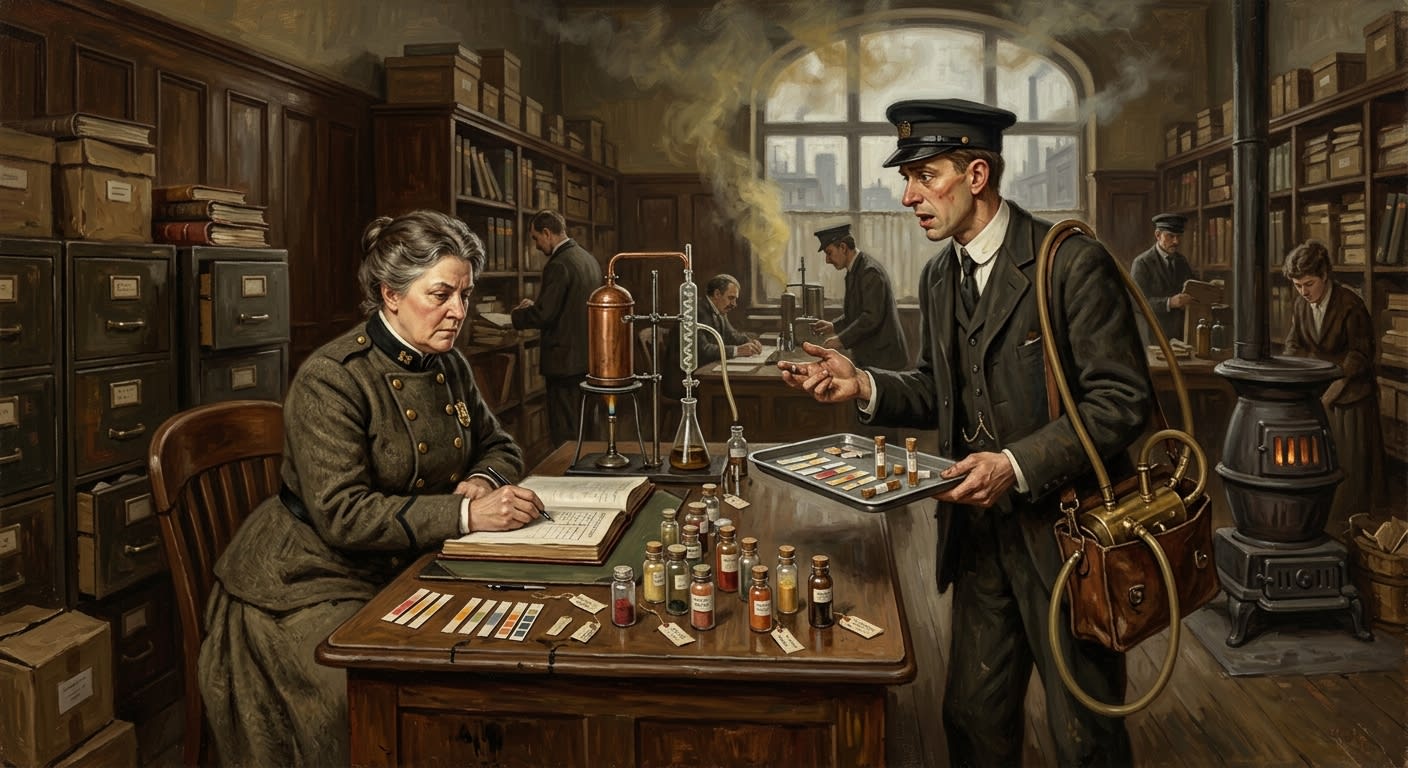
The Index of Prohibited Emanations is the Bureau of Purity’s catalogue of unlawful breath: forty-seven combustion by-products, fumes, smokes, vapours, scented residues, heated prayers, and atmospheric embarrassments by which the Fume-Inspector may turn a room’s warmth into a prosecutable fact. It is the book that gives smoke a docket number. It is the book that makes a chimney confess.
The public version is slim, clean, and fraudulent. It lists black diesel, unconsecrated beeswax, three varieties of whale oil, false incense, chapel wax adulterated with kitchen fat, lamp oil cut with gutter tallow, and gaseous by-products of prayer conducted without licence. The internal version is larger, dirtier, and annotated in hands that cough. It contains exposure charts, bloom diagrams for fume paper, seizure phrases, toxicity warnings, and margin codes indicating whether a substance is to be eradicated, tolerated, taxed, displayed, or denied until a superior office has finished using it.
The Index does not ban foul air. If foul air were banned, the Synod would have to arrest half its factories and all its councils. The Index bans unauthorised foul air. There lies civilisation, coughing into its sleeve.
#On Its Birth from Directive Fourteen
The Index was assembled in the aftermath of Operational Directive 14, A.S. 143, the act that constituted the Ninth Mark and gave Fume-Inspectors their right of entry, seizure, and citation. Before that year, smoke law existed as a litter of parish habits, guild ordinances, furnace blessings, war exemptions, and angry memoranda from clerics who disliked being gassed during morning office. Directive 14 demanded a common field language. Purity supplied one, with the tender delicacy of a man naming knives.
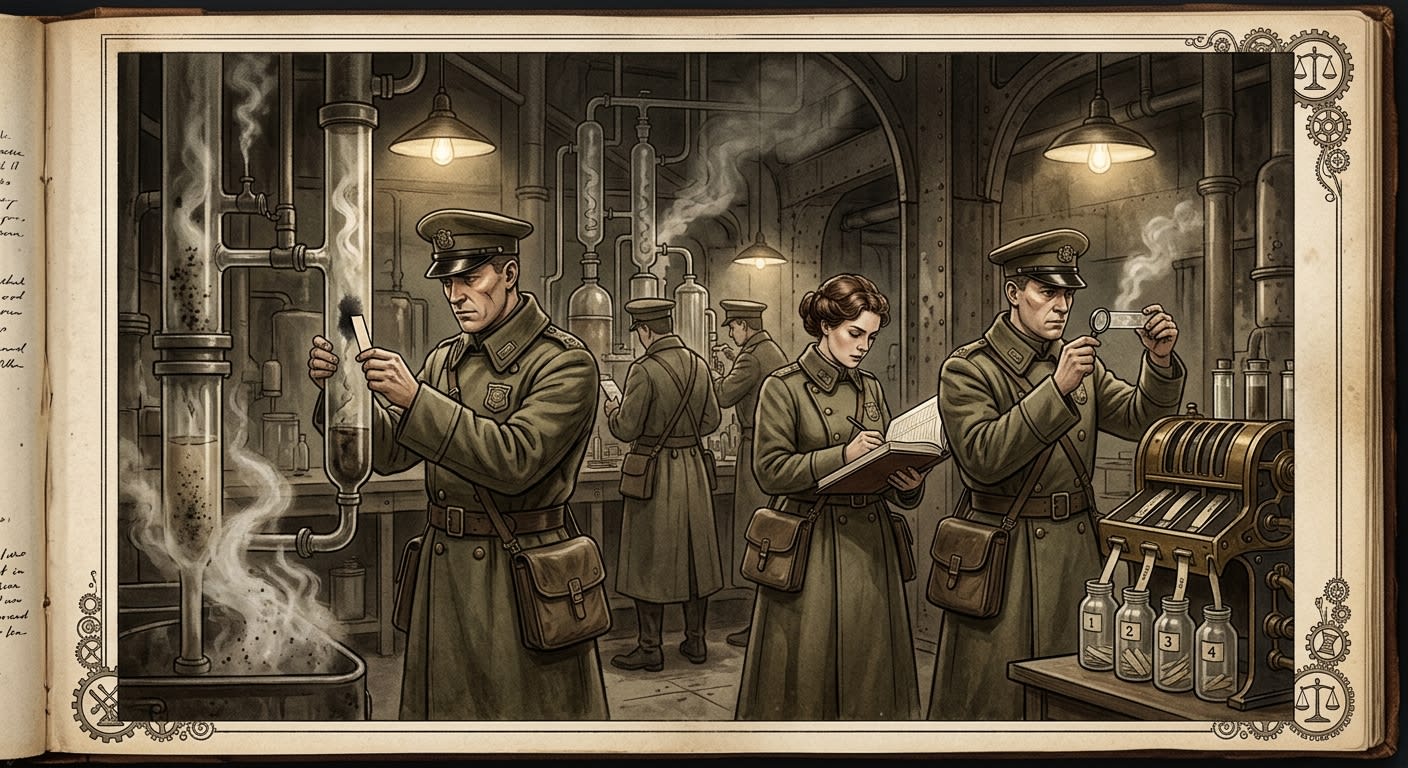
The Year of Ash Rain gave the work urgency. Maldrake’s fires in Thrace had made the eastern prefectures breathe ash for nine months. Crops failed. The Ninth Bell Famine followed. Chimneys lied, lamps sputtered, sanctioned fuel vanished into military channels, and black diesel entered kitchens with the inevitability of rats after floodwater. Purity could not stop the burning. It could name the fumes.
A Bureau anniversary tract states that the Index arose from “a matured theological science of atmospheric purity.”
Corrected: it arose because inspectors needed to distinguish battlefield ash, lawful furnace smoke, black diesel residue, panic incense, cheap tallow, and demons writing in chimneys before the bread queues tore them apart. Theology arrived later and asked for a better chair.
The first compilers were Air Auditors, Engineering chemists, Records classifiers, and two Doctrine men brought in to ensure the substances sounded sinful enough when read aloud at tribunal. Their quarrels survive in the phrasing. Engineering wanted “petroleum distillate, unblessed, high-sulphur.” Doctrine wanted “pit-oil exhalation, unclean.” Records chose “black diesel” because fewer clerks misspell it. That was the last sensible decision in the room.
#On the Forty-Seven Items
The Index’s forty-seven items are arranged by presumed spiritual volatility, not by toxicity, commonness, or actual risk to the lungs. This is why a man may burn something that kills him quickly yet draws no Purity charge, provided the substance has been blessed, paid for, and described correctly. The air is less important than the authority under which the air offends.
Items One through Nine concern fuel: black diesel; pit-sludge vapour; engine-grade lamp cuttings; coal-oil of uncertain provenance; three whale oils imported through channels the Bureau of Tithes denies with visible sweat; unregistered peat spirit; and battlefield salvage grease. Items Ten through Seventeen concern wax, tallow, and household heat: unconsecrated beeswax, chapel wax adulterated with kitchen fat, grave-wax knockoffs, gutter tallow, birth-room vinegar fumes, plague-room camphor burnt after licence expiry, and the infamous widow’s mixture, whose recipe is omitted because citizens, when given recipe law, begin cooking jurisprudence.
Items Eighteen through Thirty-One govern incense, prayer, and ritual combustion. False incense leads the list, followed by penitential resin cut with sawdust, relic-room charcoal sold twice, vigil smoke produced by unlicensed confraternities, prayer papers burned outside authorised calendars, heretical hymn ash, and any gaseous by-product of prayer conducted without licence. The Bureau has been mocked for that last phrase by tavern philosophers with short careers. Prayer is speech. Speech produces consequence. Consequence, if heated, becomes atmosphere. Atmosphere falls under Purity. A child could follow the chain, if properly frightened.
Items Thirty-Two through Forty-Six belong to the uglier shelves: demon-glass residue, scripture-smoke precursor soot, charred lens binders, marrow-lime vapours, bone-char filtration exhaust, fog-oil adulterants, underchord pipe breath, corpse-kitchen salt steam, and several named emanations sealed from public copies because naming them causes experiments. Item Forty-Seven is left blank in most district manuals. The blank is not mercy. It is administrative appetite.
INTERNAL INDEX LEAF — ITEMS 42–47, COPY DAMAGED BY SEIZURE FIRE 42. ██████████ vapour, recognisable by blue-black bloom and throat sweetness. 43. Bone-char exhaust after contact with scripture-smoke residue. 44. Prayer-heat produced in rooms containing no living petitioner. 45. ██████████, to be sealed without reading. 46. Chimney exhalation carrying names of absent children. 47. [RESERVED — DO NOT PUBLICLY NUMBER]
#On Item Thirty-Nine
Item Thirty-Nine is “air of suspicious warmth.” It is the most mocked line in the Index and the most honest. A stove may be hidden. A fuel canister may be moved. A wick may be swallowed, buried, thrown into a canal, or hidden inside a saint’s hollow head, a practice I mention because the Bureau of Relics still pretends not to remember Candlewick Annex Raid 6 (Unregistered). Warmth remains.
The Fume-Inspector knows the feel of unlawful heat on the cheek before the fume paper blooms. A tenement stairwell at ration temperature should bite. A chapel side-room after curfew should chill. A cellar beneath a closed bakery should not breathe like an animal. Suspicious warmth lets the Bureau cite the atmosphere before it finds the stove.
Its field use is broad. It justifies entry into rooms scrubbed of visible fuel. It permits seizure of ashless hearths. It allows Purity to punish the household that has learned concealment too well. It also permits mercy, bribery, terror, and arithmetic. A Twenty-Percenter may record “insufficient actionable warmth” and pass by. A Clean-Lung Purist reads Thirty-Nine literally and begins sealing doors. A Stagehand waits until a crowd can feel the warmth through the threshold.
The public commentary to Item Thirty-Nine states: “This provision applies only to anomalous heat not attributable to lawful combustion.”
Internal clarification: lawful combustion is a filing condition, not a physical property. Heat becomes lawful when its papers arrive before the Inspector does.
#On Fume Paper and Proof
The Index would be sermon without fume paper. Reactive parchment manufactured by the Bureau of Engineering’s Scriptoria annex gives the inspector his visible miracle. Held near smoke, it blooms. Dark rings for petroleum distillates. Ruddy spirals for animal fat. Grey feathering for wax adulteration. Greenish freckles for demon-glass residue. Script, when the day has decided to be cruel.
The paper’s genius is theatrical as much as chemical. A smell cannot be shown to a crowd. A bloom can. A nose may be challenged. A stained strip, sealed in a vial, witnessed twice, entered thrice, and carried to a tribunal in a little coffin of paperboard, has the dignity of the state. The accused may say the stove was cold. The fume paper disagrees in colour.
False positives are officially rare and practically scheduled. Bribed samples, planted diesel rags, pre-smoked strips, incense masking, fume lenses cut from demon-glass, and kitchen fats blessed by priests with poor eyesight have all entered case law under other names. The Index does not prevent fraud. It gives fraud a vocabulary sturdy enough to bear a fine.
#On the Three Schools of Reading
The Clean-Lung Purist reads the Index as commandment. Forty-seven items, forty-seven prohibitions, forty-seven reasons to enter, cite, seal, confiscate, and sleep badly for three years before dying or being reassigned to smoke fit for saints and corpses. His virtue is accuracy. His vice is believing accuracy has jurisdiction over winter.
The Twenty-Percenter reads the Index as a ledger of possible realities. Item One may be real today. Item Ten may remain unreal until the district has bread. Item Thirty-Nine may become real at the market fountain, where public warmth can be humiliated into public obedience. He does not deny the Index. He edits its timing.
The Stagehand reads the Index as script. Every item has blocking, lighting, witness placement, knock cadence, and a citation line to be pronounced loud enough for the third floor. To him, the Index is less a book than a playbill with arrest powers. The Bureau promotes him, because citizens cannot fear a paragraph until someone performs it at their door.
#On Black Diesel and the Necessary Heresy
Black diesel remains Item One because even hypocrisy needs a frontispiece. It is contraband pit-sludge distilled in cellar furnaces, pumped through hidden pipes, burned in lamps, stoves, engines, and inspection annexes when sanctioned fuel fails. No cleric dares bless it. No winter survives without it.
The distillers know the Index as a weather chart. They keep tithe cuts for confiscation, lamp-clean batches for households, engine-grade fuel for men with guns, and offerings for Purity officers whose filters require replacement before payroll admits it. The Index threatens them; it also structures their business. Item One creates price. Item Thirty-Nine creates urgency. Scripture-smoke clauses create panic surcharges. Law is excellent for trade when applied unevenly.
Scripture-smoke remains the Index’s ulcer. Black diesel fumes sometimes arrange into letters. The Bureau says atmospheric condensation, non-doctrinal. Fume-Inspectors say Seal. Report. Forget. Distillers say let it write and do not read. The Index lists precursors, residues, and response codes because the Bureau cannot admit that fuel has begun corresponding with the state.
#On Present Authority
As of A.S. 201, the Index remains active in every major Synod city, every bastion ward, every furnace district, every tariff-chapel smoke corridor, and every convoy kitchen where unlawful heat keeps lawful soldiers from freezing. Public copies are posted in market offices, parish halls, and Fume-Inspector kit rooms. Internal copies travel in oilcloth, sealed against weather, theft, and curiosity.
The Index has failed to purify the air. This accusation misunderstands its office. The Index makes air legible, chargeable, theatrical, deniable, taxable, and occasionally survivable. It tells the Clean-Lung boy what to hate, the old Air Auditor what to ignore, the Stagehand what to perform, the distiller what to price, and the citizen which smell to fear when the brass knock comes.