

#On Their Station
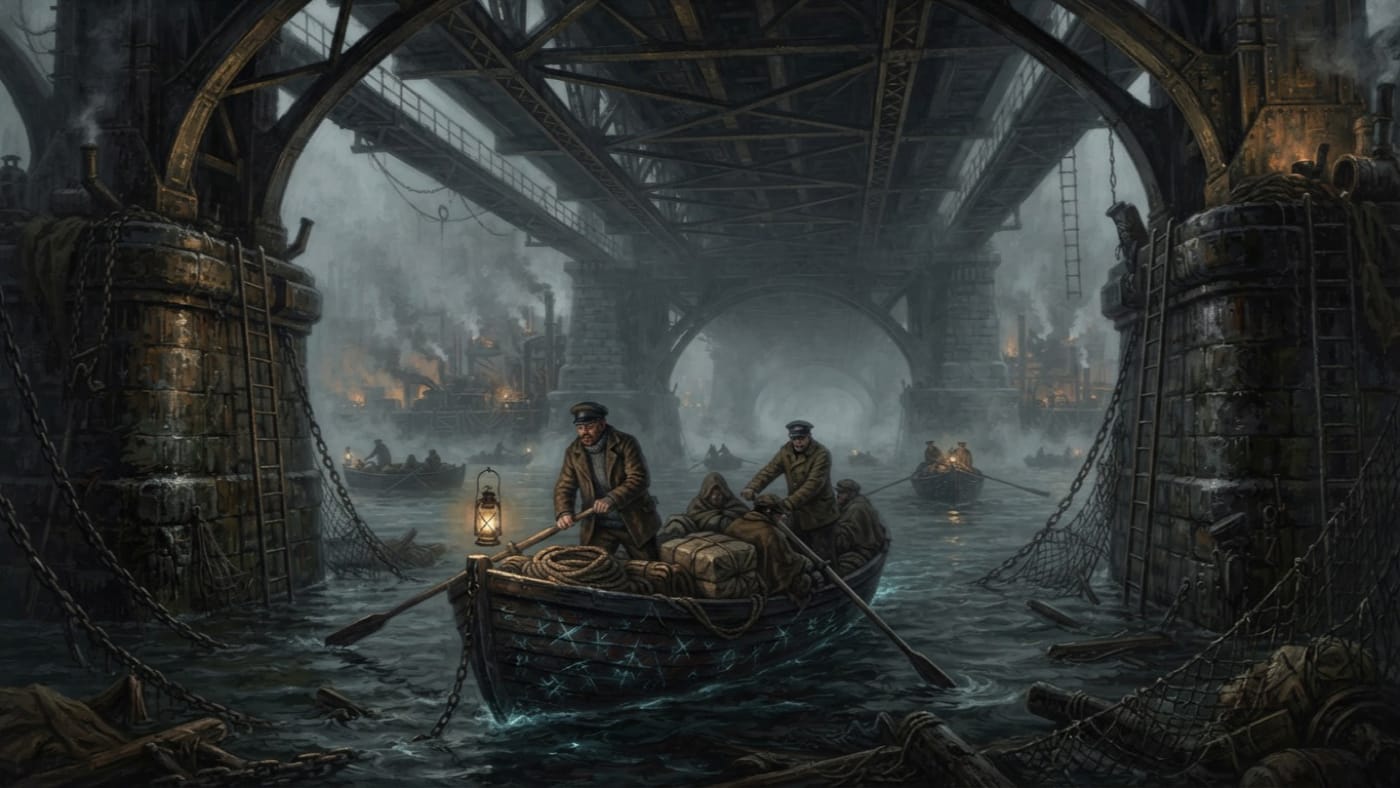
The Under-Deck Moorers are the boatmen of Bastion-Brest, and they are also a cartel. The bridge has never needed its truths to agree with each other. By day they row brasswrights, pump fitters and dredge foremen out to the footings of the Brass Ribs, where the Bureau of Engineering's drawings reach cold water and stop being drawings. By night, and in any fog thick enough to swallow a lantern at ten oars' distance, they row whatever pays.
On the deck above, movement is a sacrament with a fee schedule. A crosser on the Ribwalk presents an identity file, a confession receipt, a transit seal and a fresh Absolution Token at every threshold the Crossing Bureau has troubled to build. Below the deck, movement belongs to whoever knows which chain hangs low after the thaw. The Moorers know. That knowledge is their whole charter, and it is the only charter of theirs I have been able to find.
I give no founding date because no record I am permitted to read contains one. I give no membership roll because the Moorers keep none on paper, and the Bridge Tribunal, which keeps rolls of everyone, keeps a remarkably thin one on them. What survives is the bridge's own administrative shorthand: cartel; public face, boatmen and maintenance; aim, the fog route beneath the span; methods, smuggling, blackmail, drownings. Six words for a trade and three for a terror. Brest's clerks are efficient when they are frightened.
#On the Fog Routes
Owning a skiff does not give a man a route. The provost patrols have skiffs. The Gun-Cantor Command has skiffs. So, on paper, do the Bureau of Engineering and the Crossing Bureau, and their boats go where the Tribunal sends them and come back with nothing, because the river under Brest will not answer to a requisition.
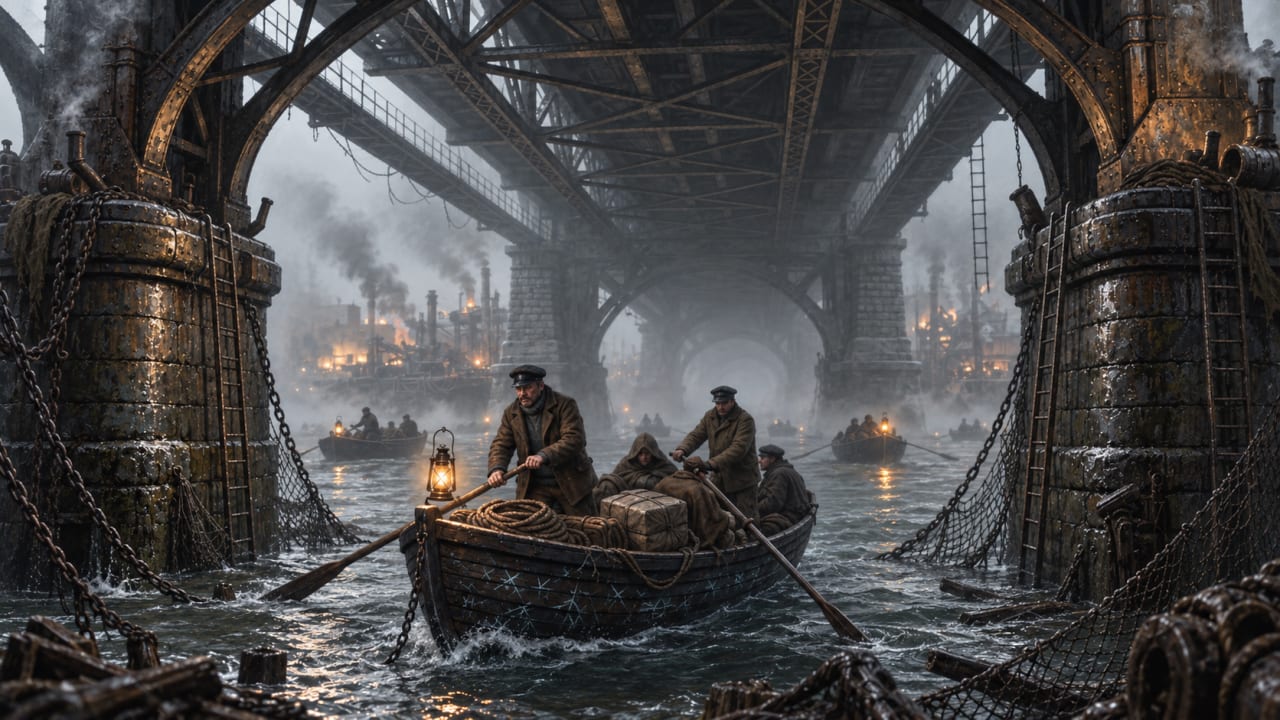
The span runs east to west across the Bug on thirty-two trusses and fourteen pylons sunk to bedrock. Beneath it hangs a defensive apparatus designed to keep anything from crossing beneath it: chain booms between the pylons, under-rib netting meant to catch climbers (and catching bodies with equal diligence), pylon ladders bolted to wet stone, and the gun-shadow of the casemates overhead. Into this the Bug pours its mist every morning, as reliably as the dawn bell.
A Moorer route is an accumulation of particulars. It covers which chain can be ducked at low water and which one will take a man's head at high. It covers which net sags after artillery recoil has shaken its collars loose, and which ladder at which pylon is missing three rungs and how many hands it takes to get past them in ice. It covers which patrol sergeant hums before he rounds the brace. It covers which confession shift on the deck makes enough noise (weeping, bell-strokes, the scuffle of the Queued) to cover the sound of oars below.
None of it keeps. The water rises a hand's breadth and the chain clearance is wrong. Engineering restrings a net. A new sergeant arrives who does not hum. Winter ice rams the pylons and takes a mooring ring with it. The Moorers' wealth spoils as fast as fish, and so it has to be renewed every night by men who go out and test it with their own bodies.
The water takes them too. Hypothermia in mist kills boatmen as readily as passengers, and a slick rung has no regard for anyone's trade. The bridge's winter memorial for the drowned, the Mist Wake, is reported by the local survey to be the Moorers' busiest season. Grief keeps the patrols at chapel, and the fog thickens.
#On the Hands and Names
Ask anyone in the Pylon Warrens who commands the Moorers and you will hear one name: Mist-Captain Rell, said to be never dry. Ask what Rell is and the answers part ways. To some Rell is a person, to others a rank. Some say it was an insult that outlived its first owner, and some say it is the name boatmen give an absent superior so that no one present can be held to account. The published survey of the Sluice Yards lists all four and chooses none. I have tested each against the Tribunal's files and found that every one of them fits equally well, so I record the name and decline to give it a face. A Codex that guessed here would be making up a head of state for a gang of oarsmen.
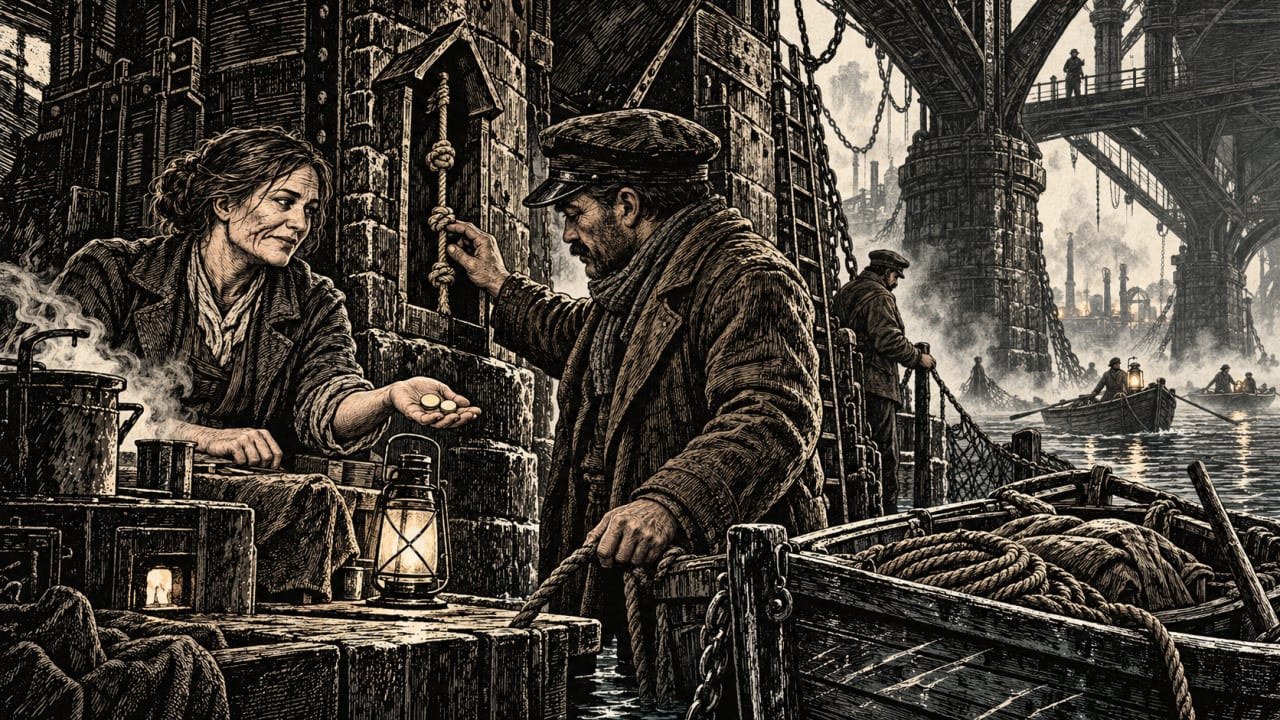
Niva Pike is easier, being only a broker. She works beside the tar kettles in the Yards and smiles with the left side of her mouth, because a hook took the right. Her trade is matching wax to need: which token passes which gate-box, which transcript will survive a mismatched sin category, and which buyer can afford the better forgery. That makes her a merchant inside Moorer territory. It does not make her the Moorers, and nobody I trust has said she manufactures anything.
The organisation below those two names is, so far as the record shows, a matter of hands. There are men who row, men who hold rope at the ladders, and men who watch the patrol bells from the chain bays. In the west chain bay stands a small chapel where boatmen touch three knots before they go under the span in fog. The first chapel there was unauthorised, and the second was taxed. The local warnings tell a passenger never to board without seeing the knot, which implies a system of recognition I have not been shown and will not invent for the reader's comfort.
#On Maintenance and Other Cargoes
The bridge cannot keep itself up. Its fourteen pylons take ice in the thaw and trees in the flood. Its pumps clog with weed, pulp and cartridge boxes, and its nets drag with whatever the river feeds them. The Brasswright Guild keeps the ribs firing and the span standing, but brass does not walk down a ladder by itself, and a fitter cannot swim a toolbox to the footing of Pylon Eleven in January. Someone has to row him there and hold the skiff against the current while he works. Someone also has to know where the current runs this week.
That is the legitimate half of the Moorers' trade, and it pays badly in coin and well in protection. Every maintenance run puts boatmen under the span with a reason to be there. Every repair order the Guild submits is, without anyone saying so, a request for Moorer service.
The other half of the trade comes from the queue. When the Confessional Lanes back up at the East Gatehouse, when a convoy waits three days for writs, when the mid-span cordon closes because a booth has started whispering, the people stuck above start looking down. A fixed price would mean nothing in such a market. Fares under the bridge rise every time the cordon tightens above, and the Tribunal's strictness pays the Moorers as surely as any wage.
The cargoes that published accounts have documented include repair crews, stolen tokens, stolen manifests, civilians fleeing the queue, and stamped officials who would rather not be seen in it. Wax and paper also pass along the fog routes. Forgers work beneath the Ribwalk in waters the Moorers control, selling copied tokens, edited confession transcripts, and sin scrips, which are confessions written to suit a trade, so that a mule-driver can buy anger and a clerk can buy envy. Some of the scribes in the Lanes sell edited sins to smugglers. The Moorers host this market and carry it, and they broker some of what passes through it. They take their share of all of it. I do not say they make every disc that changes hands under the deck, because I cannot prove it, and the Bureau of Purity has spent years failing to prove it as well.
The terms are harsh. The local warning tells passengers never to pay in full before the second rib, which tells you how often people have been put off at the first. A boatman who carried you across without confession now knows that you crossed without confession, and crossing without confession is one of the bridge's red lines. Your fare buys his silence for one night, after which he can sell it again, as often as he likes, to you. The cartel's blackmail needs no ledger, since the crime itself serves as one.
The drownings are on record as a method, not as accidents. That is all the Tribunal's shorthand says. It is enough.
#On the Tribunal's Tolerance
According to the published survey of Bastion-Brest, the Bridge Tribunal tolerates the Moorers because it needs their skiffs for maintenance runs. I have looked for a licence, a concession, a sealed agreement or any kind of contract. I have found nothing. The arrangement is necessity and it is enforced selectively, and you can see it in the raid records rather than in any statute. The dedicated survey still lists river-skiff entry among the illegal ways onto the bridge, and both statements are true. The skiff carrying a fitter to Pylon Eleven is tolerated, and the same skiff carrying a widow past the cordon is a crime, and both run the same route on the same oars, sometimes on the same night.
The bridge's three powers watch the river differently. Presiding Judge Elsbeth Krail adjudicates the crossings, the identity disputes and the manifest irregularities that Moorer passengers produce when they surface on the wrong bank with the wrong papers, and she has every reason to want the routes closed. Seal-Registrar Hett Ruis holds the stamps and identity files, and he wants every recovered token routed through his office, preferably through his own hands. Gun-Cantor Marshal Vonn holds the fire keys and the curfew. His Command hates the under-deck trade, and he wants the Moorer routes mapped, partly for emergency fire and partly out of private suspicion. None of these interests makes any of the three a partner of the cartel. If a quiet understanding exists between the river and the bench, no one has shown it to me, and I will not write what I have not been shown.
The provosts are the Moorers' open enemies, and the Bureau of Purity is their recurring inconvenience. Purity raids the under-deck token market every quarter, arrests a modest number of people, seizes wax, and declares victory. The market reopens within the week. The Bureau of Tithes taxes what it can count in the Yards and estimates what it cannot, and the Moorers come under the second heading.
#On Blank Crossings
The Blank-Sheet Circle makes blank crossing papers in the Pylon Warrens so that its people can cross without a name, a confession, or a place in the Ledger at all. Judge Krail blames the Confession Echo on the Circle. The Tribunal has arrested nineteen of its members. Between raids, the provosts have more than once treated the Circle and the Moorers as a single hand in two gloves.
They are two hands. A Moorer wants a fee for passage. He sells a way around the law, and he needs the law intact, since his price is set by how badly people want to avoid it. The Circle wants a soul the Ledger cannot see, which amounts to destroying the law's power to name anyone. Their customers overlap, and so do their routes and their enemies. A Circle client may well have crossed in a Moorer skiff, paid the usual fare and gone unasked, because the Moorers ask questions only when the answer is worth money.
The paper economy around them is shared and muddled. Dredge crews, most of them penal labourers, recover cold-water pulp from the sluice grates and sell it by weight or favour. Some of that pulp becomes receipt patches and some becomes blank stock. The dredge crews are a labour gang and not a second name for the cartel. The scribes who sell edited sins are not all smugglers, and the forgers in Moorer waters are not all Moorers. The whole under-deck is crowded with distinct trades, and the provosts lump them together, which helps their arithmetic more than their understanding.
The Under-Deck Moorers serve as the river arm of the Blank-Sheet Circle.
Struck. This conflation keeps turning up in provost talk and Purity's raid arithmetic, and it has cost Purity time and bruises without giving it a single convicted heretic. The Moorers sell passage around the confession system. The Circle sells absence from it. Shared skiffs prove only that both of them are able to row.
#On the Water Beneath the Ribs
The Bug kills people in all the usual ways, by ice shear, current, cold, and falls from slick ladders, and the Moorers live alongside those deaths as dredge crews live alongside hooks. In A.S. 199 the bridge added an unusual danger. Sins confessed in the booths began to come back as whispers on the deck, in the voice of the person who confessed them. Booth 77, sealed since that year, repeats confessions that have not yet been spoken. According to the published survey of the Sluice Yards, the Echo has since spread downward through brass braces, pump housings, wet rope and sluice gates. A sin confessed above can surface hours later below as a murmur from the river works.
The Moorers responded before the Tribunal did, with the sort of rules that working men make when they have no time for theology. Never speak your true sin under Pylon Nine. Never ask what the net caught unless you are buying. These are local customs. I do not promise anyone that they work. I record that the men who know the water best obey them.
Then came the hulls. The Moorers themselves report that skiffs have started coming back from maintenance runs under the pylons with patterned scratches on their hulls that were not there when they set out. The water at the pylons is fourteen metres deep and cold. Foreman Jost of the Brasswright Guild calls the marks stress fractures. The field chaplains call them something else, and their written reports are sealed. The Bureau of Engineering has recommended more dredging.
I note that the Moorers made this report themselves. A cartel that will not give the Tribunal a membership roll, a route map or a single name it can arrest volunteered information about its own boats. I have read every filing on the matter and found no explanation for the marks. I have not found any proof that the scratches, the Echo and the blank crossings are connected, nor any proof that they are not. Something under the Brass Ribs is marking the hulls of the only men who go there regularly. Whatever it is, the Creator has not yet seen fit to tell the Bureau of Doctrine, and the Great Deceiver has not been obliging enough to sign the hulls.
The Moorers are still on the water. The cordon is tight, and the fares are rising. Brasswrights still need rowing out to the footings, Purity still raids the market every quarter, and nobody has charted the routes. On the evidence, the only people who can tell the bridge what is happening beneath it are the ones it can neither license nor do without.