

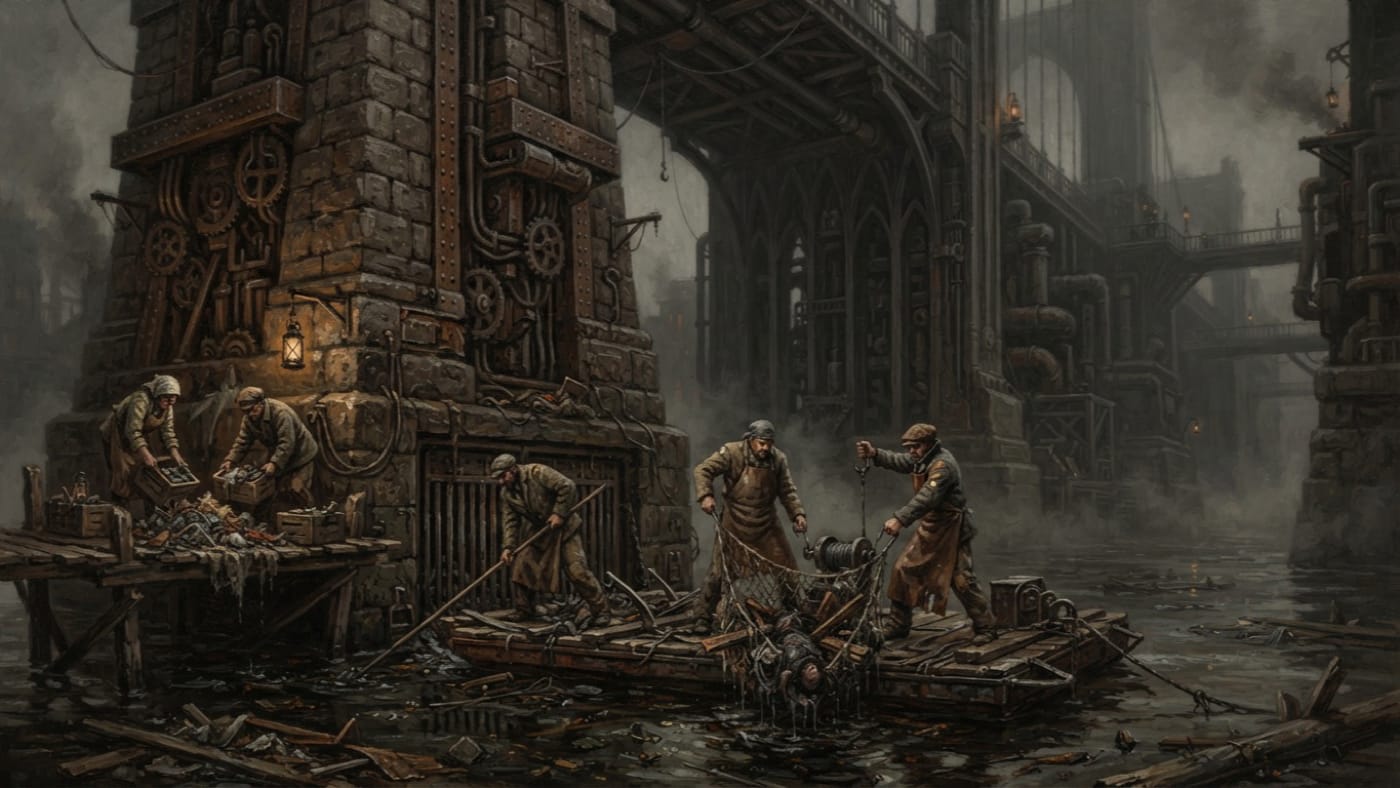
This survey was compiled in A.S. 201, which is 1911 in the Common Era's reckoning, and it describes the dredge crews of the Sluice Yards as they work in the present year. It gives no date for their beginning, because nobody recorded one. Nobody holds an inaugural mass for people sent into mud. The crews clear the Bug where it meets the Brass Ribs of Bastion-Brest. They work the pylon footings, the under-rib netting, the sluice gates and the pump throats. The bridge above carries guns, markets and the sacrament of crossing. It can carry them only while someone underneath keeps the river from choking its feet.
#On the Hands Sent Below
The crews are mostly penal. I keep the qualifier because the Yards' own records keep it, and because a Hieromnemon who rounds mostly up to all will soon be rounding suspected up to guilty. That is the Tribunal's trade. It is not mine.
Both men and women are sent below. The routes downward are recorded with the care that only punishment inspires: irregular confessions, toll arrears, forged tokens, violence in the queue, and the peculiar Brest offence of claiming to have nothing to confess. The Bridge Tribunal passes sentence. The Crossing Bureau supplies the arrears. Debt binds labour-hours to a ledger that grows faster than any pair of hands can pay it down, and compulsory assignment fills whatever gap remains. So a person condemned for bad papers, bad sums or an insufficiently guilty mouth is given a hook and told to keep the confessional bridge standing. The Bureau calls this correction. The pylons have no opinion.
Sentences produce rotation, but rotation does not erase experience. Some hands stay long enough to learn the river, and some on the hooks are not under sentence at all. The sources do not say how many of either. I will not invent a census to comfort the Bureau of Records.
Speak of crews, plural. No Dredgers' Guild exists, and neither does a charter, a foreman over all foremen or a common chest. The Brasswright Guild has its charter and its gift for invoices. The Under-Deck Moorers have their cartel and the fog. The dredge crews have assignments. When a Moorer skiff rows them out to a footing, the crews stay crews and the boatmen stay boatmen, and someone else pays the fare.
#On the Work of the Hooks
The work keeps the river's calendar, not the Synod's. In winter there is ice at the pylons, broken by lantern-light and hammer while the footings groan, and ice shear that takes ankles from anyone who misjudges the floe. Thaw drives timber and weed into the braces and the sluice teeth. Summer brings recoveries. The netting tangles in every season, and it must be cut free before the drag sets the whole span humming. The Yards' accounts name hooks, rope, lanterns and hammers. I have found no schedule of issue and I will not draw one.
Fourteen pylons stand in the Bug. That is a fact about the bridge. It is sometimes misread as a fact about the crews, but below the deck the only thing there are fourteen of is stone.
The Sluice survey records a hook custom that every rope shed repeats. Hook One takes bodies. Hook Two takes timber. Hook Three takes crates. Hook Four takes paper and small valuables. Hook Five takes whatever is still moving once it reaches land. It is a custom. No company was ever chartered under any of its numbers, and no officer outranks another by it. A novice who reaches with the wrong hook pays in drink, by yard reckoning, or in fingers.
The Yards' competence outruns their credentials. Women identify the drowned by boot leather once the river has taken the faces. Children carry tally knots between Hook Court and the Pylon Warrens. Old hands hear a gate chain change pitch and call the flood before Engineering's gauges admit it. None of this is an office, and none of it passes down by rule. Everyone above relies on it, and every one of them would deny that under oath.
The ordinary dangers need no theology: current, cold, drowning, slick ladders, rope that parts at the wrong moment. Then there is what the hooks bring up. Rail fragments have edges. Cartridge boxes have contents. Some crates are lifted by people who would much rather not open them. The Bureau calls the whole haul river salvage. The crews, more accurately, call it shit.
#On What Comes Ashore
The water gives up bodies, mule and dog carcasses, cartridge boxes, rail fragments, spoiled cargo, damaged devotional objects and paper. In the water each is an obstruction. Once it clears the surface it becomes property, and property at Brest is an argument conducted in seals.
The argument is held at Hook Court on the east mud ramp. The Sluice survey gives instances, and I repeat a few without pretending they add up to a code. A cracked token goes to the Crossing Bureau, unless it was found in a mouth, in which case it becomes Tribunal evidence. A soldier's belongings attract the Bureau of War. If a paper is folded inside the boot, Records reaches for the boot. A fragment said to be sacred summons the Bureau of Relics. The Bureau of Tithes counts whatever can be counted and arrives at every dispute already holding a figure.
The Yards have no code. They have precedent and temper, and whichever office reaches the ramp first with a dry seal.
A drowned body can pass through several claims before it reaches a grave. Families wait at the top of the ramp while the claims are settled. The crews who hauled the body up hold none of those claims. No source I have been shown records what, if anything, they receive for the hauling.
#On Pulp and Its Claimants
The upstream mills that serve the Warsaw dispatch corridor lose cold-water pulp to the current. The crews take it from eddies and grates, press it under boards and dry it near the pump heat. Officially it belongs to the Crossing Bureau once the salvage tithe is paid and contamination review is complete. In practice the review clerk is still warming his ink when the pulp moves on. Some becomes receipt patches. Some becomes safe-sin slips. By the right route, some becomes stock for the cellars of the Blank-Sheet Circle.
The Tribunal would gladly melt four propositions into one, and they must be kept apart. A crew recovered the pulp. A crew sold it. A crew knew where it was going. A crew belongs to the Circle. The first is the job. The sources prove the last of no crew as a body. Between the two lie nineteen arrests and a great deal of wet paper.
A Bureau of Records salvage circular classified lost paper stock as "commercial waste of no doctrinal consequence."
Withdrawn after the Blank-Sheet investigations. Records now counts the pulp it once declined to see, and it asks the crews why they never counted it themselves.
The Moorers carry dredge hands to the footings, and they carry other things for other customers. If one skiff carried a dredge hand at noon and a sack of drying pulp at midnight, that proves only that skiffs are useful. The Tribunal is welcome to arrest the hull.
#On Voices at the Gates
Since A.S. 199 the Confession Echo has seeped downward into the Yards. It comes through wet rope, pump housings, gate chains and brasswork. The first confirmed manifestation in the Yards was at Gate Three. Whether earlier ones went unreported elsewhere on the bridge is not settled here.
The Sluice survey records that Orven Task, scraping at Gate Three that winter, heard his own voice confess to cutting a convoy strap. A strap later failed on the Ribwalk, and a grain cart killed two. Task was arrested, released, arrested again, assigned to Hook Five and classified pre-culpable. The account proves that the Tribunal has an appetite for anomalous evidence. It proves nothing about Task's hands, nor about how a voice could arrive before its deed, nor that gates make a habit of prophecy.
The crews made their own rules before the Tribunal issued any. Never answer a confession that comes out of the water. Never repeat a voice that uses your childhood name. Never take salvage from a net while it is speaking. These are recorded precautions. Nobody has shown that they protect anyone. The crews keep them anyway, which is how most liturgy began.
Above them stands Booth 77, which speaks tomorrow. Below, chains are said to move before the order comes and net bells are said to ring for bodies not yet in the water. The crews call this borrow-current. Judge Krail calls it unverified temporal acoustic drift. She also attributes the Echo to blank crossings, a theory she holds with conviction. No one has proved it.
#On the Present Assignment
In this year of A.S. 201 the crews are overworked. The channel is silting, paper is still being diverted, identifications are uncertain and custody is tightening. Judge Krail wants the salvage under her hand. Hett Ruis wants every recovered token sent through his stamp office. Scribe-Mother Hal wants Echo reports filed before her clerks hear their own names from the drains. The crews' demands, as recorded, are dry gloves and better rope. No office at Brest has a seal for either.
The gate chains lift at dawn and the crews report. Above them a penitent confesses something brief enough to travel. Below, the rope is already wet.