
#On the River That Pretends to Be Geography
The Bug River is a military fact wearing water.
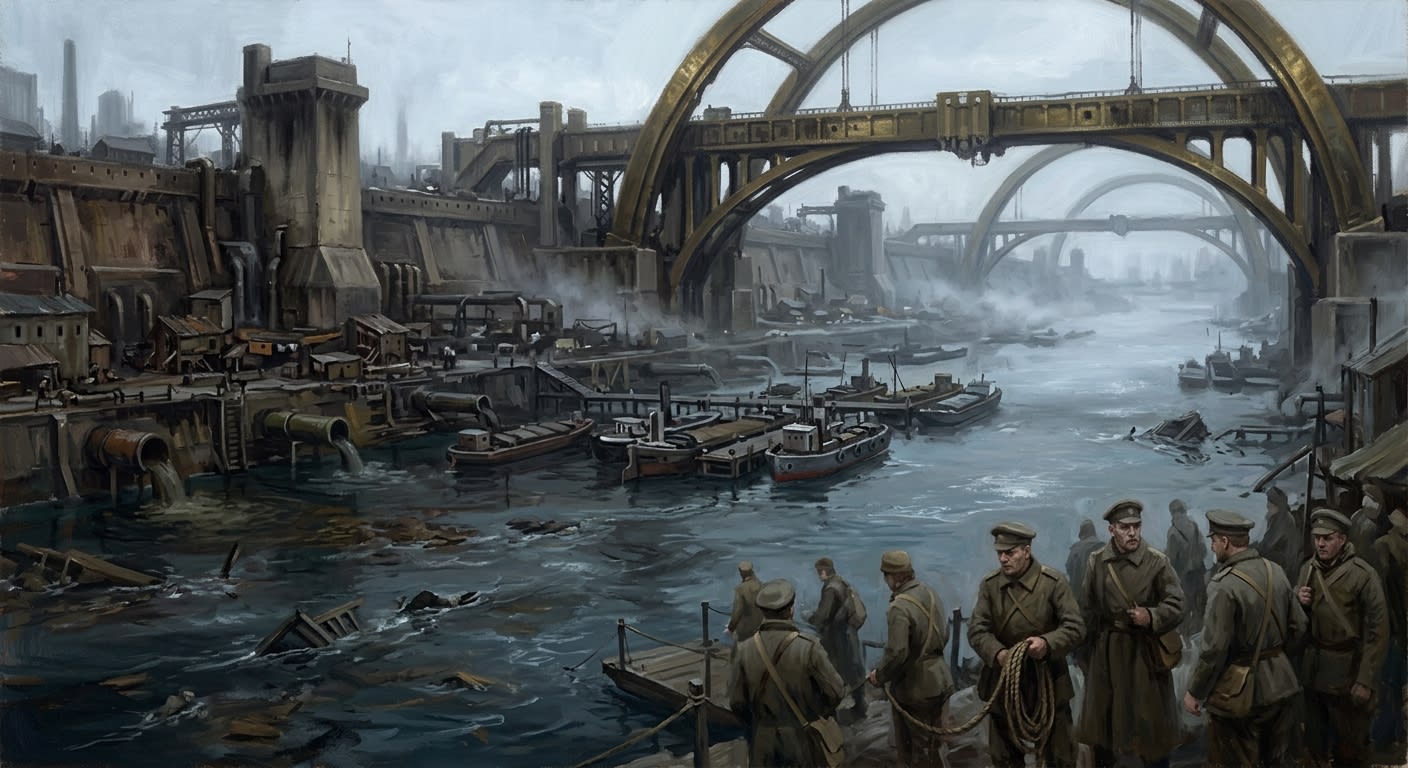
Maps present it as a north-south blue line through the Polish lowlands, which proves that maps, though useful, are accomplished liars. A blue line suggests innocence. The Bug is not innocent. It is the northern sector's natural moat, the wet hinge of Bastion-Brest, the cold witness beneath the Brass Ribs, the drain of confessions, cartridges, bodies, ration tins, severed ropes, failed names, and whatever the Nameless Tide leaves behind when it has finished pressing against the eastern wire.
The Sagittal Line uses many kinds of terrain. Königsberg has lake-maze and Baltic damp. Przemyśl has the Carpathian ridges. Sibiu has the Transylvanian wall. Irongate has the Danube gorge. Shipka has its pass. Constantinople has the Bosphorus, which is a strait with imperial vanity and excellent dramatic instincts. Brest has the Bug. Broad enough to matter, cold enough to punish, shallow in treacherous places, deep in others, always fogging the span at dawn as if the river resents being watched.
The public phrase is “natural moat.” That is accurate in the way a coffin is accurate when called a box. The Bug blocks passage across the flattest, most exposed sector of the Line, where no mountain provides theatrical obstruction and no gorge narrows violence into a single blessed throat. It receives the eastern pressure first as weather, then as rumour, then as bodies missing the courtesy of shape. It carries the westward traffic of a continent that must feed the northern front and the eastward traffic of a state that believes every crossing should produce a confession receipt.
To speak of the river apart from Brest is impossible and necessary. Impossible because the bridge-fortress has gripped the river so long that military thought treats water and brass as one contraption. Necessary because the Bug existed before the Ribs, before the Tribunal, before the two hundred and fourteen booths, before the Synod learned to call panic “transit administration.” Rivers are older than their occupations. They remember without filing. This makes them unreliable witnesses and excellent theologians.
The Bug's central sin is that it permits crossing at one useful place. The bedrock pinch near Brest gave engineers a blessing sufficiently sharp to become a curse. Had the river been deeper, wider, wilder, or less cooperative, the Synod might have scattered its forts along a broader line and allowed local incompetence to dilute itself. Instead the river narrowed obligation. The bridge grew. The bridge armed itself. The bridge learned to hear sins. The river kept running beneath it, accepting every improvement as another object to rot.
#On Course, Mud, and the Lowland Exposure
The Bug sector is a lesson in horizontal cruelty.
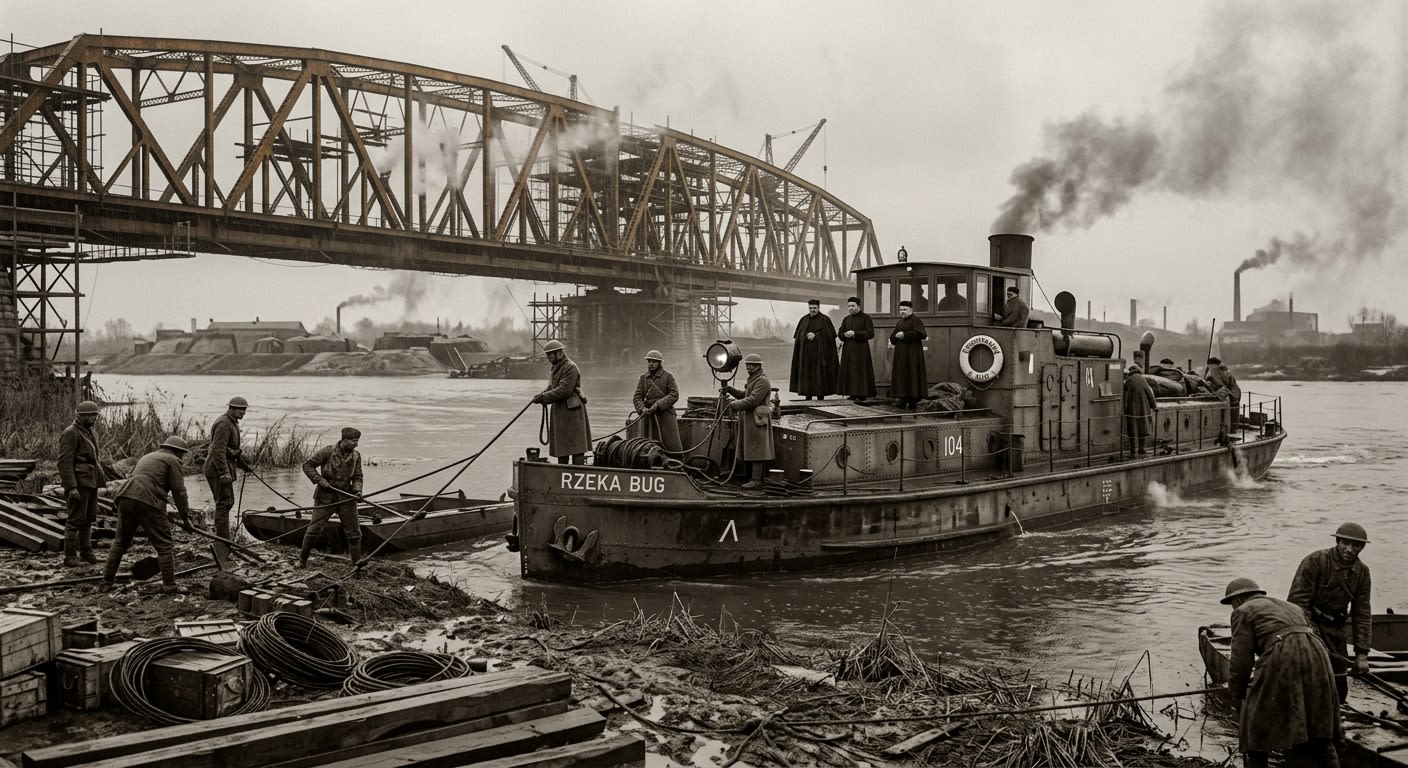
The Polish lowlands open east of Brest in long wet flats where a man can see danger for miles and gain nothing from the privilege. There are ditches, reeds, flood meadows, farm roads collapsed into supply ruts, abandoned orchard lines, plank causeways, shell bowls, ferry scars, and fields whose ownership has changed so many times that the Bureau of Records files them by casualty density. In winter, ice clots against the pylons and turns every maintenance run into an argument with blunt white teeth. In spring, the thaw swells the channel and the marsh approaches rise under carts as if the ground were reconsidering its vocation.
The river runs like a clerk with bad lungs: persistently, wetly, and with more noise than authority. Its banks are never clean. The western bank has revetments, inspection sheds, dredge hooks, quarantine racks, fuel piping, bridge drains, and the service stairs by which men descend into fog and return older than their absence warrants. The eastern bank is wire, mud, trip stakes, listening posts, salt barrels, and patrol pits whose names change whenever too many men die in one of them.
The Bug's military value begins with refusal. Cavalry hates its banks in thaw. Heavy engines sink near its approaches unless plank roads have been laid, relaid, blessed, stolen, relaid again, and guarded from men who discover that dry timber burns well in winter. Infantry crossing under fire becomes arithmetic for Vonn's casemates. Boats are worse: slow in fog, loud against ice, easy to net, and guilty by posture. Anything on water looks like smuggling until proven otherwise by a clerk brave enough to lean over the rail.
Its spiritual value, if one must dignify bureaucracy with that noun, lies in separation. West of the Bug is processed order: gatehouses, stamps, confession queues, ration allotments, artillery keys, Tribunal benches, and lamps that burn because someone has signed for oil. East of the Bug is the contested strip, Zone Five in practice and nightmare by local usage. Men cross west carrying mud on their boots and are required to speak guilt before the bridge allows them to continue. Men cross east carrying absolution tokens and are required to understand that wax is poor armour.
The river also corrupts recordkeeping. Paper sweats near it. Ink beads. Seals soften. Manifests arrive damp, folded wrong, thumbed by too many hands, smelling of vinegar fumigation and river rot. Hett Ruis's stamp room at Brest exists because the Bug makes every document look guilty. A dry paper from the eastern approach is treated with suspicion, and rightly. Dryness there indicates sorcery, forgery, or a courier so frightened that even rain avoided him.
Early Northern Theater primers described the Bug sector as “favourable defensive waterline with stable administrative crossings.”
Corrected after the third pylon flood, the seventh ferry seizure, the A.S. 97 harbour fire, and several hundred smaller humiliations. The Bug is defensive. Stable is a word written from warm rooms.
The lowland exposure shapes the mind. Soldiers at Brest envy the Carpathian men their ridges, the Irongate crews their gorge, even the Shipka rotations their fog, though no sane man should envy Syrion's fog. Brest soldiers receive sky, mud, water, wire, brass, and enough visibility to see shells arrive with bureaucratic punctuality. They develop a local fatalism that sounds like humour if overheard from a safe distance. No one is at a safe distance.
#On the First Refusal at the Water
The first defence of the Bug was not planned. This is why later planners love it.
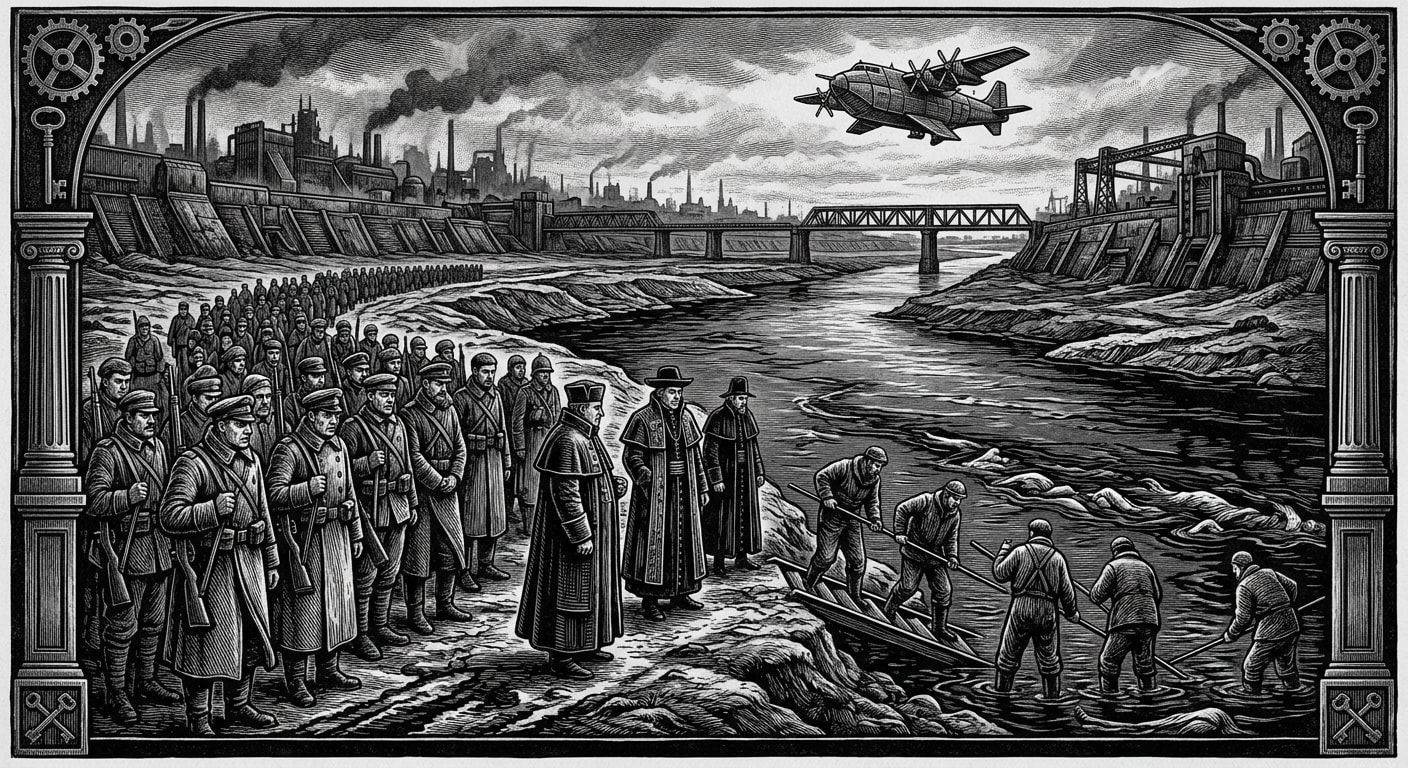
In A.S. 66, during the northern exhaustion of the Great Retreat, six companies reached the river near Brest and found an old Prussian stone bridge. It was fit for carts, peacetime vanity, tax collectors, and lovers walking under weather mild enough to encourage foolishness. It was not fit for the end of Europe. The companies held it for nine days against the eastern pressure, a phrase preserved in journals because the men lacked a better noun and because later censors liked its vagueness. Pressure sounds manageable. Terror has too many teeth.
On the tenth day the stone failed. Whether artillery cracked it, sabotage weakened it, the river undercut it, or the pressure from the east learned where stone keeps its fear remains disputed in the sealed annexes. The companies burned their pontoon behind them and dug into the western bank. By A.S. 67 the first permanent works appeared: timber forts, mud revetments, gun pits, toll sheds, a chapel tent, rope booms, and the first ledger table.
The ledger table matters. The bridge was absent. The paperwork had arrived.
The early works were ugly, temporary, damp, and successful enough to become permanent by accident. Refugees arrived in waves, then convoys, then prisoners, then engineers, then the clerks who insist on appearing after danger has made itself profitable. The Bug forced everyone to wait. Waiting created queues. Queues created authority. Authority created fees. Fees created offices. Offices created the sincere belief that the crossing had been an institution all along.
By A.S. 92, with the Concordat of Strasbourg hardening Synodal authority into continental machinery, the Bureau of Engineering presented the bridge-fortress plan. By A.S. 98, the first certified full military crossing took place under load, artillery, confession, and tribunal supervision. Public tablets call this completion. They lie in expensive stone.
The river did not object to brass. Rivers rarely object directly. They undermine, chill, corrode, fog, carry, swallow, and wait. The fourteen pylons were sunk to bedrock through silt that had already learned the taste of horses, men, powder, and prayer. Bone-lime grout sealed seams. Brass trusses rose. Casemates faced outward. Confession compartments faced inward. The Synod had taken a river crossing and built a moral intestine over it.
The Bug entered doctrine as mercy because doctrine loves calling compulsion by gentle names. The river had stopped the eastern advance long enough for men to dig. It had narrowed war into a place the Synod could fortify. It had given the northern sector a lock. The lock demanded a key. The key became confession.
#On the Brass Ribs Above It
The Brass Ribs are what happens when engineers, priests, magistrates, and artillerymen are allowed to answer one geographical question at the same time.
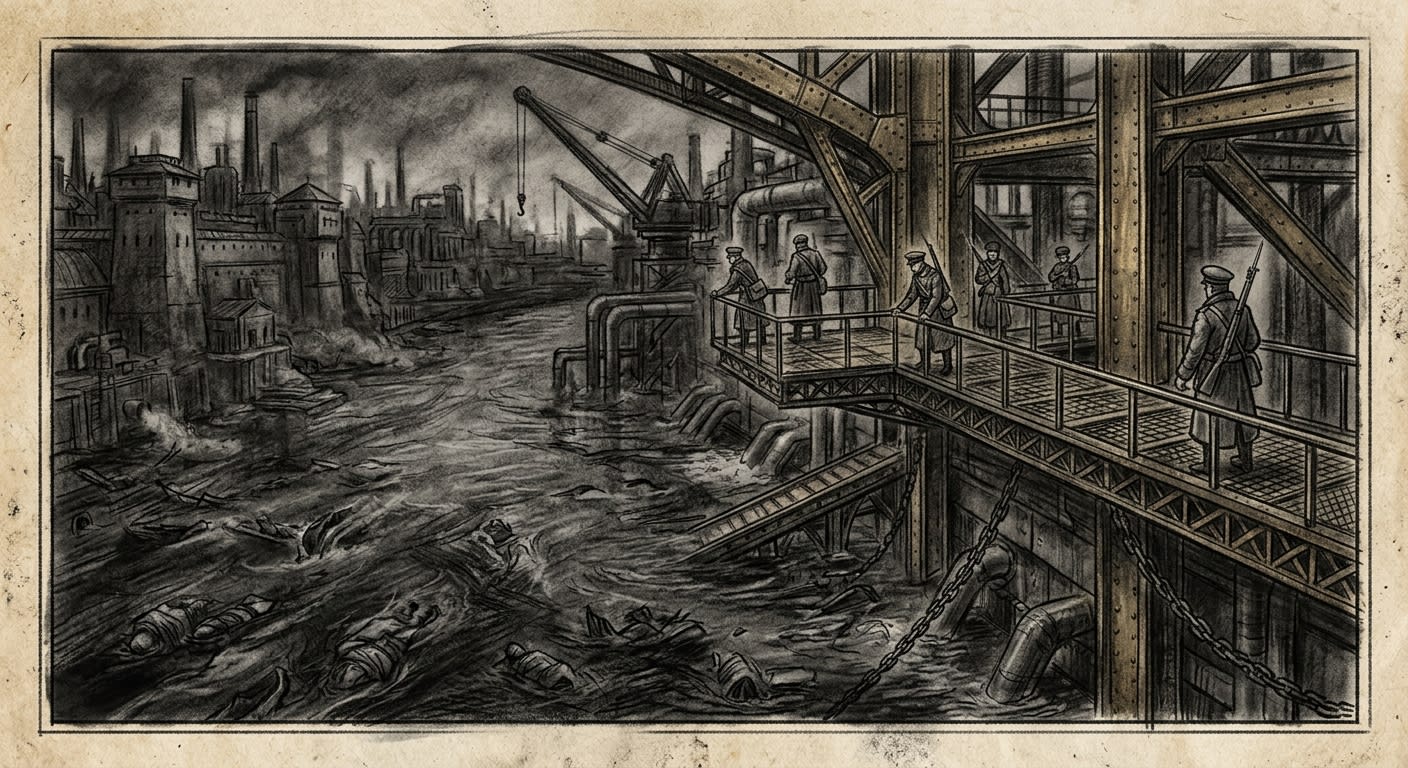
Thirty-two arched trusses span the river at Brest, riveted iron plated in brass, each rib a structural member, firing gallery, jurisdictional compartment, service passage, and local superstition. Outsiders call the whole bastion the Ribs. Locals are more exact. The bastion is the legal fiction. The Ribs are the body. The Bug is the blood beneath it, though the river would resent the comparison if it had not already carried worse.
Every system inside the bridge depends on the river's coercion. Without the Bug, there is no single forced crossing. Without the forced crossing, there is no universal confession apparatus. Without confession apparatus, no Confession Echo, no Booth 77, no Blank-Sheet panic, no Bridge Tribunal swollen into span-sovereign arrogance, no Gun-Cantor command able to treat foot traffic as a range problem. The river made bottleneck; bureaucracy made sacrament; fear made both durable.
The bridge's upper deck, the Ribwalk, is a market corridor and troop artery. Below it sit the Casemate Galleries, where Vonn's men keep guns warm enough to steam. Beneath them run the Confessional Lanes, two hundred and fourteen booths where travellers speak sins into grilles and receive wax permission to continue existing westward. Lower still, the Pylon Warrens descend toward the water, housing workers in damp vertical chambers where sleep is assigned by declared sin and coughs echo through stone like minor accusations.
The Bug reaches all of this through mist. It enters paper. It enters wood. It enters lungs. It beads on tokens and turns cheap ink into little black blisters. It makes clerks wrap registers in oilcloth and still lose corners to damp. It carries the sound of boots from pylon to pylon and returns it changed. Brest residents say the river listens through the drains. Officially, this is superstition. Unofficially, drain covers in the Confessional Lanes are sealed before major hearings.
The Sluice Yards downstream are the river's mouth inside the bastion. Dredge crews haul ice, wreckage, bodies, plank splinters, sunken toll chests, cartridge boxes, mule carcasses, broken icons, severed netting, and river salvage whose classification depends on whether Records arrives before Purity. Penal labour works the hooks. Under-deck moorers run skiffs through fog under grudging Tribunal tolerance. Everyone knows the illegal routes. Everyone denies knowing them in the correct order.
A Bridge Tribunal notice once claimed “all riverine movement beneath the span is fully supervised.”
Corrected in restricted circulation. All riverine movement beneath the span is theoretically supervised, practically taxed, selectively raided, and occasionally necessary for repairs the Tribunal later pretends were authorised in advance.
The Bug makes the Ribs necessary. The Ribs make the Bug political. A natural river can drown a man. A politicised river can drown him after revoking his crossing file, charging his family a salvage fee, and returning his confession in a voice his widow recognises.
#On Flesh-Mud and the Thaw South of the River
The Bug's mud is not always mud. This is the sort of sentence that gets a junior clerk transferred to Education for hysterical phrasing, after which an experienced officer says the same thing with worse grammar and everyone listens.
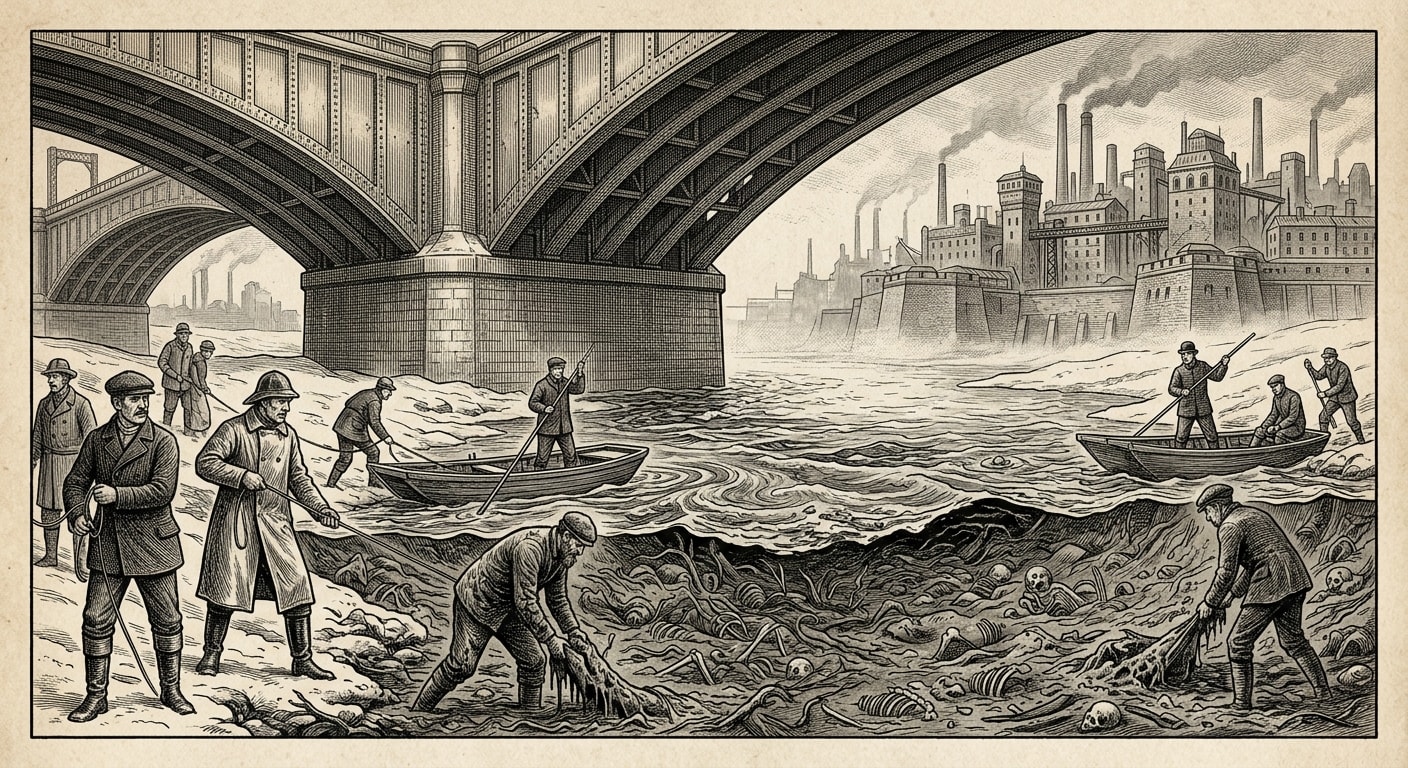
The first official record of Flesh-Mud dates to the A.S. 68 thaw south of the Bug River, three years after the Line hardened from emergency refusal into continental habit. A convoy reported six horses lost in ground mapped as firm. The horses did not sink. They were folded downward, joint by joint, while the teamsters watched the mud rise over them in sheets. One horse screamed with a human voice. Records struck the sentence from the first copy, retained it in the second, and charged the teamsters for the animals.
This is the Bug's gift to hostile terrain studies: proof that the ground near a river can learn appetite from everything the water fails to carry away.
The low approaches below Brest remain prone to active patches: black glossy mire that wrinkles against boots, tightens, produces invisible fingers, and leaves hand marks on men pulled free. It forms where war sediment gathers: clay, powder, grave-water, rust, blood, ration grease, saint-bone dust, burned vellum, hair, rosary wax, and the pulverised remainder of soldiers whose names remain legible only because some clerk far west has not yet mislaid the roll.
The Bug participates by deposit and denial. Floodwaters spread rot into shell bowls. Thaw exposes old ground and hides new hunger. Ice breaks scour the banks and leave behind mud shelves pale with bone-reef. Dredge crews claim that some active patches migrate toward the river during artillery weeks, as if thirsty for concussion. Engineering calls this unverified. Engineering has also lost three weighted rods, two surveyors, and one theological consultant whose final note reads only: it grips upward.
Approved countermeasures near the Bug include salt bombardment, plank roads, rope movement, censer smoke, and profanity. The first four appear in field manuals. The fifth appears in every successful extraction account and remains excluded from doctrine, since doctrine distrusts evidence it cannot spell in Latin.
Flesh-Mud changes the river's meaning. A moat should mark separation: here, safe bank; there, danger. The Bug refuses such tidy pedagogy. Its own banks bite. Its downstream flats remember. A soldier standing west of the water can still be taken by earth the river helped prepare. Geography, like bureaucracy, punishes the naive assumption that lines remain where drawn.
#On the Nameless Tide Across the Wire
The Nameless Tide presses against the Bug sector from the east, and the river has become its glass.
That phrasing will offend Cartography, which prefers phenomena to stay inside boxes with north arrows. Cartography may comfort itself with rulers. The men at Wire Post 11-C know better. The Tide does not arrive in boats. It does not march over a ford. It accumulates beyond the wire as grey pressure, a thickness in air and mud, a leaning of stakes, an inclination of lantern flames, a smell of river silt inside dry rooms, a moment when men look at their own cuffs and cannot pronounce what they stitched there.
Vonn's sentence remains the best: “The Tide does not arrive. You notice it has arrived. The difference is a funeral.”
The Bug assists the horror by being receptive. Mist rises from it and gives pressure a veil. Mud receives residues and refuses explanation. Holy water thrown east vanishes before striking ground. Bells cross the river in proper peal order and receive no answer except further bending of stakes. Hymns enter the grey and return flattened, technically correct and spiritually dead, like an audit prayer read over a debtor's corpse.
The Tide's relationship to the river remains classified under ABSOLUTE SUPPRESSION, a phrase the Bureau uses when it has replaced understanding with wax. Some reports describe strips of flesh on the wire after surges. Others report tokens, transcript scraps, mud ridges shaped like waves, or nothing except men with shorter names. Old soldiers stitch names on cuffs: first left, family right, unit inside sleeve. The practice is neither ordered nor forbidden. Fear, once useful, receives informal licence.
WIRE POST 11-C, A.S. 200 — RIVER ADDENDUM Recovered at bank below eastern stake-line: three absolution tokens, one left hand, boot with silt packed above ankle, page of confession transcript written in river mud. Repeated phrase in two survivor statements: “I crossed before I was named.” Instruction: do not read aloud within hearing of water.
The Tide would be easier if it were merely east. The Bug refuses merely. The Echo began inside the bridge in A.S. 199, one year before the defining eastern wire incident and three years after the Blank-Sheet Circle began making nameless transit a prosecutable art. Sins spoken into booths return from brass shutters, wet rope, empty token bowls, and once from the mouth of a dead mule hauled out of the river. Booth 77 speaks before penitents arrive. Ink sweats. Candle flames bend. The apparatus that names has begun answering to what cannot be named.
I will not claim the river is conscious. That would allow three committees to waste a season debating consciousness while the water carried another body past the pylons. I claim only that the Bug is a medium: for fog, for rot, for sound, for pressure, for transit, for the return of words men thought paid for by confession. A medium need not understand the message to deliver it. Ask any courier. Ask any corpse in a sealed bag.
#On Boats, Dredges, and the Under-Deck Economy
The Bug below Brest supports two economies: the licensed one, which is recorded badly, and the unlicensed one, which is recorded better by men who would hang if Records acquired their notebooks.
Licensed movement belongs to dredge crews, patrol skiffs, repair punts, pylon inspectors, chain-boom teams, icebreak boats, and the fortress pontoons that patrol the river-lock approaches. The work is cold, wet, dangerous, and regarded by deck soldiers as punishment until the deck soldiers are assigned below for one week and return speaking more politely to men with hooks. Dredge crews clear ice from pylons in winter, debris in spring, corpses in all seasons. They learn weight by feel: wood knocks, metal drags, cloth twists, bone taps, flesh resists, and certain sealed boxes pull against the hook as if embarrassed to be found.
Unlicensed movement belongs to under-deck moorers, skiff brokers, token runners, name traders, sin-script sellers, river boys, deserter guides, and those hard little syndicates that form wherever official crossings become too slow for hunger. They use fog routes, pylon shadows, drain noise, curfew bells, false maintenance flags, and the magnificent blindness that overtakes guards after payment in shells or medicine. They cannot move casemate firing keys. They can move almost everything else.
The Bridge Tribunal raids the under-deck moorings quarterly. The raids seize forged tokens, edited transcripts, damp ledgers, stolen lane assignments, rope, candle seals, three to seven terrified men, and occasionally someone important enough to be released as a misunderstanding. The market reopens within the week because the bridge cannot function without the very shortcuts it condemns. Official process is a cathedral organ. Beautiful, thunderous, inspiring. Also useless when a fuse needs carrying through fog in four minutes.
River labour has its customs. Never joke while the hook is down. Never name a salvage before it clears the surface. Never take a boot from the river without checking whether a foot remains in it. Never open a sealed packet under the span unless you have already decided whose faction you belong to. Never spit east during low fog. Never answer if a voice under the deck asks for a token by your childhood name.
The last rule became popular after A.S. 199. Rules born from anomaly spread faster than official memoranda because they save lives without requesting approval. The Synod disapproves of unsanctioned wisdom but tolerates anything that reduces replacement costs.
#On Warsaw, Refugees, and the Human Current
The Bug does not only divide armies. It manufactures populations.
West of the river, the Northern Corridor swells with people pushed out of settlements that the map now calls Zone Five, No-Man's-Land, contested, evacuated, or administratively dissolved. Warsaw absorbs them in layers: Poles from Bug River villages, farming families from the flats between the Vistula and the Line, garrison dependents, discharged soldiers, widows, children born during convoy delays, men whose papers say east and whose feet insist west. Standing Order 14-W/3 pretends evacuation remains a plan. Warsaw is the evacuation. Brest is its throat.
Every refugee from the Bug carries a river inside his file. Was the crossing authorised? Was the village listed before dissolution? Did the family possess confession receipts? Was the bridge token issued to the bearer or to a dead cousin with better luck? Did the child's name appear in baptismal ink before the parish chest sank? Records asks these questions because Records believes persons become safer when rendered legible. The refugees answer because hunger is persuasive. The answers rarely match.
The river's human current travels in both directions. Westward: wounded, displaced, corrected, processed, orphaned, useful, suspect. Eastward: soldiers, engineers, surveyors, punishment details, Quick Burners, ammunition carts, Mercy wagons, priests, salt crews, replacement clerks, and young men who have just learned a safe sin for their first booth. Some cross with orders. Some cross with chains. Some cross under names that will not survive the month.
The Bug villages are mostly absent now. A few remain as service hamlets west of the works, thick with laundry lines, ration sheds, fever huts, and little chapels where river saints compete for patronage with official military blesseds. East-bank names persist in Warsaw street corners and Brest bunk rows: families clustering by lost parish, cooking what ingredients still remember home, arguing over fields that now have wire through them and mud that owns the horses.
The Bureau of Settlement dislikes such stubborn locality. It prefers relocated bodies to become useful units quickly, their former geography filed under devotional memory. The Bug refuses. Men hear its name and look east. Women fold papers in oilcloth even when no crossing is planned. Children born in Warsaw know which village their grandmother left by the way she curses fog.
#On the Present Water
As of A.S. 201, the Bug remains cold, strategic, contaminated, overused, undertrusted, and indispensable.
The Ribs hold. The eastern wire bends and is straightened. Vonn's casemates keep their shutters oiled. Judge Krail opens court at dawn. Hett Ruis smiles at damp papers as if wax were stronger than weather. Flesh-Mud thickens in the low approaches after thaw. The Tide presses without a banner. Booth 77 waits behind planks. The Sluice Yards haul up evidence, dinner, and things for which neither category should be insulted.
Current river orders are severe: no solitary skiff below the span; no relic exposure within thirty paces of active mist; no confession transcript to be dried over open flame after Echo events; no recovered token to be reused without brine, fire, and Tribunal countersign; no dredge crew to name salvage before full surface breach; no Doctrine observer to approach the eastern bank without rope. The last order is mine in spirit, though not in authorship. The Bureau dislikes giving me credit for practical wisdom. Envy is unbecoming in departments.
At fourth bell the Bug darkens under the span. The brass above it cools and ticks. Dredge hooks are racked. The Ribwalk narrows into curfew ropes. Lane candles bend toward whichever booth has attracted attention. On the eastern bank, stakes lean by a finger-width and three sentries write their names again on their cuffs. On the western stairs, a skiffman spits into the water, regrets it, crosses himself, and checks whether his token still bears the same seal.
The river takes no offence. Offence belongs to persons, and the Bug has never asked to be counted among them. It accepts bodies without gratitude, tokens without reverence, prayers without visible appetite, lies without correction, and truth without special treatment. It carries everything northward with the patience of an archive that has discovered drowning.
I stood once beneath Rib Twelve while dawn fog rose around the pylons. A dredge crew had brought up a child’s shoe, two cartridge boxes, a cracked icon, and a sealed confession packet addressed to a man not yet born. The foreman asked whether he should send the packet to Records or the Tribunal. I told him to dry it first.
Practicality is the last virtue left to those of us with taste.