
#On the City Inside the Piers
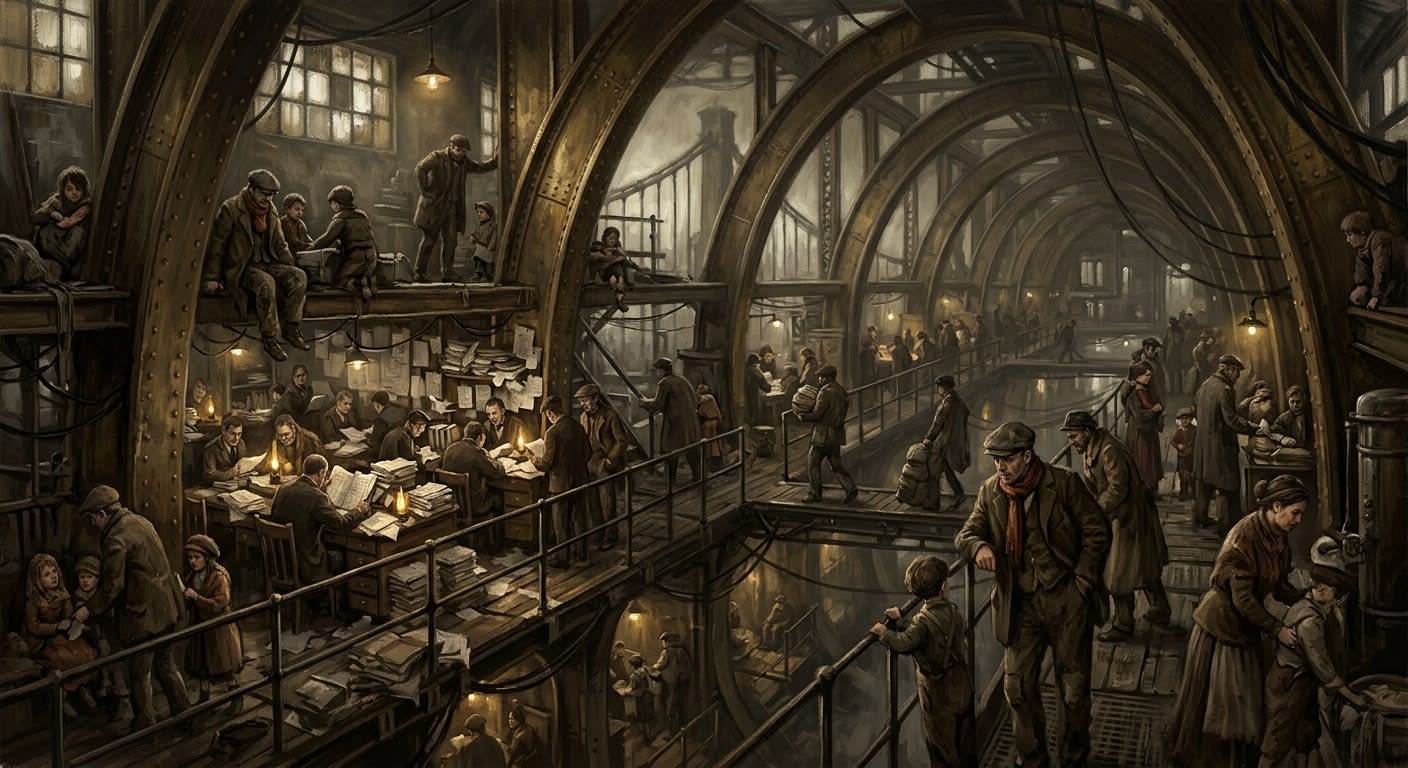
The Pylon Warrens of Bastion-Brest are the vertical slums lodged inside and around the fourteen stone-and-iron piers that hold the Brass Ribs above the Bug. An undercity has the decency to lie beneath a city. Barracks pretend that sleep belongs to soldiers. Housing implies intention, proportion, ventilation, and some official hesitation before placing children within hearing distance of structural groans. The Warrens are what occurs when a bridge becomes a nation and the nation runs out of dry rooms.
Fourteen thousand souls live inside the bridge in ordinary season. In convoy months, when the Lanes choke and the Ribwalk grows tents like a fever rash, the number climbs beyond twenty thousand. A portion sleep in the Pylon Warrens: dredge hands, stall families, receipt runners, off-shift scribes, brass apprentices, token brokers, widows, children, penal labourers, deserters awaiting correction, and those civic mysteries produced when a person remains useful after his file has ceased to agree with him.
The Warrens descend from the Confessional Lanes toward the river through stair tubes, bunk shelves, wet ledges, rope ladders, service alcoves, cable slots, lamp hooks, drainage throats, and rooms whose original engineering purpose has been forgotten by everyone except the mould. The air smells of brass sweat, candle soot, river rot, boiled fish, damp wool, old wax, cheap ink, and human fear stored too long in stone. Above: confession grilles. Above that: guns. Below: the Bug, which taps the pier bases with the patience of an auditor who knows the account will fail eventually.
A bridge should move people across a river. Brest, being a masterpiece of Synodal improvement, also stores them inside its supports, extracts labour from them, classifies their sleeping height by sin category, and then expresses surprise when they develop politics.
#On Their Founding by Accident and Annotation
The first Brest works had no Warrens. In A.S. 67, after the old stone bridge had failed and the retreating companies dug into the western bank, men slept in mud revetments, chapel tents, gun pits, toll sheds, and anywhere else rain had not yet acquired custody. Pylons came later. Human beings came into them first as workers, then as watchmen, then as families of workers, then as widows who refused to leave, then as children who had no memory of a floor that did not tremble when artillery carts rolled overhead.
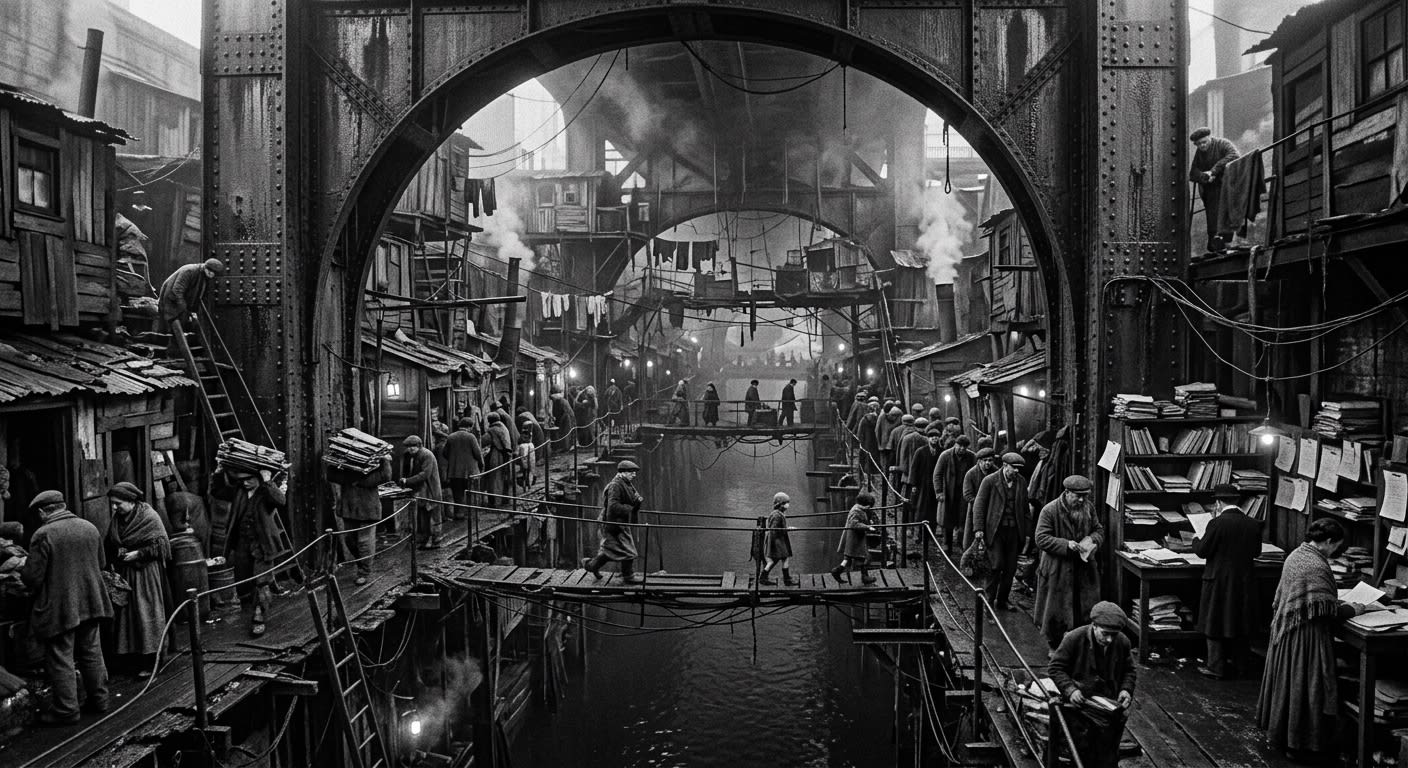
The Bureau of Engineering drew the brass-ribbed bridge in A.S. 92. Its plans showed maintenance voids, access shafts, pump stations, drainage galleries, rivet stores, emergency braces, and “temporary labour accommodations” in the pylon cavities. The phrase temporary labour accommodations should be carved over the gate of every permanent misery in Europe. Temporary became seasonal. Seasonal became registered. Registered became taxed. Taxed became moral.
Early Engineering summaries describe the pylon chambers as “non-residential service capacity.”
Corrected by occupation, childbirth, laundry lines, debt records, and the A.S. 104 bunk allocation table. A room containing twelve sleepers, two cooking hooks, and a grandmother who charges for lamp trim has become residential, whatever the plan says.
The first certified full military crossing in A.S. 98 required men in the pylons to operate pumps, listen for stress, manage flood valves, haul broken wheel assemblies from under-deck cradles, and keep the confession apparatus above from shaking itself loose. The bridge praised its own completion. The workers remained in place because removal would have required new housing, and new housing would have required a budget line not protected by crisis.
By A.S. 103, a tired quartermaster assigned bunks according to declared sin, likely as jest, punishment, and bad theology produced by lack of sleep. Pride went high. Sloth went low. Envy faced richer ladders. Wrath slept near vibration zones. Gluttony received narrower shelves after an unfortunate collapse. Lust was moved twice before the matrons took jurisdiction by broom. Miscellaneous sins went wherever the night supervisor could fit breath. By A.S. 104, the joke had acquired ledgers. That is how laws are born when no one respectable is watching.
The Bureau of Settlement never authorised the density. The Bureau of Settlement has never had to house a bridge. This explains much about its confidence.
#On the Anatomy of Descent
The Warrens are counted by pylons, ledges, and local grudges. Engineering numbers the pylons west to east. The Confessional Lanes count them east to west. The Warrens count them by water behaviour, rent severity, and the quality of sleep: Dry One, Drip Two, Singing Three, Rat Four, Red Five, Mother Six, Knife Seven, Rib-Nine-Under, Low Eleven, Fever Twelve, Little Salt, and other names the maps omit because maps are cowardly where people are precise.
A pylon is stone at the base, iron through its ribs, brickwork in repairs, brass plate where visitors might see it, and improvised timber everywhere the poor have corrected architecture with boards. Stairs coil downward in half-dark. Rope lifts carry coal sacks, river hooks, receipt bundles, sleeping infants, stolen token trays, dead dogs, and once, according to Sluice Yard testimony, a chair with a condemned man tied to it because the official passage was congested. The chair arrived. The man did not. Records asked whether the chair should be inventoried as salvage or evidence. Brest answered by sitting on it.
The upper ledges receive the least water and the most suspicion. Clerks who sleep there learn to fold papers under oilcloth and their own ribs. Brasswright apprentices hang tool rolls from nails above their faces lest rats carry away socket keys. Young soldiers on temporary underdeck duty rent half-shelves and pretend the Warrens are picturesque. They stop pretending after the first night the bridge expands with a sound like a giant jaw considering prayer.
Middle ledges hold the real civic mass: families in stacked rooms, pots over charcoal, laundry over warm pipes, bucket chains, narrow shrines, illicit school corners, pawn racks, old women teaching children safe sins before numbers, young men with river cough, girls carrying receipt slips through passages too narrow for provost armour. Walls are written upon because paper costs money and walls already accuse. Names, debts, jokes, warnings, lane schedules, false booth numbers, dead kin, bad priests, good prices, and drawings of Moth wings appear under soot and are scraped away before inspections badly enough to remain legible.
Lower throats belong to dredge hands and pump crews. The air there is colder. The stones weep. The Bug makes itself known through knocks, seepage, rot-smell, and small pressure changes that blow candles sideways. Penal labourers sleep near hook racks because punishment and employment are neighbouring cupboards at Brest. Some carry river scars: white finger, rope burn, black nail, the little crescent under the eye made when a hook slips while pulling a body that still objects to retrieval.
The deepest maintenance galleries are not housing by any official definition. Naturally, people sleep there.
#On Work, Rent, and the Sluice Economy
Warren life is built around the bridge’s appetite. The Ribs require rivet-tappers, shutter oilers, lamp trimmers, brine carriers, receipt runners, pylon sweepers, rope menders, dredge hooks, pump turners, stool boys, lane scrubbers, booth washers, token polishers, gutter hands, rat bounty children, body taggers, corpse haulers, under-deck skiff guides, and that small priestly class of elderly women who know where everyone ought to stand when the bells disagree.
Rent is paid in coin where coin can be shown, in ration chits where Tithes can see, in labour where War can claim necessity, in information where the Tribunal can deny purchase, in silence where the Warrens govern themselves. A bunk may cost two night shifts scraping brass vents. A dry shelf may cost a cousin in the dredge crew. A whole alcove near a warm pipe may cost more than marriage and last half as long. Nobody owns space. They rent permission from damp.
A Bureau of Tithes inspection sheet described Warren occupancy dues as “modest, regular, and locally adjusted.”
Amended after a night supervisor was found charging storm rates during clear weather, fog rates during candle shortage, child-width supplements, and a “moral ventilation fee” for bunks near a chapel crack. The approved phrase is “irregular under pressure.” The supervisor was reassigned to counting rope ends, where he now steals in shorter units.
The Sluice Yards feed the Warrens from below. Dredge crews haul river debris from the pylons: logs, ice, cartridge boxes, plank splinters, mule bones, drowned sacks, broken icons, toll chests, anonymous shoes, nameless hands, and the cold-water pulp that spills from upstream paper mills serving the Warsaw corridor. Most debris is sold, burned, repaired, blessed, hidden, or reported according to who arrives first. Pulp is special. Pulp can become paper. Paper can become passage. Passage can become treason with good margins.
Women dominate the small economies because men with official titles are too visible. Dredge wives identify bodies by boot leather after the river has taken the face. Market widows sell candle cups and safe sins to travellers who think guilt can be purchased fresh. Pylon matrons run bunk rolls truer than the Tribunal’s census because a matron who miscounts bodies wakes to theft, sickness, or worse. Children carry messages through maintenance slots and are paid in crust, tallow, or secrets. Secrets fatten faster than children at Brest.
The under-deck market begins wherever a patrol ended five minutes ago. It sells forged tokens, altered lane assignments, warm bunks, dry socks, lamp oil, tooth pulls, paper scraps, safe-sin scripts, queue positions, gutter access, silence by the hour, and small bottles of river water labelled against insomnia. The last fraud is admirable. Anyone who sleeps better after drinking the Bug deserves either healing or study.
#On the Blank-Sheet Cellars
The Blank-Sheet Circle chose the Pylon Warrens without romance. Heretics with romantic taste die fast and leave tedious pamphlets. The Circle chose the Warrens because the place is damp, crowded, poorly mapped, jurisdictionally disputed, rich in paper stock, crawling with people injured by the crossing system, and close enough to the Confessional Lanes that a whisper can become a token before a patrol finishes its tea.
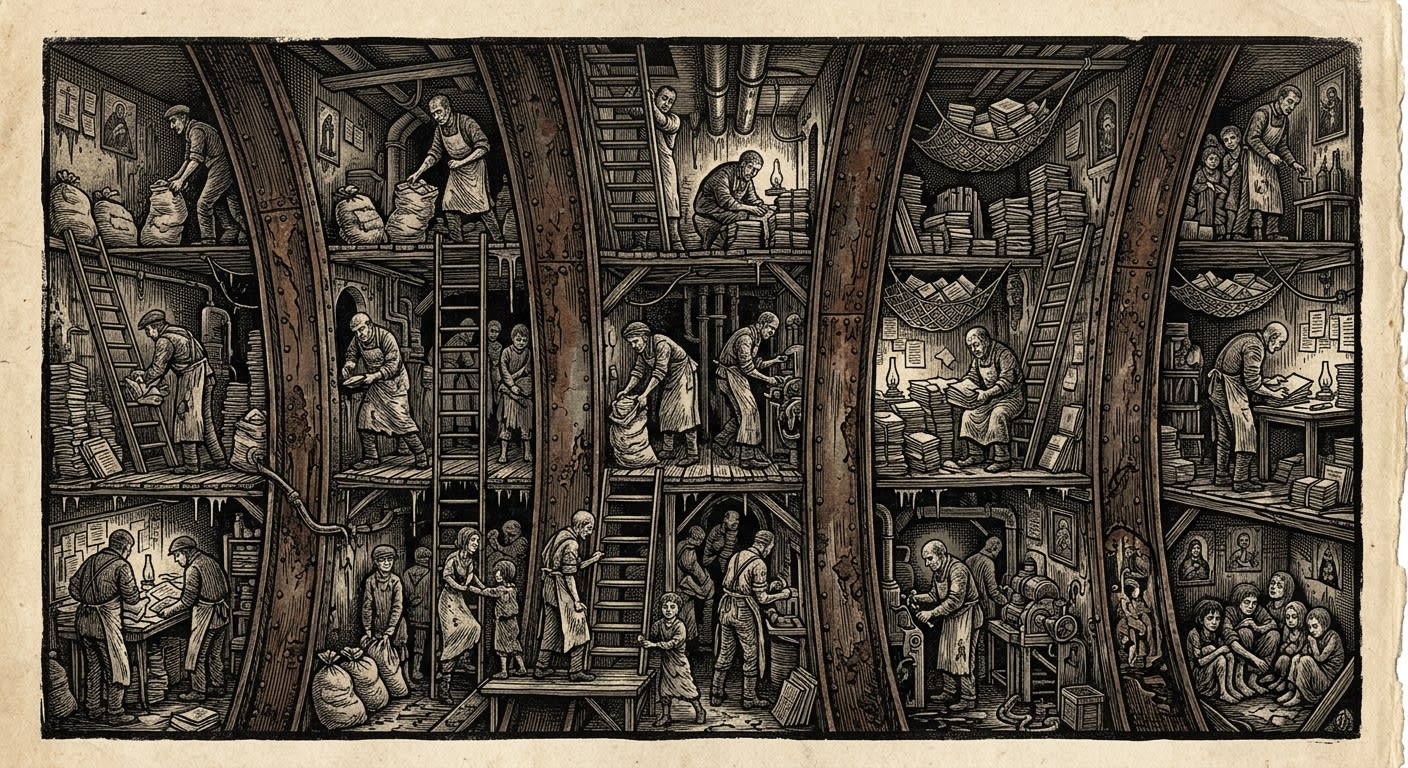
A printing press can be broken down in minutes. The Tribunal knows this because it has found empty rooms still warm from work, floor scratches where press feet stood, linseed stains under straw, paper dust in cracks, and once a child asleep on a stack of blank sheets who claimed he thought they were prayer cards. The child lied beautifully. He should be watched, educated, or hired.
The Circle’s material chain begins at the river: pulp from the Sluice Yards, rags from lane scrubbers, old receipt edges from careless clerks, wax scrapings, lamp soot, linseed, and the intimate knowledge of which official shortage makes which guard look away. Irena Vale’s apron made the chain dangerous. Before Vale, blank sheets were absence. After Vale, absence learned how to receive a stamp. Her wax impressions, carried out of the stamp room in work-cloth dirt, allowed duplicated dies good enough for an hour, a gate, a tired clerk, a busy convoy, a soul seeking to pass without consenting to become legible.
The cellars use ordinary pylon life as cover. A press thump hides under pump noise. Paper drying hides among laundry. Linseed smell hides beneath fish oil. A safe-sin meeting becomes a funeral supper if boots approach. Children chase actual moths near Rib Five while adults listen to whether the provosts are walking heavily enough to mean raid or lightly enough to mean bribe collection. Nothing in the Warrens is purely what it is. Poverty has its own grammar. Heresy merely learns the alphabet.
BRIDGE TRIBUNAL INNER PACKET — WARRENS / MOTH Witness: “The press was gone before the lamp went out.” Question: “Who carried it?” Answer: “The rooms did.” Review note: Possible cell choreography; possible Echo contamination; possible ███████████. Action: seal Pylon Four; do not evacuate families; observe movement of walls.
Krail has made nineteen arrests. The Warrens have made nineteen spaces where arrested people used to stand. That is not victory. It is subtraction performed in a place that knows how to rearrange its furniture.
#On Safe Sins and Warren Childhood
Children of the Warrens learn safe sins early. This alarms visiting catechists, who imagine innocence as a blank white cloth, which proves visiting catechists have never laundered anything useful. A Brest child must pass lane supervisors, ration clerks, provost boys, market watchers, and the little predatory saints of other children. He needs a minor guilt ready to hand. Stole crust. Spoke sharply. Envied upper bunk. Hid candle. Slept during bell. Desired officer bread. Lied about fish. Safe sins are civic manners.
A child who cannot produce a safe sin is either sheltered, stupid, or already being used by someone dangerous. Matrons test them at soup. “What did you do?” “Took thread.” “Whose?” “Mother Six.” “Too specific. Say lint.” So theology becomes table discipline.
The Warrens run informal schools in stair niches, where older girls teach letters from expired tribunal notices and boys learn numbers from token strings. Lessons stop when boots descend. Some teachers are clerks. Some are fugitives. Some are people whose official names no longer work west of the Gatehouse. The curriculum: letters, sums, bell calls, queue arithmetic, which booth scribes cough before lying, how to hold paper near candle without scorching, how to answer if asked who owns a blank sheet. The correct answer depends on the asker.
Booth 77 has altered childhood games. Children dare one another to stand near the sealed pylon wall and whisper sins they have not yet committed. They come back laughing until one comes back silent. Mothers beat them for it, then salt their tongues and make them sleep with cuff names tied to wrists. The Tribunal calls these customs unauthorised. The Tribunal has not volunteered to sit beside children in the dark when the planks speak.
The Confession Echo seeps downward. It comes through vent grates, old water channels, brass tubes, drain mouths, and sometimes through the bread ovens when the dough rises wrong. A returned confession in the upper lanes becomes a murmur in the Warren walls hours later, softened by stone and altered by fear. Adults pretend not to listen. Children listen professionally.
A Purity notice once ordered “immediate discouragement of Warren echo-listening customs.” Commanders withdrew it after observing that discouragement required patrols in six lower pylons during night fog, and night-fog patrols returned with fewer men, worse reports, and one corporal who confessed to a theft scheduled for tomorrow. The customs remain unofficial and better staffed.
The Warrens are accused of breeding heresy. More accurately, they breed technical fluency in survival. Heresy arrives where survival discovers the law has a blind spot.
#On Krail, Vonn, and the Unowned Stair
No office owns the Pylon Warrens completely, which is why every office suspects them. The Bridge Tribunal claims jurisdiction when papers, testimony, nameless transit, or manifest irregularity appear. Since all four appear daily, Krail claims much. The Brasswright Guild claims maintenance authority over structural voids. War claims emergency passage, billeting override, curfew enforcement, and the right to shout at anyone between gun and ammunition. The Crossing Bureau claims stamp integrity. Records claims census. Tithes claims dues. Purity claims the right to arrive after everyone else has made the problem interesting and call it sin.
The Warrens obey whoever stands nearest with food, keys, guns, or a rope ladder. This is civic realism.
Krail maps the Warrens in red ink. Her map is beautiful and false by dawn. Rooms change use. Families trade bunks. Presses move. A pump chamber becomes a chapel. A chapel becomes a paper room. A paper room becomes a nursery when the raid arrives, and the babies are real, which is unfair to investigators but excellent tradecraft. Krail understands this and resents it in the manner of a mathematician faced with soup.
Vonn understands the Warrens through vibration. He knows which lower stair fills before panic reaches the Ribwalk, which pylon cough means pump trouble, which crowd hush precedes a blank-sheet run, which shout means domestic quarrel and which means a knife with politics attached. He would shell the cellars if given clean permission and no concern for load-bearing masonry. This is why he is valuable and must be occasionally prevented from solving problems in ways that create larger architecture.
The local authority conflict is written nowhere cleanly because clean writing would invite accountability. Tribunal preserves evidence, issues raid writs, and seals rooms. War claims curfew, emergency clearance, and fireline access. The Brasswright Guild claims structural passage, pylon bracing, and shutter ducts. Records and Tithes claim census and dues. Practical authority belongs to matrons, dredge bosses, night supervisors, and fear.
There is an unowned stair below Pylon Nine, so called because every office denies responsibility when it floods and claims right of passage when it dries. Vale was seen there once, carrying a wooden measure and returning with river mist in her hair. A North Lane scribe was seen there twice, then not seen again, though his handwriting appeared on three receipts after his disappearance. Children call it Moth’s Stair because children enjoy accuracy when it frightens adults.
A restricted Pylon Nine extract records an inspection team entering at third bell with forty feet of rope. Twenty-seven feet returned, cut clean. The last audible report said, “There are pages on the walls.” Wall condition after sealing: dry. Previous condition: running water. Krail ordered preservation. Vonn recommended fire. Doctrine wrote one note, struck it through, and filed the ash.
Brest continues to call this a stair because calling it an aperture would require forms.
#On Inspection, Clearance, and the Lie of Mapping
Inspection parties enter the Warrens with chalk, tape, lanterns, cord tags, breathing cloths, warrant slips, and the grave faith of men who believe a place becomes obedient when measured. The Warrens indulge them at first. A matron points to the wrong stair with perfect courtesy. A child offers to carry the tape end and shortens the survey by three feet whenever the clerk looks up. A dredge boss unlocks a pump room after moving the cot, the press screw, the fugitive cousin, and the better kettle through a coal vent. By evening the inspectors possess a map, twelve signatures, one confiscated knife, two false rooms, and the satisfied fatigue of officials who have mistaken cooperation for surrender.
The worst inspections are compassionate. Purity raids make noise; War clearances smell of rifle oil; Tribunal searches leave red wax and frightened silence. Compassion arrives with doctors, Settlement clerks, Mercy ladles, lice combs, clean blankets, and questions about children. The Warrens fear those most. A rifle may miss. A doctor counts ribs. A Mercy sister may notice one child too many under a bunk, one old woman too cold for her ration class, one worker whose cough marks him for removal. Kindness is a census with warm hands.
Scribe-Mother Hal understands this better than the inspectors. Her runners pass through the Warrens without pretending they are neutral. They need clerks fed, booth stools repaired, receipt bundles carried, brine buckets filled, and night rosters obeyed. Hal pays in favours: a better lane, a warning before Krail’s men arrive, a candle allotment, a silence inserted into a staffing note. The Warrens do not love Hal. Love is for people with spare bread. They trust that her needs are legible. At Brest, legible hunger is almost honour.
The Bridge Tribunal tried a full pylon census in A.S. 200 after a crossing-anomaly count suggested four to eleven unrecorded souls per day. The census lasted nine days and produced three totals, none compatible with the others. Day count found workers. Night count found families. Curfew count found nobody in rooms that were smoking with recent cooking. Krail ordered the numbers preserved side by side. A lesser judge would have averaged them, which is how cowardice dresses as statistics.
The Warrens cannot be mapped once. They must be mapped like a wound is dressed: repeatedly, with suspicion, and with acceptance that the bandage will lie by morning. Rooms change because people change. People change because papers fail. Papers fail because the bridge demands names at a rate human life cannot keep clean. Every false wall in the Warrens is an answer to a question the Synod asked with too much confidence.
#On the Present Damp
As of A.S. 201, the Pylon Warrens are overcrowded, undercounted, structurally necessary, morally suspected, commercially alive, and more politically intelligent than several central offices I could name under seal and will one day name without it. The Blank-Sheet Circle remains active. Moth remains person, office, paper, or insult to every theory that wants a throat. Vale remains outside custody. The Echo continues to seep downward. Krail’s red marks multiply. Vonn’s patience shortens. Hal alters rosters without explaining why. Ruis smiles over stamps that should make honest men reach for tongs.
The Warrens endure because the bridge needs hands inside its bones. Evacuate them and the pumps fail, the shutters stick, the receipt runners slow, the dredge hooks hang empty, the lower vents clog, and the bridge discovers that it has been calling its lungs illegal. Keep them and blank papers dry behind stove bricks, children learn sins before sums, and someone below Rib Nine teaches absence to cross.
A Strasbourg security proposal once recommended “temporary full clearance of the Pylon Warrens pending purification.” Local command rejected it before Doctrine could enjoy rejecting it. Full clearance would remove dredge labour, pump crews, brass apprentices, runner children, matron rolls, under-deck guides, and half the unofficial knowledge by which Brest remains upright. Purity was invited to supply replacements. It supplied adjectives.
At night the lower pylons listen. Water knocks. Brass answers. A booth above mutters a confession from yesterday or tomorrow. A woman salts the threshold. A child ties his cuff name tighter. A press, somewhere, does not sound like a press because the pump beside it is louder. In Pylon Four a wall dries too quickly. In Pylon Nine a stair stays sealed. On the Ribwalk, a traveller buys a safe sin and thinks himself clever. Beneath him, the Warrens receive his footsteps into stone.
The bridge holds because the poor live where the plans left space for maintenance. Remember this before praising architecture. The load-bearing member is usually hungry.