
#On the Yard Where the River Is Made to Confess
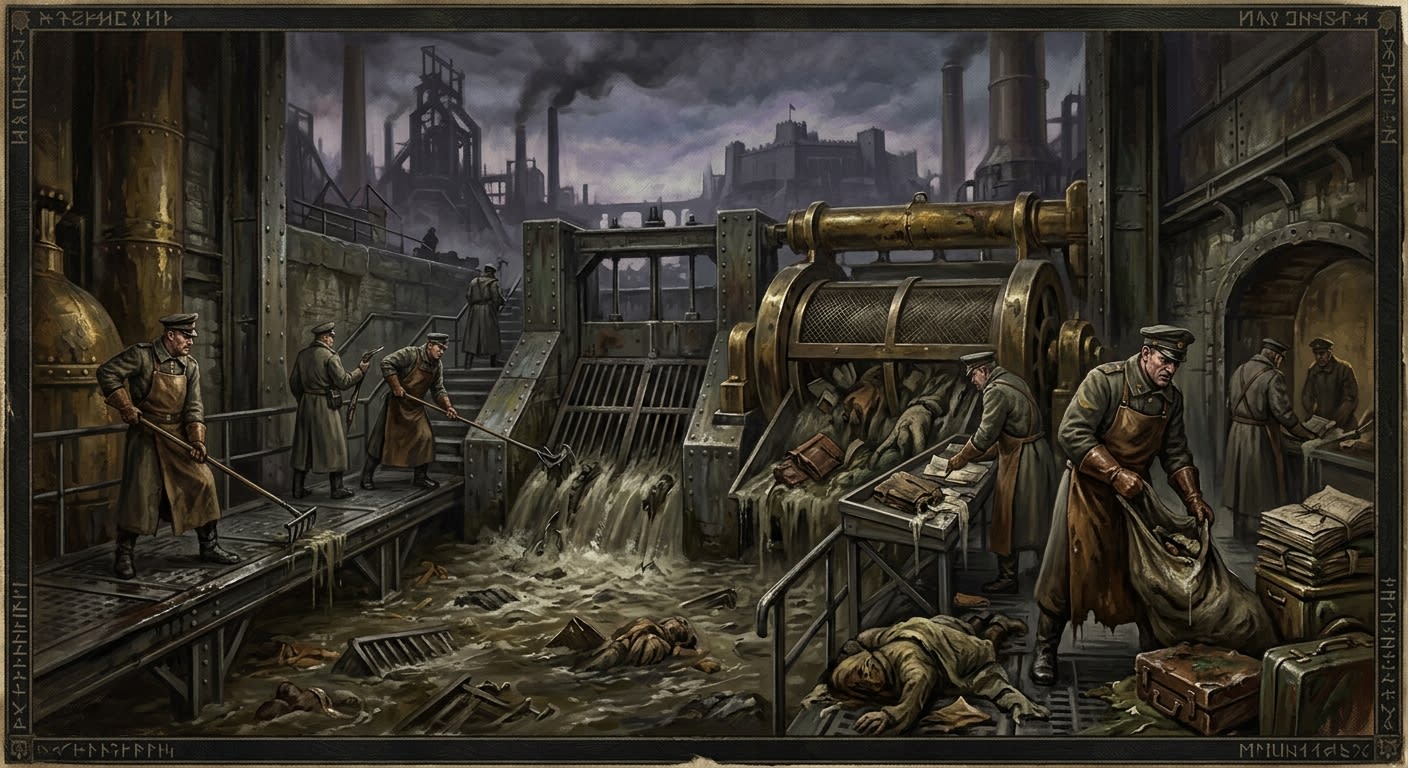
The Sluice Yards of Bastion-Brest lie downstream of the Brass Ribs, beneath the span's gun-shadow, where the Bug arrives cold, brown, burdened, and is forced through gates, grills, dredge hooks, net cradles, pump throats, and the bad temper of men sentenced to argue with water. They are the river interface of the bridge-fortress: mooring, dredge intake, penal yard, under-deck market, salvage court, paper nursery, corpse rack, skiff cartel harbour, and civic stomach.
Everything Brest wishes to deny passes through the Yards first or last. Ice. Logs. Paper pulp. Broken icons. Mule bones. Shell crates. Token trays. Nameless hands. Men who fell. Men who were helped to fall. Things the Bureau of Records calls river salvage and the dredge crews (Unregistered) call by names that cannot be printed without Purity reaching for a cudgel.
The Yards smell of river rot, diesel smoke, wet rope, brass oil, dead fish, hot tar, and the sour steam of confession receipts soaked past legal usefulness. The deck above smells of cordite and fear. The Absolution Hall smells of wax heat and iron ink. Down here, the truth has fewer manners.
#On Their Founding Beneath the Ribs
The first Brest works in A.S. 67 needed a way to keep the river from eating the western-bank defences. The first sluices were crude flood boards, chain booms, and mud ramps where infantry hauled driftwood away from pontoon scars with hands already split by winter. When the Bureau of Engineering drew the brass-ribbed bridge in A.S. 92, it gave the future Yards a cleaner name: downstream maintenance access and pylon clearance works. Such phrases are how engineers baptise misery before workers arrive.
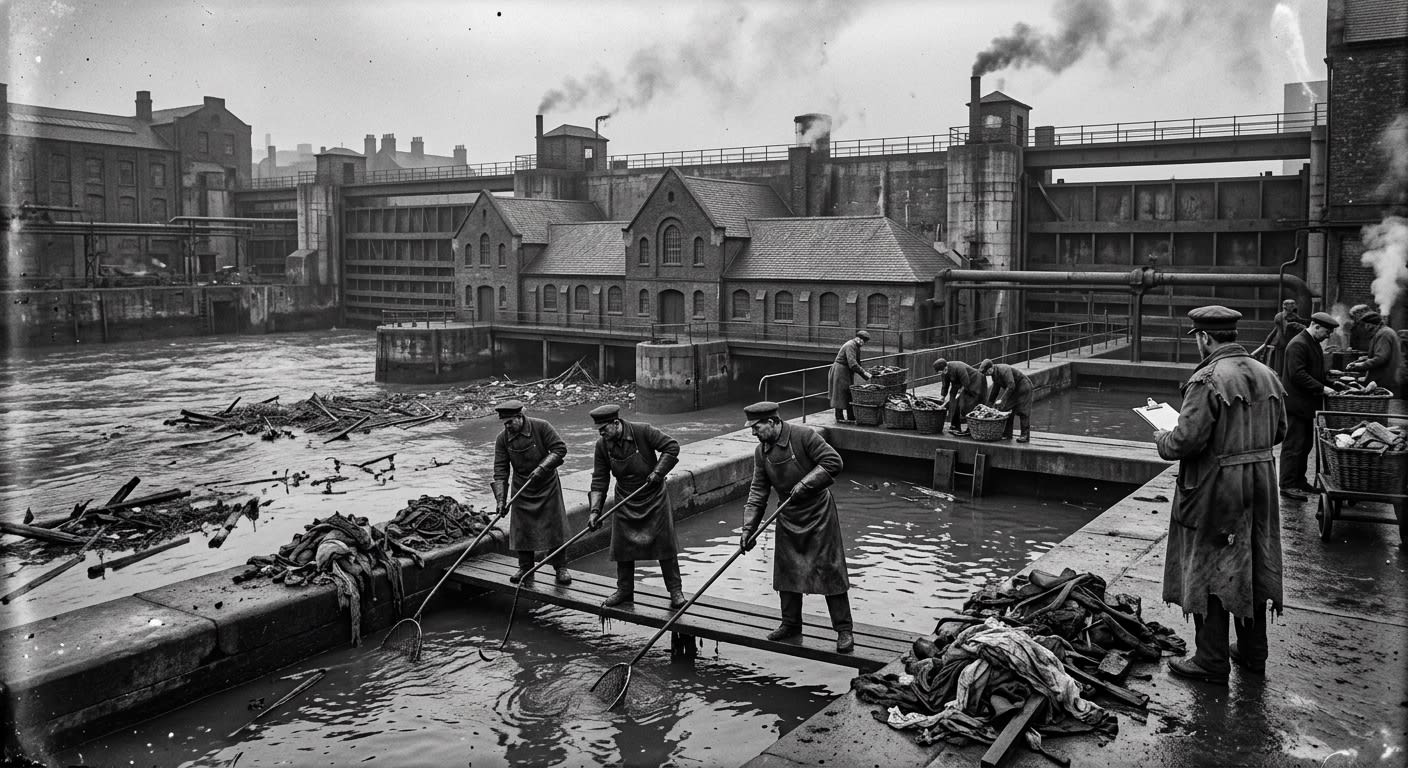
By A.S. 98, when the current Ribs were complete enough for public lying, the Sluice Yards had become permanent. Fourteen pylons sunk into a cold river do not preserve themselves. Ice rams the bases in thaw. Floodwater drives trees into braces. Dead things tangle in under-rib netting and drag until the whole span hums. Cartridge boxes lodge where pump teeth must bite. A bridge that carries guns, markets, confessional lanes, and twenty thousand temporary souls requires constant underwork, and underwork requires hands the upper bridge can spare without admitting it needs them.
Early Engineering plans labelled the downstream works as “non-civic maintenance frontage.”
Corrected by drownings, bunk rolls, mooring ledgers, night markets, penal assignments, and three generations of children who learned to sleep above hook racks. A place that feeds, fines, buries, bribes, and breeds citizens has become civic, whatever the plan preferred.
The Yards grew where necessity left room. Dredge racks became shelters. Rope sheds became taverns. A pump-house porch became a hiring line. The east mud ramp became Hook Court, where salvage shares are argued under a bell no one admits installing. The west chain bay became Moorer Chapel, where boatmen touch three knots before rowing under the bridge in fog. The first chapel was unauthorised. The second chapel was taxed. Sanctity, at Brest, follows revenue.
#On Dredge Crews and Penal Labour
Dredge crews are mostly penal labourers: men and women serving sentences for confession irregularities, toll arrears, forged tokens, unsafe sins, queue violence, stamp insults, and the local offence called clean-mouth presumption, which means claiming no confessable fault when a clerk wanted one. The sentence is simple. Report before dawn. Tie rope at waist. Take hook. Enter mud, skiff, cage, or gate mouth. Remove what obstructs the pylon, pump, net, or record. Return alive if convenient.
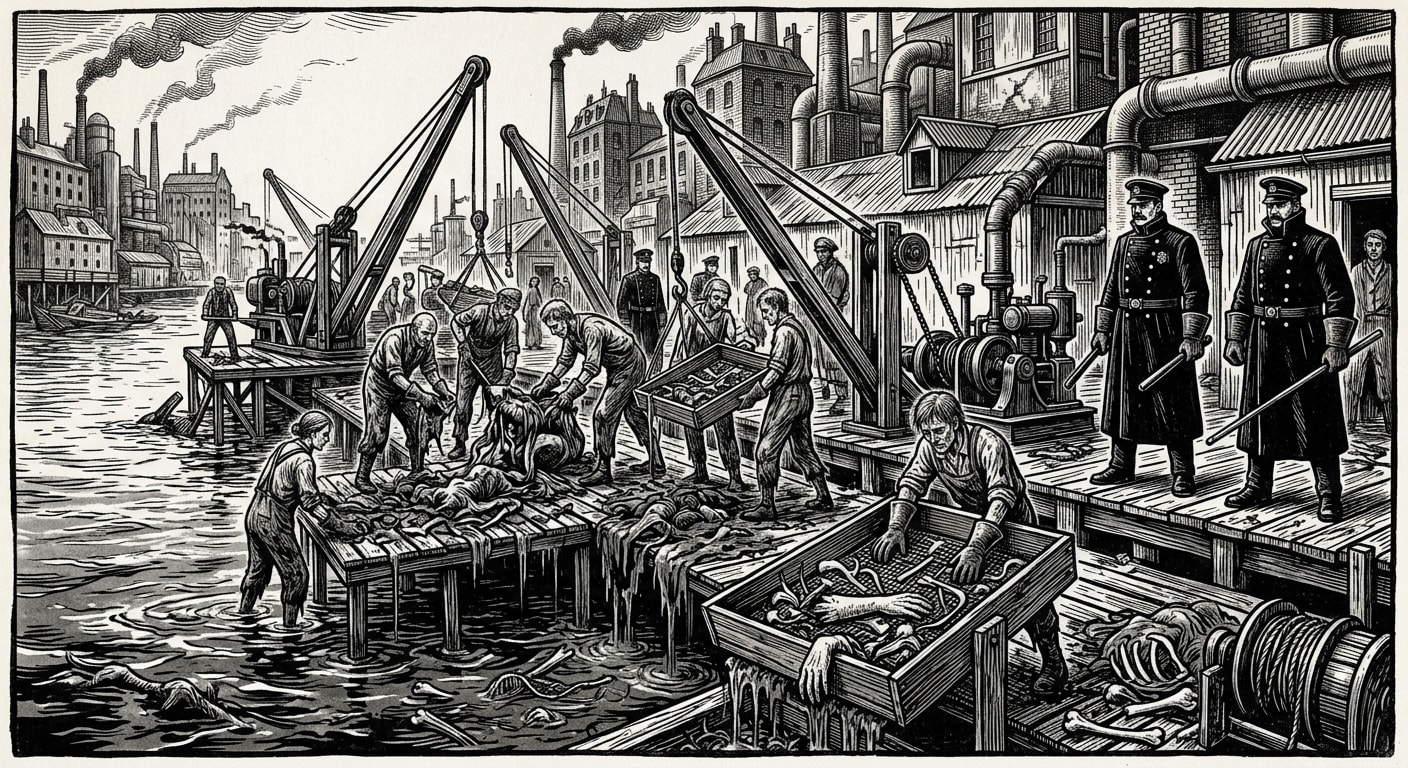
They clear winter ice from the pylons by lantern, hammer, curse, and song too ugly to attract official licence. They drag dead mules from under-rib netting. They cut weed ropes from sluice teeth. They haul up rail splinters, drowned sacks, torn prayer banners, half-barrels of spoiled tallow, and the pale cold-water pulp that spills from upstream paper mills serving the Warsaw dispatch corridor. The pulp matters. Pulp becomes paper. Paper becomes crossing. Crossing becomes theology with wet edges.
The crews live by hook hierarchy. Hook One takes bodies. Hook Two takes timber. Hook Three takes crates. Hook Four takes paper and small valuables. Hook Five, the oldest and most hated, takes whatever moves after touching land. A novice who reaches with the wrong hook buys drink for the yard or loses fingers. The yard prefers drink, but accepts fingers with administrative calm.
Dredge wives identify bodies by boot leather after the river has taken faces. Children run tally knots between Hook Court and the Pylon Warrens. Old men listen to gate-chain pitch and call flood change before Engineering gauges notice. The Sluice Yards survive on such uncredentialed competence, which the Bureau resents because it cannot be stamped without first confessing dependence.
SLUICE RECOVERY LOG — A.S. 200, THAW WEEK Recovered at Pylon Eleven lower teeth: one hand, left; one absolution token fused into palm; three blank receipt slips packed beneath fingernails; mouthless head recovered separately two bells later. Identification: ███████████ Tribunal note: do not release token to family. Dredge note, unsigned: “Family already knows.”
#On the Under-Deck Moorers
The Under-Deck Moorers (Unregistered) operate from the fog pockets below the Ribs, tolerated by the Bridge Tribunal because the bridge needs skiffs for maintenance and because prosecuting the entirety of one's own maritime infrastructure is a luxury reserved for offices with dry boots. The Moorers call themselves boatmen. The provosts call them cartel. The Pylon Warrens call them weather: dangerous, necessary, and always charging extra.
They own fog routes beneath the span. Their custody is practical: which chain can be ducked at low water, which net sags after artillery recoil, which pylon ladder has three missing rungs, which patrol hums before rounding the brace, which confession shift produces enough noise above to cover oars below. Their skiffs carry repair crews, stolen tokens, exhausted mothers, stamped officials avoiding queues, blank-sheet clients, dead clerks, and once, by Sluice oath, a chair with a condemned man tied to it. The chair arrived. The man did not.
Mist-Captain Rell (Unregistered) is the name most often attached to the Moorers. The name may be a person, rank, inherited insult, or collective convenience. Niva Pike (Unregistered) brokers tokens beside the tar kettles and smiles with the left side of her mouth only, the right having been claimed by a hook in A.S. 197. The Yards respect asymmetry. A symmetrical face suggests the river has not yet had its say.
The Moorers differ from the Blank-Sheet Circle. This distinction has cost Purity much time and many bruises. Moorers sell passage under law. The Circle sells absence from law. Their routes cross, their customers overlap, their enemies share boots, and their payments smell alike, but motive matters. The Moorer wants a fee. The Circle wants a soul the Ledger cannot see. Both may use the same skiff. This is why clean categories drown quickly under Brest.
#On Pulp, Paper, and Blankness
Cold-water pulp is the Sluice Yards' quiet treason. Upstream mills lose stock into the Bug during thaw, flood, accident, theft, and those clerical events where numbers alter politely between dispatch and arrival. Dredge crews recover the pulp from eddies and sluice grates, press it under boards, dry it near pump heat, and sell it by weight, favour, silence, or fear.
Officially, recovered pulp belongs to the Crossing Bureau after salvage tithe and contamination review. Practically, pulp moves before the review clerk finishes warming his ink. A handful becomes receipt patch. A sack becomes safe-sin slips. A barrow becomes blank crossing stock if it reaches the right cellar in the Pylon Warrens, where linseed, soot, wax scrapings, and Irena Vale's stolen stamp knowledge can teach absence to look official.
The Yards know which dredge teams are watched. They know which teams pretend to be watched to raise prices. They know which children can carry a folded wet sheet under a shirt without leaving a square mark. They know which pump shed hides drying racks behind saint banners. They know that the Bridge Tribunal has arrested nineteen and left the river untouched, which is like arresting smoke while admiring the fire.
A Bureau of Records salvage circular classified lost paper stock as “commercial waste of no doctrinal consequence.”
Corrected after the Blank-Sheet investigations. Paper without a watermark may carry more doctrine than a bishop with three seals. The circular author now works in a room where every scrap is counted before and after prayer.
#On the Echo Below the Deck
The Confession Echo began in the Confessional Lanes, but Brest is a bridge, and bridges transmit. Returned sins now leak downward through brass braces, drain throats, net collars, wet rope, empty token bowls, and the sluice gates themselves. A confession spoken above may arrive in the Yards hours later as a murmur from a pump housing. The river repeats badly. It clips names, changes categories, fattens small theft into betrayal, and gives dead men the voices of boys.
The first confirmed Sluice Echo came from Gate Three during winter scraping in A.S. 199. A dredge hand named Orven Task heard his own voice confessing to cutting a convoy strap. He had not cut a convoy strap. By noon, a strap failed on the Ribwalk and a grain cart killed two. Task was arrested, released, re-arrested, assigned to Hook Five, and eventually classified as pre-culpable. Brest has a gift for inventing crimes that arrive slightly before the criminal.
The Yards developed rules before the Tribunal issued them. Do not answer a confession from water. Do not repeat a voice that uses your childhood name. Do not take salvage from a net while it is speaking. Do not let children sleep beside wet rope after an Echo night. If Gate Four whispers a sin in future tense, strike the hush bell twice and fetch someone from Hal's lanes who still has steady handwriting.
Booth 77 contaminates the Sluice imagination most. The sealed booth speaks tomorrow above; below, gate chains sometimes move before orders, and net bells ring for bodies not yet in the water. Dredge crews call this borrow-current. Krail calls it unverified temporal acoustic drift. The crews are shorter and more accurate.
#On Salvage, Theft, and Lawful Appetite
Every object pulled from the Bug enters argument. Salvage law divides recovery into Crown, Bridge, Crew, Tribunal Evidence, War Necessity, Records Custody, Purity Suspicion, and Worth Stealing Before Classification. The last is the oldest and fastest category.
A cracked token belongs to the Crossing Bureau unless found in a mouth, in which case Tribunal evidence claims it. A dead soldier's boot belongs to War unless the boot contains paper, in which case Records reaches. A saint fragment belongs to Relics unless it proves false, in which case Tithes may still levy display fraud. A body belongs first to identification, then burial, then debt recovery, then whatever office arrives with the loudest seal. Families wait above Hook Court and learn grief by jurisdiction.
The Sluice Yards' black market is not hidden. It is merely timed. Under-deck dice, token swaps, safe-sin scripts, hook shares, rib-ladder keys, contraband route maps, wax guilt, and small bottles of river water labelled against insomnia all change hands between patrol bells. The fraud water sells well. Anyone sleeping after drinking from the Bug should be examined, exorcised, or envied.
The Bureau of Tithes taxes salvage it can count and estimates what it cannot. The Bridge Tribunal impounds what might testify. War requisitions anything hard, sharp, explosive, or capable of becoming so. The Moorers steal from all three and occasionally return what would cause general collapse. This is civic balance, though no one with a clean collar may say so.
#On the Present Yard
As of A.S. 201, the Sluice Yards are overworked, undercounted, silt-choked, Echo-touched, Blank-Sheet-suspect, and structurally necessary. Spring thaw was heavy. Pylon Eleven teeth bent twice. Under-rib netting caught bodies faster than Records could assign them to incidents. Hook Five lost two hands and one man. The man returned after dusk, or something using his coat did, and the matter sits under Krail's black cord.
Judge Elsbeth Krail wants tighter salvage custody. Vonn wants Moorer routes mapped for emergency fire and private suspicion. Hal wants Echo events reported before her clerks hear their own names from drain mouths. Hett Ruis wants every recovered token sent through the stamp office and preferably through his hands. The dredge crews want dry gloves, better rope, and fewer magistrates learning river vocabulary.
No one will clear the Yards. The bridge would choke within three days. Pumps would clog, pylons would take ice, under-rib nets would drag, Moorer skiffs would vanish into private routes, salvage would rot into lawless evidence, and the Ribs would discover that their holy crossing depends on men ankle-deep in brown water poking death with hooks.
At dawn, the gate chains lift. The dredge crews report. Hook Court opens its ledger. A child runs a knot tally toward the Warrens. A Moorer skiff noses out from beneath Rib Six without a bell. Above, a penitent enters a booth and offers a sin concise enough for travel. Below, the river receives the words through brass, stone, rope, and rot, and considers what to give back.