

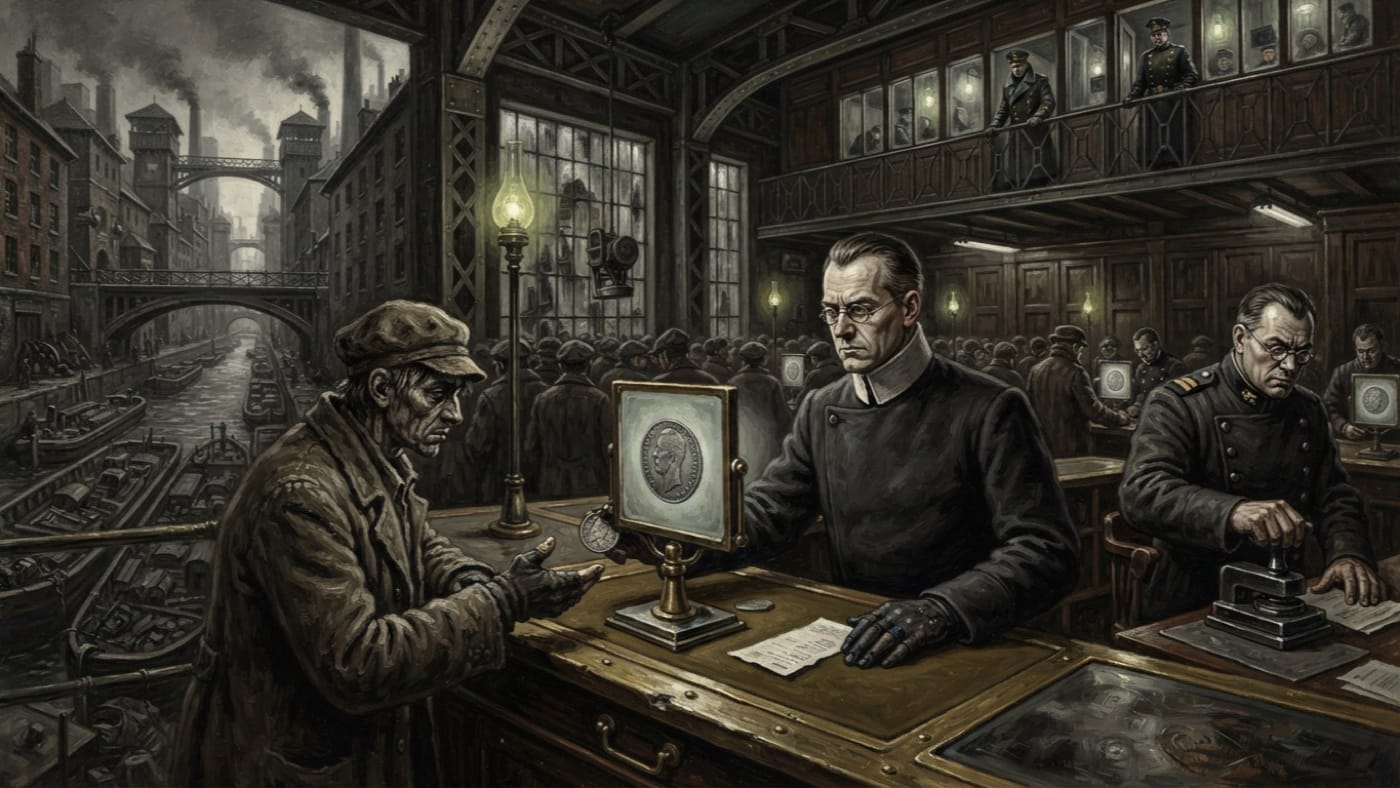
#On the Authority of the Face
A coin goes down on the felt of an exchange counter in Sable Court. The clerk turns it once under the mirrored inspection glass, lays an assay slip beside it, looks from the stamped profile to the face across the counter, and does not pick it up. No one has been accused and no one has been struck. The coin stays where it was laid. Its owner bought bread with its twin that morning, and now holds a disc of metal and an appointment.
That pause is how the quarter is governed. The rest is staffing.
Sable Court is the restricted mint quarter of Cologne. It is a ringed enclave in Zone 2 of the Central Heartlands, enclosed out of the old guild district in the city's south. Some twenty-eight thousand souls live there, plus a flux of labourers, couriers and warrant crews whom the gate-books count in and out like bullion. Formal government rests with a Synod Mint-Prelate, a Crownwright Master-Engraver Council and a Mint Tribunal. The streets and rooftops belong to the Wardenate. Outsiders say the Sable Court as though they were naming one body with one will. What they are naming is an arrangement: three hands on a single coin, and any of them may refuse to let go.
#On the Compact and Its Hands
The arrangement dates from the Mint-Chapter Compact, ratified in A.S. 94 / 1804 CE, four years after the Concordat of Strasbourg settled the formal Synod. The Compact bound the Crownwright Guild to the Synod's new Mint-Chapter. The Guild brought the hands that could cut a likeness into a die. The Chapter brought the law that could call that likeness lawful. Between A.S. 94 and A.S. 100 the guild district was walled, gated and bridged into the quarter that now houses the Crownwright Diehouses. This took six years, whatever the gate-plaques imply.
The Face Archive followed in A.S. 102, and identity became portable. A face that had been struck, registered and carried in a purse could now vouch for its bearer in a town that had never seen the bearer's own face. In A.S. 134 the Bureau of Doctrine condemned mechanised die-cutting as spiritually imprecise. The presses on the Strike Floors still thunder through their hymn-timed shifts. Doctrine forbade only the machine that would cut the die, which left the die in the engraver's veiled fingers, where the Guild had always preferred it.
No further clauses are needed to explain the division of labour. The Guild supplies the likeness, through skill, apprenticeship and the careful scarcity of both. The Chapter supplies acceptance, through decree, audit and correction. The Wardenate controls circulation: gates, watchwalks, vault doors, raids, and certain private correction schemes about which it has never been questioned in writing.
#On Recognition and Its Price
Doctrine teaches that a coin joins a stamped face to a name, and the name to the soul's account in the Great Ledger. The Bureau of Records keeps the name. The Mint-Chapter keeps the face. By Doctrine's account, the Creator keeps the rest. This office is not licensed to audit the third party and does not try.
The fee schedule is another matter. Seigniorage is taken at the strike. Identity fees are taken at registration. Correction levies are taken whenever a face is disputed, and a face is disputed whenever a clerk says it is.
The procedure runs as follows. A coin hesitates at the counter, and the bearer is sent to a doubt inspection at the gate. There the bearer must recite a name-history aloud, covering parentage, guild, parish and prior exchanges, without stalling. Any stammer is recorded. An intent declaration is attached to the exchange permission; it is a confession in everything except the furniture. While the dispute stands, the bearer is under facehold. The coin has not been found counterfeit. It is simply unacceptable, and so is every other coin bearing that face. The bearer buys bread on credit for a while, and then cannot buy it at all.
Then the levy falls due. If it goes unpaid, the fine becomes an identity hold, and the hold passes to the Tribunal Hall of Corrections. Proceedings there are sealed, and by persistent report the correction orders are signed before the hearing opens. The Tribunal keeps no prisons, because space in the quarter is too dear. It issues debt-labour warrants instead. The debtor reports to the Anneal Courts or the Strike Floors to work off correction quotas and purity-penance shifts, until the account clears or the debtor's voice gives out, whichever the furnace-tender records first.
A recall is the same procedure at wholesale. When the Chapter withdraws a face and restrikes, everyone who holds that face queues together, and Clipper's Market fills with people carrying money the law has stopped hearing.
A second effect comes with the first, and the Bureau files it in a separate drawer. Merchants hesitate halfway through names they have known for years. Witnesses lose a suspect's face somewhere between the cell and the hearing. Families argue at supper over who existed. A facehold is procedure and can be appealed. The forgetting answers to no clerk this office has managed to locate.
#On the Offices Above and Below
Formally the quarter is ruled by three chambers. In practice it is ruled by three persons.
Mint-Prelate Varo Sable holds lawful recognition. A coin the Prelate refuses is just metal, and a face the Prelate refuses belongs to a petitioner. The clerks say the Prelate smiles like a stamp. Master Engraver Irena Coilhand holds the craft that strikes a likeness into permanence. How far the Master Engraver's word binds the rest of the Council is a question the Council has never volunteered to answer. Warden-Captain Joss Kline holds no seat in any chamber, but holds the vault keys, the raid warrants, the quarter's disappearances, and a private pouch of coins the Warden-Captain calls impossible.
None of the three can act alone. Take a disputed batch in the exchange lines. The Chapter may condemn it but cannot replace it without the Guild's engravers. The Guild may recut it but cannot make the new face lawful without the Chapter. And neither can pull the old coin out of a crowded queue without wardens on the walks. Every quarrel among them ends at the same counter, with the same clerk declining to pick up the coin.
Beneath the counters works the Clipped Choir. It is the union and counter-mint of the market and of the Black Canal, the quarter's own canal spur, where bullion comes in and other cargo goes out. The Choir clips coin and sells face-swaps, memory wash, portable innocence and proof-buying. It copies the Chapter's forms down to the shape of the warrant. Its whole trade assumes that recognition has value, which means it assumes the Mint-Chapter. Officials hunt it, bribe it, use it and fear it, in proportions that change by the week.
The Unface Society is a different creature. According to the Chapter's files, it seeks the destruction of the Archive plates and the end of the face registry. The Choir would rather sell a citizen a face than abolish faces altogether. The Society wants nothing left to sell.
Bureau advice on file held that Wardenate arrests in Clipper's Market and the seizure of clipping instruments would dismantle the Clipped Choir.
Corrected. The arrests reduced clipping. Brokers, assayers, canal judges and their respectable customers were untouched, and the Choir continues to trade. The advice is withdrawn and the instruments remain in evidence, where several have since gone missing.
#On the Present Failure
Since A.S. 199 / 1909 CE, citizens of lawful standing have found the coins in their purses changing. A familiar profile takes on the wrong eyes, or a mouth sits wrongly, and the face drifts away from its owner. The Mint-Chapter responded with emergency recalls across seventeen denominations. Seventeen measures the breadth of the recall. It is not a count of victims, and the Chapter publishes no such count. Warden circuits doubled. Doubt inspections multiplied until people waiting in the queues began to forget why they were queuing.
Official suspicion settled on the Choir, and the Choir earned part of it. Its brokers supplied washed coin to three outer districts. Its assayers certified two counterfeit batches that passed outer-gate inspection. Those facts are established. The rest of the campaign has not been attributed to the Choir, to the Society, or to any hand this office is prepared to name. The Tribunal's appetite for a single culprit does not change the evidence.
The exchange lines have settled on a rumour of a master die that could overwrite the Archive simply by circulating. This office records the rumour because the queues act on it. Citizens hoard old coin, refuse new strikes, and carry sealed name-slips under their tongues. This tract is not competent to say whether such an object exists, and the Chapter has not asked it to.
The Warden-Captain's pouch is fuller than it was. Some of the impossible coins bear faces that match no archived plate. They spend. No one has determined what they are evidence of.
Each Bureau has written its prescription. The Bureau of Purity wants a burning. The Bureau of Records wants a list. The Bureau of Engineering wants to reopen its sealed A.S. 187 survey of the vaultwork beneath the Black Canal, whose findings remain sealed. The Bureau of Doctrine wants the truth, as soon as it has been made safe to publish.
#On the Continuing Account
As of A.S. 201 / 1911 CE, the machinery runs. Bullion comes in through the canal lock. On Die Row, engravers in finger-veils cut faces. In the Assay Cloisters, clerks issue slips. The Strike Floors keep their hymn. The Archive registers, the Tribunal corrects, and the wardens walk the roofs above the mirrored windows of the Diehouses. The fees arrive on schedule, which is the surest sign of institutional health this office knows.
What has failed is the promise beneath it all. A lawfully struck coin may no longer mean its bearer. A face confirmed at noon may falter by dusk. The Chapter answers doubt with inspection and failed inspection with more inspection, and the quarter has shown it can bear a great deal of both.
At the counter, the clerk still turns the coin once under the glass, and the citizen still waits.