

#On the Name and Its Correction
An unhymn is a counter-prayer. It is a hostile cadence built from sounds the faithful already trust, sung or transmitted so that the familiar form arrives intact while the obedience it should carry does not. The word names a class of hazard, not a composition. No single unhymn exists to be catalogued, which the Bureau of Records takes as a personal insult.
The Shadow Court counts the unhymn among the working instruments of the Mock Liturgy, beside counter-seals and inverse rites. The kinship is real, but sermons overstate the dependence. An unhymn needs no altar of black glass. It needs a throat, a carrier or a trench wall, and a hearer who learned the original before he learned to read. The Pale Chanters are its best-attested performers. Rival towers and captured repeaters have produced respectable imitations. Whether the Great Deceiver supervises each performance in person is a question Doctrine answers on feast days and declines to answer on weekdays.
Unhymn: hostile song of the Shadow Court and its servants.
Corrected per the Bureau of Orison and Song, Fifth Revision: replace all references to "unhymn" with "counter-hymn." The former term is banned as insufficiently reverent of structure. The trenches have not complied. This tract is indexed where the trenches will look for it.
#On Familiar Sound Turned Against Its Hearers
The Bureaus recognise three grades of hostile sound, and only the lowest is noise. Jamming smears a transmission into hiss. The hearer knows he has heard nothing and waits for the repetition. The second grade is inversion. The words survive, the cadence bends at a vowel, and comfort arrives as surrender. Vigilance arrives as exhaustion, and a ration notice arrives as panic in an official tone. The third grade takes intention itself. A man hears the right order in the right voice and finds he no longer wishes to lift the rifle.
Soldiers who have stood within range of the Chanters describe hollowness rather than fear. The apathy is sudden and total, as though a clerk had removed the reason to resist while they watched. Purity's Iron Choir has measured vibrations passing through trench walls and rattling inside helmets. Veterans say they were sung by their own skeletons. Volume does not account for it. A droning murmur across no man's land has emptied firesteps that a night of shelling could not.
The cause remains in dispute, and the dispute is in excellent health. The Bureau of Doctrine holds that the Chanters' voices are sorcery. The Bureau of Engines and Furnaces holds that the chants align with certain subterranean acoustics, and has requested a larger instrument budget to prove it. Records keeps a third opinion under redaction, where Records keeps its best opinions.
#On the Volley That Did Not Come
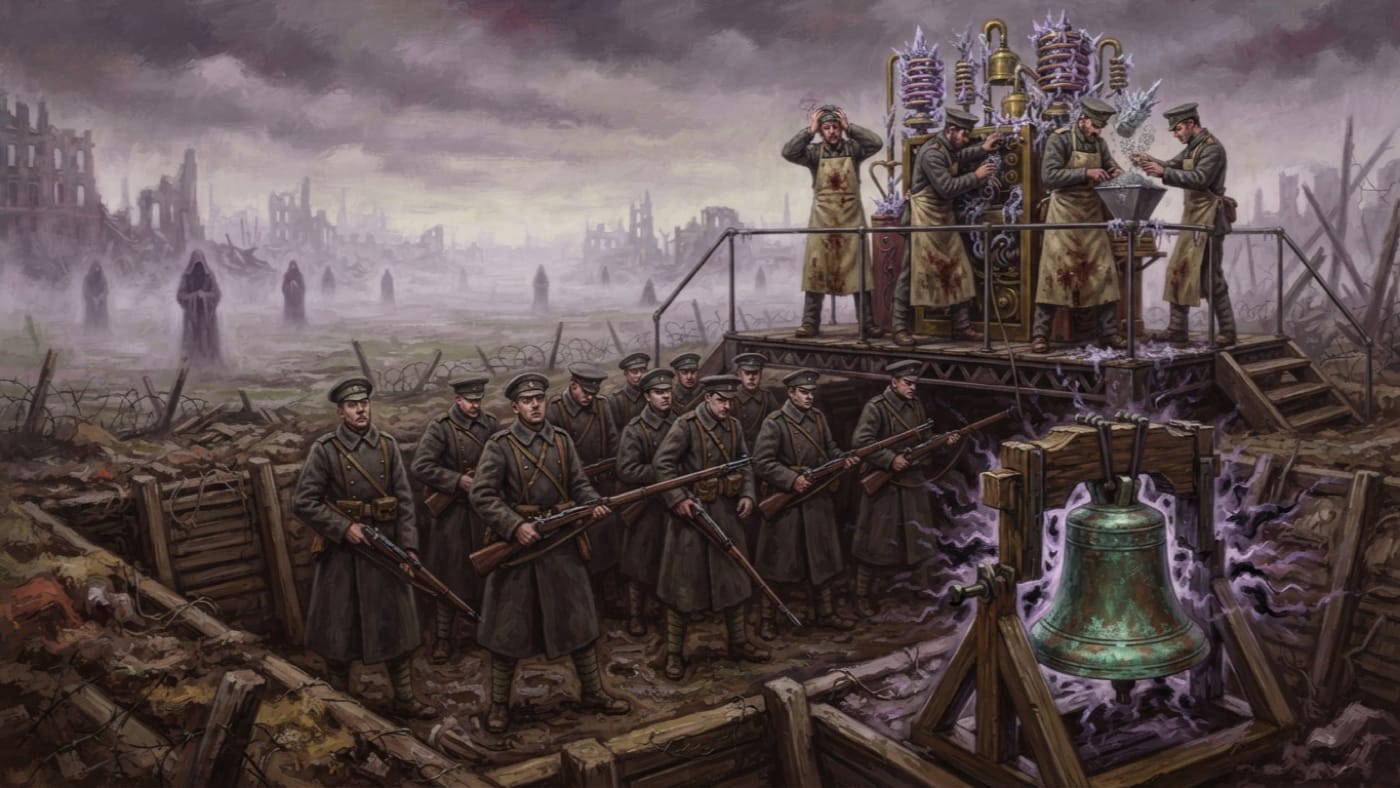
The Night of Silent Steel at Prague remains the standard lesson. A regiment of Radiant Fusiliers formed for the triple volley under banner-light, with the command timed to the banner as the drill books require. As the banner rose, Pale Chanters across the field began a slow, droning inversion of a mercy prayer that every recruit knows before he knows his letters. The banner flared white, and no volley came.
The Fusiliers stood with their eyes open and their rifles loaded, and they did not fire. Witnesses describe no panic, no flight and no visible struggle. The enemy surged across the ground the volley should have held. Afterward their commanders swore that these men had never once disobeyed an order. The annals record "command miscommunication." The soldiers call it the day the Creed went silent.
Both statements are accurate. The command was given, and it never reached the place where a man decides to pull a trigger. "Miscommunication" is a fair administrative description of a severed will, and it has the further merit of fitting on the form.
The method does not need a battlefield. In the First Unhymn Winter, a rival city inverted ration broadcasts, and thousands starved in a panic that arrived bearing every mark of authorisation. At Rouen, the pilgrims of Saint Aurelia's Convoy began to sway as one and to hum in counterpoint to a chorus no one could see. Within minutes relic-bearers were smashing their burdens and Ash Chaplains were strangling their own choirboys. Purity burned the survivors as prophylaxis. Locals say the plaza still murmurs at dawn, and they say it with the particular pride of people whose cobblestones are haunted.
#On the Carrier and Its Custodians
The Church's voice now travels by air, and the air is contested. Sky-Sermons, curfew decrees, convoy routings and casualty rolls pass through repeater houses along the Sagittal Line and far behind it. The Chanters broadcast in counter-frequencies that tangle a hymn into static. Worse, they can tangle it into sense. A prayer half-heard becomes a heresy with good posture.
The Orison Signal Engineer holds the carrier. His answer is saint-dust: authenticated relic powder fed into the apparatus alongside harmonic salts, a calibrated carrier and a witness seal on every packet. The dust weighs the signal down against inversion. According to engineering reports, a soft unhymn begins with backward consonants, timing drift and chorus-phase anomalies. Sometimes an under-voice beneath the approved text speaks a listener's name. A hard inversion announces itself by breaking glass or turning a district toward the wrong horizon. The soft kind is the professional's nightmare, because it passes the test prayer.
A clean certificate proves that the needle held. It does not prove that the ward which heard the broadcast went to bed with its own intentions.
The engineers pay for the defence with their lungs. Dust escapes the seals. Over-dusting clogs the coil banks and produces choir-bloom, which the logs record as hallucination reports and the operators record as Tuesday. The supply runs through salvage, grading halls and ledgers. Records counts every grain, and every shortage ends with somebody reassigned.
#On Containment and Failed Remedies
The catechism remedy is bells. A sufficient barrage of sanctified peals from the Bureau of Bells shatters a Chanter's resonance, and in most sectors on most nights it works. At Vienna it did not. The Chanters sang through the peals and bent them tone by tone until the bells themselves rang off-key and the garrison's own defence turned traitor in its ears. Engines and Furnaces called it prayer-jam. Doctrine called it impossible, which is the strongest classification Doctrine possesses.
Saint-dust reduces inversion but confers no immunity. The engineer who forgets this tends to be forgotten by the next audit.
Rope crews work deaf, with their ears packed with reliquary wax. They communicate in tugs and gestures, because a single forgotten knot under a Chanter's voice drops a pallet of shot into the trench. The wax helps. It does nothing for the man whose helmet has begun to hum, or for the one whose shinbone is keeping time. The ear is only the most obvious entrance, and the Iron Choir has measured the unhymn travelling through timber, iron and marrow.
Suspect repeaters are isolated. Field doctrine on the matter is short: if a repeater goes quiet, assume capture, and if it comes back too clean, assume worse. The Repeater Massacre fixed that rule in blood. Infiltrators held a front station and sent orders for hours under seals that had been warmed and reset. The engineers were executed as accomplices. When their logs were recovered, they contained warnings that had been duly filed.
The last remedy is refusal. Doctrine Directive 77-C forbids reproducing hostile formulas, melodies, response patterns or seal geometry. No unhymn is transcribed for training. Instructors teach by break notation and by describing what was lost. Silence removes contaminated lyrics before choirs can gossip them into memory, and Rites witnesses the removal. This tract contains no example. Readers who feel it would be improved by one are invited to discuss the matter with Purity.
The opposite error also costs lives. Field slang calls any unlicensed tune "foreign choir" or "wild cadence," and every quarter some sergeant reports a drinking song as a Chanter assault. Most of them are drinking songs. Orison inspects them, Purity confiscates the ones that rhyme badly, and neither verdict certifies Hell.
#On Present Custody
As of A.S. 201 the hazard is current and uncontained. Chanters still sing across the Line. Port fog towers report soft inversions every quarter. Repeaters go quiet and are presumed taken. The Orison Hour goes out clean by every instrument the Bureau owns, and listener reports remain pending, as listener reports always are.
The Bureau's corrected term is counter-hymn. The men under the banner still say unhymn, and they have earned the word.