

#On the Term and the Present Compilation
This survey was compiled in A.S. 201 / 1911 CE. The year belongs to the compilation and to nothing else. No record I have consulted names a first sufferer, a first physician, or a year in which anyone first noticed that men who feed powdered saints into copper end up coughing. Somebody must have noticed. Nobody was paid to write it down.
Saint-dust lung is a trade term. Orison crews use it for what their work does to their chests, and the published account of saint-dust repeats it: "that slow reliquary of the chest by which a man becomes the container he once handled." I wrote that sentence, and it holds up. It names a cost. It does not describe a disease, and this survey will not pretend that it does.
The commission files the exposure under Orisonpowder. That is a clerk's word for whatever dust an Orison house measures, injects and loses into its own air. I use it the way the commission does, and I make no claim about what is in it. Saint-grade, front-grade and port-grade blends differ by allocation and by seal, and the cheaper grades are cut with chalk, lime, river salt and lies. Whether every one of these is Orisonpowder in the same sense is a question for Alchemical Standards, who have not offered to answer it.
Archived Codex referrals carried "saint-dust lung" under persons, as though it were the surname of some unfortunate engineer.
Corrected. The term names an occupational complaint. There is no man called Saint-Dust Lung. There are a good many men who would answer to it.
#On the Coil Room and Its Procedures
The Bureau of Orison and Song has held its charter since A.S. 92 / 1802 CE. Its engineers keep the Synod's voice in one piece over distance by lacing the carrier with relic residue, and in the Sky-Sermons account they say the dust weighs corruption down so that an unhymn cannot turn the prayer at the third syllable. Engineers report that it works. The Broadcast Directorate behaves as though it works. Nobody has written down a mechanism, and I will not invent one.
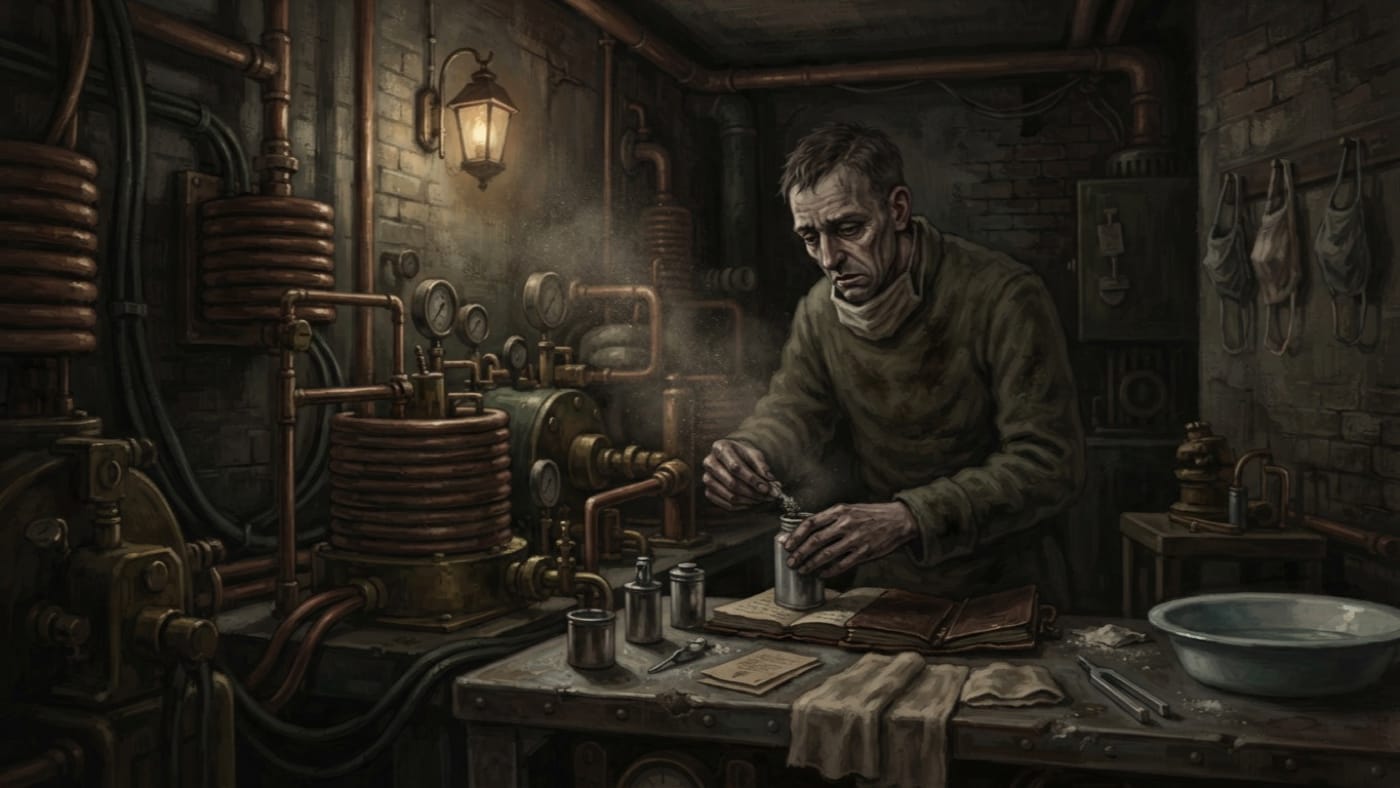
Attested workspaces include broadcast houses, coil rooms, repeater bunkers, port fog towers and trenchline signal pits. At the Cloister of Calibrated Breath in Strasbourg, the east-range carrier rooms keep masks hanging beside prayer cards. The Cloister's own account says one protects the lung and the other protects the report. In my experience the report fares better.
A shift runs roughly as follows in the professional record. The engineer washes his hands in saltwater, taps the urn three times, checks the mask seals and strikes a tuning fork to listen for clean decay. Then he measures the dust blend from the house allotment and checks the message's wax and witness marks. He calibrates the carrier, injects dust by micro-venturi or coil-film, and runs a test prayer to confirm it still reads forward. After that he transmits, monitors, logs every variance and issues a Clean Carrier certificate for the archive and for whatever trial later wants it. Late in the day the urns are swapped in front of two witnesses, because no one opens an urn alone. At the end of the shift he burns his scrap notes, seals the ledger, swaps his filters and spits.
Almost every procedure in that sequence protects the broadcast. Two protect the engineer: the mask check at the start and the filter change at the end. The record shows both being done. It does not show that either works well enough, and the parent account gives the reasons in plain terms. Masks clog. Seals leak. Coil blooms drive powder through cloth, into the nostril and into the gaps between teeth. A mask that has been checked is a mask somebody looked at. That is not the same thing as a mask that keeps dust out.
The coil bloom described in the saint-dust account should not be confused with the "choir-bloom" in the engineers' own failure lists. Choir-bloom is what listeners report when a coil has been over-dusted and clogged, and those reports are hallucinations. The two words are related. The complaints are separate, and they will not be merged here simply because they rhyme.
#On What the Workers Bring Up
The parent account lists harms by trade, and I keep its divisions. Dust graders cough chalk-white. Slurry loaders get cracked lips and pale gums. Orison engineers develop saint-dust lung. Old Dustcasters spit black in the morning and call it proof of service.
Those observations come from four occupations. They are not one list of symptoms, and nothing in the record says every grader, loader or engineer shows every one of them. Nor do they make a diagnosis. No physician has signed a criterion for saint-dust lung. No test is on file, and no account divides it into stages.
The engineers' own professional file adds a chronic cough to their usual hazards, along with coil burns, shock, hearing loss and port fog sickness. Its slang separates "clean lungs" from "gray throat." Its status symbols include a mask filter that is still white. Its signs of strain include checking filters compulsively. The same file lists lung rot among the trade's threats and counts "crews coughing blood" among the marks of a badly run house. It never says lung rot and saint-dust lung are the same thing, or that coughing blood is where either one ends. Each claim stays in the file that makes it.
Other dusty trades have their own lung terms, and those terms have their own articles. Ice-lung belongs to Irongate's chant voices. Bone-lung belongs to the Ritual Bone-Stampers. White-lung has its own usage. None of them is folded into this one. When two jobs both make men cough, that does not make the cough the same.
#On the Supply and the Price of Breathing
The dust reaches the coil room through other people's hands. The Saint-Dust Salvage account puts salvage crews in battlefield slurry with sieves and ledgers, recovering powder from mud that soldiers walked through on their way to becoming part of it. Upriver, the Saint-Dust Cooperage of Mournwater has handled holy particulate since the reliquary contamination of A.S. 98 / 1808 CE. The Cooperage Compact of A.S. 104 / 1814 CE made that handling an industry. Mournwater lies in the River-belt. Which river it is, the record does not settle, and neither will I.
At Mournwater, graders wait in silence under the Settling Bell while samples settle in glass dishes. Slurry loaders move casks of dust suspended in brine. Lock provosts read the manifests and wave the casks downstream. I name these trades because they handle the same material and turn up in the same lines of the record. Working near the dust does not prove that any of them has saint-dust lung, and I do not claim it.
Demand for certified dust never meets supply. Broadcast takes it first, ahead of shrines, field hospitals along the Sagittal Line, quarantine seals and provincial chapels. The engineer at the end of that queue is paid in wages, hazard rations, housing priority, a small relic stipend and a filter allowance. That last item admits more than the Bureau usually does in print.
The professional file lists the engineer's debts with unusual frankness: replacement masks, lung medicine, favours owed for keeping audits quiet, and dust quotas no one can meet honestly. Bribes in the trade are paid in filters, medicine, salt and "mask stock." A district boss who wants a cleaner feed knows exactly what to offer. In the saint-dust account, the Bureau of Mercy prescribes cleaner air, which is not available at the place of work.
At the Cloister, engineers whom exposure has left unfit for coil work are moved into the Quiet Walk, where the account says they become excellent at hearing comfort through a door. The record does not say how many, how sick, or whether any of them recovered. It records a transfer of staff. Records files that sort of thing quickly.
Crumble-Wrong needs a sentence, since nervous readers will bring it up. It is an irregular-settling problem, first classified at Mournwater in A.S. 194 / 1904 CE, in which dust hangs, creeps and forms the shapes of bones. That makes it a dust problem. Nothing in the record makes it the cause of saint-dust lung, a form of it, or a stage of it. The two are filed separately and stay separate here.
#On What This Survey Certifies
The record shows that Orison engineers handle relic residue in enclosed rooms. Their masks clog and their seals leak. Coil blooms push powder past cloth. The trade has a name for what its members' chests become, and nearby trades report chalk-white coughs, cracked lips, pale gums and black morning spit. Exposure and harm turn up together in every source consulted.
What those same sources fail to show is how the harm happens, whether a pathogen is involved, what a physician should look for, how the condition develops, whether anything cures it, and what becomes of any particular engineer. No record supplies a count of the afflicted, and I have not produced one to make the column look full.