
#On the Rite That Answers Back
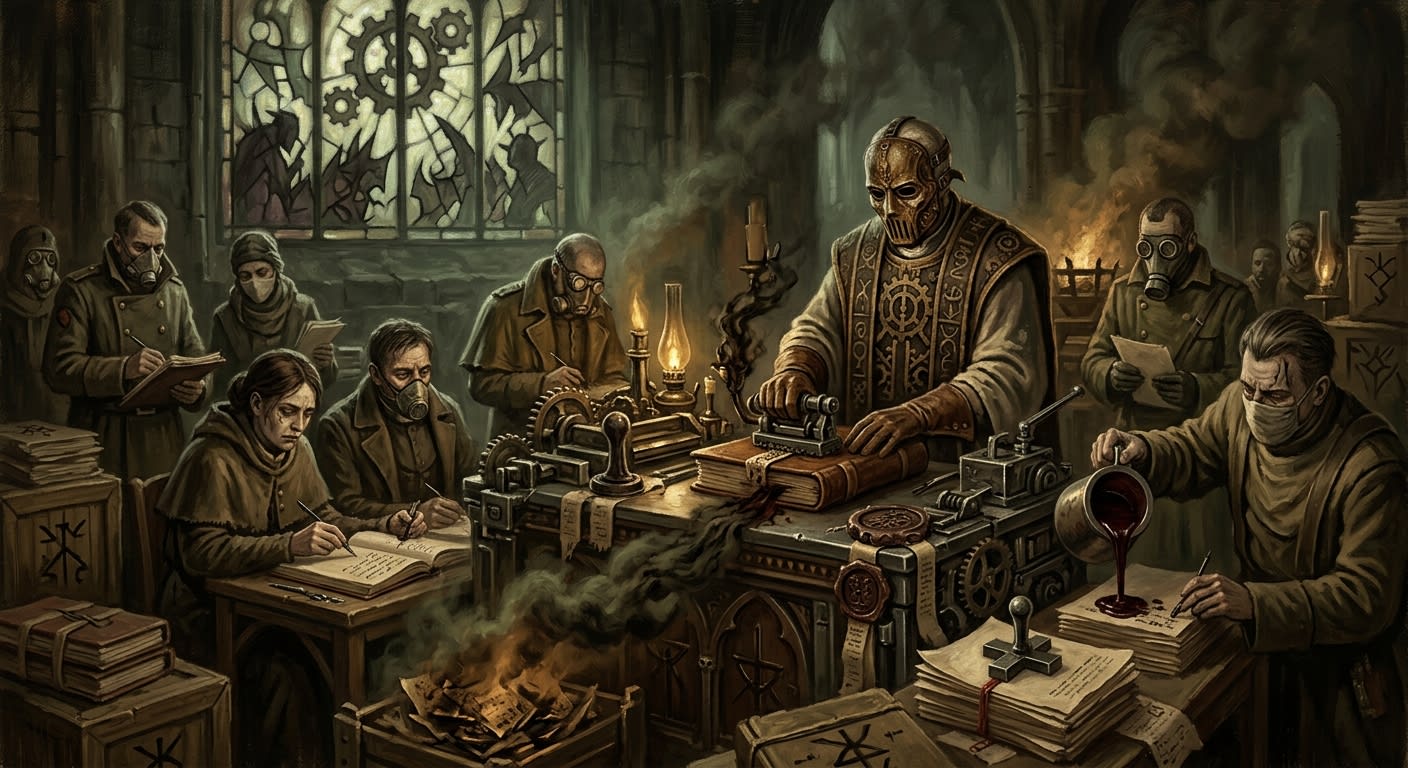
The Mock Liturgy is the Shadow Court’s parodic religious apparatus: a body of masses, confirmations, confessionals, processionals, counter-seals, inverse stamps, and tribunal ceremonies by which the Great Deceiver turns worship into paperwork for damnation.
The name deceives by sounding harmless. Mockery suggests theatre, and theatre suggests distance: painted devils, tin censers, a schoolboy with soot on his chin pretending to be Wrath. The Court’s rites are not theatre. They function. Bureau of Rites assessments conducted through captured artifacts, scrying bowls, burnt vestment samples, and the testimony of operatives whose sleep subsequently became unusable confirm measurable effects. Wards fail. Confessions bind. Baptisms mark. Hymns undo other hymns.
#On Its Instruments
The Mock Liturgy copies Synod form with priestly spite. It has altars, though their mensae are bone, black glass, or stone taken from desecrated chapels. It has vestments, stitched from catechism leaves and cured skin. It has candles whose flames bend toward the celebrant’s mouth. It has censers filled with ash that smells of old chrism and wet iron. It has bells which ring without motion and stop only when someone answers.
Its hymns are the worst instrument because a soldier trusts melody before doctrine. A tune learned in childhood enters the body by a road argument cannot guard. The Court takes familiar plainsong, alters the third descent, breaks the cadence at the name of mercy, and returns it to the ear carrying teeth. A prayer half-heard becomes an order to unlock. A ration announcement bent through an unhymn becomes famine with an official tone.
The seals are subtler. The Bureau of Masks and Seals authenticates lawful meaning: writ, warrant, relic, execution order, marriage bond, transit pass. The Court answers with counter-seals that do not merely forge authority; they invite authority to contradict itself. Wax stamped by the Court may bear a bishop’s mark reversed, a Bureau sigil cut through its own centre, or a Triune Knot whose angles point where no triangle should possess a point. The Armorial offers no approved correction for geometry that appears guilty before it is drawn.
Early Doctrine circulars described Shadow Court seals as counterfeit Synod instruments.
Corrected after the A.S. 174 debriefs. A counterfeit lies about origin. A Court counter-seal revises origin while the reader watches and then convinces the reader he always approved the revision.
#On the Confirmation of Choice
The most cited account remains the A.S. 174 Shadows debriefing from the Court perimeter. An operative observed twelve kneeling figures before an altar of black glass while a vestmented celebrant recited a catechism recognisable as the Bureau of Doctrine’s own. Word for word, until the response.
Where the Synod teaches I submit, the children answered I choose.
That alteration contains the Great Deceiver’s whole sermon. The Synod demands obedience and calls the demand salvation, which is proper, efficient, and often bracingly unpopular. The Court offers choice and makes the soul co-sign its own ruin. Submission can be compelled. Choice stains deeper. A slave may be recovered by force; a volunteer requires confession, and confession is precisely the office the Mock Liturgy has profaned.
SHADOWS DEBRIEF 174-M, LINE 41: OPERATIVE: They looked like children. EXAMINER: Were they children? OPERATIVE: Their shadows were older. EXAMINER: Did they resist? OPERATIVE: ███████████████████████ EXAMINER: Repeat. OPERATIVE: They corrected the priest when he missed a word.
#On Anti-Synod Proceedings
The Mock Liturgy reaches its mature form in Anti-Synod proceedings. These are not councils in any wholesome sense. They are tribunal-rites in which Court functionaries parody the Holy Bureaus, raise charges against virtues, subpoena the absent, acquit treason, and condemn obedience as spiritual fraud. The minutes are stamped in ink that dries before touching paper. The witnesses wear masks of flayed saints.
A proceeding may try a village before the village knows it has been named. It may annul a baptism by calling the font water “unwitnessed.” It may grant an indulgence for betrayal already committed but not yet remembered. It may issue a counter-warrant under a seal close enough to Synod form that a tired gate clerk reads it as lawful and opens the wrong passage at the wrong hour.
The Bureau of Doctrine forbids repeating the Court’s charges. It also forbids denying them in detail, because denial gives shape, shape gives memory, and memory gives the enemy a shelf in the archive. Approved sermons may say only: The Court’s proceedings have no jurisdiction over the faithful. Priests are instructed to say this loudly. Volume is not proof, but it has pastoral uses.
#On Counter-Rites and Containment
Containment begins with refusal of reproduction. No melody is copied. No seal is drawn. No response pattern is entered in training manuals except by break notation. Artifacts are boxed by Purity, witnessed by Rites, registered by Records, and then misplaced by Shadows in a procedure everyone denies and everyone relies upon.
Field chaplains receive three instructions. Sing over any suspected unhymn before listening for sense. Break wax rather than read a suspect seal. Remove children from any ceremony where the word choose appears in response to grace. The third instruction was added in A.S. 174 and has caused difficulties with ordinary weddings, which the Bureau considers acceptable collateral confusion. Bells supplies masking peals. Silence removes the contaminated lyrics before choirs can gossip them into memory.
The Mock Liturgy persists because parody is economical. It feeds on our form. Every stamp we sanctify teaches Hell what a stamp can do. Every rite we polish shows the Court which surfaces shine. This is not an argument against order. It is an argument for sharper custody of order, which is my favourite kind of argument: severe, expensive, and certain to increase my office’s budget.
A Bureau of Rites memorandum proposed composing a public “Anti-Mock Mass” to neutralise Court ceremonies by counter-parody.
Rejected by Doctrine after thirty-one seconds of review. The author was transferred to candle inventory, where parody has fewer opportunities to become sacrament.
The Court sings because we sing. The Court stamps because we stamp. The Court confesses because we taught the world that confession has power.