

#On the Refusal at Dusk
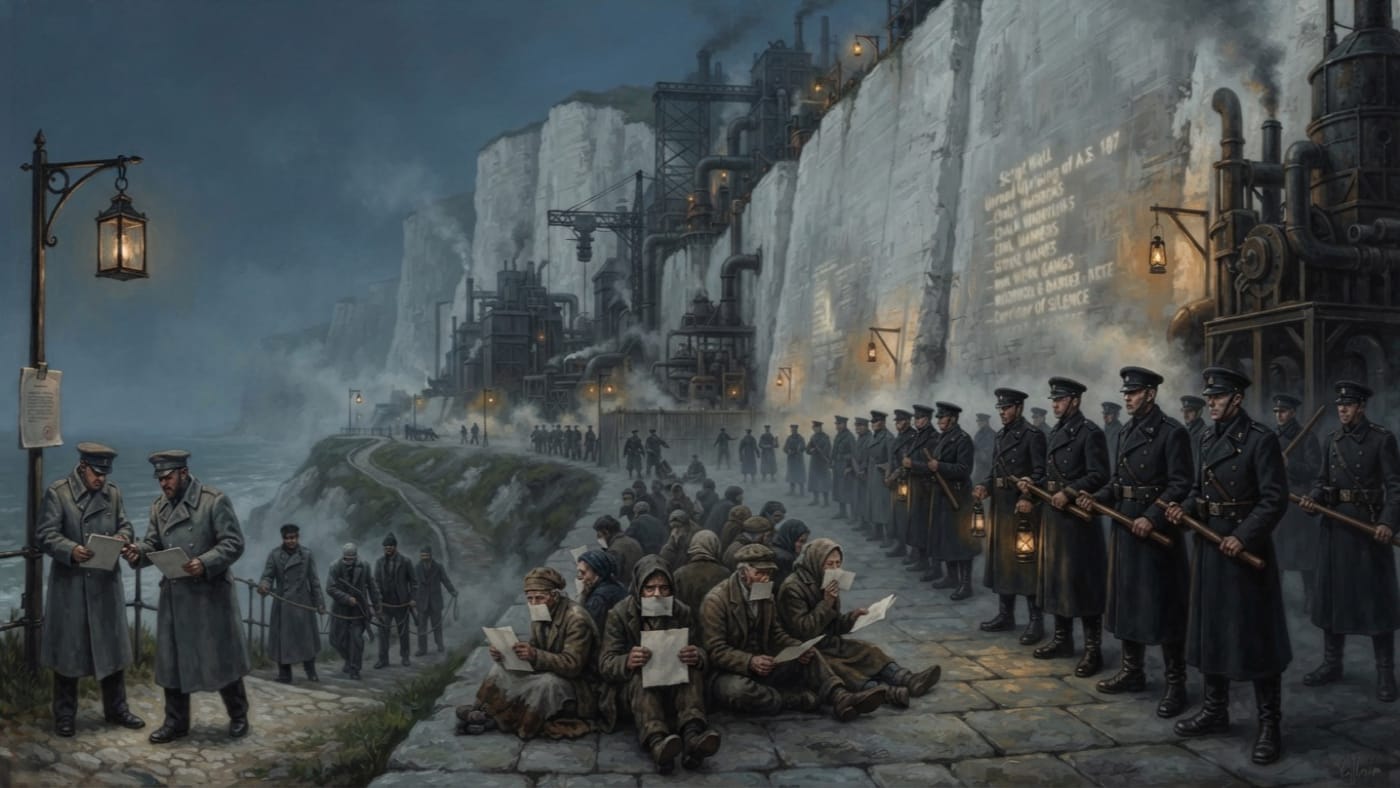
In A.S. 187, which the heathen almanacs number 1897, the Unread of Calais spent three days withholding the one tax the Chalk Redoubt collects in person. They stayed away from the night readings. They kept their lanterns, their slates and their throats from the Script Wall. Some came to the chalk at dusk with blank paper held over their mouths. Theologians are trained to despise that gesture and clerks are trained to confiscate it. The Coastal Chapterhouse broke the refusal with quarantine writs and quarry conscription. Corridors of enforced silence were cut near the Wall afterward. The Unread outlived the lesson the way damp outlives whitewash.
That is the event. The rest of this entry is its invoice.
I was not at the Wall in A.S. 187, and I will not pretend otherwise for the sake of colour. I have what the Bureau has: rosters, writs, pass-suspension lists, a garrison after-action note with most of its numerals blacked out, two later accounts of my own and a great deal of Coastal correspondence from men who mainly wished they had been somewhere else. The Chapterhouse filed the matter as a disturbance. The Warrens call it the Uprising. Both names are wrong. Nobody rose. Several hundred people sat down, in the theological sense. The state then learned that a body sitting still is harder to charge than a body running, because it has not yet committed the offence of motion.
Two facts have to be held in the same hand. The refusal was defeated. Its doctrine survived. A reader who drops either fact will misunderstand Calais, and people who misunderstand Calais tend, in time, to have their names read.
#On the Voice Levy
To understand the refusal, start with the debt. Calais is a western coastal installation in Zone 1, cut into white cliff, facing the Channel rather than the Sagittal Line. Coastal and war authorities requisitioned the headland in A.S. 69, two decades before there was any formal Synod to thank them. Two years later, in A.S. 71, the Great Breach opened the sea caves inward and drowned hundreds. When the fog came over the quays afterward, the chalk between the Gun Galleries and the Crownline began to write. It has been writing ever since.
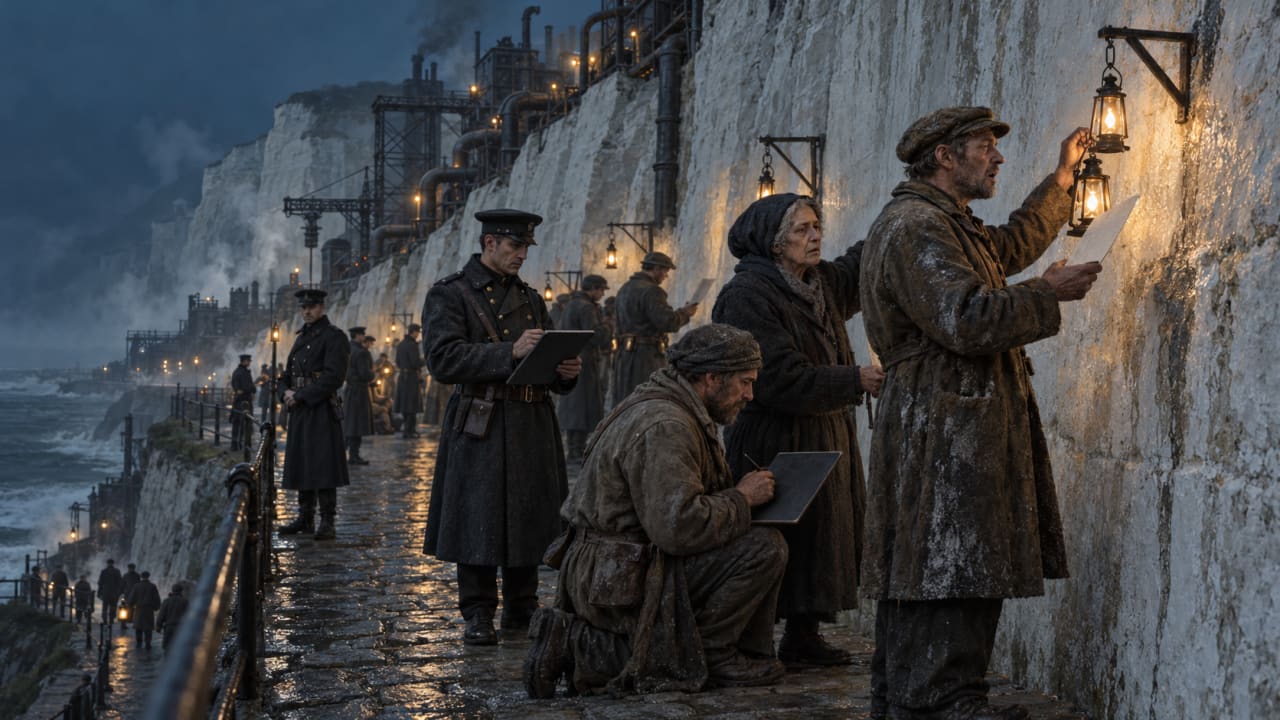
The Wall is about seventy feet of exposed chalk. On fog nights names bead out of the condensation: legal names, dock names, baptismal names, the name a mother uses for one child and never says in company. The Fog Bell Tower strikes three short, one long, three short, and the reading begins. Readers take measured stations along the face. Lantern-bearers angle their light against the stone so the letters can be seen before they fade. Chalk Scribes kneel with waxed slates and copy each name as it is spoken, for the ledger of the Salt Tribunal. Behind each scribe stands a copyist of the Bureau of Doctrine, which keeps its own copy because it trusts no hand but its own. That includes mine. My own Bureau has audited me, and I have never been prouder of an institution's suspicion.
A name read aloud stays on the chalk as a warning. A name left unread darkens, bleeds and sinks into the stone, and the harbour answers. A skiff does not come home. A diver's rope goes slack. A child in the Warrens wakes up coughing salt water. A crew comes back with the right number of men and the wrong faces. Sometimes the water beyond the Teeth falls into west-hush. The old hands tell it from ordinary calm the way a gaoler tells a sleeping prisoner from one holding his breath.
That is the reason for the levy. Every household in Calais owes voice, night-watch and sleep. The work has never been shared evenly, and the Bureau has never claimed it was. The miners, lantern runners and seal porters of the Chalk Warrens live beneath the cliff, and their families carry most of the reading support. They fill lamps, trim wicks and carry slates. They stand behind the readers as spares, take over when a voice fails, and walk home at dawn with throats like scraped vellum. A reader may spend four hours at the chalk and then report to quarry or quay at first light. The roster decides whose throat the night will spend. If it goes unspent, the Tribunal decides what the family owes.
I do not have the instrument that first made this service compulsory, and I will not invent a date for readers who like their oppressions properly numbered. By A.S. 187 the levy was established practice. It was enforced by roster, and every Warrens family understood it as a debt payable only in person. The refusal mattered because the service mattered. Withholding it meant leaving names on the chalk with nobody to say them.
One coastal digest records the aftermath of the Unread Uprising as the moment "reading was made mandatory by law."
Corrected. The reading was owed before the refusal. That is what made it a refusal. The A.S. 187 suppression enforced an existing obligation. The doctrinal escalation came the following year and is recorded below under its own date. The digest compressed three stages into one sentence. Its author has since been given more paper and less authority.
#On the Case Against the Reading
The Unread hold that the readings feed the sea. I set the doctrine out here only as far as the event requires. The full version is filed under its own entry, where it can do less damage.
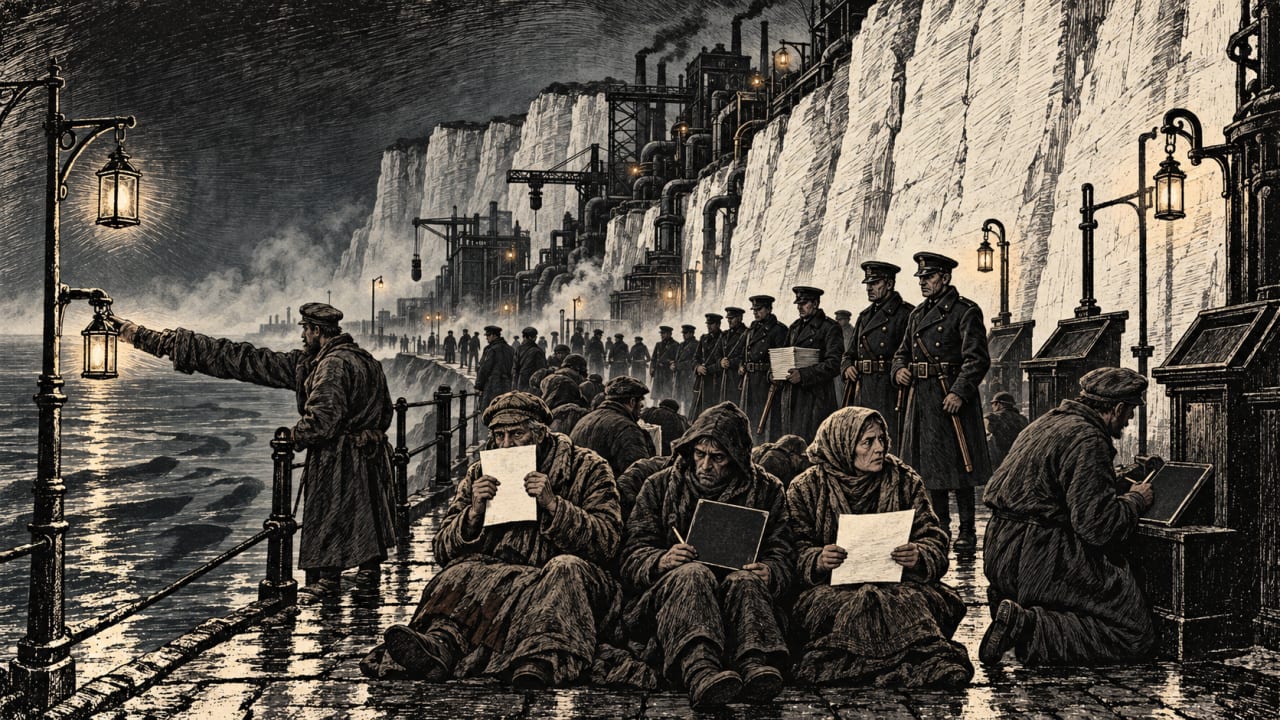
Their case starts with what any diver will tell you over a third cup. The Undertide gathers when Calais reads. Divers report tapping inside the chalk during voice duty. Lanterns at the Wall draw shapes toward the harbour mouth. The Gunline Choir's sequences drive those shapes off only once they have come close enough to hear the bells. On these observations the Unread build a structure the Bureau cannot tolerate. A spoken name is a hook lowered into the water. The readings maintain some mechanism the city cannot see. Calais believes it is defending the coast, and it is in fact baiting it, with its own people threaded on the line.
The official answer runs the other way. Voice is rescue. A name read is a name held above water. Refusal leaves names to sink, and sunk names are paid for in drowned bodies, which the casualty ledger records in its own column. Over the years Doctrine has propped up this answer with circulars. Some call the Wall an acoustic-relic event. Others call it a meteorological illusion produced by condensing chalk and tired, suggestible garrisons. Through every one of these circulars the readings stayed mandatory, as a precaution against the illusion.
Both camps accept the correlation. Each agrees that the Undertide moves when the Wall is active and that harm follows sunk names. They disagree about which way the cause runs, and neither has been allowed to test it. A test would need a night on which Calais chose not to read and then counted what followed. The Bureau forbids that comparison. In A.S. 187 the Unread ran it without a permit.
I record their claim as doctrine. The Bureau has condemned the question of whether any installed mechanism stands behind the Wall. It has forbidden investigation and sealed the matter in cabinets beneath the Tribunal. I have no intention of opening those cabinets in a public codex for the entertainment of the Warrens. The reader may notice that a proposition this thoroughly forbidden has been handled with unusual respect. The reader is advised to notice it quietly.
#On the Three Days
The fullest account of the first night is the one I filed under the Unread entry, drawn from roster returns and Coastal reports. I have found no second, independent tally to test its figures against. I give them here as that account gives them. Anyone who repeats them in company should repeat the attribution as well.
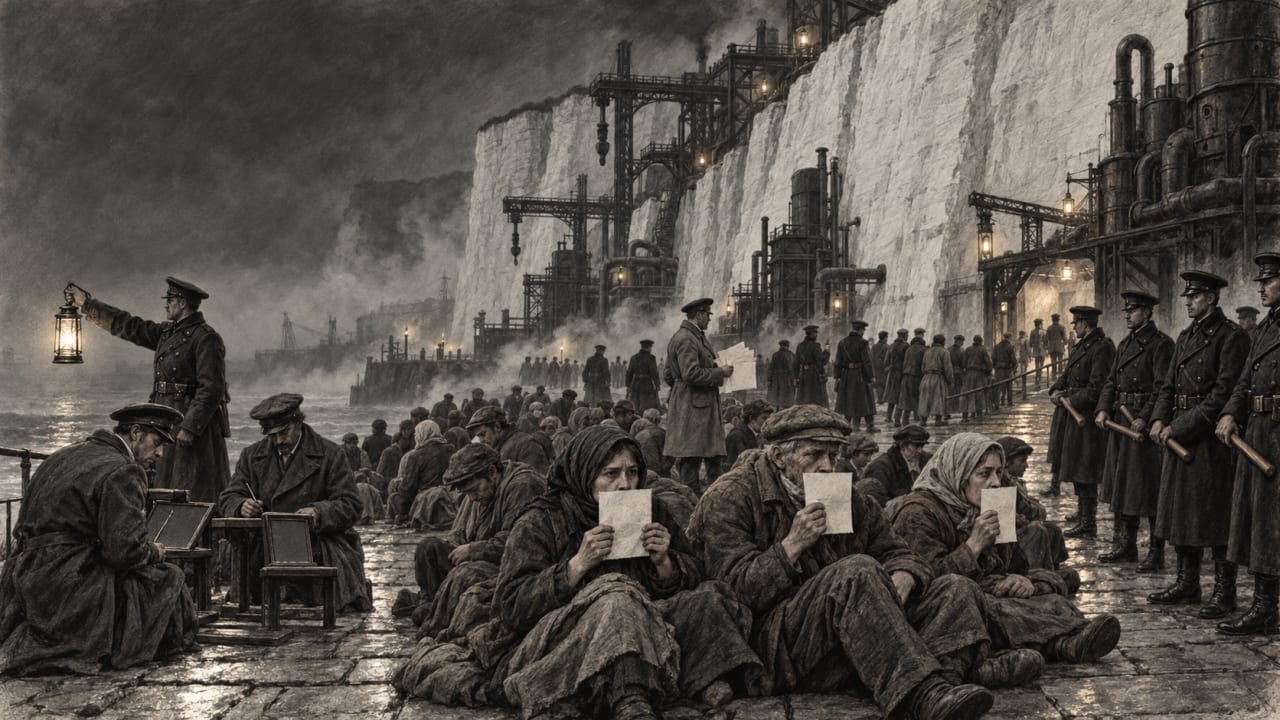
According to that account, three hundred Warrens workers failed to report for reading support at dusk on the first night. Lamps went unfilled and slates went uncarried. No spares stood behind the stations. Forty-two registered readers came to the Wall and put blank paper over their mouths. Lantern-bearers turned their lamps toward the harbour, so the light fell on water and left the letters dim. Two Chalk Scribes wrote no names on their slates. Each drew vertical strokes instead, one for every person standing silent beside him.
Do not add the three hundred to the forty-two and call the total the strength of the movement. The registers do not say how many readers also appear among the absent workers, or how many households sent people of both kinds. Purity added the figures together in A.S. 187, because Purity likes a large number when it is asking for warrants. I decline to inherit the arithmetic.
The Wall wrote anyway. The account records thirty-one names by second bell and nineteen sunk by third. The harbour went into west-hush before midnight. The Gunline Choir struck Sequence Three from the galleries, and the Teeth breakwaters at the harbour mouth answered with a sound the account describes as chewing. No major breach followed.
Every one of those sentences has been misused. Nineteen sunk names means nineteen sunk names. The record of that night does not establish nineteen deaths. I have seen pamphlets on both sides claim that it does. The Bureau's pamphlets use it to prove that refusal kills by the score. The Unread's use it to argue that one night's toll was trivial beside what a year of full readings costs. What became of the nineteen belongs to the casualty ledgers, the intake forms of the Undertide Pens and the Wall's own later returns. No file I am allowed to cite reconciles any of them with that night.
The absence of a major breach is an equally narrow fact. It does not show that nobody died or that the sea was indifferent, and the west-hush and the noise at the Teeth point the other way. It does not show that refusal worked. It shows that on one night, with the Choir at its guns and the Divers on call, the harbour did not open inward the way it had in A.S. 71. That was enough for the Unread to preach on and not enough for the Bureau to refute. If the night had drowned half the Warrens, Purity would own the argument for good. If nothing at all had happened, the Unread would own it. Calais produced a result both sides could use and neither could settle.
The second and third days are thinly documented. The Coastal files record that the refusal continued and give no itinerary. No reliable record says when each night began, how many names appeared, how many sank, what the harbour did, or which households held out and which gave way. I have read drafts by men who filled those gaps with speeches, raids and a dramatic surrender at dawn. The drafts went into the stove, and they warmed the room better than they ever informed it.
A few things can be said. The refusal lasted three nights, so the levy went partly unpaid at three fog summonses. The garrison kept readers at the chalk throughout, drawn from people who had not refused, and the Wall was read by fewer voices than it was owed. By the end of that span, the refusing households had been returned to compliance or taken into custody. No battle did it. The instruments that ended the Uprising were made of paper, and they belong to the next section.
#On Writs and Quarry Service
The Chapterhouse never had to fight the Unread. It only had to reclassify them, and Calais keeps three offices that reclassify people for a living.
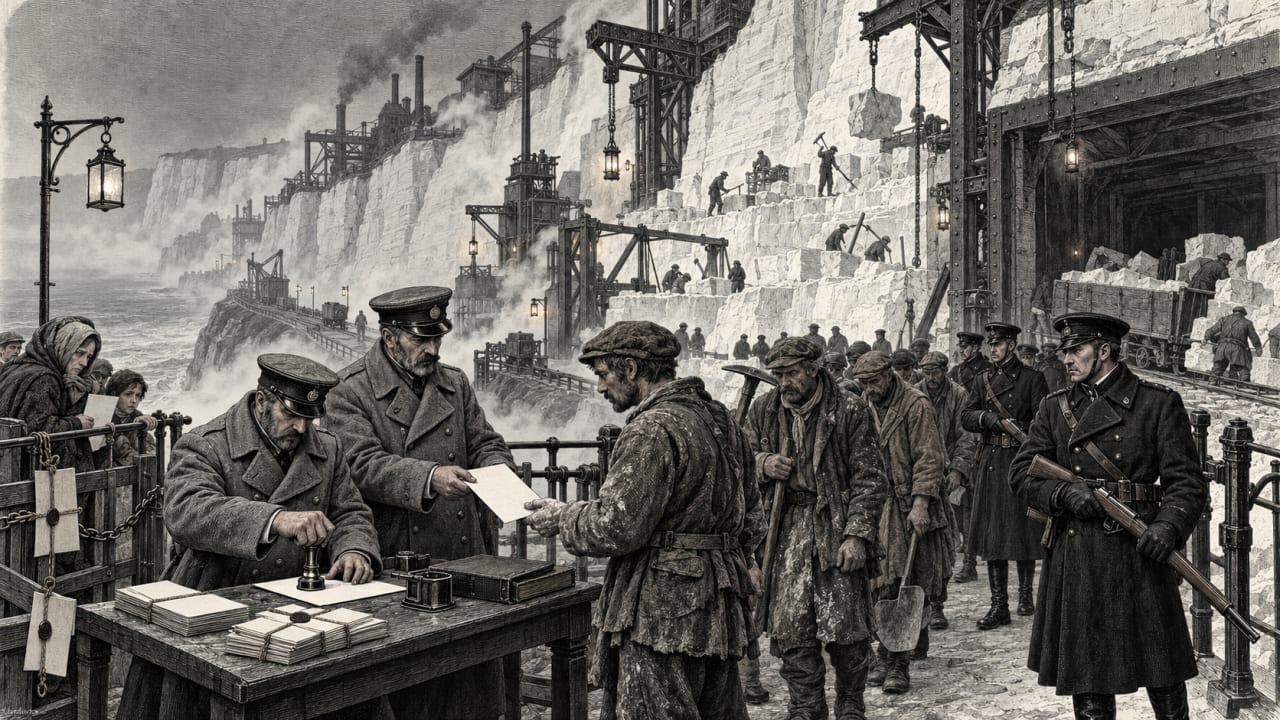
The first instrument was quarantine. Wardens sealed the approaches to the Warrens under writs issued on Commander-Prior authority. The files keep the office and the seal. They do not keep a name I can responsibly attach to either, so I attach none. Quarantine is a health jurisdiction, which makes it the most flexible weapon in any Synodal arsenal, because a health jurisdiction never has to prove intent. A congregation under writ is treated as a contagion. Its members may not gather, because gathering spreads the condition. They may not move freely between districts, because movement carries it. They may not complain together, because complaining together is classed as a symptom.
The refusers had chosen to stay away from the Wall, and the Chapterhouse answered by forbidding them to leave their own approaches. The writ worked anyway, because the Wall was never its real target. A sealed approach is also a sealed quay-path, a sealed water stair, a sealed route to work and a sealed route by which pages, signs and news travel from one household to the next. The Unread had organised a refusal across the Warrens. The writ cut the Warrens into pieces.
The second instrument was passage. The Salt Tribunal suspended sea passes for every household marked by refusal. In Calais a pass is worth more than coin, because coin cannot cross water. A fisherman without a pass cannot launch. A carter without one cannot take cargo across the quay. A family without one cannot leave. The Tribunal did not need to find the refusers. They were already in the rosters, entered by the very clerks whose stations they had left empty. The levy's record of absence became the list of the punished. It is the most economical thing I have ever seen a tribunal do, and I have seen tribunals bill the dead for their own exhumation.
The third instrument was custody, and it came in two kinds. The Bureau of Purity took the organisers, so far as it could identify them. The Bureau of War took the strong backs and assigned them to quarry service. The Silent Steps records add beatings and arrests to the work of those days. I believe them, because no Calais file from any year describes a coercive week without both.
Quarry service needs explaining for readers who have never smelled chalk-lung. The Warrens began as quarry cuts. The cliff that holds the Wall also gives the Redoubt its lime, its building stone and its supply of men with white lungs. Conscripting refusers to the quarry took the able-bodied out of the households that had organised the action. It turned their withheld labour into compelled labour. It moved them physically away from the Wall approaches, into cuts under War supervision, where nobody reads and everybody coughs. A man who would not give his voice to the chalk was made to give his back to it.
The three instruments did not have to work in any set order. Their force was cumulative. Households sealed in by writ, unable to launch or trade under pass suspension, and short of their organisers and strongest workers, had very little left to refuse with. Most of them, by the record, returned to the rosters. The record does not say how many were detained, how many went to the quarries, how long they served, or how many came back. The after-action note answers those questions in ink that has since been overwritten.
AFTER-ACTION NOTE — UNREAD DISTURBANCE, A.S. 187 — EXTRACT Households under quarantine writ: ████ Sea passes suspended: █████ Taken by Purity: ███ Assigned to quarry service by War: █████ Released to roster: ████████ Disposition of remainder: ████████████████████████████
#On the Silence Cut Afterward
Once the refusal was broken, the Chapterhouse turned to the ground it had been staged on. Corridors near the Wall were declared no-speech zones. These are the Silent Steps of Calais. In the stretch of approach where the Unread had stood silent without a licence, silence became compulsory, policed, and owned by the people who policed it.
The official rationale was acoustic safety. Coastal circulars describe the Steps as protective approaches, set up to keep the readers' concentration from being broken by chatter, by prayers said too loudly, by grieving relatives calling out names the Wall had not yet written. There is a sound case for this. A name spoken carelessly near an active Wall can contaminate a roster or give the fog a spelling it did not have before. The circulars say nothing about the other function, which was plain to every family in the Warrens. The approaches where the refusal had gathered were now ground where gathering, signing to one another and saying a word of protest were offences in themselves. The Unread had used silence as an argument. The Chapterhouse confiscated the medium.
At the Wall, speech is owed. A reader who stops before the last consonant leaves a name half-sunk. On the approaches a few yards away, speech is forbidden. A reader on duty may speak a stranger's name because the roster commands it. A mother on the Steps may not say her own child's name, however frightened she is. One sound is compulsory and the same sound is criminal, and the stone between them is marked with a painted band.
The same aftermath produced the Silent Corridor between the Undertide Pens and the Wall. It was cut so that names could move between the chalk and the quarantine cellars without being spoken. Its door on the Wall side is the Reader's Wicket, which has no handle on the Pens side. Names, witnesses and objects pass along it on slate and under seal. The Pens and the Wall had always exchanged names. Since A.S. 187 they have done it without raising their voices. The Silent Corridor is a related work and should not be confused with every Silent Step in the Redoubt. It is a service passage for the quarantine. The Steps are a public jurisdiction over the approaches.
A caution on chronology. The record dates the creation of the Steps and the Corridor to the aftermath of A.S. 187. It does not date each piece of furniture now found on them. The salt-white boundary bands, the posted infraction tables, the lay enforcers in candlecloth wraps with waxed cudgels that bruise without staining the white stone, the rules about crying children and appeals made inside the boundary: these are all practice by A.S. 201. Several are certainly older than that, but none can be shown to have been in place the morning after the writs were lifted. A jurisdiction is cut in a day and furnished over decades, much as a gaol starts as a locked room and gets its chaplain later.
What can be said is that the Steps were born out of the refusal. They were not a general improvement to Wall safety that happened to coincide with it. Every later Bureau that copied the device, and several have, copied a punishment and filed it as a precaution.
#On the Year After
A.S. 188 has to be kept separate from A.S. 187, and the Bureau has often failed to do so.
In A.S. 188 the Bureau of Purity formally reclassified non-compliance with the reading protocols as heresy. Before that, refusing to read was a breach of levy, punished by roster discipline, Tribunal assessment and, as A.S. 187 showed, by any coercive instrument within reach of a Commander-Prior's seal. After that, it was a doctrinal offence under Purity's jurisdiction. The refusal of A.S. 187 was suppressed as an administrative and public-health emergency. It was not tried as a heresy, because the category was not yet available.
A post-uprising standing coastal order, as reproduced in Coastal compilations, states: "Refusal to read during active fog equals non-compliance. Non-compliance equals heresy when witnessed by two officers, one scribe, or the sea."
Clarified. The order as compiled joins two stages. The equation of refusal with non-compliance belongs to the enforcement regime after A.S. 187. The equation of non-compliance with heresy rests on the Bureau of Purity reclassification of A.S. 188 and cannot have bound anyone before it. Compilers are instructed to date their clauses. The sea's standing as a witness remains unratified.
The reclassification brought its own vocabulary. "Pre-sedition," the offence of carrying an Unread mark outside the Wall perimeter, was invented after A.S. 188 by a Purity assessor with a productive hatred of margins. Blank paper inside the perimeter came to require a seal. The reading itself did not change: the same bell, the same stations, the same slates. The change was in what the state now called the people who left those stations empty.
The same year produced the reading failure filed as Roster 14-F. A reader at the Wall recognised a name, the name of the reader's own daughter, and left the station before the final consonant. The name partly sank. West-hush began within seven minutes. Three lamps went out underwater. The Pens took on three feet of water from behind sealed stone, and the mark is still cut into the wall of the Salt Vestibule. The recovered-body count in the file is redacted. The disciplinary finding is sealed. The reader was reassigned to maintenance on the Silent Steps.
Roster 14-F was not a fourth night of the Uprising. Nothing in the file connects that reader to the Unread. It was one person's failure at one station, of a kind that rosters are meant to absorb and sometimes cannot. I include it because it shows what the Chapterhouse feared in A.S. 187 and why the settlement afterward took the shape it did. One unfinished name, at one station, could put three feet of sea into the cellars. The refusers had left dozens of stations empty. The Bureau drew its conclusion. The Unread drew another from the same facts, and I find that more inconvenient than I can say on letterhead.
The reassignment deserves a closing remark. The Steps were built to punish the silence of A.S. 187. In A.S. 188 they took in a reader whose voice had failed. The corridor accepted the reader in the same way it accepts all silence: as property.
#On the Refusal That Remained
The Uprising failed. The Unread did not. Those two statements have different files, and the Bureau keeps trying to bind them into one volume.
Purity has been suppressing the movement continuously since A.S. 187, in the way sweeping is continuous during an ashfall. Cells are broken and blank pages come back. Organisers are taken and the hand sign reappears: a palm before the mouth, three fingers chalked white. The movement has survived by being useful to people who do not believe it. That includes the mother who rejects the Hook doctrine but takes an erased pass for a child whose name turns up too often near the surf, and the clerk who condemns silence by day and hides a roster at night.
In A.S. 199, twelve years after the refusal, chalkscript appeared on doorframes in the Warrens, three hundred yards from the cliff, in rooms no fog should reach. The Unread call this proof that the Wall follows the voice and that the suppression taught the writing to come inland. The Bureau attributes it to spread under Amber conditions. A twelve-year gap is a chronology. It does not prove a cause, and the Unread pamphlets that treat it as one have the same evidentiary standing as the Coastal circulars that treat it as weather. What A.S. 199 changed was the force of the argument. A doctrine that had been crushed on the Wall approaches suddenly had lintels to point at.
The two figures most often linked to the movement have no place in the record of A.S. 187. Brother Vell leads, or is said to lead, the Unread from the edges of the Warrens by sign and chalk-mark. He cannot speak. The Tribunal, the Divers, the Unread and the street all explain this differently, and none of their explanations is established. No file places him at the Wall during the refusal, and none makes his silence a sentence passed in its aftermath. Mara White, his lieutenant, carries pages from which every line has been erased. Before her detention in A.S. 200 she wrote on a slate: "If name is rope, why is the rope wet?" The slate was confiscated. The phrase is still chalked on fish crates. Neither of them is a veteran of A.S. 187 on the evidence I have. They are what the movement grew into after the refusal failed.
As of A.S. 201, fourteen years after the refusal, Calais remains under Amber status. The Wall still writes, the Warrens still supply the readers, and the Tribunal still suspends passes. The Steps are still silent by law and the Wall still demands to be heard by law. Unread cells persist below the threshold of open revolt. Purity counts its seizures of blank paper as achievements and has asked for more paper seals.
The fog bell still strikes three short, one long, three short. The readers take their stations, the lantern-bearers face the chalk, and the scribes kneel. In the Warrens, a child covers their mouth at the sound and denies, with angelic incompetence, that anyone taught them to.