

#On the Object of the Assessment
Compiled for the Codex in A.S. 201 / 1911 CE as a documentary survey of the levy as it now stands. The year belongs to this compilation. No document available to me gives the levy a year of its own.
Edremit is a foundry-town of the Hintermark, Zone 3, west of Bastion-Constantinople, on the southern road-and-rail route that carries the Last Lock its iron. It casts boiler throats, rivet stock, furnace collars and casing rings for the supply and repair chain that keeps Constantinople's engines hot. Its adult workers pay a local assessment that the town calls the Throat Tax. This entry concerns that assessment and nothing grander.
The assessment falls on adult workers whose labour is classified under one of three heads: voice-damaging, lung-darkening, or sermon-limiting. The worker pays because the work has been found to harm the worker. That is the whole logic of the levy, and Edremit has never been embarrassed by it.
#On the Three Heads
Voice-damaging labour needs little gloss in a town where the pour is louder than the preacher. Heat dries the cords. Shouting across a casting floor wears them. A throat crew ends its shift speaking in the narrow, scraped register that Edremit's own account calls hoarse and that the Bureau of Medicine would call something longer in Latin.
Lung-darkening labour concerns smoke, filings and the cough that follows a worker home and sits down at table. The term is a foundry word, not a physician's, and it is honest in the way foundry words usually are.
The third head is sermon-limiting. Edremit's account gives the phrase without definition, and I will not invent one in the town's name. As a theologian I can say only what it presupposes. A worker in Edremit is a congregant as well as a pair of hands, and any labour that leaves a person unable to receive, repeat or carry the Church's instruction has damaged the Church's property along with the worker's. The doctrine is sound. That a congregant should be billed for the damage is a separate question, and this survey does not have to settle it.
I have found no instrument that says who classifies a trade under these heads, by what test, at what bench, or how often. The surviving account says nothing about the rate, the method of collection, exemptions or appeal. I record silences as silences. A Codex that fills them is a forger with good handwriting.
#On What the Money Buys
The Codex account of Edremit lists four uses for the assessment's proceeds. It lists no others, and neither will I.
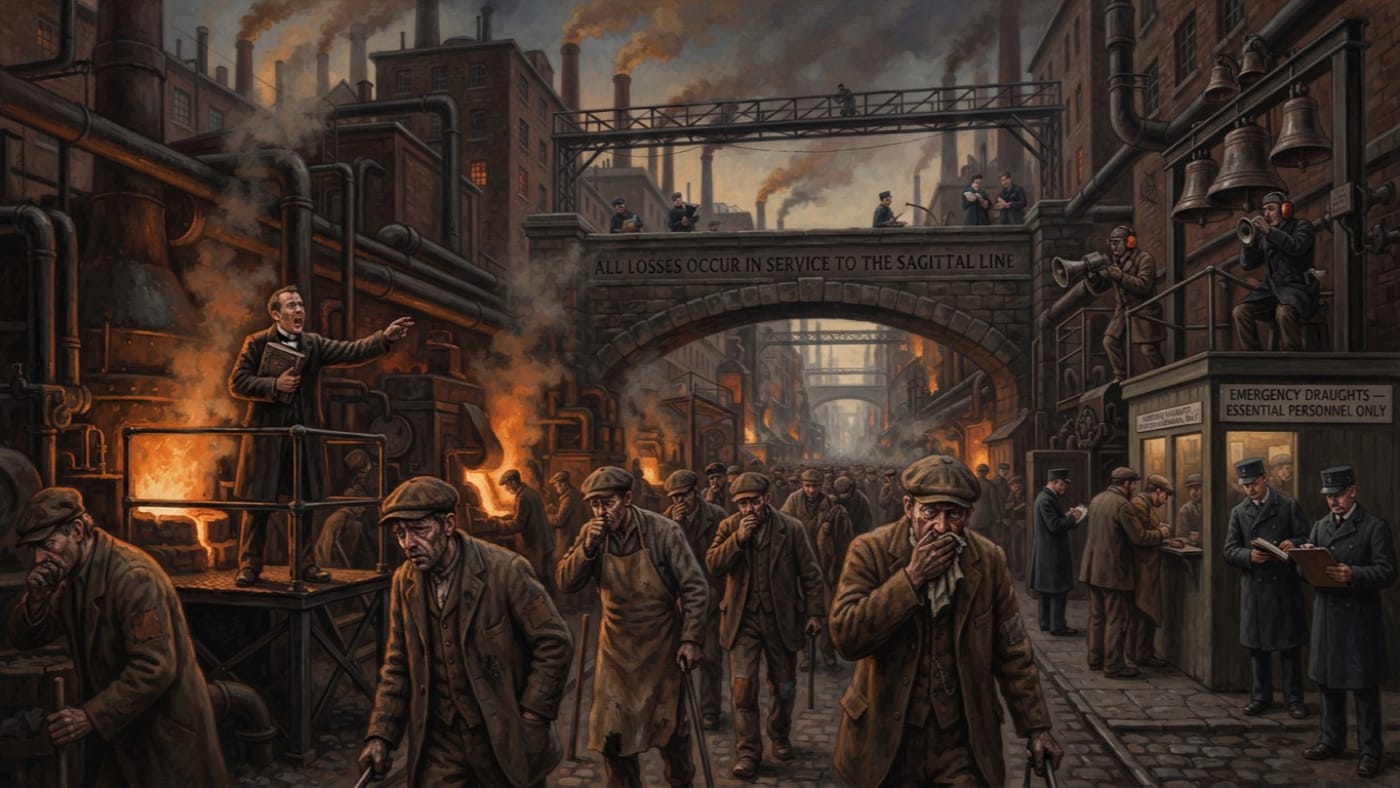
The first is replacement catechists. On the casting floors of Lower Throat a Furnace Catechist recites the Chain of Cause over the moulds, the furnaces and the ladles, loudly enough to compete with metal. A voice spent this way wears out at the same rate as those it addresses, and the town does not allow the floor to fall silent while a successor is found. The tax buys the next preacher.
The second is bell-listeners. Edremit's sheds run by bell: the mould chapels open, the furnaces wake and the ladles are sealed, each on its signal. The account names the bell-listeners as an object of expenditure and does not describe their duties. Nobody in a foundry needs to be told why the people who hear the bells must be people who can still hear.
The third is emergency cough draughts for essential personnel. I have copied the phrase exactly because it holds two qualifications. The draughts are for emergencies, and they are for those whom some unnamed authority counts as essential. The account does not say who belongs to that class. Nothing in the record makes a draught the right of anyone who has paid the tax, so an assessed worker cannot read the levy as a dispensary promise. The phrasing implies, without saying, that a cough which does not threaten essential work is not an emergency.
The fourth is a public inscription stating that all losses occur in service to the Sagittal Line.
Compensation looks backward at a loss and pays the person who suffered it. The Throat Tax looks forward at a function and pays for whatever keeps that function running. The floor keeps its preacher, the bells keep their listeners, essential hands keep coughing at a workable volume, and the town keeps a sentence in stone telling it what all of this was for. The worker whose throat narrowed in the pour keeps the narrowed throat, and has paid for the privilege.
The Codex settlement abstract for Edremit gives the Throat Tax a founding year, an account of the winter that produced it, and a schedule of differing rates by trade.
Corrected for this survey. No independent instrument supports the founding year, the origin account or the rate differences, and none is adopted here. The assessment's object and its four stated applications stand. Its beginning does not.
#On the Casting Floor and the Offices Above It
The levy draws its matter from Lower Throat. The throat crews work there among moulds, furnaces, ladles and smoke, while the catechist's voice carries over the work. The boiler throats and casing rings that leave those sheds travel east into Constantinople's supply and repair chain, through the Foundry Quarter and the Carrier Yard. Before it is iron for the war, it is heat for the worker's lungs.
Two offices touch the town in the surviving account. The Bureau of War values Edremit's output, and the Bureau of Tithes measures the town. It would be convenient to conclude that Tithes sets the Throat Tax, collects it, or audits its four applications. Convenience is how errata are born. The record names Tithes as the office that measures Edremit and does not name any office as administrator of this levy, so this survey leaves the levy's administration unassigned.
What can be stated is the pressure. Constantinople wants rings, collars and throats on schedule. Edremit's furnaces burn the people who make them on the same schedule. Read with that in mind, the levy is the town's arrangement for keeping its voices, its hearing and its doctrine working at the pace the iron demands. Whether that is piety or engineering I leave to the War chaplains, who rarely see the difference.
#On Other Throats
The phrase is older and wider than Edremit, and a careless reader will try to build a single institution out of its echoes. There is none to build.
On the Salt-Vigil Causeways, outsiders call the winter roads themselves "the Throat Tax," and they mean it as an insult. Travellers use "throat tax" in lower case as slang for the tear toll. Toll-house ascetics tithe tears into glass vials as the price of a bed, and those who cannot weep must bleed, confess or freeze outside. Edremit charges for the damage done to workers by their labour. The roads charge for a bed by the measure of a traveller's grief.
In Essen-of-Hymnsteel, the singers of the Choir Quarters call the voice tithe "the throat tax": the mandatory choir service owed by certain classes. Essen takes the voice itself as labour rather than taxing an injury done to it. Others enter that service through debt, quota penalties or a household's unmet labour-hours, and a temporary exemption can be bought. I have found no permanent exemption there either.
My own entry on the Gauge Ward used "a throat tax" as a figure for the cadence licences of the Chrismole Furnaces of Brast. It was rhetoric, and it was accurate. It established no law.
A tear toll on marsh roads, a choir levy in a hymnsteel city, a licensing regime in Brast and a local assessment in a Hintermark casting town share an ugly phrase. They do not share a statute, a fund or a court, and anyone filing them together should be prepared to explain the folder.
#On the Present Assessment
As this A.S. 201 compilation finds it, the Throat Tax of Edremit is collected from adult workers in labour classified as voice-damaging, lung-darkening or sermon-limiting. It funds replacement catechists, bell-listeners, emergency cough draughts for essential personnel, and an inscription declaring every loss to have been service on the Line. It pays no assessed worker for what was lost. No instrument available to this survey gives its rate, its collector, its exemptions or its first year.