

#On the Present Survey
This entry is a documentary survey of the Lantern Stair of Calais as it stands in A.S. 201 / 1911 CE. The year is the year of this compilation. It is not the year the stair was cut, named, repaired or inspected, and I have found no document that gives any of those years. The Codex has a long and disgraceful habit of mistaking the date on the folder for the date of the thing inside it. I decline to extend the habit by a flight of steps.
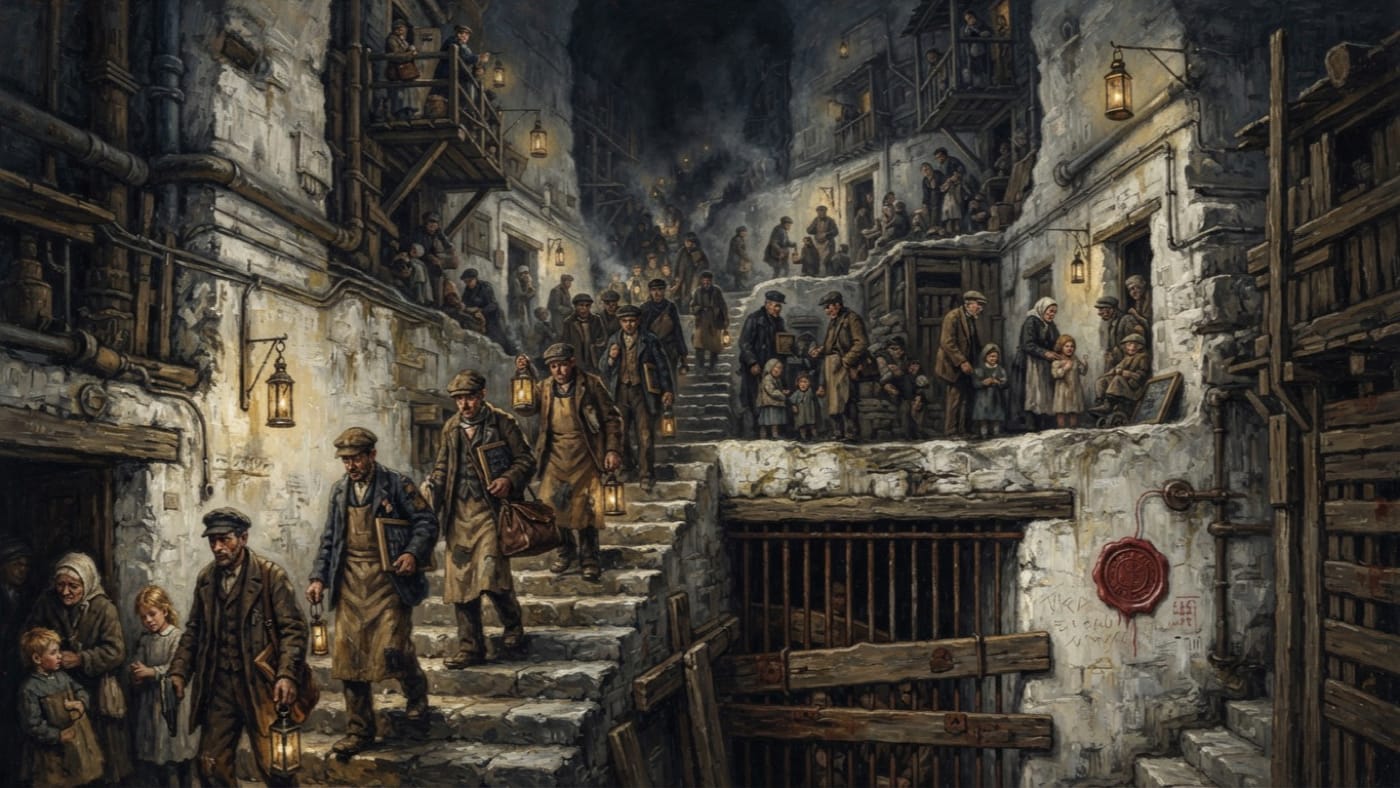
What the files do establish is use. The stair stands in the upper Chalk Warrens, the worker-city cut into the cliff beneath Calais and behind the Chalk Redoubt. It lies near the Crownline lifts and near the lodgings of the Warrens' better-papered households. The Redoubt's register of notable places gives it a single line: a vertical artery, smelling of tar and damp stone, whose recorded hazard is falls. Seal porters climb it with wax, slates and docket strips. People gather on its landings. That is the stair's entire documentary estate. I have catalogued reliquaries with less.
#On the Cuts Beneath the Steps
The Warrens began as pre-Synod quarry chambers, worked for lime, graves and boundary stones by a coast that could make a living from powder. The Synod requisitioned the headland in A.S. 69 / 1779 CE. Between A.S. 69 and 71 the Bureau of War widened the cuts into barracks, workshops, rope stores and shelters for the crews carving the Redoubt's face. The Great Breach of A.S. 71 / 1781 CE flooded the lower cuts, and the labour housing that survived became a permanent defensive population. The miners stayed because the cliff required them. The seal porters stayed because the paper did.
None of those dates belongs to the stair. The files do not say whether its steps were quarrymen's work, Bureau work or a later improvement forced by the traffic of a growing Row. I have found the Warrens' origin, the Breach, the Row's regularisation in A.S. 84 / 1794 CE and the first standardized Wall register. The stair attends all of them the way a back stair attends a cathedral: used daily, mentioned never.
Older Redoubt summaries consulted for this survey place the first writing of the Script Wall in A.S. 83, and imply that the Warrens' reading duties began with it.
Corrected. The Wall first wrote after the Great Breach of A.S. 71. A.S. 83 / 1793 CE is the year of the first standardized reading register. The Warrens owed the Wall throats for twelve years before anyone ruled the columns to count them.
#On Who Lodges Beside It
Order in the Warrens is vertical, and the stair keeps its upper end. The cuts nearest the Lantern Stair and the Crownline lifts house licensed riggers, signal assistants, senior Chalk Scribes, and families holding enough paper to prove they live there on purpose. The middle cuts belong to miners, lime burners, net menders, quarantine porters and Sea-Pass widows who rent dead licences by the bell-hour. Lower still, near the boat tunnels and the old quarry mouths, live the people the census describes with the greatest confidence and the least accuracy.
This is the district's arrangement as the district's file sets it down. It is not a roster of who may climb. I have found no ordinance barring a lime burner from the steps, no toll, no gate and no office of the stair. A miner's wife may climb as freely as a rigger. She climbs past the rigger's lodging on the way, and seeing it was always part of the arrangement.
At the landings the stair becomes a street. The Redoubt's own account lists them among the places the city gathers, with the Net Quays, the Salt Row tea-halls and the chalk taverns of the Warrens. I give no number, height or position for them, because the account gives none. Anyone who has stood in a Calaisian crowd can picture the rest: wet wool, lamp smoke, chalk in the hair, a porter shouldering through with wax that must not cool before it reaches a counter.
#On What Is Carried Up
The stair's one fully attested traffic belongs to Salt Tribunal Row. The Row's clerks begin as apprentice seal porters from the Chalk Warrens, running wax, slates and docket strips up the Lantern Stair. By their third year they can identify forged salt-wax by smell. An apprentice carries the materials of judgement long before he is trusted to read any of them. It is the oldest curriculum the Church possesses, and the only one whose students never fail an examination, since none is ever set.
I keep this traffic carefully apart from the night's evidence. The slate abstracts copied at the Wall travel by a different documented route. Before dawn a Tribunal runner wraps them in waxed cloth and carries them through the runner slit into the Row. No file I hold sends that runner up the Lantern Stair. The porters' slates may be blank, used, or bound for some clerk's desk. The record says slates and nothing more. A reader who wants the stair to be the spine of the Wall's evidence will have to forge the vertebrae.
The Warrens' wider debt climbs all the same. Every household is registered for reading support: lantern carrying, slate running, throat relief, name relay or post-sink quarantine notice. When the Fog Bell strikes three short, one long, three short, those assigned to Wall duty go up with throat oil and salt wax toward a night that may end with a relative's name on the chalk. Warrens folk use the stairs nearest their beds. I do not certify which.
#On the Offices That Do Not Own It
Authority over the stair is authority over everything near it, shared out with Calais's usual generosity toward claimants. The Salt Tribunal checks sea passes and cargo seals. Its wax goes up the steps, and its decisions come down from Seal-Justice Corvin Hald's clean window. The Bell-Gunners enforce signal compliance across the installation. Captain Lute Auvray assigns the reading rosters that send Warrens households toward the Wall. Commander-Prior Sabelle Morn commands the Redoubt. Regional command rests with the Coastal Chapterhouse, alongside the Tribunal and the Gunline Choir. The Chalk Scribes who lodge by the stair copy names and grant nothing. Their authority ends at the slate.
Below all of them works Warden-Doctor Voss of the Undertide Pens. The doctor's dossier observes that nobody living below the Lantern Stair can remember a ruddy face. The doctor records pallor. On no paper I have read does the doctor inspect the stair, order its use or close it.
#On the Two Sealed Cuts
By A.S. 201, chalkscript had appeared in two sealed cuts under the Lantern Stair. The Warrens' file lists them beside Lime Mother, Childcrawl and Silent-Below among the inland surfaces that have begun writing names since inland chalkscript was confirmed in A.S. 199 / 1909 CE. The file says the letters form during fog, oil shortage, Unread arrests and heavy readings. It gives these two cuts no date of first writing, no exact position, no sealing office and no reason for the seal. It does not even say whether they were sealed before the writing came or because of it.
I supply none of it. I will not claim that the stair writes, that its lamps provoke the chalk, or that porters' boots carry letters downward like mud. No mechanism is known, and Doctrine has not pretended otherwise in any file I have seen.
What the report does establish is neighbourhood. The households with the best paper in the Warrens now sleep above two rooms that have learned to spell. The Unread hold that reading feeds the Undertide and that every spoken name is a hook let down into the Channel. I record the belief as theirs and condemn it on the Bureau's schedule. The licensed families on the upper landings hear the same arguments as the widows in the middle cuts. They simply hear them closer to the lifts.
#On the Present Condition
As of this compilation, A.S. 201 / 1911 CE, the Lantern Stair remains in working use under the Amber conditions that govern Calais. Lamp oil is short, so readings run longer and lantern-bearers stand longer on less light. White-lung continues in the rooms beside the steps. The Bureau of Mercy hands out vinegar cloths. Commander-Prior Morn has asked for oil, collapse engineers and quarantine surgeons, and the Chapterhouse ledger lists the request for surgeons as pending. The porters climb.