

#On the Paper That Keeps a Body Warm
This survey of the warm chit was compiled in A.S. 201 / 1911 CE. Its sources are the Boiler Commons holdings, the published Ordnance account, the Heat Allotment Office survey and the record of Ash-Hospice Row. None of them says who printed the first chit or in what winter. I have looked. The Ledger is silent on the matter, and I am silent with it.
What the record does say is enough to hang a household by. The warm chit is the stamped heat credit of Brast. It began as a heat-ration marker issued while the furnaces were expanding, and it did not stay one for long. In the Commons it now passes as wage, rent, savings, fine and bribe, and it settles debts. The street keeps a shorter list: wages, savings and chains.
The dates around the chit are firmer than its own. The coal-seam junction was requisitioned in A.S. 68 / 1778 CE and sung into Chrismole production in A.S. 72 / 1782 CE. Both years fall before the formal Synod of A.S. 90 / 1800 CE, so any Ordnance seal a clerk assigns to those decades is a later office's name laid over an older practice. The first timber halls of the Boiler Commons went up behind Kiln Five in the winter expansion of A.S. 91 / 1801 CE. The Heat Allotment Office dates from A.S. 118 / 1828 CE. Brast rationed heat before that office existed. The record does not say whether the ration took the form of a chit in those first winters.
#On the Face of the Chit
I have no complete official specimen before me. I can certify no dimension, no paper stock, no layout, no denomination and no named issuing officer. Anyone who offers you a full template of the genuine warm chit is offering you a forgery with a lecture attached.
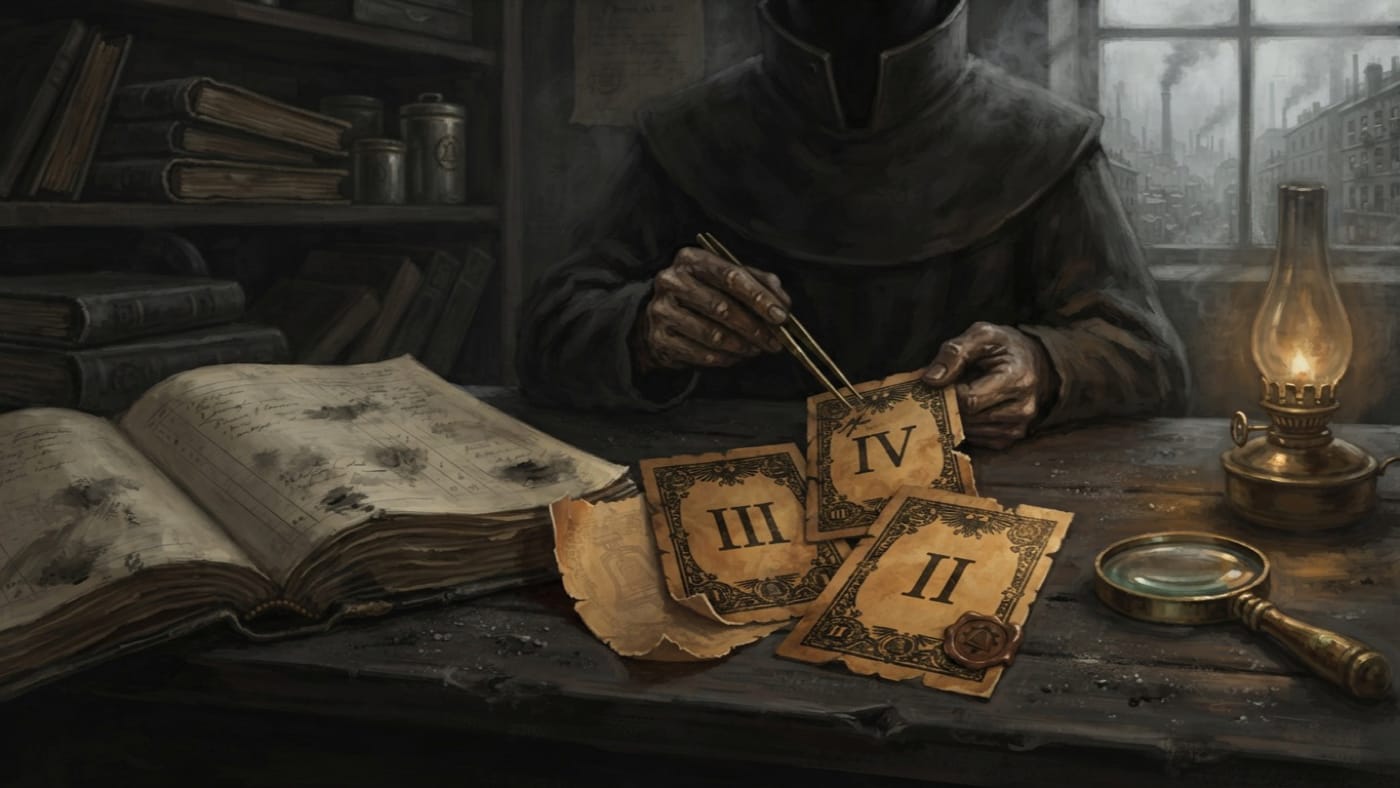
Four features are recorded, and they are recorded by the counterfeiter's standard: what a false chit must imitate in order to pass. The Commons account and the Ordnance account give the same list:
- the Ordnance border;
- the heat-rank numeral;
- the pressure-bell watermark, which shows when the chit is held to the lamp;
- a faint scent of furnace ash in tallow wax.
Provosts mishandle the last of these. By the Commons account, children catch poor fakes faster than provosts do, because children have better noses and fewer promotion incentives. A chit is checked first by the eye, then against the lamp, then by a child's nose. In Brast this counts as procedure.
These four marks are not the whole chit. They are the part forgers have been forced to study, and this survey goes no further than they do.
#On Issue and Allotment
Ordnance prints the chits. Shift foremen hand them out. The Heat Allotment Office administers the allotment the chits stand for. The published office survey is careful on this point, and so am I. No register says that the office prints a chit, counts one by hand, presides over an exchange, or owns every kitchen and rack where a chit is spent.
Allotment begins at the barrack line, where each line receives a pipe quota according to shift value. Furnace feeders get more than slag sorters. Choir technicians get warmth in private rooms and call it housing. The Bureau of Ordnance runs this whole economy of temperature through heat ranks, shift marks and pipe access, and the chit is the form of that government a worker can carry. He holds his rank on paper, folded into his coat.
What the chit buys is recorded in kind, and this survey records it the same way. It buys time beside a heat pipe. It buys a better bunk, or a room whose walls do not sweat ice. It buys broth, a barber's hot water and a place nearer the stacks. Racks are assigned by warmth, rank, shift and debt together. In the ration kitchens, bowls are marked by heat class, labour class and household debt. A kitchen notice copied into the Commons record reads, in part, No second ladle without heat rank. The figure on the paper and the depth of the ladle answer to the same rank.
Other entries print what so many chits once bought at some table in some winter. Those were bargains, and I do not reprint them. Copied here they would look like a tariff, and I have found no published tariff for the chit.
#On Deductions, Renewal and Debt
Allotted warmth can be docked. The Commons account names the occasions. One is a missed bell. Another is lateness, including lateness spent tending a fevered child. A third is a failed inspection, including one failed because soot covered the shift stamp. Each costs warmth. The stamp was there all along, and the warmth is docked anyway.
A household that burns past its allotment falls into heat debt. The Brast holdings name three ways to repay it: overtime, informing and confession. The city survey adds that the Manifest Court publishes the rates and amends them without notice. I hold no copy of those rates and cannot supply one. Commander-Auditor Sorn Vale uses heat debt the way other men use chains. Its victims hold on to it themselves, for fear of freezing.
Heat-allotment renewal appears among the common forms of Brast, alongside the accident confession slip, the tool-issue receipt and the audit summons. That is everything I can certify about it. The holdings give no interval, no signatory, no witness and no penalty for late filing. I have left those lines blank, which is more than the clerks of Brast do with most blank lines.
Debt does not always die with the debtor. The Commons account records that widows inherit debt before blankets. Ash-Hospice Row records that when a worker enters the wards, his family inherits his heat debt, and that the Ash-Hospice Sisters sit at kitchen tables and explain this, slowly, twice. Some wives beg that a husband's confession never reach the accident column, because an accident with a named cause can be charged to his household. Neither account gives a statute, a method of calculation or a means of appeal, and I have not invented one.
#On Counterfeits and the Canteen Press
Every short allotment makes a customer. The Commons account places counterfeit presses in laundry cupboards, boiler seams, shrine boxes, coffin workshops and beneath two official ration kitchens. The Slag Market sells forged chits by the bundle and sorts them into three grades: fakes that fail under lamplight, fakes that pass foremen, and fakes good enough to frighten the Bureau of Records. The Warmth Thieves move counterfeit paper along with their other goods. They are scattered crews and networks. No record makes them the single source of every false chit, and I will not make them one.
The only press described in any detail was taken from under a canteen plank during a sweep by the Manifest Court. The Commons account is plain about it. The border was too heavy. The pressure-bell watermark sat crooked. The ash scent came from rubbing the sheets along the kitchen flue. It would not have fooled a child. It got by because hungry people will accept a bad document when the good ones will not feed them. The account tells us what one bad press got wrong. It specifies nothing else about the genuine article.
Officially, the owner of the press is unknown. A kitchen widow confessed to having it. She withdrew the confession after her son was moved away from the Red-Three fever, then repeated it once his heat allotment doubled. The record keeps all three statements. So does this survey. It names no owner.
The Boiler Commons entry, and the Manifest Court auxiliary filing it reproduces, date the canteen sweep and its seized press to A.S. 201.
Corrected, following the dedicated canteen sweep compilation. A.S. 201 is the year the drums were lost and the year these entries were compiled. The record places the sweep after the loss and gives it no year. The seizure list, press included, is the Court's own account and has not been independently verified.
The sweep went looking for seven drums and found paper. The drums belong to another file, and this survey leaves them there.
#On Heat Paper Elsewhere
Other cities also ration warmth on paper. The resemblance proves nothing about exchange between them.
In Essen-of-Hymnsteel, heat credits are rights to duct-space in the Ash Warrens. A family's place beside a warm vein may rest on a paper chit, a brass tag, a chalk mark, or a spoken tenancy witnessed by enough neighbours to make eviction awkward. The clerks of Ledger Row regulate these credits under Records. No source I hold shows an Essen credit spent in Brast, or a Brast chit honoured under Essen's ducts.
At Bastion-Irongate, the Choir Magistracy assigns voice-licence tiers. The tier governs a resident's access to heat, rations and bunks, and the right to stay inside the mountain. The licence belongs to the voice: it is won at audition and lost on a failed stanza. It is a separate regime of vocal labour and no relation of the warm chit. A Brast feeder keeps his warmth by answering the bell. An Irongate worker keeps his by singing to it.