
#On the Counter-Government
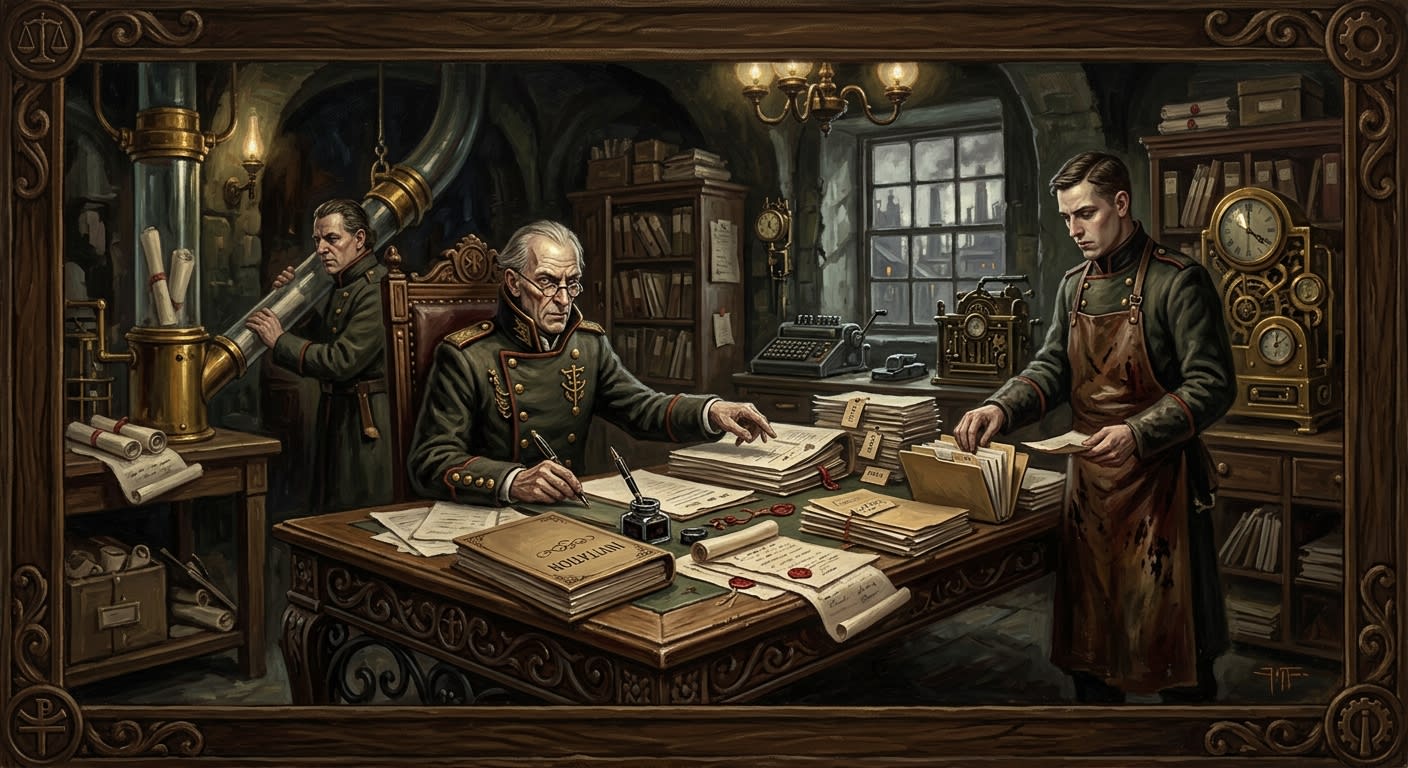
The Anti-Synod is the Shadow Court’s governing apparatus: the corrupted administrative order by which the Great Deceiver parodies the Holy Bureaus, answers decree with invitation, and proves — to the Bureau’s considerable irritation — that damnation can keep minutes.
Do not imagine a rabble of horned magistrates gibbering over a skull-piled table. That is theatre for frontier chapbooks and insufficiently supervised children. The Anti-Synod is worse because it is orderly. It has offices, seals, hearings, auditors, envoys, adjournments, procedural quarrels, and clerks who know where the file has gone. Its evil is not chaos. Its evil is competence without grace.
#On the Counterparts
For every Bureau, the Court maintains a counterpart. The Bureau of Doctrine defines truth; the Anti-Doctrine of the Court offers selected truth at the moment truth will do the most damage. The Bureau of Records files names; the Court unfiles them, removing the ligature between body, memory, and lawful existence. The Bureau of Purity brands sin upon flesh; the Court absolves treason with a smile and leaves the guilt intact for later use.
The Bureau of War commands battalions. Its Court-counterpart arranges refusals: one sentry declining to fire, one quartermaster delaying powder, one captain accepting a truce whose wording contains a tooth. The Bureau of Tithes counts obligation upward toward Strasbourg; the Court counts desire downward into the private cellar where a man stores the thing he will betray for. The Bureau of Bells orders time by peal; the Court rings moments out of sequence until yesterday arrives with papers requiring signature.
The Court-counterpart to Shadows is hardest to name. Shadows withholds. The Anti-Synod reveals. It tells a widow what became of her husband. It tells a clerk which superior destroyed his petition. It tells a village which tithe assessment was inflated to cover a Procurator’s gambling debt. The facts are often correct. Correct fact is the Great Deceiver’s favourite poisoned host.
Earlier Doctrine memoranda called Anti-Synod offices “imaginary reflections with no administrative reality.”
Revised after the A.S. 174 and A.S. 188 debriefs produced compatible descriptions of Court registers, countersigned warrants, and one receipt for a soul not yet born. The receipt remains under Seal Obsidian. Its ink remains wet.
#On Procedure as Temptation
The Anti-Synod governs through invitation. This principle must be hammered into every officer’s skull until even his vanity can recite it under shellfire. The Court does not usually drag a man to damnation. It places a chair before him, sets the pen beside his dominant hand, and waits for him to appreciate the courtesy.
A Synod warrant commands. An Anti-Synod warrant recognises. It tells the deserter he was always free, the thief he was always hungry, the heretic he was always honest, the traitor he was always practical. It transforms failure into identity and identity into office. Men do not merely fall under Anti-Synod jurisdiction. They are appointed to themselves.
SHADOWS FIELD NOTE — A.S. ███ Recovered summons bore the name of Lieutenant █████, then serving at Bastion-Irongate. Charge: “continued loyalty under coercive sanctity.” Verdict entered before hearing: “acquitted upon first refusal.” Lieutenant refused no order for nine months. On the tenth, he opened Gate-Postern Six and asked whether acquittal still counted.
This is the Court’s administrative genius: it replaces sin with paperwork that makes sin feel like delayed recognition. A man signs because the document appears to understand him. Strasbourg understands men as subjects, sinners, soldiers, taxpayers, petitioners, and names. The Anti-Synod understands them as secrets.
#On Efficiency
The Bureau of Doctrine resisted the word efficient for one hundred and twenty-nine pages of internal dispute. The word survived. I dislike it. I also dislike accurate artillery aimed at my office, and yet I record its range.
In certain theatres, the Anti-Synod processes allegiance faster than the Synod processes suspicion. A Synod investigation requires complaint, witness, seal, counter-seal, hearing, review, and enforcement. The Court requires need. Need appears, invitation follows, consent is obtained, and the consequence enters the world already stamped. No queue. No fee schedule. No clerk informing the petitioner that the relevant office is closed for the Feast of Saint Bartleby’s Elbow.
The Court’s swiftness tempts reformers, which is why reformers require watching even when they are correct. A deacon sees a village starve while three Bureaus debate jurisdiction. A Court envoy arrives with grain, names no price, and files no visible claim. The grain is real. The children eat. Six months later the village refuses a levy, not in rebellion but in gratitude to its “other patron.” Gratitude is a chain polished until it resembles jewellery.
The phrase “administrative efficiency in certain operational theatres exceeded the Synod’s own” was originally stricken from the Shadow Court debrief record.
Restored by order of Doctrine, then sealed from general circulation, then cited in three budget petitions, two disciplinary reviews, and one sermon no parishioner was permitted to hear.
#On Counter-Administration
Countermeasure begins with contempt, proceeds through training, and ends in boredom. Contempt alone fails. Soldiers who scoff at enemy papers often read them first, which is how scoffers become exhibits. Training alone fails. A trained officer can still be flattered by a document that knows his childhood nickname. Boredom works best. The faithful clerk who refuses to read unsanctioned writs because the seal lacks approved wax composition has done more for salvation than a hundred poets with clean throats.
All suspect instruments are to be bagged unread, tagged by outer description only, and delivered to the nearest Purity station under bell-cover. No officer may answer a summons naming him in the second person. No chaplain may debate a Court advocate. No Records clerk may check whether an unfiled name was ever registered without a second clerk holding the first clerk’s sleeve.
The Anti-Synod remains active wherever the Court’s influence thickens: beyond the Sagittal Line, in contested villages, in dreams after intercepted unhymns, in captured ledgers, and in those moments when a citizen discovers that Strasbourg’s answer will take six weeks while Hell’s answer has arrived before breakfast.