

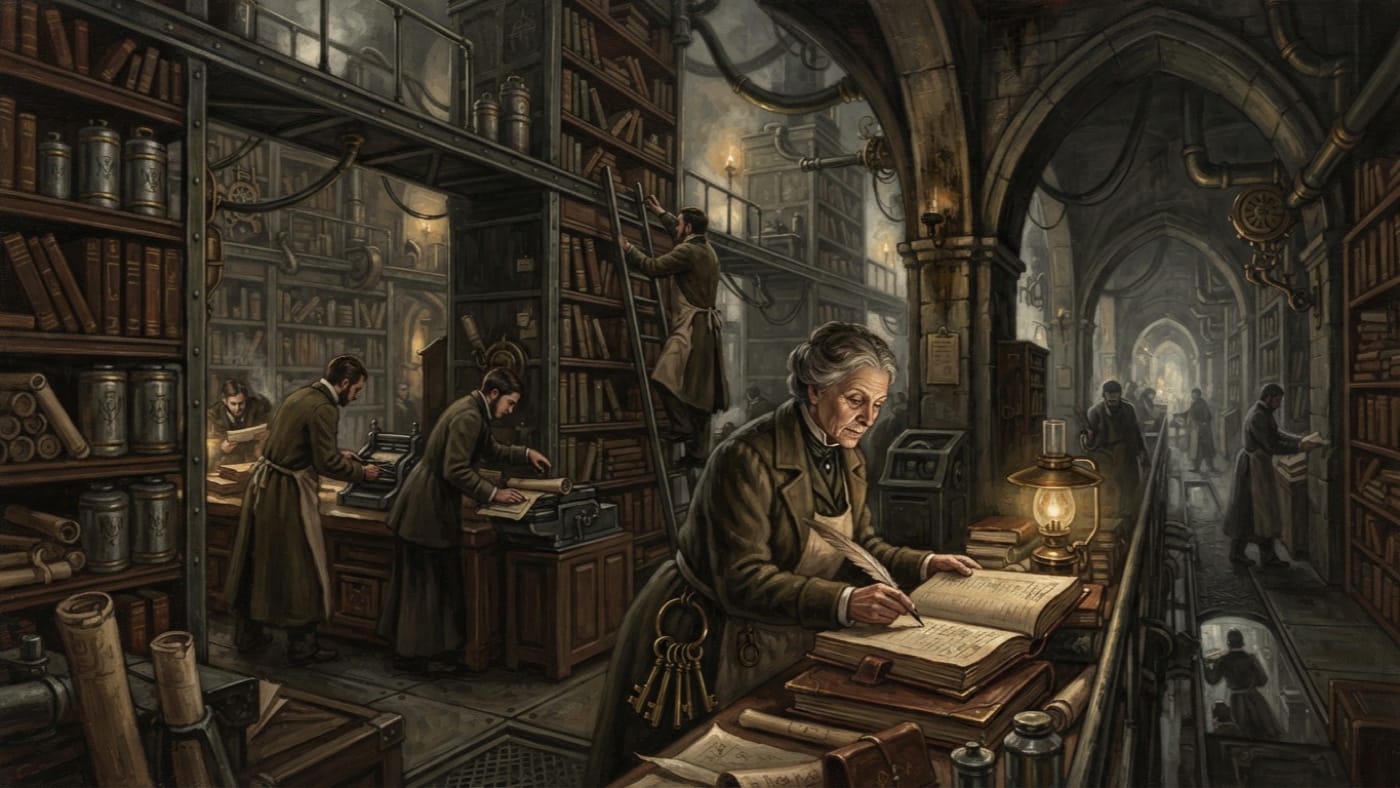
#On the Work of the Record
This survey is a present documentary compilation, made in A.S. 201, 1911 by the old reckoning, for the Bureau of Doctrine. It founds nothing. It records who can be shown from sealed files to be doing archival work this year, and under which roof. A reader hoping for a charter of the Archivists, a grand master, a headcount, or a ladder of ranks rising from novice copyist to some mitred Keeper of All Paper will find none of these. None has been produced to me, and I asked in the tone that usually produces things.
Archivists are a profession, and the profession has no guild. Each one answers to their own institution, their own keys and their own superior, and they meet one another mostly in correspondence, where they are rude.
The work is narrower than its reputation and worse. The Bureau of Records keeps births, baptisms, deaths, confessions, tithes and changes in legal standing as entries, copies, indexes and custody. A quartermaster checks the entry before he issues a ration. A paymaster checks it before he pays arrears, a priest before he marries two people or buries one, a gate sergeant before he lets anyone through. When two entries disagree, someone has to decide which one the office will recognise. The consequence then follows that decision with all the sentiment of a loaded cart going downhill. That someone is the archivist.
I hold office inside this machinery as Archivist of the Bureau of Doctrine and Warden of the Sacred Ledger. Neither title makes me master of Records or a Chief Archivist, and Records corrects anyone who suggests otherwise with a speed I would admire in any other department.
#On Copies Declared Original
The profession learned its most consequential habit on a chalk ridge near Strasbourg. In A.S. 96, six years after the Concordat, Records took over a Benedictine ruin as the Hollow-Script Scriptorium of Nemea and filled it with the continent's quarrels: census rolls that counted the same households differently, martyr lists, and command records that promoted the dead. Its first Abbot-Registrar, Solene of Lyon, could read six languages and trusted no document written in any of them.
Her answer was original by ratification. A corrected copy, once witnessed and sealed, became the operative record, and legal consequence followed from it instead of from the older papers it outranked. The wagon-master Odran Pell shows how it worked. Tax ledgers had him alive, troop rolls had him dead, and a tribunal copy had him as a deserter. Solene called witnesses, his sister among them. She declared him dead, paid his arrears and voided the desertion. Three offices had held three different Pells. Once the seal went on, every office held the same one, and the army's debt to him could finally be collected.
Solene died at her copying desk after forty sleepless days, within the founding cycle her dossier records. Her final page remains sealed. I have not seen it, and this survey does not need it.
In A.S. 103 fire took the west scriptorium wing and half the novice dormitories. Books had to be rebuilt from fragments and from the memories of survivors, and the rebuilt records were in their turn declared original by ratification. Families went missing from the new books. Clerks argued over whether a remembered household was a witness or a counterfeit, and where nobody could swear to it, no entry was made. I record the absences. I do not record their cause, because the files that could settle the question are the files that burned.
Draft heading for this section: "On the Fire That Made the Doctrine."
Struck. Solene ratified originals before the west wing burned, and the Pell case is hers. The fire took a practice for settling contradictions and widened it to cover reconstructing what had been lost. A heading that blurs the two gives the fire credit it has not earned.
Custody at Nemea now belongs to another Abbot-Registrar. Maelen Voss holds the Chapterhouse seal and the vault keys, and she decides who may see an original. She shares a title with Solene and a surname with Alzen Voss of the Burnless Archive. Neither coincidence proves anything. I have seen genealogies built on less, by men who were later promoted.
#On Registers and Their Readers
There is more than one way into the work. The Academy of Strasbourg, whose post-Concordat form is attested by A.S. 90, is the best documented. The Synod needed archivists who could catch a falsehood written by educated men, so the Academy taught accounts, records discipline and liturgical chronology. Its examiners gave students two contradictory parish registers and expected a single answer. That is one training house. It confers no credential the continent must honour, and nobody at the Steppe Gate has ever asked to see one.
Comparing registers assumes there are at least two entries to compare. The Academy's own files contain the case where that assumption failed. In A.S. 187 a lecturer filed a seminar note calling the Silent Colonnade folklore of no administrative consequence. The attendance register afterwards listed him as absent from his own birth and from each milestone after it. His name remains sealed. The file names no clerk as the author of the entry, and I name none.
No method taught in Strasbourg reconciles a man with a register that records him as absent from his own beginning. Since A.S. 188 the methods course has opened with a corrected rule carved above the lectern. The examiners still set two registers. They no longer promise that both will contain the student.
#On Custody
Some archivists rarely correct anything. Their trade is keeping. Under the Steppe Gate, at the Burnless Archive, the Paper Keepers shelve, cross-reference and audit treaty and court records in eight-hour shifts, and they check for pages that were not there the day before. They are a guild with a compact of their own. They are not clergy and hold no Synod rank. Theirs is one guild among the people this survey counts, and nobody else is a member.
In A.S. 143, during the Year of Ash Rain, the Bureau of Alchemical Standards subjected the Archive's folios to fire, acid, water and grinding, and the folios outlasted every test. The Classification Ladder filed the vault's phenomena under Category Two, thermal and scribal, and handed the Archive back to its keepers with advice on humidity. The classification went into a drawer in Strasbourg. The folios stayed at the Gate with the people who have to dust them. Classifying a thing and keeping it are separate duties, and only one of them comes with a cistern and four hours of daylight a week.
From A.S. 194 the quarterly audits began to turn up the Living Addenda, folios matching no index entry and written in ink still wet when found. In A.S. 199 the rubbing of the Third Stone's southern face was missing at audit. Its place on the shelf holds a blank folio with wet ink. Paper Keeper Seld lifts that folio to his lantern every morning, looks for text and finds none. The Archive's own literature says its paper does not leave. The rubbing's absence says something else. I enter both statements and reconcile neither. Theft, consumption, departure and any future inscription remain unproven, and Seld remains at his post.
Keth holds custody of another kind under another roof. She has been Archivist of the Bead Vault at the Cloister of Miscounted Beads since A.S. 182 and is still active. Her authority covers case discipline, evidence entry, access to the lower cabinets and the summoning of anomaly officers. The Cloister's clearance seals belong to Prior-Scribe Erem Vale, not to her. She keeps confiscated pilgrim strings. She has none of Nemea's originals and none of the Gate's treaties, and she has never been asked to declare a bead original. Sounds reported from the cases appear in the file as reports, and I leave them there.
#On Authority and Reports
One archival title does carry a defined power, and the definition is tight. Under Administrative Dissolution the originating Bureau requests a Dissolution Writ on Form 77-D, a Chief Archivist of at least Third Rank countersigns it, and an assigned scribe performs the strike. The year the office was founded is undocumented. So is the full ladder of ranks, including which way it climbs. No other office in this survey has been shown to carry a numbered rank. That includes Nemea's Abbot-Registrar, Seld and Keth. The countersignature makes the Chief Archivist party to an erasure. It does not make every archivist an erasure officer, however much the provinces enjoy believing it.
The best records outside an archive are sometimes kept by people with no archival office at all. In A.S. 199 Sgt. Kollar of the 14th Garrison logged three Self-Devoured from Observation Post Sigma-7: position held, cycle unchanged, no external aggression, continued non-engagement recommended. I have written before that soldiers are sometimes better archivists than specialists. I meant it as praise for the entry. Kollar is no archivist, the garrison is no archival corps, and Father Dressler's chaplaincy is no Records appointment. The ninety-second limit on observation and the ban on leather log covers belong to Sigma-7 and should stay there. Kollar's entry is worth copying for its manners. A sergeant who leaves out adjectives deserves no credential for it.
This compilation closes as it opened: a survey of A.S. 201 / 1911 CE that records archival work wherever a named institution attests it. It establishes no charter, no guild of guilds and no count of practitioners. Solene's desk, Maelen Voss's keys, Seld's lantern, Keth's cabinets and the Chief Archivist's countersignature each belong to their own house and are filed under it.