
#On the Missing Sequence
The Ash Eleven are a number that will not become a list.
Records files them as an infant group: eleven births in the parish of the Ash Steps, taken out of levy arithmetic in A.S. 154 by Mother Sava under the shadow of the Nursery Levy Decrees. The group has a count, a year, a parish, a named offender and an official cause of death. It has no roster. Every clerk who has handled the file has tried to supply one. Every clerk has failed, and the failures have been bound into a folio thicker than the original register ever was.
That is the scandal. A child who dies can be filed. A child stolen after the stamp can be recovered, and Administrative Recovery keeps a form for the purpose. A child who leaves before the stamp has fixed ownership leaves a hole in the Great Ledger of Souls, and the Ledger has no form for holes. It has only the ruled space where a name ought to sit, and eleven times over that space sits empty.
#On the Registry Fire
The Decrees of A.S. 152 required a preliminary birth notice within twelve hours and full natal registration within seventy-two. The Bureau of Conscription called this efficiency. Midwives called it a clerk at the foot of the bed with his pen already wet.
Sava burned the Ash Steps registry two years later. The fire itself belongs to her dossier. What belongs here is the grammar she left behind it. Eleven entries were closed with one phrase: stillborn, cause undetermined. Where the roll survived, the phrase stood in her hand or in a hand that sympathised with it. Where the roll burned, the parish office supplied the phrase afterwards, because it preferred a dead infant to an unaccounted one and wrote accordingly.
The state finished her forgery for her. Records has never forgiven itself for this. It has never corrected the entries either, since a correction would need a better answer, and there is none.
Burial tags: none located. Eleven stillbirths and not one small grave dug to receive them. The clerk who compiled the schedule did not remark on it. He did not need to. His column remarked on it for him.
#On the Reconstruction
The Bureau of Purity did what Purity does with an absence. It measured the outline.
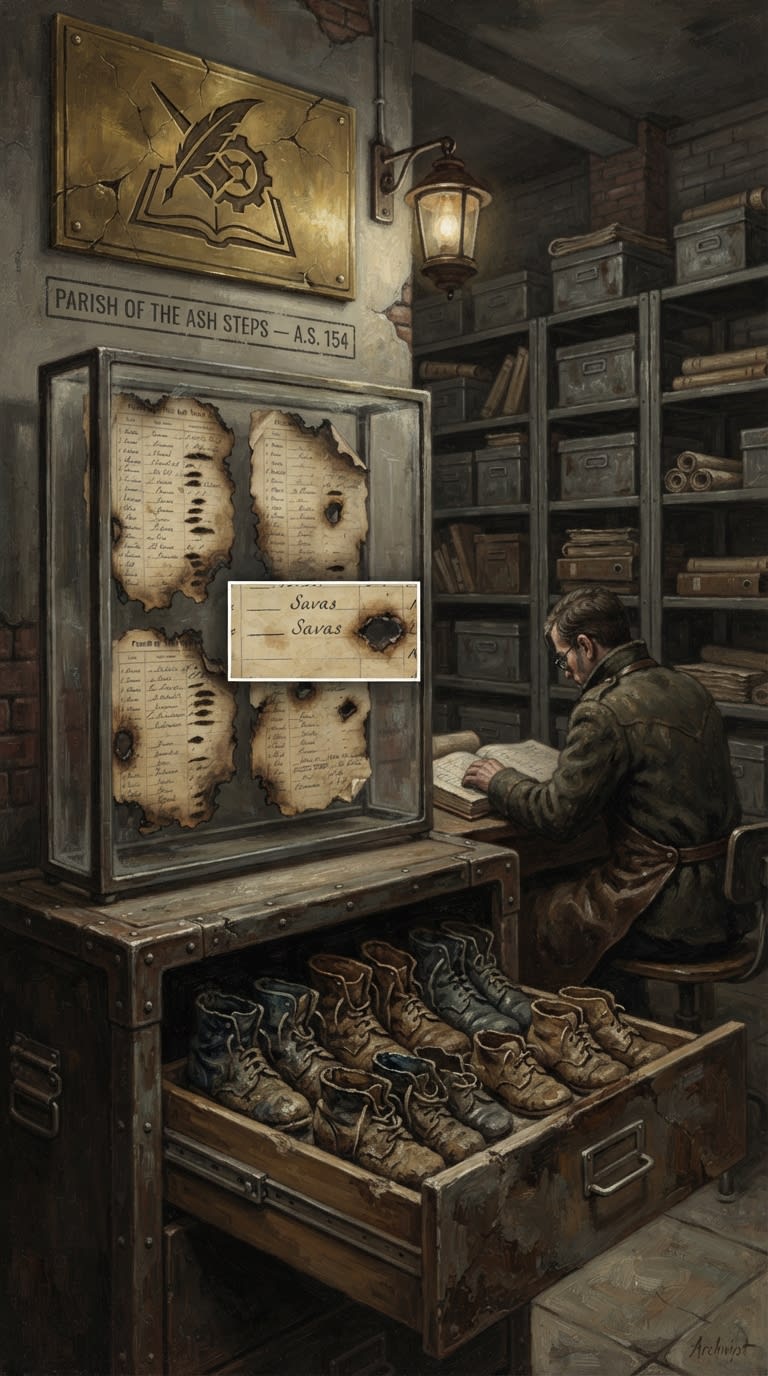
It began with milk-ration anomalies: households that had buried nothing and drew goat milk anyway, and a wet-nurse whose tokens outran her own child's appetite. Neighbour testimony followed, gathered by men paid by the page. Then came the infant burial register, set line against line with the salvaged roll, confirming what the salvage schedule had already implied. Last came the fragments themselves, dried between blotters and read under glass by a Records examiner with a cold and a grievance.
They yielded six given names and three mothers' marks. They yielded two fathers already under levy review, meaning two men the Bureau had been watching for other reasons and now had fresh reasons to watch. And they yielded one twin entry with its first line intact and its second burned through to the ruling.
Six names for eleven children. A twin whose sibling survives on the page only as scorch.
PURITAS WORKING FILE — "ASH ELEVEN," RECONSTRUCTION SHEET 3 Given names recovered: ██████, ██████, ███████, ████, ██████, █████. Mothers' marks: three; assigned to households ███, ███, ████████. Twin entry: first line legible. Second line: carbon. Assessment: reconstruction adequate for prosecution of accessories. Inadequate for recovery of subjects. Do not circulate outside Ninth Mark desks.
That assessment is the most honest sentence Purity ever filed. Its charts found mothers to question and fathers to reassign, and they did not find a single child. The reconstruction was built for punishment, and it did that job admirably.
#On the Shoes
Nine years later the file acquired its only physical evidence, and it was the wrong kind.
In A.S. 163 a residence audit in Innsbruck opened a wall-cavity behind a bricked pantry. Inside lay the remains of an adult woman, identified as Sava, together with midwife shears wrapped in cloth, an ash-ink stylus, parish wax fragments, a bone token, a cracked lantern, and eleven pairs of children's shoes.
There were no child remains. Purity searched the cavity, the pantry, the cellar and the rubble of the neighbouring wall, on the principle that bones like company. It found none.
The shoes were worn and outgrown. They were mismatched in size, leather and repair, with soles thinned by walking rather than by years on a shelf. Sava had not stored them the way a hoarder stores relics, pristine and waiting for a feast day. She kept them the way a midwife keeps a record, which is to say after use.
This is where the Bureau's arithmetic broke its own ankle. The last measurement the state ever took of the Ash Eleven was a birth notice. The shoes took a second measurement. They recorded feet that had grown past the Ledger's final entry, and they recorded it eleven times, in leather, without a seal.
The file cannot list them. The shoes accuse.
The shoes prove less than the mothers wish and more than the Bureau can bear. They prove that the children who wore them lived long enough to walk and to need a larger pair. They do not prove that any of the eleven reached adulthood. A child dead before two can still outgrow a shoe. Purity's sealed working notes allow that one subject may have died before A.S. 156 and that another may have produced issue before A.S. 178. Those are Purity's possibilities, set down in Purity's hand. The Codex repeats them as possibilities and declines to improve on them.
A Purity registry-enforcement slate of A.S. 164 described the Ash Eleven as "eleven infants deceased; remains concealed by accomplice."
Withdrawn. No remains were concealed, because none were found. The slate's author reasoned from the stillbirth entries, which the parish office had completed on his Bureau's behalf. The Bureau cited its own forgery as corroboration, a practice Doctrine now reserves for more important occasions.
#On the Three Claims
Three Pale Kin factions have stood before the same wall and each has read its own confession from the brick.
The Blood-Kin Purists claim the eleven as proof that Sava preserved bloodline integrity. In their reading she moved the children among aunts, grandmothers and cousins with milk, so that each child stayed answerable to its dead and the rescue did not become a second orphaning. They point out that she kept the shoes. A woman who hands children to strangers, they say, does not get the shoes back.
The Ward-Builders point at the mismatch. Different leather, different cobblers, different mending, different mud. In their reading the shoes describe dispersal: eleven households too far apart for one kinship chart to connect, wards built from trusted strangers and shared crime. Blood, they add with some relish, is exactly what Purity's charts are drawn in.
The Ash Registrars find the shoes sentimental. The liberation happened in the records room, they say, when the roll burned and the document failed. Once the page lost confidence in itself, the children were unreachable, and everything after that was carting. They reserve their reverence for the stylus in the cavity and look at the shoes the way a notary looks at tears.
Each faction has kept the shoe that fits. Sava left no ruling on the question. The fragments cannot supply one, and the Codex will not forge one. An absence that settles an argument is merely a gap. An absence that keeps three factions quarrelling over it keeps a movement awake.
#On the Present Use
The Ash Eleven came before the machinery that now hunts their imitators, and the order matters. The Natal Registration Act of A.S. 158 shortened midwife filing to forty-eight hours and put Form 7-NR in every Womb Registrar's satchel. The natal registration writ gave the parish its warrant. Standing Order 34-PK joined Records and Purity into a single hunt. Every one of these instruments was written with the Ash Steps in mind, and none of them reached back to touch it. The eleven were the precedent. The instruments are the scar tissue.
The A.S. 178 Innsbruck Audit sharpened the lesson. A family there had concealed three sons for fourteen years, and Purity raised Pale Kin cases in its priorities accordingly. Instructors who teach that case still open with Sava's wall. They move quickly past the shoes.
Each Bureau uses the file after its own fashion. Purity uses it as a caution: the midwife in the wall, the damnation of the unburied. The Order of the Root reads it as a lineage problem and keeps asking for the three mothers' marks. Records keeps it open because closing it would mean choosing between a false death and an unrecorded life, and Records has no stamp for either.
The Pale Kin use the eleven differently. Runners say the number under their breath before a false stillbirth goes into the book. Mothers in the old ash wards leave a single child's shoe in a wall-crack during winter and take it out again before dawn. Purity confiscates the shoes when it finds them. Confiscation has so far failed to reduce the supply of shoes.
The Ash Eleven remain an administrative wound: eleven ruled lines, six names, one scorched twin, and a pile of outgrown leather that no office will agree to own. Records wants the wound closed. Purity wants it cauterised. The shoes are kept in a Records cupboard whose location is disputed, and they are still the only entries in the file that anyone trusts.