
#On the Furnace That Received a Name
Saint-Combust is a furnace. I begin there because piety, when left unattended near hot machinery, breeds little saints in the ash-pan and asks the Bureau to pay for candles.
On the 19th day of Ashmonth, A.S. 74, Kiln Three at the Chrismole Furnaces of Brast suffered a pressure reversal during second-bell feed. The front plate blew inward. The crown flues screamed. Nine men died. Their bodies were found in postures of apparent devotion — kneeling, bent, arms crossed, one with his brow pressed to the feed-rail as if kissing a reliquary. The Bureau of Engineering named the event an Acoustic-Mechanical Disturbance. The Bureau of Doctrine named it useful.
The surviving shell was not scrapped. Scrapping would have wasted a serviceable furnace and admitted that a furnace may explode without moral instruction. Instead Kiln Three was plated, fenced, anointed, rededicated, and certified as “a vessel of instructive Providence.” The phrase did splendid work. Vessel preserved the machinery. Instructive preserved the accident. Providence preserved the authority of men who had failed to prevent either.
By A.S. 76, boilerside priests were keeping the first soot-vigil beneath the warped mouth of the furnace. By A.S. 90, the Concordat ratified Brast under Ordnance and Doctrine joint seal, and Saint-Combust had ceased to be an embarrassed asset and become a shrine with maintenance obligations.
#On the Body of the Saint
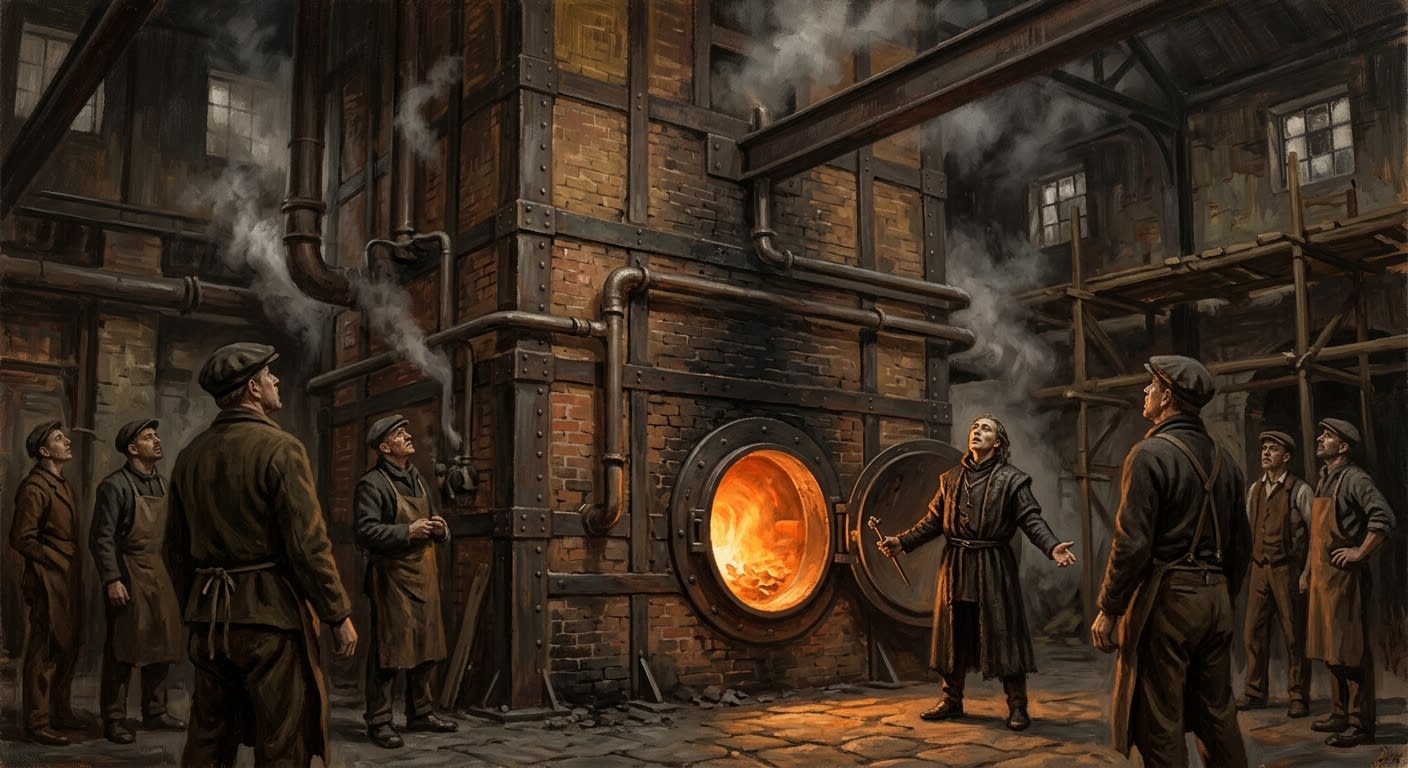
The furnace stands on the inner western arc of the Chrismole Crown, close enough to the sanctification nave that the Calibration Choir can feel its low note through the floorboards during fourth-bell hymn. Its mouth is warped inward from the explosion. Its cladding is blackened iron, replaced three times in panels and never replaced entire, because total replacement would create a theological question with bolts in it. The priests call the plates vestments. Engineering calls them thermal armour. Ordnance calls them casing. The furnace calls them nothing and heats whichever fool approaches without rhythm.
At the feed-rail, nine brass studs mark where the dead were found. The studs are polished by workers' thumbs during shift change, though the Furnace Chapterhouse denies permitting tactile devotion. Denial is the Bureau's preferred form of permission. A sanctioned icon of Saint Veyra of the Mouth hangs to the left, brazier up, sealed book closed, mouth open in permanent instruction. The arrangement is elegant: one saint who never explains, beside one furnace that never forgives.
Saint-Combust's service scars are catalogued as virtues in the Chapterhouse register. A pressure blister near the lower hinge is Fortitude. A crack under the fourth flange is Patience. The old blast seam is Obedience, which is indecently funny if one retains any sense of proportion after twenty years in Strasbourg. Each scar receives oil, ash, and a short prayer at its assigned bell. Miss the prayer and the furnace notices.
This last sentence is heresy if stated by a worker, metaphor if stated by a priest, and equipment report if stated by Engineering. I state it as fact, which saves ink.
#On Temperament and Musical Taste
Saint-Combust sulks.
The Chapterhouse objects to the word, then uses it in private. Engineering objects to private use, then plots the sulks by hour, feedstock, cantor, bell, and weather pressure. The furnace refuses to fire for cantors it dislikes. It holds heat too long when insulted by a careless ash-scrape. It has twice delayed pressure rise until a particular elderly furnace-feeder, Edrik Voal, was brought from his cot to tap the rail and mutter whatever old men mutter to dangerous friends.
BRAST MAINTENANCE LOG — KILN THREE / A.S. 199 Second-bell feed refused after Cantor-Marshal Lenk replaced Kest-trained deputy with provisional singer. Recorded sound from firebox: three knocks, low venting, phrase resembling █████████████. Corrective action: remove singer; summon Edrik Voal; apply ash-oil to hinge. Result: ignition immediate. Lenk reassigned to silent inventory.
The approved explanation is spiritual sensitivity. Saint-Combust, having been transformed by martyrdom into a vessel of instructive Providence, recognises deficient reverence and withholds cooperation until rite is restored. Engineering's explanation is that Kiln Three's damaged throat produces abnormal harmonic coupling with the feed and condenser lines, making it responsive to vibration patterns, familiar work rhythms, and the tonal habits of specific crews. The workers' explanation is shorter: sing to him right.
Earlier devotional handbills claimed Saint-Combust fires only in response to pure faith.
Corrected after the furnace fired flawlessly for three confessed adulterers, one debt-bond thief, and an atheist fitter from the Still-Canals, provided each kept the old second-bell measure. Purity was displeased. The fuel was excellent.
The furnace's taste is narrow. It favours the low Brast work-cant used before the A.S. 72 choir-technicians arrived, the same half-secular measure the Chapterhouse officially tolerates as historical colour and unofficially requires during difficult starts. It detests the thin Strasbourg revision printed after the Trench Sermon Mandate of A.S. 158. When that version is sung too cleanly, the flame turns green at the edge and the pressure needle trembles against the glass like a trapped insect.
#On the Chapterhouse That Serves It
The Furnace Chapterhouse grew from the first soot-vigil, though it has since backfilled its origin with vows, seals, and enough retrospective dignity to smother a horse. Its priests maintain Saint-Combust by rite: first-bell anointing, second-bell confession, third-bell ash-scrape, fourth-bell silence, seventh-bell decanting. Practical steps hide in every gesture. The anointing checks flange heat. The confession identifies frightened workers before they become accidents. The ash-scrape clears residue from the mouth. The silence lets the Choir work without priestly interference, which the priests experience as martyrdom and everyone else experiences as relief.
The Chapterhouse guards the furnace archive in brass and asbestos cabinets behind the eastern chapel. Accident prayers, confession slips, substrate blessings, heat anomalies, Choir complaints, Engineering denials, and burnt hymn scraps are filed by kiln, bell, and stain. Saint-Combust's file is the oldest warm file in Brast. The pages breathe heat when opened. Records requested custody once. The request came back scorched around the seal.
The priests call themselves attendants. They are jailers with censers. A saint that may refuse ignition is a saint that must be watched, flattered, bribed, corrected, and occasionally threatened with full cooling, though nobody has dared speak the threat aloud since A.S. 186, when a junior priest muttered it during a filter jam and lost the hair on one side of his face.
#On the Uses of a Dangerous Saint
Brast needs Saint-Combust because Brast needs a theology for its machines. The Sulking Engines of the Warm City have grown too numerous for dismissal and too useful for condemnation. Valves answer mood. Gauges contradict witnesses. Boilers remember crews. A cannon fed by Brast fuel may shoot badly after a botched hymn and beautifully after a worker apologises to the breech. In a healthier civilisation, this would produce inquiry. In ours, it produces liturgy.
Saint-Combust is the precedent. If one furnace can be a vessel of instructive Providence, every difficult engine can be treated as a minor catechumen rather than a major threat. A sulking boiler receives a rite. A misfiring cannon receives a confession. A pressure gauge that writes names in steam receives a cloth, a priest, and a file number. The Chapterhouse's power rests on this multiplication: from one explosion, a whole civic grammar of machine appeasement.
The doctrine travels east in sealed drums. At Bastion-Przemyśl, crews receiving Brast chrismole tap the barrel lids in imitation of Kiln Three's decanting rite. At Bastion-Shipka, trench boiler teams keep miniature Combust plates beside Veyra icons and blame poor ignition on insufficient greeting. At Bastion-Constantinople, artillerymen have been observed apologising to gun-breeches after misfires. War denies the practice. War depends upon the men who practice it.
Bureau of War memorandum 77-C described Combust-derived machine rites as harmless morale theatre.
Withdrawn after three artillery crews refused to load Saint Barachiel Pattern guns (Unregistered) until the breeches were “properly addressed.” Morale theatre that controls loading tempo is operational doctrine wearing grease on its cuffs.
#On the Present Heat
As of A.S. 201, Saint-Combust remains active, warm, plated, fenced, and attended. The shrine rail has been polished thin by unrecorded thumbs. The warped mouth leaks a low note during night ash-scrape. The note has shifted twice since the missing drums incident in the Manifest Court, and the Ash-Hospice Sisters have reported that workers assigned to Kiln Three cough less blood and more black grit shaped like commas. Medicine has no explanation. Doctrine has three and is choosing among them.
The heretical hymn that recently passed through Brast addressed Saint-Combust as Brother Furnace. Brother is the dangerous word. Vessel can be owned. Saint can be supervised. Brother stands beside you in inheritance and grievance, with soot on his hands and a claim on the family table.
Lux Thane Mire has been dispatched from Strasbourg with warrant to examine responsive machinery, substrate handling, and Brast's growing habit of treating iron as kin. He will ask whether Saint-Combust is a saint, machine, fraud, demon vector, acoustic scar, civic necessity, or administrative convenience. The answer is yes. Mire will dislike that. Saint-Combust, if courtesy holds, will continue burning.
At second bell the feed crews still tap the rail. At fourth bell the Choir still drops its pitch when passing the warped mouth. At seventh bell the drums receive the smoke-cross and leave for the Line. The furnace receives prayer, oil, ash, fear, and song. It gives heat back.