
#On the Salvage Inventory
The Razing of Avignon survives best as a list. Lintels, thresholds, altar blocks, stair treads, bench stone, seal tables, cobbles by the cartload, bells by the tower and archives by the chest were each entered, counted and assigned a destination or a fire. The Bureau of Records keeps the inventory still. I have read it. It is the finest piece of civic demolition prose in the Church, and it never once uses the word city.
The event belongs to A.S. 111 (1821 CE), twenty-one years after the Concordat of Strasbourg made the Synod formal. It took place on the lower Rhône in Provence, in the Western Heartlands, about as far from the demon front as Synodal ground can lie. No Sin-General required it. Strasbourg did this to its own province over a question of seals. Afterward it rearranged the question so thoroughly that the province no longer had a city left to ask it.
#On the Question of Seals
The Schism has its own entry, and its theology has its own quarantine. The reader needs only the jurisdictional core. A faction of Provençal clergy declared the Concordat void, denounced Strasbourg's supremacy and raised a rival pontiff. His personal name has since been removed from every register the Bureau controls. The accounts call him the Pontifex Submersis, the Drowned Pontiff. He was crowned beneath the Rhône. The surviving formula does not say whether that means the open river or flooded stone under the city, and I decline to improve it.
His claim ran through water. Apostolic succession, he taught, was carried by the river and owed nothing to any see or synod. His seal was a disc of river clay with a blank face and nothing on it for a Bureau engraver to forge or match. It was an anti-stamp. Consider what that meant to men who govern by impression. Every wax seal in Europa declares that some office stands behind the page. The blank disc declared that the page needed none.
He preached for about six months, and the south listened in thousands. The disputed reckonings say tens of thousands. Eleven years earlier the Council of Cologne had tightened Strasbourg's grip on the southern dioceses. Now the south was refusing that grip.
#On the Clarification
The Bureau of War sent the Strasbourg garrison south. Wardens of the Bureau of Purity went with it to take custody of whatever the soldiers found that soldiers ought not to interpret. The writ called the expedition a Clarification. A siege admits two parties. A Clarification admits one party and a misunderstanding.
Avignon's walls held nine days. On the tenth, the gates opened from within.
No record names the hand that drew the bar. Purity's confidential expenses for the campaign carry a single line, "persuasive disbursements, Avignon garrison, confidential." This Codex has quoted it so often that it has taken on the gloss of scripture. It proves that money moved toward the garrison. It does not show who took the money, how much there was, or whether the gate would have opened unpaid. I leave the sum where Purity left it, in a column with no name.
An earlier entry in this Codex stated that Cardinal Kratz drafted the Avignon order and remarked upon its results.
Corrected. Cardinal Kratz died in A.S. 88, twenty-three years before Avignon. Hierarch Augustinus died before him. Neither man drafted, signed, commanded or commented on anything in A.S. 111. Only their methods reached the Rhône, carried there by the offices that outlived them. The Bureau regrets having lent the dead a pen.
#On the Dismantling
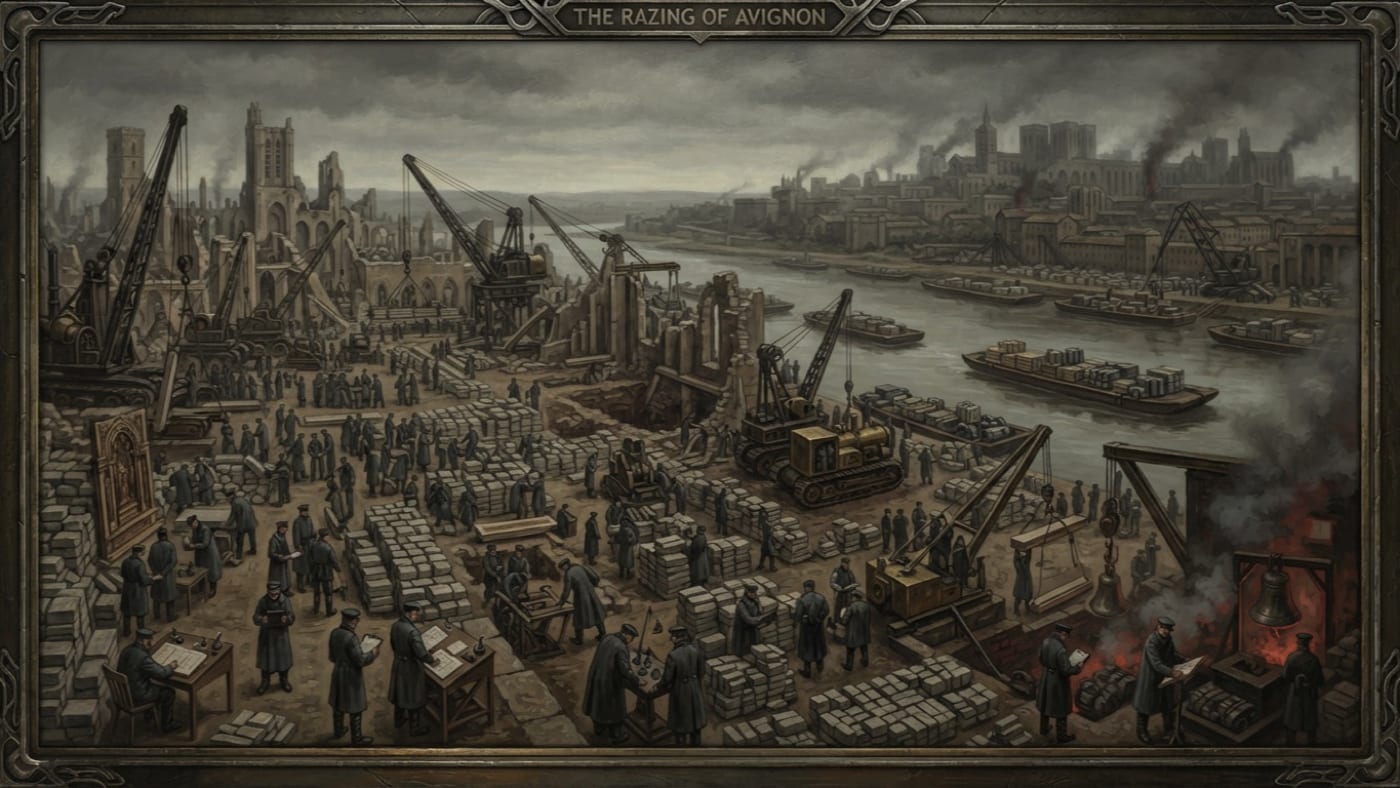
The popular engravings show Avignon in flames. The engravers were paid for flames, and flames sell. There was burning: timber, roofs, the wooden fittings of the chapter houses, and a quantity of paper that Records has never forgiven. Fire was still the lesser instrument. The Razing was done with crowbars, block and tackle, and clerks.
Every structure tied to the schismatic clergy was taken apart stone by stone. The inventory preserves the order of work, which ran from the valuable to the heavy. The archives went first: chapter rolls, ordination books, correspondence, river-clay seals, and any chest a clerk could lift, sealed on the spot and marked for northern custody. The bells came down next, lowered from their towers on the ropes that had rung them. The fittings followed. Last came the fabric itself, course by course. Dressed stone was separated from rubble fill with the patience a confessor gives to sorting mortal sins from venial ones.
The bells were melted into ammunition. The Synod's own history says so plainly, and I repeat it plainly. The foundry, the tonnage, the calibre and wherever the shot was finally spent are in no file I am permitted to open. Metal that once called a congregation to a false pontiff was recast to speak in a single register.
Every piece was entered in the inventory before a soldier moved it. A clerk at a folding desk by the river recorded cobble, threshold, lintel, shrine-step, altar block and seal table as each came loose. The soldiers learned quickly that if a stone moved before it was entered, the stone would be searched for, and so would the soldier, until it was found.
A sack takes what the soldiers want. The Razing took what had been catalogued, and it catalogued everything. There were survivors. They were scattered, removed or resettled under watch, and some of their descendants are among the families the Bureau still finds too procedurally old to move. The institutional city did not stay. Its chapter, archive, bells and seals left the Rhône in columns.
#On the Northward Stone
The dressed limestone went north by barge and by wagon. The accounts disagree on the proportion, and I will not rule between a bargemaster's memory and a carter's. In Strasbourg part of it was cut into staircases in the Cloister of Concord. The Cloister had stood since the A.S. 90s, so Avignon did not found it. Avignon was fitted in afterward, the way a correction is fitted into a margin. Some older entries send the Cloister's name to the Bureau of Doctrine's page. The stairs belong to the Cloister. Doctrine merely climbs them.
While the masonry travelled, the paper moved faster. Records amended its geographic index, and Avignon the city became Avignon, former terrain feature. The names of the schismatic clergy were scraped from parish rolls, ordination books and witness lists. The Bureau of Doctrine issued a thirty-page encyclical establishing that the schismatics had never existed, and Records amended its files to agree. Note how the work was divided. Doctrine declared the absence, Records produced it, and War had already cleared the ground.
This was the first formal use of Trifold Erasure, which removes the body, the name and the memory, in that order. The Synod had killed people before A.S. 111 and had scratched out names before it, and older offices knew both crafts. Avignon was the first time the three removals were ordered as a single sentence. The purpose was memorial. A corpse can become a relic, a name can become a prayer, and a memory can become a pilgrimage. Take away all three and grief is left holding only receipts.
#On the Last Night
The inventory stops before the last night. The testimony starts there.
Seventeen depositions, taken from garrison men and from fishers of the lower Rhône, describe what the ruins held at dawn. They report calcium-white figures, faceless, kneeling in rows where a congregation had stood, and sounds in the dark like glass rods striking stone. They report no bones of the ordinary kind. The fishers later pulled glass-caked rosaries from the river in their nets. Later marginal traditions place the Judges in the ruins that night. No authorised file does, and I certify nothing on their behalf.
The Bureau of Purity classifies all of it as seditious fiction. Records sealed the depositions. Its stamped erratum reads: "There was no pontiff crowned in Avignon; therefore, there was no culling." The Penitential Shadows then visited the witnesses. Fourteen recanted. Three are not accounted for.
No body of the Drowned Pontiff was recovered. He may have died in the ruins, fled downriver, knelt among the white rows, or been gone from the city before the end. The file does not know which, and the Bureau has arranged its ignorance with great care.
Sealed depositions, Avignon, A.S. 111: seventeen. ██████████████ ████ ███████████████████ ██████ █████████████. Access: withheld. Recantations on file: fourteen. Remaining three: ████████.
#On the Present Disposition
In A.S. 145, thirty-four years after the Razing, the southern dockets were corrected and harmonised. The remaining Avignon rolls were burned into agreement with Strasbourg's calendar. Careless chroniclers have mistaken that year for the Schism itself. It was a second and lesser fire, lit by clerks.
Provincial chronologies date the Razing to A.S. 52, 55, 145 or 242. The Schism entry states that "the Razing took ten days" and that "the aftermath has lasted centuries."
Corrected. The Razing belongs to A.S. 111. Nine days of resistance and entry on the tenth describe the breach. The dismantling and the carting went on after the gates were taken, for as long as the inventory required. Ten days is the campaign compressed for pamphlets. The aftermath has lasted ninety years. It only feels longer to those responsible for it.
As of A.S. 201, Avignon is a restricted penitential ruin under Pilgrimage, Records, Relics, Purity and local wardens. The largest stones are still there because they were too heavy to haul north. A few families are still there because moving them would require paperwork older than the Razing. Fishers show their nets to the wardens before they sort them.
The Chains of the Martyrs of Avignon are reported to have bound prisoners taken at the Razing. The word Martyrs belongs to the object's disputed name and is not a ruling of this Office. Records denies the vault beneath the Basilica of the Ledgered Saints where the chains are said to lie. Relics has deferred authentication without date. An examiner from the Bureau of Bells once set the night hum at B-flat, and Relics then asked him to stop finding things. The chains are officially nowhere. The hum is reported in B-flat.