
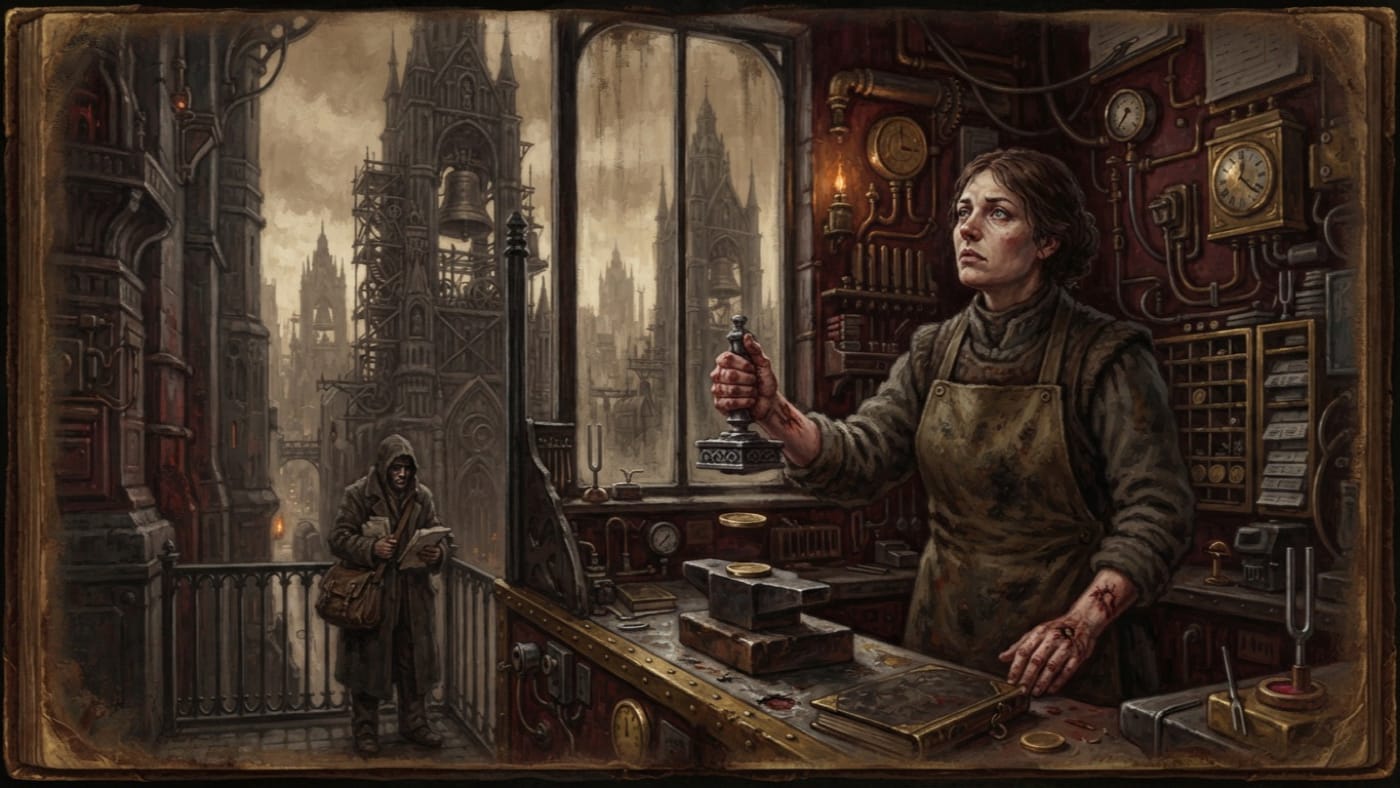
#On the Interval
"The bench waits for the bell." — Stamp-chapel saying, unattributed, and for once nobody has tried to attribute it to a saint.
The Route-Stampers call it a bell-eclipse. In their usage it means one of the intervals between canonical hours when the city's bells fall silent. That is the whole of the definition, and I give it exactly as the trade gives it. They publish no timetable for it. No clock face in any stamp-chapel marks it, no Bureau circular lists its hours, and nobody holds a founding date for it, though I looked. A smith knows an eclipse has begun because the bells have stopped. Anyone with ears could say as much, and yet in the trade it is the one thing about a bench that nobody argues over.
The rule attached to it is short. During a bell-eclipse, no token is stamped.
The rule does not tell the smith to leave the forge, stop speaking, or put down the wax. Nothing in it closes the pacing lane or the gate, and nothing in it touches the ledger. It forbids one act, the strike of the die on the blank, and forbids it absolutely. I have seen smiths whose whole family history is written in brass burns across their thumbs keep hold of a die in mid-air with their eyes on the chapel window, waiting to hear something that has not yet come.
Doctrine has not recognised the taboo. Statute does not enforce it. Every smith I have met keeps it all the same, and in a profession that exists to turn movement into obedience, that gap between what the Synod requires and what the trade actually does is worth writing down.
#On the Refusal to Stamp
To see why the moment of the strike matters, you have to know what the strike makes.
An indulgence-token, as I recorded in my survey of the Route-Stamper trade, is a palm-sized piece of brass carrying a traveller's identity, route, serial and permitted movement, all bound to an audible bell-hour. The work goes in a fixed order. The smith checks identity and eligibility. The master die strikes the crest and the serial is bound to its line on the ledger-board. A sliver of consecrated bell-metal is seated in wax and wire and tuned to the cadence of the route's Bellway. Red wax seals it. The last step is the walk-test in the shop's pacing lane, where a Tuner paces the lane with the token to confirm that it tolls true at the expected stride.
Every one of those steps involves sound. The smith strikes the tuning fork once at the start of shift, never twice. The core is set against a note. The finished token is judged by ear, and only the ear can pass it. A trade that lives this much by listening does not like to work while the city says nothing.
The strike is the point at which a blank brass disc becomes a permission. Before it, the smith has a slug of metal and a queue. After it, there is a serial in the ledger, a person bound to it and a route that will answer to it. The smiths hold that a token made while the bells are silent "walks into the wrong world." I have written the phrase down exactly as they say it. They will not define the wrong world and I will not do it for them. I asked several of them what the words meant, and each looked at the die in their hand instead of at me.
What the smith does during the silence is ordinary work. Wax warms. Blanks come out of their lots of fifty. A Serial Clerk may go on copying names. The finished tokens hang in the rack, already struck and already sworn to. When the bells come back the die comes down again, and the queue at the iron rail moves up by one.
#On the Bureaus' Judgement
The Synod's offices have looked at the matter and, as they always do, split it between themselves.
The Bureau of Doctrine classifies the taboo as superstition. That settles its theological standing, and the Bureau considers nothing else about it worth settling. Doctrine does not tell the smiths to stamp during the silence. It simply records that their reason for refusing counts for nothing. The two positions sit side by side in the archive and neither Bureau has asked the other to reconcile them.
The Bureau of Bells calls the taboo "unconfirmed operational guidance." I admire the phrase very much. The Office of Bells was constituted in A.S. 52, and the current Bell Codex standard was ratified in A.S. 115. Neither text says whether a token struck in silence differs in any way from one struck under the hour. By its own wording, the Bureau of Bells has neither confirmed the guidance nor withdrawn it. It has not claimed the guidance as its own either.
The Bureau of Commerce holds the charter that licenses the trade. It measures a forge in tokens per hour, and it could have taken the silence as an insult to its figures. So far as I can find, it has issued no instruction on the matter. The Bureau of Records binds and audits every serial and keeps its veto over every forge. It can shut a bench for drift, for forgery or for no reason given. It has never shut one for refusing to stamp during an eclipse. The obvious explanation is that nobody has ever stamped during one and so nobody has ever had to explain doing it.
A smith who breaks the rule therefore breaks no statute and commits no heresy. She takes nothing from any Bureau's revenue. She only makes a token her whole trade believes to be wrong, and then she has to stand at the kiosk window and hand it to a stranger. No Bureau has claimed the liability for that token, so it stays with the hand that struck it.
The Route-Stamper survey stated that the profession was chartered under Commerce after the Great Counterfeit Winter.
The Commerce Charter dates from A.S. 114. The Great Counterfeit Winter came about A.S. 160, and after it came the purge. The Hieromnemon regrets reversing the two. The Bureau of Records regrets nothing, as usual.
#On Silence and Its Interpretations
The Synod has many kinds of silence, and the trade keeps them in separate ledgers.
A dead token is silent because its core has drifted, cracked or been swapped. That is a fault in the object, and the remedy is to melt it. The midnight quiet-box test is a separate thing again. In the sealed chamber at Rheinscarp, where I sat once, a Calibrator rejected a token for a sound he called "wet" and said that something had answered. The Bureau of Engineering puts after-midnight variation down to temperature drift. The smiths put it down to what is listening. Either way, that test concerns a finished token heard in a sealed room after midnight. Nothing in it touches the strike, and I found nothing that makes midnight an eclipse hour.
The Silent-Core Crew make silence on purpose. Their cores pass a visual inspection and produce no toll a gate warden can hear, which is useful to deserters and smugglers. The Crew are criminals and their muting is a separate crime. I found no evidence that a token muted in a cellar was ever struck during an eclipse, and none that muting makes a token safe from one.
Then there are the Bellwardens, who keep the city's acoustic infrastructure in order and treat a failed peal as a breach condition. They log each deviation and seal it. Among themselves they say "silence is a door." That saying belongs to their towers and their failed peals, and I would not lend it to the stamp-chapels, who have their own proverb and keep it better.
The factions disagree on nearly everything else. The Cadence Purists tune only to the Bells' published harmonics. The Route Pragmatists retune for fog, river-fords and mountain roads. The Silent-Core Crew tune to nothing that can be heard. Each faction thinks the others are heretics, incompetents or both. On the eclipse, all three wait. None claims an exemption and none offers a theory of the wrong world. The trade venerates Saint Cadrin the Measured, whose approved vita of A.S. 112 has him counting steps round a besieged city, and the smiths would give him credit for anything. Even so, nobody credits him with the rule.
#On Waiting for Permission
While the bells are silent, the queue does not go anywhere.
Behind the iron rail at any gate kiosk wait the people the token system was built to sort: pilgrims for the pilgrim roads, couriers with sealed satchels, merchants whose convoys are already parked in the yard, and conscript columns under orders to move. None of them can walk a licensed road without a token, and none of their tokens can be struck until the bells return. However short an eclipse is, it happens at a counter where a person is waiting to be allowed to leave.
That follows from the system itself. I have no stranded family to lay before you and no lost convoy, and I will not invent one for the sake of the prose. The mechanism is enough. A smith decides who moves, and then waits for the city to speak before deciding it. The Gate Prefect sends a runner and the runner is told to listen. Commerce counts the empty minutes. Records will log the delay in the ordinary way, as a delay.
The smith who waits is holding two duties at once. One is to make a token that does not lie. The other is to let the traveller go. Doctrine has ruled that the first does not depend on the bells. The smiths have ruled that it does. The traveller at the rail has no part in either ruling and keeps his papers in his hand.