
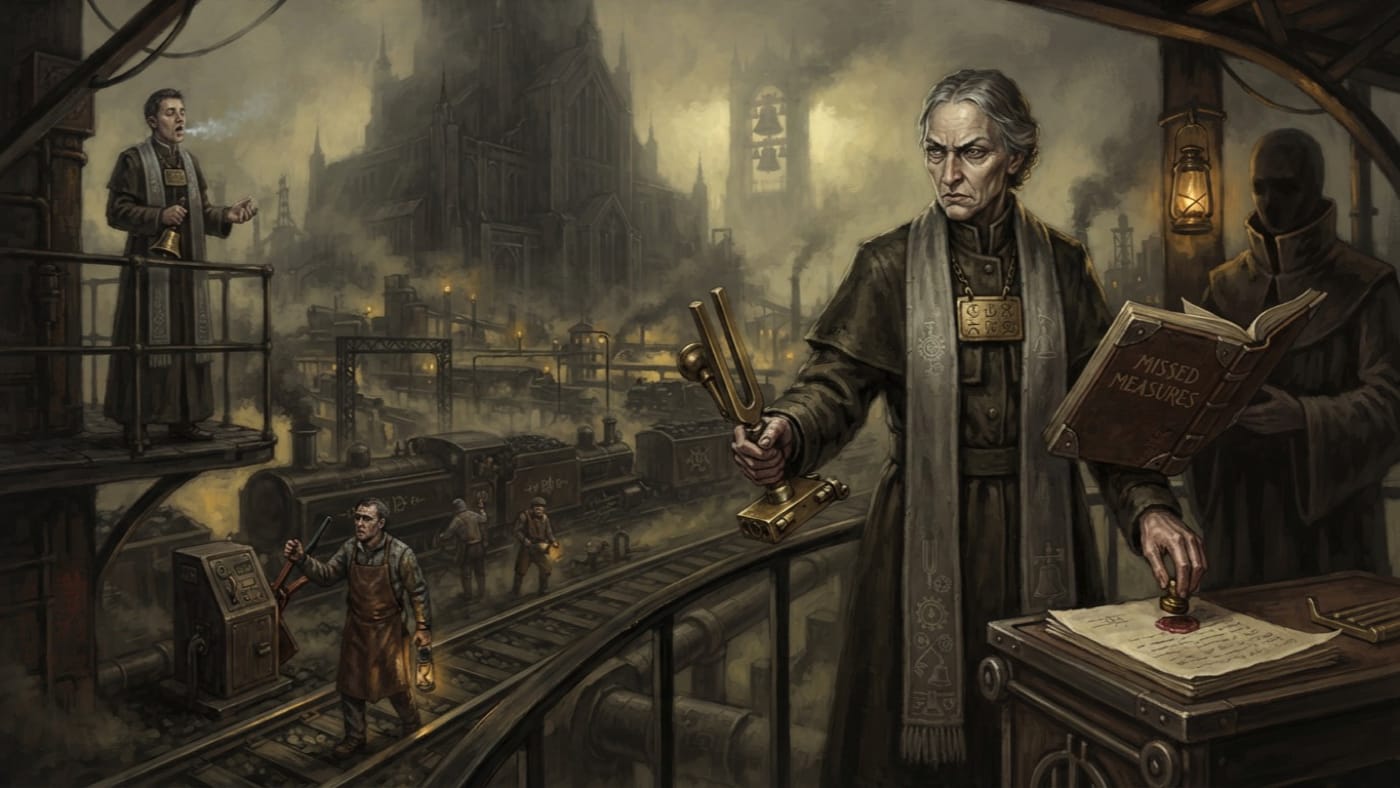
#On the Marshal's Station
The Palatine Switchyard of Lorn is governed by three chairs set under one roof of soot. Palatine Yard Command seats the Yard Palatine, who decides which train goes first; the Records Prefect, who decides whether that train, its cargo and its crew exist; and the Bell Marshal, who decides whether the motion was lawful. Odrin Kessel holds the first chair and wants throughput. Prefect Halden Wry of the Bureau of Records holds the second and wants every name legible. The third chair currently belongs to Sister-Calder. She has a voice like a saw, and she wants the measure kept. She also keeps a book of everyone who failed to keep it.
The Marshal commands no regiment, owns no track and holds no master-manifest seal. Her instrument is certification. A cantor sings a route code only under her license. A switch moves only after a licensed voice has sung. Once something goes wrong, the accident becomes a question of whose measure failed, and Lorn's paperwork knows only one way to ask it. Twelve rail lines converge on the city and feed the Sagittal Line by way of every ledger that matters. Each of them passes through her book.
#On the Settlement After the Derailment
Bells governed the Church long before they governed Lorn. The Office of Bells was constituted in A.S. 52, when the formal Synod was still a draft in several bishops' drawers. The Bureau of Bells matured under the constitutional settlement of A.S. 90, and the current Bell Codex was ratified in A.S. 115. None of these is the Marshal's birthday. The Bureau of War requisitioned Lorn in A.S. 104 from a market town whose name the Ledger declined to keep. By A.S. 110 the yard was dispatching seven hundred trains a day under arrangements that were, by later standards, practically conversational.
Then came A.S. 112 and the Silent Derailment. Forty-one men died on a siding the manifests denied existed, against a slag wall the manifests had no grounds to deny. The official lesson arrived before the bodies were counted: no switch would thereafter be thrown without a voiced measure. Singing became mandatory procedure. The Bell Marshal system was installed in the aftermath. The Bureau's own folios decline to fix that date, and I will not fix it for them.
The catastrophe that made the Marshal also made her opposition. The Switchmen's Union counts its useful birth from the same forty-one bodies. It had burial funds by A.S. 113 and oath funds by A.S. 115. By A.S. 119 it had enforcers, route books and widow stipends. From one wreck Lorn built a choir and a grievance, and both have been singing ever since.
Bureau of Bells digest, A.S. 148: the Switchmen's Union is "an auxiliary workforce formed under Cantor supervision."
Retracted. The Union has never accepted Cantor supervision and answers the phrase with its fists. This retraction does not make every cantor in Lorn younger than the Union. The clerk simply wished the hierarchy ran the way his digest drew it.
#On Certification and Accident Guilt
The Marshal's working arm is the Cantor Corps, a bell guild with doctrinal manners. It is quartered along Cantor Walk, where the halls smell equally of incense and machine oil. Sister-Calder holds one hundred and twelve certified cantors. They wear ash stoles and brass throat tags, and they occupy the switch towers and the platforms above the fog. Their creed is short enough to engrave on the tag: bell-time is truth, and safe motion is sung motion.
Reduced to its stations, a lawful movement in Lorn runs like this. The Manifest Basilica grants the train permission to exist and to go somewhere. Under the Dispatch Litany, a licensed voice sings the route code, and every departure line sings its own. A hand at the points throws the switch. Then a record is made of what was sung, what was thrown and what arrived. The Marshal owns the second station outright and casts a long liturgical shadow over the fourth. She cannot stand at the lever, press the Records seal or send a provost anywhere. She can certify that the song was correct. In Lorn that is very nearly the same as certifying who is to blame.
The rituals do the rest. At the Bolt-Blessing a cantor lays a waxed glove on the switch housing. At the Silence Measure the whole yard holds one breath at the midnight bell. The Accident Confession is held in the Safety Booths of the Basilica. There a crew confesses its errors so that Records may forgive them back into work, and each confession is fastened to the man's employment license like a burr to a coat. Bell fees, certification fees and safety fines follow the confession the way the plate follows the sermon.
When an unsung offence reaches the Yard Tribunal, the Marshal supplies the tonal record, the safety inquisitors supply the questions and the provost patrols supply the iron. The court fastens oath-collars on repeat offenders. The Marshal never does it with her own hand, and she keeps that distinction with great care, because it lets her stay clean while the iron closes. The yard's propaganda proclaims that Procedure is mercy and Mercy is sound. It also proclaims that compliant operation prevents accidents. The first claim is theology. The second is a lie, and this office files it under that heading.
#On the Hand That Refuses
A cantor on a platform is a voice. A switchman at the points is a body within reach of moving iron, and iron does not read certificates. The Marshal's whole authority depends on men she holds in contempt. They must do exactly what she sings, at the moment she sings it, in coal fog thick enough to hide a train until it arrives. The Thrown Hand understands this better than any Bureau does. Its oldest article is carried in the wrists and has never been written down: the hand that throws may refuse if the hymn is false.
Every accident in Lorn is contested between two libraries. Sister-Calder keeps the Missed Measures, a record of those who sang late, sang flat or threw unsung. The Union keeps the Crushed Book, bound in black oilcloth and updated in Cinderrow after midnight. It lists workers killed after correct hymns and correct orders. Each book proves its keeper's theory. If the measure was missed, the worker erred. If the measure was perfect and the man died anyway, procedure failed. The Tribunal must choose a library, and the choice has always carried a wage.
Cinderrow testimony from A.S. 200 records the dispute at its plainest. Switchman Roel Tamm lost both legs under a munitions bogie routed by a certified dispatch hymn. Nobody in the Corps has called the hymn faulty. Tamm's legs are entered in the Crushed Book. Sister-Calder has not said whether his name appears among the Missed Measures.
The Union answers with delay: caution intervals, second inspections, and witness disputes over which tower sang which measure and who heard it. Some of this saves lives. Some of it is bargaining, timed by stopwatch and backed by a widow's fund. The solidarity fines levied on any man who throws during a declared interval are as coercive as anything Cantor Walk charges. The Marshal can license every throat in Lorn, yet no license of hers can move a single wrist.
#On the Measure That Answers Wrong
The office would be easier to judge if the Hymn-Phase Slip were a fraud. It is a localized acoustic-mechanical disturbance, classified once and never reclassified. Its recorded signs are these. A switch is thrown clean and sets wrong. An echo returns a measure late. Manifests smear as though wet. Crews swear the yard briefly became a place they did not know. Doctrine files the Silent Derailment as a large Slip event involving the late answer of Tower Nine. Ask a local "Which tower answers?" and the reply is "Nine — late." The Hush Tunnel Runners read the same lamp-talk from below and charge for the translation.
The Corps answers with double-canting, two voices on one route. Housings are wax-sealed, salt goes down on tower steps, and a quiet minute is kept before the Needle. Some of these measures help some of the time, and none is certified to help every time. The same wax that seals a housing also hides tampering, which the yard calls wax-sweat.
What the Slip will not do is respect the Marshal's books. A hymn performed correctly can still produce a wrong route. Each time that happens, the Missed Measures lose an argument and the Crushed Book gains a name. I make no pronouncement on the cause. The cause is under audit, and I value my seal.
#On the Present Certification
The Payroll Spur has been bleeding since A.S. 199. Crates scanned twice and stamped once arrive nowhere. Kessel answers with audits. Wry answers with corrected manifests. Sister-Calder answers with tonal records showing every hymn was sung as written. Each document is valid, and together they add up to a hole.
The Thrown Hand has planned a citywide slowdown for A.S. 201. Its complaints are cantor overreach, rising fees, and attempts to charge switchmen for accidents caused by sung procedure. The slowdown has not begun. Inquisitor-Regent Veyl Hark has been dispatched from Strasbourg with emergency authority under the eye of Purity, to audit Tower Nine's bell codes and open the Payroll Spur logs. She has not arrived. Lorn waits on both of these at once, like a train held at the Needle with its fire banked.
When she does arrive, the Inquisitor-Regent will ask the question the office was built to settle. If the hymn was correct, the hand obeyed and the yard still chose wrong, who signs for the dead? The Marshal certifies songs. Records certifies paper. Kessel certifies schedules. The forty-one men under the slag wall certified nothing, and the Creator has never been consulted on route codes. Yard gossip already predicts that if the Marshal's credibility breaks, Lorn will get a revolt of silent procedure or a harder hand from the Synod. I record the gossip and endorse neither outcome.