
#On the Book Under Glass
The Black Ledger of Ghent is a book. I begin with that plain fact because thieves have taken the name, and a stolen word has to go back to its owner before anyone argues about the thieves.
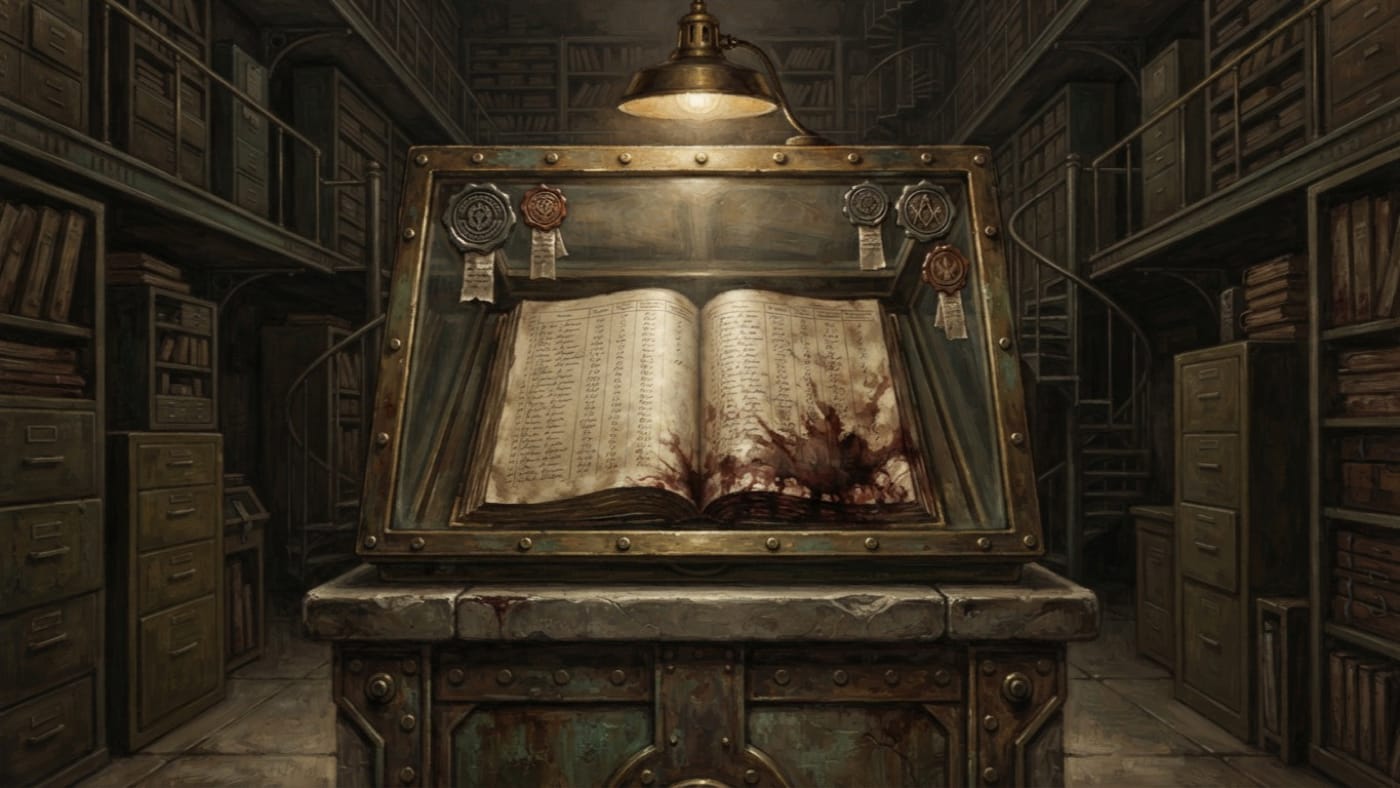
It is a confessional weigh-station ledger, ruled in columns and kept in a clerk's hand at a station in Ghent. It was seized in A.S. 159 and carried to Strasbourg, where it lies in a sealed case. Its vellum has gone stiff. The ink on its final pages has run into itself, the way ink runs when something wet reaches the page faster than a blotter can. The criminal Black Ledger that robs ration carts borrowed the title. The second books its Ledgerwrights keep in cellars are imitations of the original, and they have no claim on it. The original belongs to the Church, which has never been asked to explain it in public.
The Church keeps the book. It keeps the stain as well. It also keeps a word for the stain, and the word is wrong.
#On the Corrective Weight
A confessional weigh-station unites two scales that lesser institutions keep apart. The sack goes on the pan and the soldier kneels beside it. He confesses, and the clerk adjusts the counterweights according to the recorded assessment of his repentance. A sufficient confession lightens the load. An insufficient one adds to it. Doctrine teaches that the scale reports the soul and the soldier carries the report. Soldiers on the road tell stranger stories about their loads. This Codex records that they tell them and certifies nothing about Ghent on their account.
In A.S. 159 an inquisitor discovered that the clerk at the Ghent station had been falsifying the burden-weights. Men who paid him marched lighter. The rest carried the full catechetical load and were never told that their neighbours had bought relief. The sources do not preserve the clerk's name or the inquisitor's. I have looked. Neither Records nor Doctrine has troubled to remember the two men whose arithmetic decided the day.
One hundred thirty-seven soldiers passed through that station in a single day. When the fraud came to light, all one hundred thirty-seven were executed. Their bodies were stacked on the weighing scales as corrective weight.
The surviving account does not separate the men who bribed the clerk from the men who only stood in his queue. Separating them would have meant asking each man whether he had paid. Asking would have admitted that the scale could be bought one penitent at a time, and an instrument that can be bought one man at a time is an instrument with a price list. The judgment fell on the whole day's record instead. I read the sentence as a repair to the scale's reputation, carried out on the men who had stood on it. Doctrine has never offered me a better reading, and I have never asked for one in writing.
#On the Columns of Faith
The book has four columns, and I have admired them for longer than is pastorally appropriate.
The first holds the man's name. The second holds his supposed burden, the load his confession was meant to earn. The third holds his actual burden, the load he carried out of the station. The fourth holds the differential, expressed in ounces of faith found wanting. Someone ruled that last column, either the clerk while he still felt safe or the inquisitor during the audit. The book does not sign it, and I decline to guess for it.
These columns are the best-kept record of an atrocity the Church owns. Every man is named and every load is entered. The differential sits against each name like a verdict entered before the trial. The clerk falsified the weights, but whoever kept the columns kept them faithfully, and their fidelity is the problem. A forged ledger can be burned with an easy conscience. An accurate one has to be kept, and the next man to open it reads exactly what was done and to how many.
Records could not have asked for a cleaner specimen. Doctrine could not have asked for a worse one.
Then there are the final pages. The archivist who showed them to me called the blurring water damage. I have handled water-damaged vellum by the cartload. It cockles, softens and smells of cellar. These pages have set hard, like a scab. I told the archivist nothing, and the archivist did not press the point. Our courtesy was complete and our accuracy was nil, and the archive's catalogue still says water.
This Codex previously stated, in its entry on the Black Ledger Cutpurse / Assassin, that the blood soaked through the vellum "a century and a half ago."
Corrected. The incident is dated A.S. 159 and the present year is A.S. 201, so the blood is forty-two years old. A century and a half would have made the stain someone else's ancestors' business. Forty-two years puts it within living memory, and some of the people who remember it still draw a Synod pension.
#On the Name Taken by Thieves
The modern criminal network adopted the title deliberately. No surviving record shows when it did so or by what ceremony, if there was a ceremony at all. The bureaus' claims about older antecedents disagree. The Bureau of Shadows traces criminal ancestors to a Rhineland ration freeze around A.S. 112. The Bureau of Purity claims the network is older than the Concordat. Both are claims about what came before the name. Whatever crawled in the gutters earlier, the name came later, because the name belongs to Ghent and Ghent's book.
As propaganda, the choice is very good, and I say so with professional resentment. A thief who calls himself a thief recruits other thieves. A thief who names himself after the day the Church executed a whole queue over a clerk's arithmetic recruits the queue. Every widow in a ration line understands the story without reading a word of it. The Bureau supplied the atrocity, the artefact and the title. The criminals only had to pick them up.
They picked them up for a reason. The network's second books turn assistance into obligation. A loaf goes into the book as debt, a hidden cousin goes in as a claim, and silence is entered and collected later. The station book did the same work under a holier seal. It took a man's confession, turned it into a number, and turned the number into a claim on his back. When the numbers failed, it made a claim on his body. Both kinds of ledger take a person's circumstances, write them down, and present the writing as a right over the person.
The network's factions each find something in the book. The Theatres love the story. The Accountants love the columns. The Knives love the precedent that a whole queue may answer for one man's sum. That none of these readings is charitable should surprise nobody.
The resemblance does not make the criminals merciful. Nor does it make the hundred and thirty-seven guilty. It makes the book instructive, and I have never forgiven it for that.
#On Preservation and Permitted Reading
The cutpurse entry places the case in the Forbidden Stacks at Strasbourg, and I place it there with the same confidence, having stood in front of it. What follows describes the Stacks in general and does not certify a chain of custody for this one volume. The Bureau of Silence holds the repository. Records and Doctrine set their co-seals on it. Purity keeps its rights of inspection, which it uses whenever it feels unloved. The book sits on the Forbidden shelf, which is a different shelf from Seal Obsidian. The book is disturbing, but being disturbing is not a classification. If the archive filed everything that disturbed it under Obsidian, the Obsidian vault would hold most of the archive.
Nobody exhibits it. It is shown by permission to officers whose work requires them to see it: inquisitors, auditors and, on three occasions, a Hieromnemon of Doctrine whose work required whatever he said it required. That is instructional custody, and the instruction runs in two directions. A young auditor learns that a bought scale is a crime against the Creator's order. He also learns how the Church corrected the crime, and if he is sharp, he notices that the correction outweighed the fraud by one hundred thirty-seven bodies.
The Church keeps the book because burning it would give the thieves sole possession of the story. A burned ledger leaves only the gutter's version, told in bread queues with no columns and no differential. The book under glass at least proves that the Church can count its own dead. The Great Deceiver has never needed a record of anything. He trusts us to keep the records for him.
So the case is polished, the seals are renewed, and the catalogue still says water.