
#On the Quarter Where Fuel Becomes Verdict
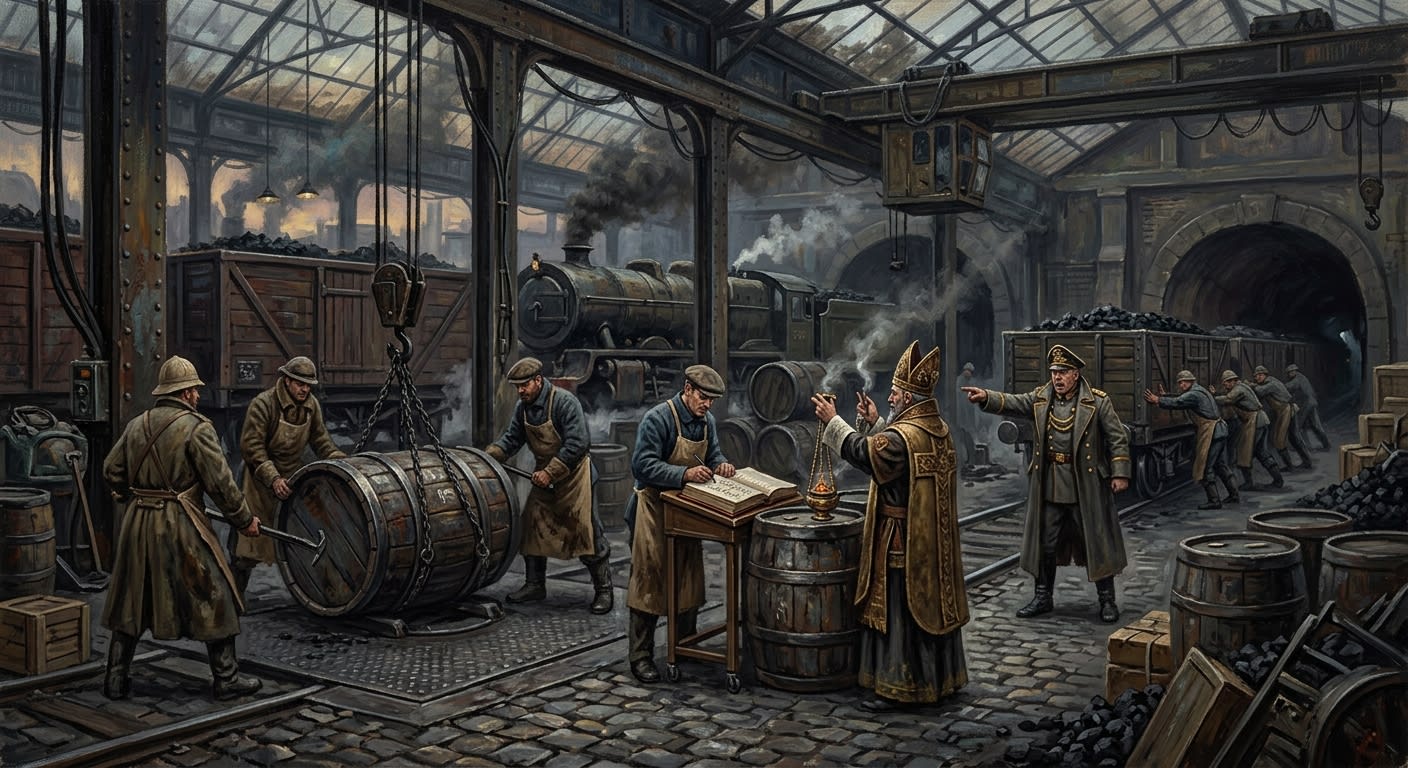
The Rail-Manifest Quarter of Brast occupies the eastern arc of the Warm City, where sealed drums of chrismole leave the furnace-cathedral, raw feedstock enters under tarpaulin and armed embarrassment, and every gallon receives those two sacraments without which no Synodal substance may travel: a number and a culprit.
It smells of tar, ozone, hot iron, wet rope, wax prayer, paper dust, and the clean fear of clerks who know that arithmetic in Brast is permitted to kill. Yards, cranes, weigh-bridges, rail spurs, dispatch cages, seal tables, provost posts, cold sidings, and the narrow balcony of Commander-Auditor Sorn Vale form its visible body. Beneath that body run siphon drains, oath-note tunnels, warm-chit exchanges, and those ratwise paths by which official fuel learns unofficial mercy.
The Quarter is a place, a court, a throat, and a threat. Drums pass east toward Bastion-Przemyśl, Bastion-Constantinople, Bastion-Brest, and the lesser hungry mouths of the Sagittal Line. Feedstock comes in from coal-seam rivers, tallow contracts, peat allotments, ash sources, and other sources named only in rooms where the windows have learned obedience. A train departs. A gun fires. A barrack warms. A family in Boiler Commons freezes because the manifest preferred artillery. Behold logistics.
#On Its Founding in Need and Track
The Quarter began as a siding. Many tyrannies begin that way: a loading platform whose clerk owns a sharper pencil than his neighbours. In A.S. 68, when the first Brast requisition seized the coal-seam rail junction and converted practical fuel into war necessity, the eastern track served only to carry crude output toward hungry batteries. Men rolled barrels by hand. Ledgers sat in oil crates. Destination marks were chalked on wood and trusted, a fact that should make any modern administrator clutch his seal and whisper a penitential decade.
By A.S. 72, chrismole production had been sung into doctrine. The fuel now bore blessing, and blessing, being expensive, required custody. A blessed drum lost in transit became more than an industrial error: fuel diversion, sacramental negligence, possible heresy, probable theft, and an invitation to create a court. The first weigh-bridge was laid that year beside the eastern spur. The first seal table followed within the month. The first execution for missing gallons occurred before the roof was finished.
Early Brast commemoratives call the Rail-Manifest Quarter “the natural extension of the furnace works.”
Corrected. Nothing involving three offices, two courts, oath-collared handlers, summary authority, and a crane schedule revised by hanging is natural. The Quarter was built because sanctified fuel made ordinary loss intolerable and profitable loss tempting.
A.S. 90 Concordat ratification transformed the siding into an organ. The Ordnance Bureau regularised dispatch law. Records imposed serial discipline. Doctrine insisted that wax prayers travel with fuel, lest a drum arrive merely useful. Tithes discovered that every movement could be assessed. By the First Continental Levy in A.S. 110, the Quarter had expanded into a district of cranes, rail throat gates, tally chapels, and the Manifest Court whose docket decides whether a missing gallon is spillage, theft, sabotage, miracle, evaporation, or a man whose widow will receive no useful explanation.
#On the Weigh-Bridges and Gates
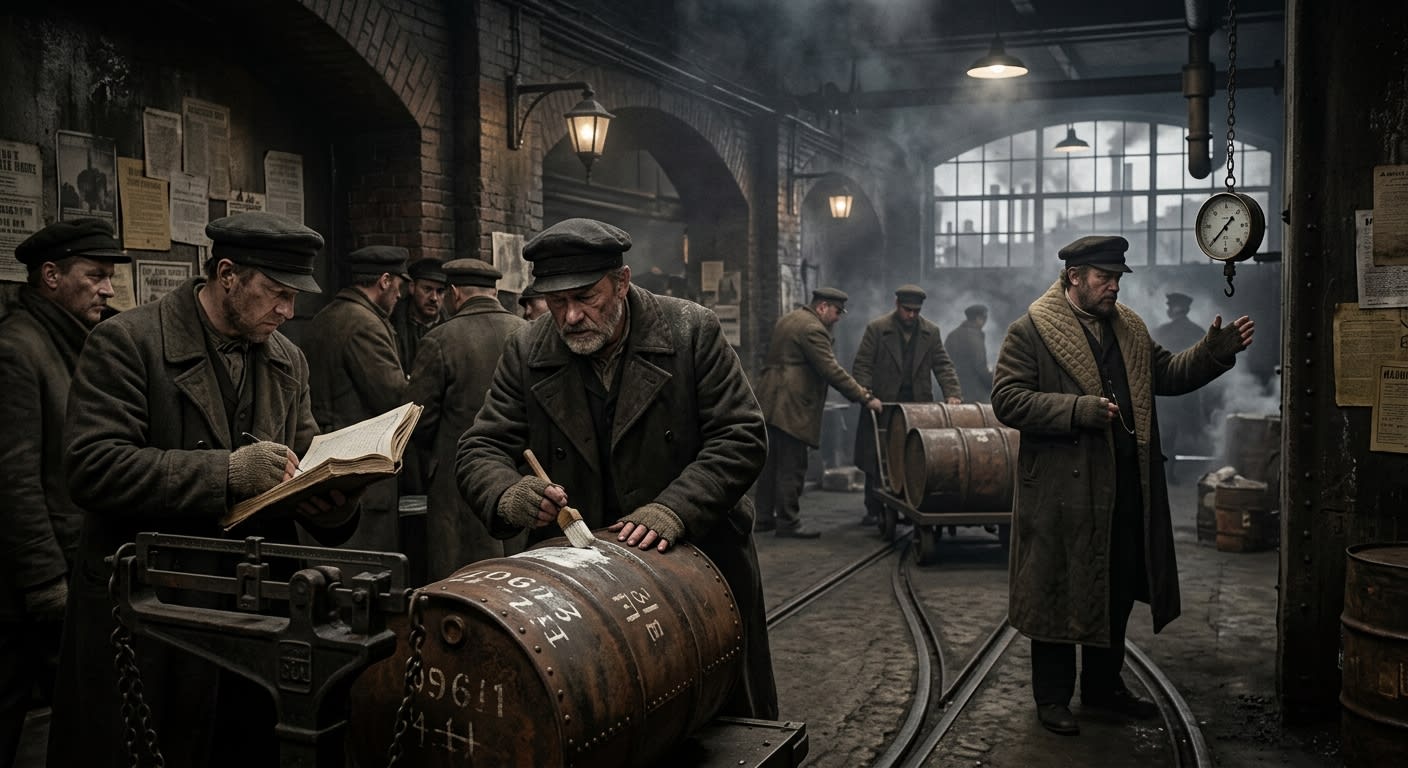
The Weigh-Bridge Gates form the Quarter’s outer teeth. Every inbound wagon, rail tank, coal cart, ash crate, tallow barrel, substrate drum, filter bundle, prayer-wax chest, and condemned wall-brick passes through them under inspection. Every outbound chrismole drum returns to the bridges after decanting and sealing. Weight is measured before blessing, after blessing, before loading, after loading, and whenever Vale wishes the yard to remember that doubt has mass.
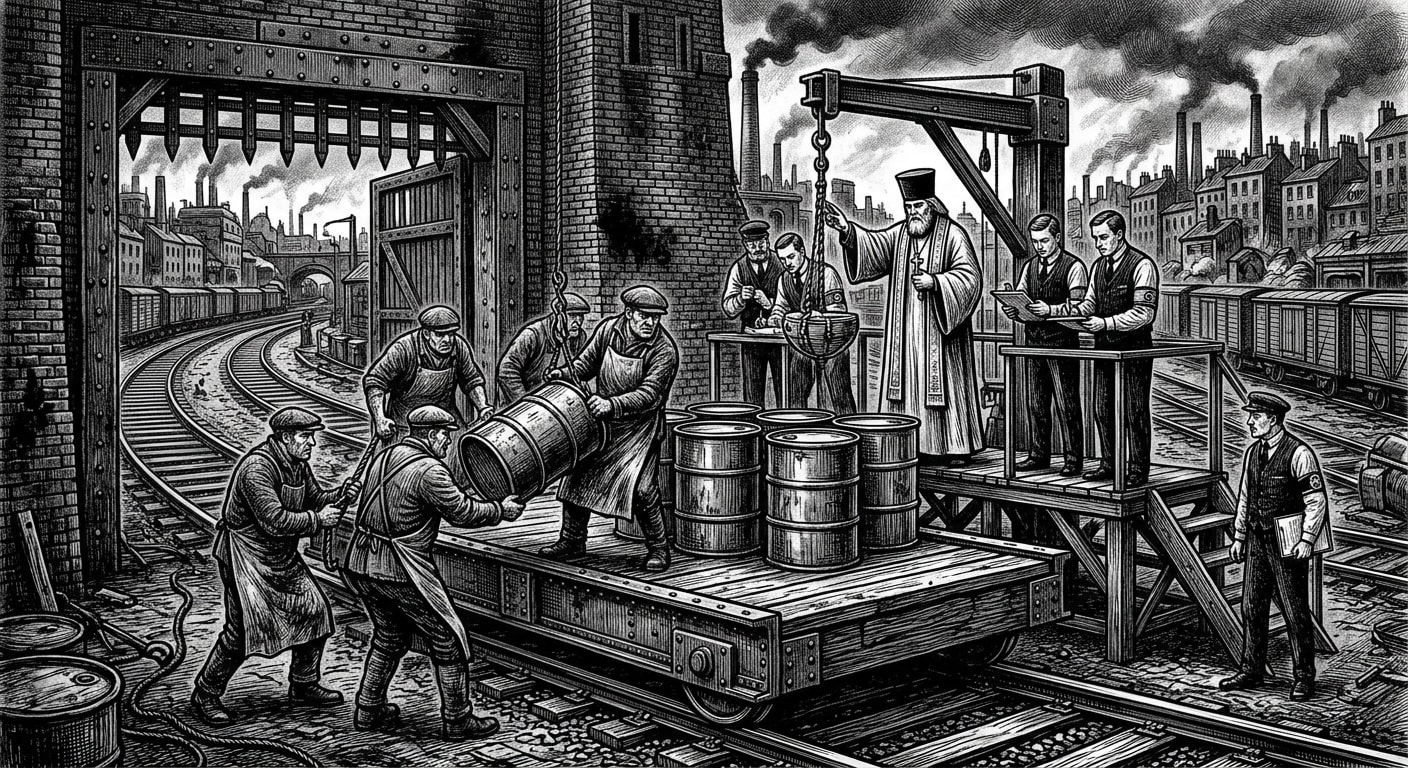
Each bridge has three officials: a gauge-scribe, a provost witness, and a hymn-checker. The gauge-scribe reads weight. The provost watches hands. The hymn-checker listens to the drum’s seal prayer and notes whether wax, scent trace, and pressure memory agree with the manifest line. A poor forgery fools a tired guard. A good forgery fools a bridge. A master forgery fools a ledger until the fuel misbehaves three provinces east and someone counts backward through corpses.
The Gates are also theatre. Workers are made to wait in cold alleys while officer carts pass under green lamps. Warmth Thieves are paraded in rope collars when caught, which is less often than the posters suggest and more often than the thieves prefer. Drums that sweat wrong are set apart beneath red cloth. Nobody touches red cloth without gloves, witnesses, and a face already prepared for bad news.
#On the Manifest Court and Its Balcony
The Manifest Court sits inside the Quarter like a judge inside a lung: elevated, narrow, indispensable, and always inhaling other people’s labour. Its lower floor is a grid of dispatch desks, seal presses, receipt cages, variance tables, copying benches, and black iron rails that guide drum carts toward the loading throats. Above it runs the balcony from which Sorn Vale watches the yard with immaculate boots and the stillness of a man who has arranged his emotions alphabetically.
Vale’s court adjudicates the daily flow: sealed drums outward, feedstock inward, accident reports sideways, blame downward. A discrepancy enters as a number and leaves as punishment. Receipt against weight. Weight against seal. Seal against dispatch bell. Dispatch bell against Kest’s Choir certification. Certification against filter lot. Filter lot against Distillers’ Compact issue. Compact issue against substrate receipt, if anyone has become suicidal enough to request the word in writing.
The court lamps burn blue-black, a privilege granted only to spaces where chrismole is counted but not opened. They dim at Iron Vespers, after the last departure docket is sealed. Clerks remain. Clerks always remain. Their hands smell of wax, ink, and the stale terror of men who know that a digit transposed at dawn can become eleven dead at Przemyśl before supper three days later.
Ordnance notices describe the Manifest Court as an administrative dispatch office.
Corrected for use by literate adults. The Court names, seizes, sentences, reprieves, reallocates, and buries error under seal. Dispatch is the portion visible from the door.
#On Drums, Gallons, and Warmth
A chrismole drum is heat, range, mobility, pressure, bargaining power, treason, comfort, sacrament, debt, and a small black sun that may be rolled if enough men pretend not to hear it knocking. Each drum carries wax prayer, serial mark, destination docket, scent trace, heat class, choir certification, feedstock batch, filter notation, pressure memory, and the faint legal pulse of everyone who will be blamed if it fails.
The Quarter’s authorized route is beautiful in the way a scaffold is beautiful to a carpenter. Drums leave the Chrismole Crown after seventh bell. They enter cooling lanes, rest under witness cloth, pass to scent handlers, receive their dispatch cards, cross the weigh-bridge, enter the rail throat, and depart under guard. A proper convoy carries a choir slate, a sealed destination packet, two provosts per wagon, one emergency oil priest, and enough warning labels to make a timid man believe the labels are the dangerous part.
The unauthorized route is shorter.
A siphon bladder under a canal grate. A false cold-stamp. A warm-chit debt forgiven. A widow’s ration line advanced by three days. A rail clerk’s brother moved off a penal boiler shift. A seal press borrowed beneath the furnace roar. A drum rolled six yards into the wrong shadow. Crime in Brast is rarely romantic. It is domestic arithmetic with burned fingers.
RAIL-MANIFEST VARIANCE SHEET — SPRING A.S. 201 Lot: Brast-Seventh / Crown decanting cycle ███. Missing: seven sealed chrismole drums. Bridge record: intact. Seal table: intact. Dispatch cage: intact. Rail throat witness: missing by clerical leave later revoked. Heat-chit disturbances in Boiler Commons: fourteen. Recommendation: public charge fuel diversion; private question whether the drums walked before they were rolled.
The seven drums missing in spring A.S. 201 made the Quarter louder by making every man quieter. Seven exactly. The number carried theatre, theology, and insult. Vale answered with sweeps through Boiler Commons and Slag Market: fourteen arrests, three confessions, no drums. The Court called the response ongoing. The yard called it weather. Workers know the feel of a season when paper is about to decide who dies.
#On the Slag-Market Shadow
The Rail-Manifest Quarter pretends to end at its posted walls. This is a sweet civic fiction, like clean coal or voluntary overtime. In truth the Quarter extends by shadow into the Slag Market, the Still-Canal under-locks, the Boiler Commons canteens, Ash-Hospice confession booths, cold alleys, pipe tunnels, and every hand that touches a warm chit with more devotion than it gives a saint.
The Warmth Thieves of the Still-Alleys feed on dispatch delay. They do not think of themselves as criminals, which is one of the few points on which criminals and Bureaus agree about themselves. They siphon heat because the official allotment fails first. A stolen gallon may warm a ward, bribe a provost, buy passage west, cook marrow broth for a hospice row, or fire a private boiler long enough to keep a child breathing. The same gallon may also cripple a battery and kill men whose names arrive later in ash dishes. Mercy grows teeth when carried in contraband skin.
Seal-forgers work under scrap altars and pipe hoods, carving counterfeit impressions in bone-lime, brass, hard wax, and stolen prayer metal. They prefer small papers: warm chits, ration extensions, labour exemption slips, false cough certificates, clean departure stamps for children whose true names have become costly. Drum seals are rarer. A drum seal carries scent, pressure memory, fibre inclusion, prayer pattern, and serial impression. The forger who masters all five does not remain a forger. He becomes either a dead man or a department.
Ash-Hospice Row supplies the Quarter’s most dangerous paper because it records what the Court prefers to phrase. A lung ward confession may name a siphon route. An accident slip may prove a drum was missing before the bridge count. A fever dish may spell a dead worker’s surname in settled ash. The Sisters file cleanly, and clean files frighten corrupt men more than knives. Knives can be taken. Copies breed.
#On Misfire, Backward Counting, and Przemyśl
The Quarter lives under a doctrine of backward counting. When a gun lies at the front, the count returns through battery docket, transport packet, dispatch slate, seal table, weigh-bridge, choir certification, filter batch, feedstock lot, and the hand that wrote the first number. This is how Brast turns distant death into local jurisdiction.
A.S. 199 proved the doctrine’s cruelty and its necessity. A Brast-fed battery at Przemyśl fired four rounds into a friendly rail junction, killed eleven, and crippled a supply train. The shots began as front-line accident. They became Brast inquiry when the fuel mark was read. Ordnance blamed sabotage. Kest blamed degraded feedstock at receiving measure. The Distillers’ Compact blamed the Choir. Vale searched for a hangable discrepancy and found several too small to satisfy him.
The Quarter has since treated every outgoing Przemyśl allotment as a hostile witness. Double bridge counts. Redundant scent checks. Bell-hour locks. Random reweighing after certification. Provosts posted at dispatch cages with hands on pistols and eyes on clerks. The clerks hate this. Hatred is not a recognized exemption.
Przemyśl receives its drums under misfire precautions now: separate prayer wax, uglier warning seals, lower hymn exposure, sealed battery allotment notes, and a little extra contempt from Brast, which resents being judged by what happens after its fuel leaves home. This resentment is understandable and useless. A fuel that carries hymn carries responsibility. If the hymn sours on the rails, the Quarter must count the souring.
#On Present Condition and Mire’s Approach
As of A.S. 201, the Rail-Manifest Quarter moves under Amber weather. Brast itself has Amber status for Sulking Engine escalation. The night roar has acquired a syllable no choir-technician claims. Kest’s wax-cylinder rests in Vault Brast-4 (Unregistered). Settled ash spells names in hospice dishes. Seven drums remain missing. Inquisitor-Mechanic Lux Thane Mire is en route from Strasbourg, and the trains have displayed a sense of timing too malicious to be called delay.
The Quarter prepares for him with full courtesy and partial ledgers, as civilisation requires. Vale will present variance charts, execution warrants, bridge registers, scent affidavits, seal inventories, and the polished silence of a man confident that any missing evidence has left by rail. The Distillers’ Compact will present filter shortage records thick enough to stun a mule. Kest will present little and change more by raising one finger than all the rest will change by talking.
Mire’s danger is not that he will find theft. Theft is Brast’s steam vent. His danger is that he may find a transaction between fuel and machine that no court can hang. A drum that warms itself in storage. A seal that sweats before tamper. A bridge that records weight for a drum not present. A convoy that arrives short by seven and long by one sound. Vale’s authority punishes men. The present scandal may have learned to pass as process.
The rail throat opens at evening bell. Chains lift. Cranes swing. Wax cools. Clerks flatten manifests beneath hands that shake only when no officer watches. Out east, guns wait for black fuel and blue-black flame. In the Quarter, Sorn Vale counts drums until the smoke seems numbered.