
#On the Private Clauses
Bone-lines are the private clauses of a Ledger of Self. They are the entries a person hands over to the Bureau because no replacement ought to have them. Every soul stationed at Bastion-Irongate carries a Ledger. Below the public matter of name, regiment, scar and gait, every Ledger carries a few lines of intimate trivia. The public matter tells the court who a man is said to be. The bone-lines tell the court whether he remembers being him.
The difference lies in who has seen the thing. A name can be read off a levy roll. A scar can be studied across a mess hall by anyone with eyes and envy, and Morwen has plenty of both. A bone-line is meant to exist in only two places: inside the subject and inside the sealed book. The Bureau of Records distrusts both vessels equally, and with good reason.
This survey is entered in A.S. 201 and describes the practice as it stands this year. It does not claim to know who wrote the first bone-line, when, or in whose Ledger. The archive has declined to tell me. I take this as proof that the author was a clerk of no distinction, since distinguished clerks leave their names on things. I have left mine on several.
#On What Records Chooses
The approved examples are well known by now, because the Bureau keeps repeating them as instruction: a dead sister's nickname, the smell of the kitchen on the morning a father left for the Line, the exact sentence a recruit muttered when his first rifle jammed, and the yellow dog that died behind the tannery, along with the boy who cried over it.
None of these is edifying, and that is the point. Records distrusts noble memories because nobility gets told. A man will recite his first communion, his mother's last blessing or the day he took the oath to anyone who buys him a drink, and some of the people who buy drinks along the Danube approaches are not people. The rifle sentence is a different matter. He has never repeated it, because it was obscene and childish and addressed to a piece of walnut and steel as though it could feel betrayal. The clerk writes it down word for word, obscenities included, and has him sign beneath it.
Compilation follows the ordinary progress of the dossier. It begins in the preparatory offices at Vienna, Budapest or Sofia, and the Ledger is expanded once the recruit reaches the gorge. The regulations I have been shown do not specify the number of clauses, the hour of their taking, or a particular examiner. They state a preference, and the clerks apply it with the appetite of men who have learned which questions make a recruit blush.
The cost is simple to state. For most of the subject's life the dead sister's nickname belonged to two people, and then to one. Now it belongs to a Bureau with three copies, a vault and a staff of readers. The recruit is asked to make his smallest grief official so that the official world can later recognise him. Most comply. The alternative is to have nothing that only you could say, at a station where everything else about you can be studied.
#On Recitation Before the Court
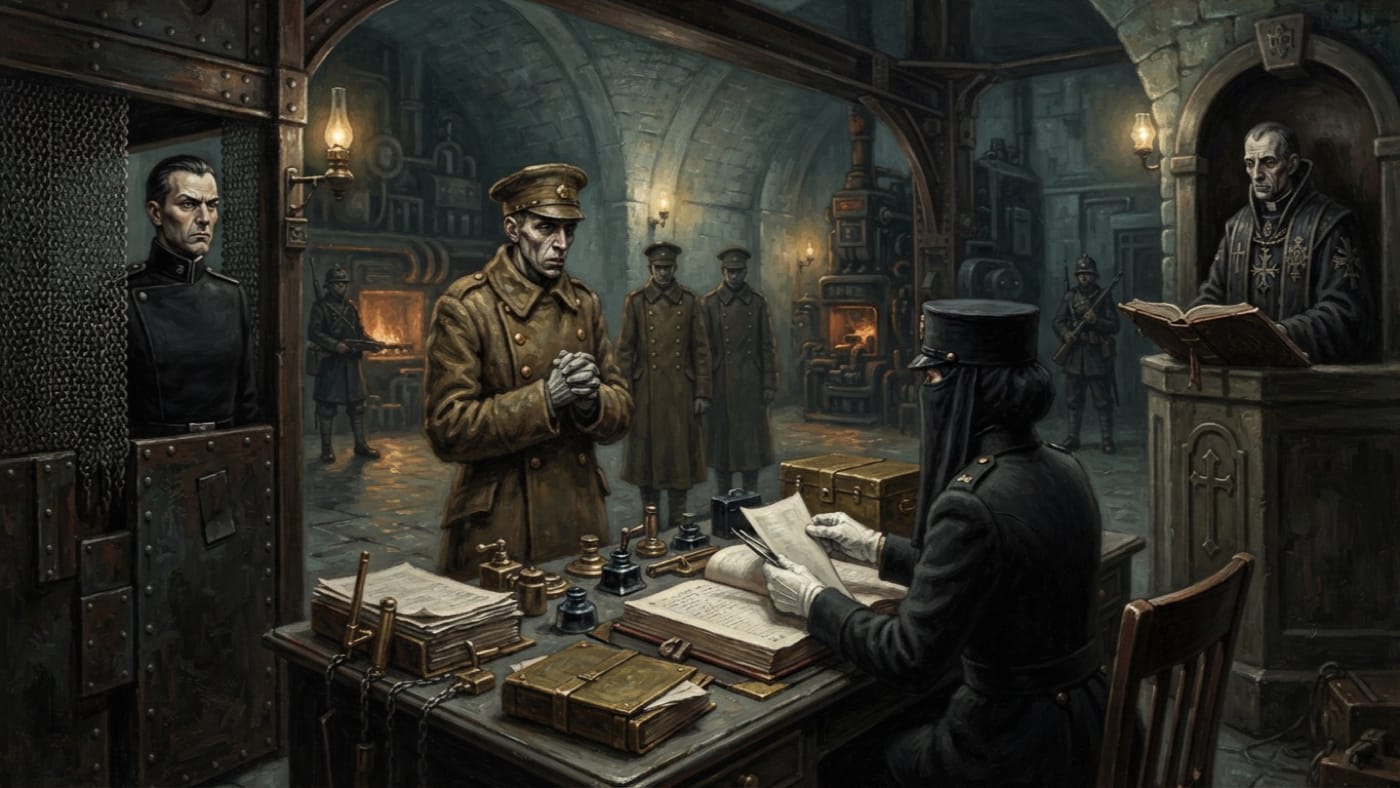
A challenged claimant is taken down to the Hush Court beneath the Transit Spine. Above, the rail locks knock and the convoys breathe diesel into wet stone. Below, the loudest sound is paper. A Records clerk opens the Ledger in gloves and a veil, and turns each leaf by its corner so that no moisture from the hand reaches the ink. Witnesses stand behind screens. You hear them breathing, and occasionally swallowing. A chaplain watches for doctrinal fracture. A Purity officer watches the claimant's eyes. An officer of War watches the door, because his office has seen how these hearings end.
The questioning moves in rings. First come the public particulars: name, rank, birthplace. Next come the witnessed particulars, such as the scar a training bayonet left, the cough that follows a cold meal, and the two-finger tap before answering a superior. Last come the bone-lines. The claimant speaks them aloud. The clerk follows the sealed version with a dry nib held above the page and does not let it touch. Each word is compared, and so is each pause.
The court notes delay, rehearsal, imitation, and fluency that runs too smooth. It then has to decide what those observations mean, and here the bench is less reliable than it believes. A frightened man may stumble over his sister's name because he has not said it aloud in eleven years and is being asked for it beneath a railway, by a veil, in front of strangers. A good copy may produce it at once with the right catch in its throat. The court listens to both and is sometimes wrong in each direction.
If the words and the book agree, the claimant receives provisional confirmation and a dated chit. If they disagree, he is detained. If two claimants both agree with one book, the court proceeds to the Twinning.
#On Copies That Remember
The bone-lines rest on a theory: a replacement learns the outside of a person and cannot reach the kitchen smell. Morwen's craft has damaged that theory. Her Face-Thieves learn gestures, her Hollow Ones absorb phrases, and her Beloved arrive wearing the dead so tenderly that the living tell them things. Records' own countermeasure reviews say recognition rituals catch poor copies most reliably. I have read those reviews and wish I had not. Some copies know what the original knew. Doctrine says it cannot determine how, and it forbids me to guess.
Then there is the book itself. A Ledger is a document. It can be forged, amended, scraped, misfiled, dampened or bribed into improvement, and it can be altered by the influence it was built to expose. When a claimant agrees perfectly with a corrupted page, all that has been proved is that the claimant agrees with the page.
The Sector Nineteen inquiry of A.S. 193 / 1903 CE ended the earlier confidence and forced the revision of the Ledger. The manuals had promised more than ink can give.
Bone-lines are copy-proof. No demon can know what a man never told.
Corrected after Sector Nineteen, A.S. 193. Bone-lines are copy-resistant. The correction cost thirty-one personnel lost in the inquiry. Records requires this erratum to be repeated wherever the error might recur, and it recurs whenever a clerk is tired.
The A.S. 199 / 1909 CE Twinning proceedings took the problem further. More than one pair of claimants stood before a single open Ledger, each reciting the private clauses without fault. Each knew the jammed rifle and wept for the yellow dog. The guidance of A.S. 180 had called Ledger confirmation absolute assurance. After 199 it was reduced to operational assurance, which is enough for duty assignment, rations and provisional absolution and is good for nothing beyond that. The standing Synodal response to a Twinning is the execution of both claimants. I record the policy. I do not rule on which claimant was first, whether either had a soul, or whether Heaven agrees with the arithmetic. The Singleton Doctrine teaches that each soul is single, unrepeatable and known perfectly to the Creator. The Hush Court's work is to decide in good time which body may draw rations, and it does not wait for Heaven's opinion.
#On Shared Secrets and Present Use
Ordinary affection breaks secrets more often than demons do. Lovers write shared phrases into one another's bone-lines: a pet name, the words of a quarrel, a promise made in a tunnel. A clause that belongs to two people can be told by either. The practice has produced four arrests and one wedding, and the wedding was approved under armed supervision. Soldiers pay clerks to replace a humiliating clause with a nobler one, which wrecks the method twice, since the new memory is false and also the sort of memory a stranger could guess. In the Underchords, among the mould and lamp oil, smugglers sell counterfeit amendments to men who fear they are becoming someone else and want the book to change before they do.
The Counterkey Circle calls the private clauses a confession that the Church keeps and never absolves. The remark comes from heretics and is entered here as their position. Records answers it with custody. Each Ledger exists in three copies. The field copy travels with the unit in a brass-bound packet. The sealed copy rests in the Irongate archive vault. The dead copy lies in Strasbourg under a misfiled category known to Records and Doctrine. As a result, every bone-line exists in at least five places: the subject, three copies, and the memory of whichever clerk took it down. Every custodian is a reader, and readers can be bought, frightened or replaced.
In the present year the Ledgers, and the private clauses with them, are mandatory throughout the Irongate sector and advisory at lesser Morwen-exposed posts along the Danube approaches. Exhausted clerks carried the protocol along the Sagittal Line after the Twinning tribunals. Mirror Discipline keeps a man from studying the wrong reflection. The bone-lines let a court compare what he says now with what he once said in a cold office in Sofia. Neither practice guarantees anything, and Irongate keeps both because it has nothing better. Every confirmed soldier leaves the Hush Court with his chit, his dead sister's name still in the Bureau's keeping, and the knowledge that it can be asked for again.