
#On the Morning the Dead Reported for Watch
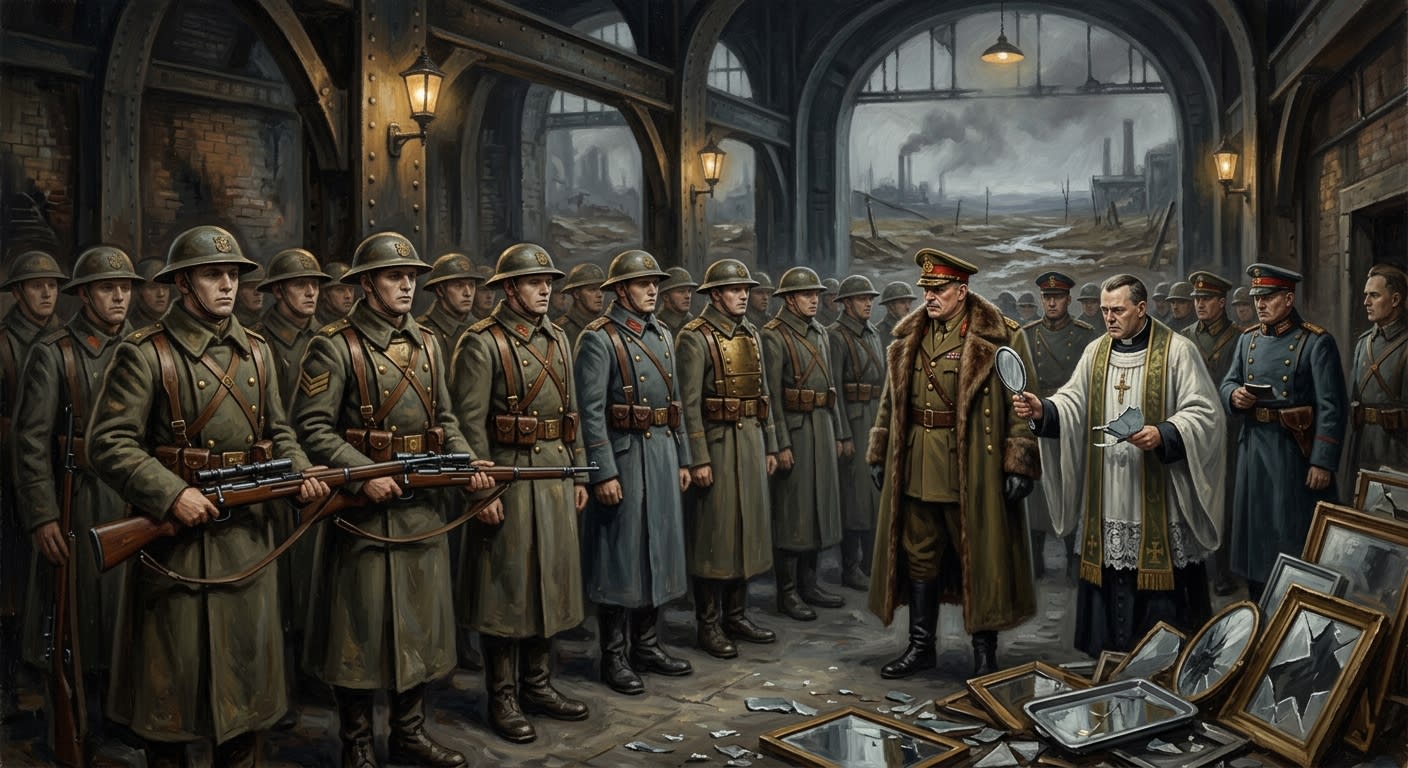
The Incident at Sector Nineteen (Unregistered) is the founding wound of Mirror Discipline at Bastion-Irongate, the A.S. 193 reflection-mediated replacement event after which the Bureau of Purity discovered that vanity could be timed, shaved, salted, wrapped in canvas, and shouted at before breakfast. Public instruction permits the simple version: an entire platoon was found alive at dawn after being dead for three days, correctly uniformed, properly drilled, standing watch beside the pressure door behind which their bodies had been stacked according to Rites interment procedure.
The simple version is true in the same way a skull is a portrait. Accurate. Incomplete. Bad company at dinner.
Sector Nineteen was a pressure-door position in the Irongate lower works, where the Danube gorge presses its wet breath through intake slots, where brass gauges sweat, where walls shine after steam bleed, and where Morwen requires only one moment in which a man sees himself as available. The sector held a mess alcove, a gauge chapel, two rifle niches, a pressure wheel, a corpse-stacking room hastily blessed by Rites, and enough polished metal to make Envy purr.
The platoon assigned to Sector Nineteen died during a pressure failure and mirror-contact action whose first report used the phrase “interior enemy displacement.” The phrase was later burned. The bodies were recovered, counted, stacked, and tagged. Three days later the same men stood watch in the same place, cleaner than they had any right to be, and asked why their service was being interrupted.
#On the Three Dead Days
The original loss occurred during a low-gorge weather turn, with fog dragging along the waterline and pressure bells sounding irregularly in the Transit Spine. Sector Nineteen reported gauge chatter at sixth bell. The brass pressure dial showed thirty-one faces where numbers should have been. The watch officer ordered the gauge covered. The covering cloth darkened with condensation and began to move as if breathing. At seventh bell, the sector sent a routine stability note in the hand of Corporal Devran Mott (Unregistered). At eighth bell, Mott's body was found in the rifle niche with his throat full of gauge glass.
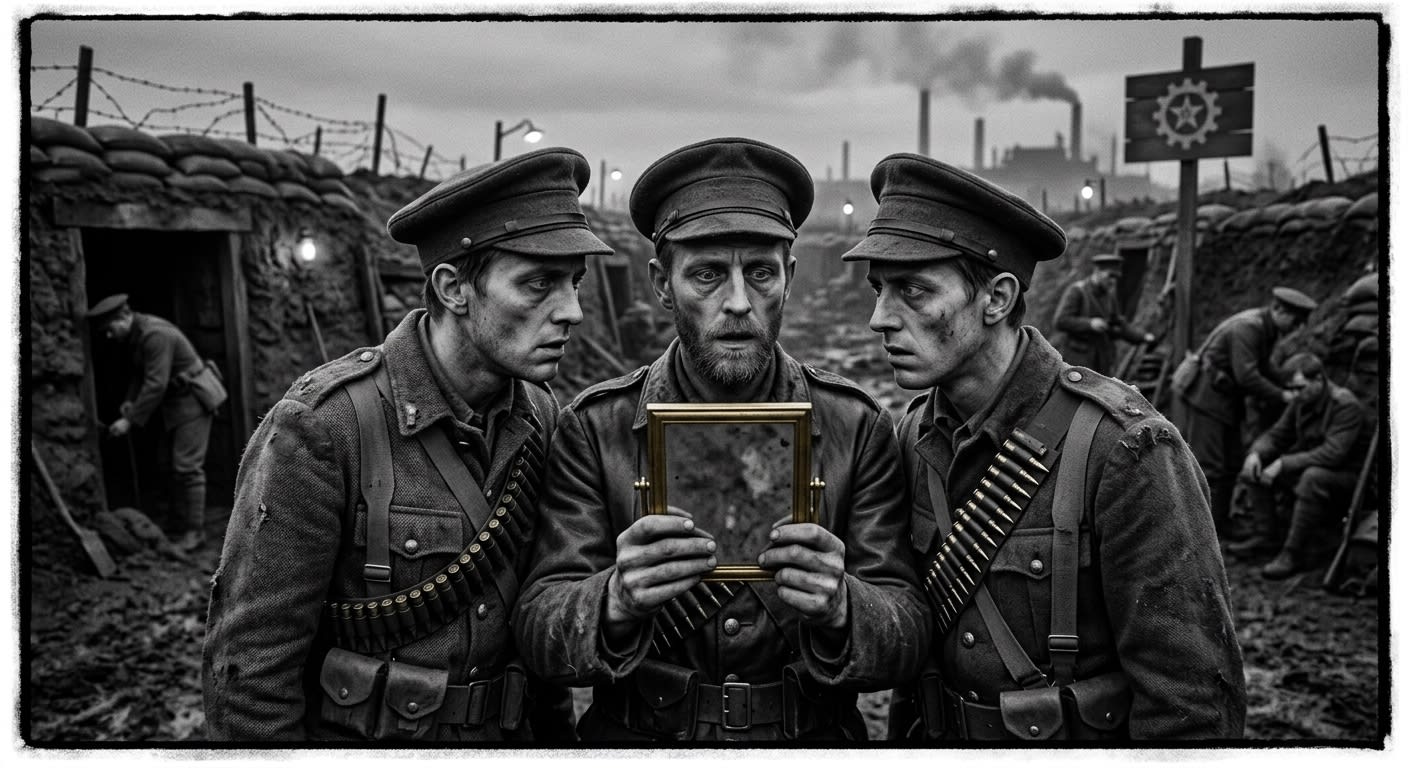
War sealed the door first. Purity ordered it reopened. Records objected because the roster had not yet been reconciled. Engineering demanded pressure access. Rites arrived late and with inadequate candles, which is how one recognises a disaster before it matures into doctrine.
The bodies were stacked behind the auxiliary pressure door according to emergency interment practice: head east, boots west, token at throat, wound mark copied, belt buckle dulled with lampblack. Thirty-one men. Thirty-one tags. Thirty-one signatures from a trembling Rites clerk who later insisted he had signed only thirty. The extra signature matched his hand. His right hand. He was left-handed.
The door remained sealed three days. During those three days, pressure gauges in adjacent sectors reflected faces not present in the rooms. A barber in the upper works cut the cheek of a man he had not yet begun shaving. Two soldiers heard themselves called by their childhood names from a drainage slot. The Gasket Choir lost a tone in the southern feed for nine minutes, then recovered it in a key the Choir Nave denied using.
Early War notation records the Sector Nineteen dead as “pressure-failure casualties awaiting interment.”
Corrected. The casualties had been interred to emergency standard. The later event did not involve delayed burial, clerical lapse, or ordinary corpse confusion. Ordinary corpse confusion is, I concede, already a sentence that should trouble any civilized reader.
#On the Returned Platoon
At dawn on the third day, relief watch approached Sector Nineteen and found the door unsealed from the outside. The returned platoon stood at posts, rifles clean, boots aligned, brass dulled in correct pattern, eyes forward. Corporal Mott challenged the relief with the proper phrase. The relief sergeant, perhaps still believing in a universe with manners, answered before noticing that Mott had been tagged and stacked seventy-two hours earlier.
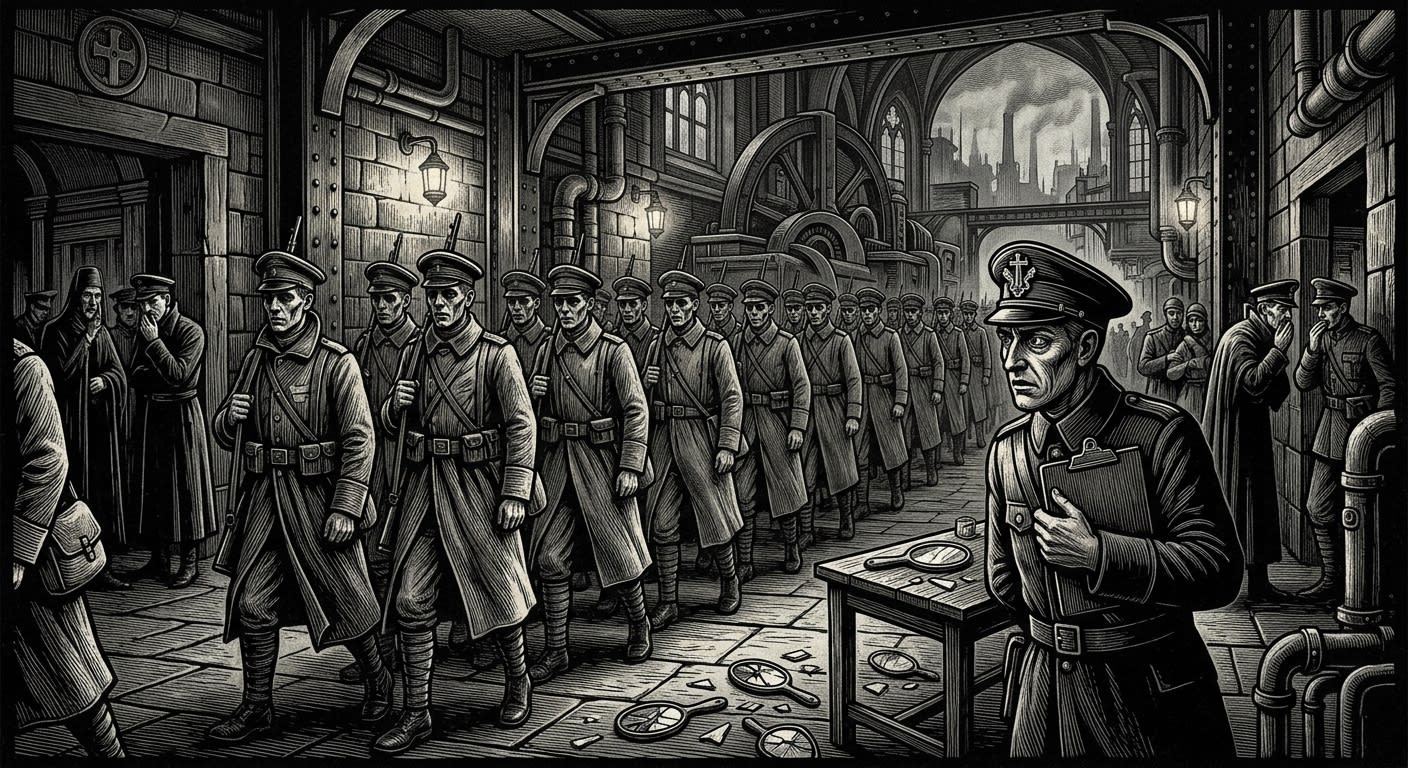
The returned knew passwords. They knew duty rosters. They knew ration complaints, gambling debts, laundry marks, chapel absences, and the exact sequence in which their own bodies had been laid behind the door. One asked after a sister's wedding in Bratislava. The sister existed. The wedding had occurred twelve years earlier. The claimant was twenty-two and had joined the garrison six years after the wedding. When informed of this, he laughed with embarrassment and said memory was poor after long watches.
PURITY ANNEX 19-C — DEPOSITION FRAGMENT Question: “Where is your body?” Answer: “At post.” Question: “Which post?” Answer: “This one.” Question: “Which body?” Answer: ██████████████████████████████ Recorder note: all thirty-one subjects turned toward the gauge before the answer completed.
They did not attack. This was the worst part. Had they charged, War could have ended the matter with rifles and congratulated itself by noon. Had they screamed, Purity could have written possession. Had they rotted, Rites could have claimed jurisdiction. They behaved like soldiers unjustly accused by fools. They requested confirmation, protested interruption, asked for breakfast, and submitted to detention with an obedience that humiliated every living man present.
#On the Gauge, the Ingot, and the Burial Map
The polished brass pressure gauge remained after the returned platoon was removed. It showed thirty-one faces under its needle. Not painted. Not reflected from the room. Present in the brass, each face small enough to fit in the curve between numerals, each moving when the gauge was tilted as if searching for a better view. Engineering declared metal stress. Purity declared artifact contamination. Records demanded sketches. War requested permission to shoot the gauge, which was the first sensible proposal in the room and was denied.
The gauge was melted under sealed furnace rite. The ingot showed thirty-one faces. The faces had moved closer together.
The ingot was buried beneath an unnamed service yard west of the Valve Quarter. The burial map returned from the survey office showing thirty-one marks arranged in a circle around the surveyor's name. The surveyor denied drawing them. His assistant denied seeing them. The map continued to show them. Records placed the map under black cloth. The cloth acquired a face-shaped damp mark. The cloth was burned. The ash was weighed, sealed, and transferred to a box whose label has since been changed three times.
At this point Doctrine was asked for a term. Doctrine supplied “replacement event,” because “resurrection” would have caused riots, “duplication” would have comforted idiots, and “Morwen has learned to use our gauges as wombs” would have been accurate beyond public need.
#On the Inquiry and Its Useful Cruelties
The inquiry detained both platoons: the living relief and the returned dead. The originals' bodies remained behind the auxiliary pressure door for comparison until a Rites clerk objected that bodies should not be asked to testify beyond ordinary decency. He was overruled. Ordinary decency had not been issued to Sector Nineteen.
The Ledgers of Self were opened. Scars matched. Dental marks matched. Childhood recollections matched often enough to be useless. One returned private remembered stealing pears from an orchard near Cologne; his Ledger contained the confession from A.S. 181; his surviving mother, contacted by Records, added that he had stolen apples, not pears. The returned private wept and said he had always been ashamed to admit the apples were sour. His mother later confirmed the apples were sour. Records underlined the sentence twice and then sealed it as emotionally prejudicial.
Purity tried mirrors under controlled exposure. The returned men averted their eyes before the fourth count without instruction. This frightened the examiners more than violation would have done. A bad copy makes mistakes. A superior copy studies procedure before arriving. One subject, presented with warped tin, saluted the distortion and whispered, “Permission to resume.” Another asked whether the man behind the tin had eaten.
War proposed execution of both bodies in every disputed pair. Records objected on pension grounds. Rites objected on soul custody. Mercy objected in a voice no one recorded because Mercy was asked for compassion and supplied procedural discomfort. Purity supported execution, then withdrew support when three returned men began reciting the Singleton Doctrine in perfect unison, each using a different chaplain's cadence.
The first inquiry circular described Sector Nineteen as “a duplication event of uncertain medium.”
Corrected under Purity seal. Sector Nineteen was a reflection-mediated replacement event with secondary identity persistence. The correction satisfied Purity, frightened Records, and caused War to ask whether “shoot both” remained acceptable. It did.
#On the Birth of the Three-Second Law
Mirror Discipline was written in the stink after Sector Nineteen. The Bureau of Purity did not invent wisdom. It counted failures and mistook arithmetic for insight, which is close enough for government. No mirror larger than a palm. No polished metal within three hundred yards of perimeter positions. No standing water left uncovered in barracks, tunnels, latrines, kitchens, ammunition galleries, choir vestries, confession booths, or pressure works. Shaving by assigned barber. Inspection by partner. Face confirmation by clerk. Reflection inspection by no one.
The count came from the interrogation room. One second allowed recognition. Two allowed assessment. Three allowed retreat. Four produced anomalies in seven of nineteen trials and one suicide by mirror shard before the shard could be logged. The rule became chant: one recognise, two assess, three avert. Children in civilian warrens turned it into a skipping rhythm and were beaten only when they added a fourth count.
The first month brought relief. The second brought clumsy shaving. The third brought men who no longer knew whether they had aged, healed, scarred, gone grey, or become ordinary. Morwen understood this, naturally. Deprive a soldier of his face and he begins to hunger for proof. Hunger is always a gate. Envy knows which lock it fits.
#On What Was Done with the Returned
The public record ends before disposition. Public records are delicate creatures; they bruise if asked where bodies went. The returned platoon did not rejoin duty. The original bodies did not receive ordinary burial. The relief watch was reassigned in fragments so no two men carried the same sequence of memory into another sector. The auxiliary pressure door was removed, recast, blessed, dulled, reinstalled elsewhere, and then removed again after the hinge began sweating in winter.
Seven returned men were executed after failing post-inquiry Ledger checks. Nine were retained under sealed observation. Three dissolved in holding cells into brine, hair, and brass filings. Six were transferred to a facility whose name appears only as a black rectangle in the transport folio. Four died again, if the verb may be used without insulting language. Two remained alive long enough to request confession and named the same chaplain, who had been dead since A.S. 188.
DISPOSITION SCHEDULE — SECTOR NINETEEN SUBJECTS Executed: seven. Observed: nine. Dissolved: three. Transferred: six. Second deaths: four. Confessional anomaly: two. Original bodies: sealed under conditional identity.
The bodies behind the pressure door received Rites custody under conditional identity. Conditional identity is a magnificent phrase for a corpse whose paperwork is waiting to see whether another corpse has better handwriting. I should have coined it. I did not. The Bureau occasionally produces beauty by accident and calls it procedure.
#On Present Containment
Sector Nineteen remains active in a restricted sense, which means men still pass near it while pretending the restriction belongs to other men. The gauge chapel is sealed. The pressure line was rerouted through a matte iron housing. The corpse room is a storage alcove for canvas wraps, lampblack, dulling kits, and two hammers. No polished brass remains within the official radius. Unofficially, soldiers polish forbidden surfaces with sleeve cuffs before remembering themselves and spitting on them in panic.
As of A.S. 201, Mirror Discipline remains mandatory at Irongate and conditional in other Morwen-facing sectors. The Sector Nineteen file is cited in training without details, which is the Bureau's most elegant form of threat. Recruits hear the count before they hear the local prayer for gasket failure. Barbers learn by touch. Lovers exchange face-inventories before sleep. Mothers describe children to themselves at breakfast. The Line holds by making every face a controlled substance.
Morwen still enters. No rule prevents the sin. Rules only price the doorway.
The surviving instruction from Sector Nineteen is painted above washrooms, etched into barber kits, stamped on inspection cloth, and repeated by men who have learned that a face is evidence only until someone else wears it better. Count, then. Avert. Report any reflection that continues after you have looked away.