
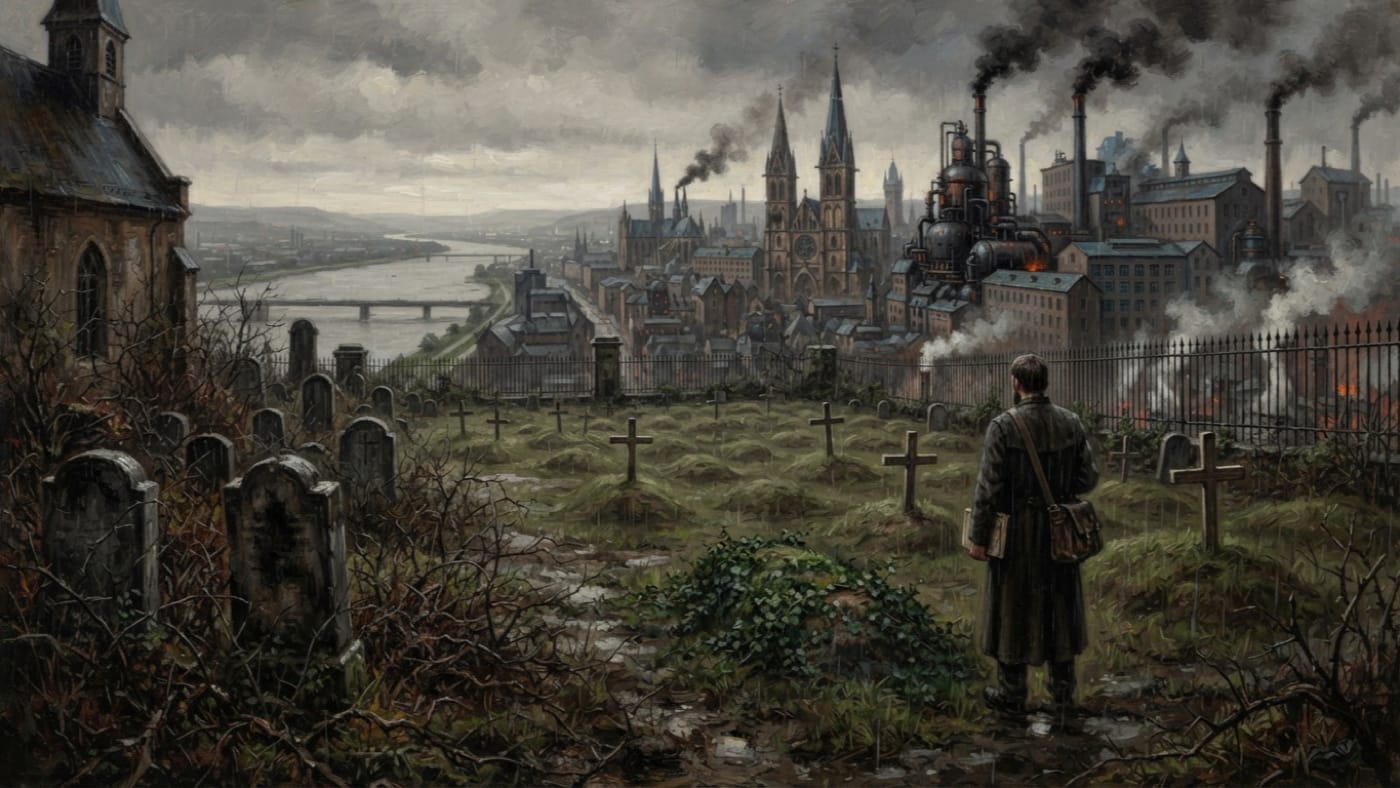
#On Bonn and the Rhine
A city enters the Codex by whatever door it is given.
Bonn is a Rhineland city on the Rhine, upstream of Cologne. It sits in the western heartland, which lies safely behind the Line and has spent generations mistaking that safety for virtue. It has its river, its churches and the ordinary furniture of a place where barges pass and clerks keep accounts. None of this earned it an entry. Bonn is in the Codex because a parish clerk died near it in A.S. 71 and was put into the ground with no name above him.
Notice the word near. Keep noticing it. The record says near Bonn. It says so twice, in two dossiers, with the dull consistency I prize in a source and despise in a dinner companion. It never says in Bonn. A churchyard near a city belongs to whatever parish owns it, and the record does not name the parish. Bonn lends the grave an address the way a famous neighbour lends his name to a street he has never walked down.
The dead man was Ignatius Brenner. The porters call him Father Ignatius of Cologne, and the calendar calls him Saint Ignatius the Carrier. That makes one man, one grave and two titles. The Rhineland has always been generous with titles and stingy with headstones.
#On the Road Before Bonn
Brenner was parish clerk of Saint Gereon in Cologne. He belonged to no order. The "Father" is a courtesy from the cellars and proves no ordination. The Treaty of Regensburg turned his ledgers into evidence. In A.S. 31 he carried three apostolic phalanges, Relic 31-C(α–γ), across the Rhine from Cologne to Deutz under black rye in a breadbasket. Aldric Hartmann received them beneath his brewery. The bones stayed hidden there until A.S. 45, through Hartmann's death and a series of later keepers that included Klara. For those years the Cellar Saints were the nearest thing the Church had to a postal service.
After the Sundering, Brenner recovered the bones and carried them to a waystation near Koblenz. There his part in that cargo ended. An unnamed military chaplain took them on, then the 7th Rearguard Column, then Brother Tomislav. In Tomislav's hands they were among the seventeen relics that blazed against Maldrake's vanguard at Kalnik Ridge in A.S. 48. Brenner was not there.
A reader who likes maps will see Bonn on the river between Deutz and Koblenz and want to draw a line through it. Put the pencil down. No source places Brenner or the phalanges in Bonn during the post-Sundering movement. The road from Deutz to Koblenz is documented only at its two ends. Everything between is river, and the river keeps no register of who walked its banks.
#On the Unmarked Churchyard
Ignatius Brenner died near Bonn in A.S. 71. The cause entered against his name is exhaustion. A churchyard near Bonn received him, and no stone was set.
That is the whole deposit. The record does not name the churchyard. It gives no day of death and no witness or officiant. It does not say what he carried last or to whom he last spoke. I have read devotional pamphlets that supply all of these, along with a deathbed, a sunset and a loaf of rye laid on his breast. The pamphleteers were not present. Neither was I. The difference is that I say so.
Consider the year. A.S. 71 is twenty-six years after the Sundering and nineteen years before a formal Synod existed to keep anyone's books. The Church had come up out of the cellars and was still building the offices it would later claim it had always possessed. A clerk who died of overwork in a Rhineland parish got no Bureau burial, because the Bureau that would have conducted one did not yet exist. Later Records men copied the entry into their files and gave it the dignity of a folio number. Nobody gave the graveside anything.
Why was there no marker? The dossiers put it down to habit: a man who survived by being invisible stayed invisible to the end. That is an interpretation. It is as much mine as anyone's, and I hold it with the confidence I keep for interpretations that flatter the dead. It may equally be that nobody in the parish knew who he was. A carrier who did his work properly would have left exactly that impression. The Church has canonised men with far less tact.
#On the Name That Returned
In A.S. 104, thirty-three years after the burial, the Fourth Doctrinal Congress canonised him as Saint Ignatius the Carrier, patron of porters, smugglers and supply-runners. The inquiry found no verified miracles of his own. The miracle belonged to the relics at Kalnik. The Bureau of Doctrine spent a long time deciding whether a man may be credited with fire he never saw. It decided that he may. I concur, having written about a great many things I never saw myself.
After that, each place along the river claimed whatever share of him it could put on display. Deutz has the crossing and the Hartmann cellar. Koblenz has the handoff. Strasbourg has the phalanges themselves, displayed in the Relics Archive beneath the sentence attributed to him: "The calm of a man who knows the Lord is watching and the guards are not." On the seventeenth of Octobris, porters carry bread toward that glass case.
Bonn has the body. Of everything in the inventory, the body is the one item nobody can locate to within a yard.
Every Rhineland cult wants a tomb. Relics travel well, but a tomb stays put and draws coin. Bonn was dealt the one part of this saint that cannot go in a case. The record names no Bonn pilgrimage station, feast procession or exhumation. I note this so that no enterprising dealer cites the Codex as evidence for one. I have remarked elsewhere that three dealers in Bonn will sell you Bishop Adelmar's portrait, seal and autograph by Thursday. I would rather they did not add a thumb to the stock.
#On What the Record Permits
A named locality is not an authenticated grave. The Bureau of Records can tell you that Brenner lies near Bonn, as surely as it can tell you the Rhine runs past Bonn. It cannot walk you to the mound, and no published survey can either. That is the state of the file, and it is a state rather than a curse. Churchyards keep registers, and registers turn up in sacristies. A competent clerk with a lamp could settle the question in a winter. Brenner would have been the man for the job.
Certain pilgrimage broadsheets identify Father Ignatius of Cologne and Saint Ignatius the Carrier as separate devotional figures.
Corrected, as already entered in the Codex dossier on Father Ignatius of Cologne. They are one man, Ignatius Brenner. The correction is repeated here because a reader who believes in two Ignatii will go looking for two graves near Bonn, and the neighbourhood has trouble enough producing one.
The Codex records the locality and declines to invent the yard. Brenner got past every inspector the Republic posted on that river. I do not intend to be the first to catch him by manufacturing the evidence.